
from __future__ import annotations

from datetime import datetime

from airflow.sdk import DAG, task


with DAG(
    dag_id='example_dynamic_task_mapping',
    start_date=datetime(2022, 3, 4),
    catchup=False,
    schedule=None
):
    @task
    def add_one(x: int):
        return x + 1

    @task
    def sum_it(values):
        total = sum(values)
        print(f'Total was {total}')

    added_values = add_one.expand(x=[1, 2, 3])
    sum_it(added_values)
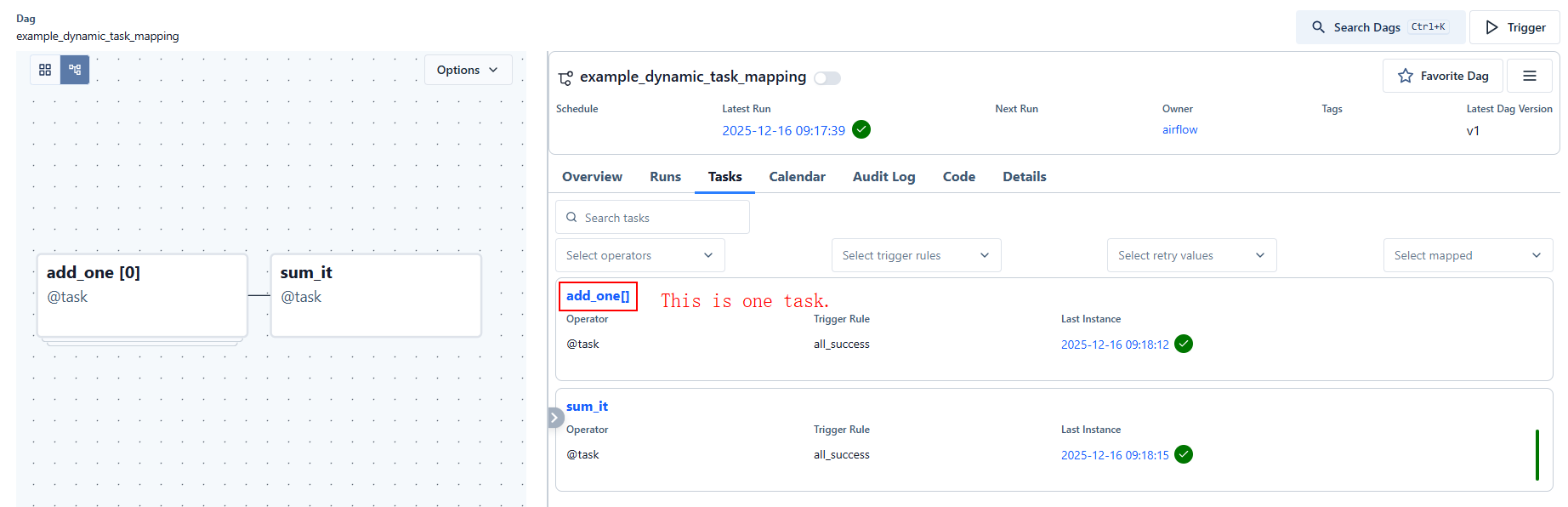
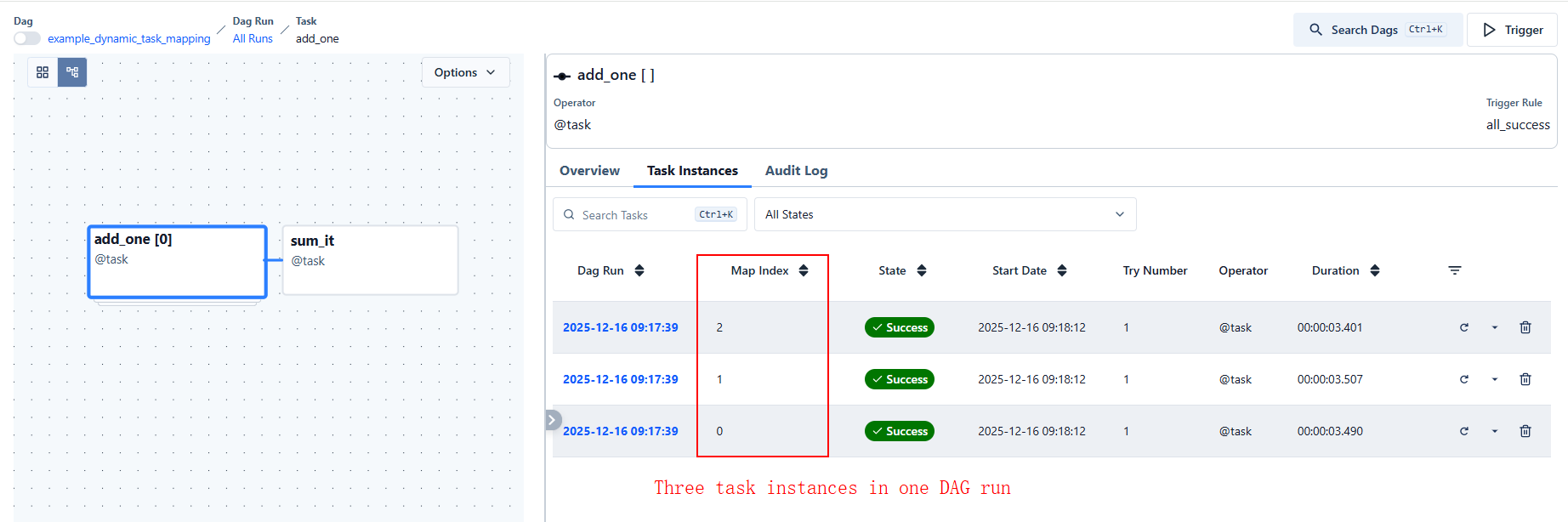
In Apache Airflow, expand() is the core API for Dynamic Task Mapping. It tells Airflow to create multiple task instances at runtime from a single task definition, based on iterable input values.
Let’s break down what it does specifically in your code.
What expand() does conceptually
expand() takes a task and maps it over a collection of inputs, creating one task instance per element in that collection.
Think of it as Airflow’s equivalent of:
…but done declaratively inside the DAG definition so Airflow can schedule and track each run independently.
Line-by-line explanation
Task definition
This defines a single logical task called add_one.
Dynamic mapping with expand()
This is the key line.
What happens:
-
Airflow does not run the task immediately
-
Instead, it creates three mapped task instances at runtime:
| Task Instance | x |
|---|---|
add_one[0] |
1 |
add_one[1] |
2 |
add_one[2] |
3 |
Each instance runs independently and returns a value:
So added_values becomes an XCom collection (not a Python list yet):
but resolved by Airflow, not during DAG parsing.
Passing mapped results downstream
Here’s the important behavior:
-
Airflow automatically collects all outputs from the mapped
add_onetasks -
Passes them as a list to
sum_it
So sum_it receives:
And prints:
Why expand() exists
Without expand(), you would need to:
-
Manually define multiple tasks
-
Or precompute task counts at DAG parse time (which is often impossible)
expand() allows:
-
Task counts to be determined at runtime
-
Parallel execution of dynamically sized workloads
-
Cleaner, more scalable DAGs
Key rules of expand()
-
Input must be iterable
-
Each element creates one task instance
-
Works only with TaskFlow API (
@task) -
Produces mapped XCom output, not a Python list
Mental model
You can think of this:
as meaning:
“At runtime, run
add_oneonce for each value inx, in parallel.”
Summary
-
expand()enables dynamic task mapping -
It creates multiple task instances from one task definition
-
Each mapped task gets one element of the input
-
Outputs are automatically collected and passed downstream
Your DAG ends up running 4 tasks total:
-
3 ×
add_one -
1 ×
sum_it


 浙公网安备 33010602011771号