
"""
Example DAG demonstrating the usage of setup and teardown tasks.
"""

from __future__ import annotations

import pendulum

from airflow.providers.standard.operators.bash import BashOperator
from airflow.sdk import DAG, TaskGroup


with DAG(
    dag_id='example_setup_teardown',
    schedule=None,
    start_date=pendulum.datetime(2021, 1, 1, tz='UTC'),
    catchup=False,
    tags=['example']
) as dag:
    root_setup = BashOperator(task_id='root_setup', bash_command="echo 'Hello from root_setup'").as_setup()
    root_normal = BashOperator(task_id='normal', bash_command="echo 'I am just a normal task'")
    root_teardown = BashOperator(
        task_id='root_teardown',
        bash_command="echo 'Goodbye from root_teardown'"
    ).as_teardown(setups=root_setup)

    root_setup >> root_normal >> root_teardown

    with TaskGroup('section_1') as section_1:
        inner_setup = BashOperator(
            task_id='taskgroup_setup',
            bash_command="echo 'Hello from taskgroup_setup'"
        ).as_setup()
        inner_normal = BashOperator(task_id='normal', bash_command="echo 'I am just a normal task'")
        inner_teardown = BashOperator(
            task_id='taskgroup_teardown',
            bash_command="echo 'Hello from taskgroup_teardown'"
        ).as_teardown(setups=inner_setup)
        inner_setup >> inner_normal >> inner_teardown

    root_normal >> section_1
Your code uses Airflow’s Setup & Teardown tasks, a feature introduced in Airflow 2.5+ to make resource-management patterns first-class citizens in DAGs.
✅ 1. What are Setup and Teardown tasks?
In Airflow, setup tasks run before dependent tasks to prepare resources.
Teardown tasks run after dependent tasks to clean up resources.
Examples:
-
Setup: create temp directory, open connection, prepare environment
-
Normal tasks: the main DAG work
-
Teardown: delete temp files, close connection, notify shutdown
Importantly:
✔ Teardown tasks always try to run
—even if upstream tasks fail—
because teardown is meant for cleanup.
✔ Setup and teardown create an implicit lifecycle
Airflow ensures the order and failure handling are correct even once the DAG gets complex.
🔧 2. What .as_setup() and .as_teardown() do
.as_setup()
Marks a task as a “setup task”.
Airflow registers it internally so teardown tasks know to wait for it and respect its lifecycle.
.as_teardown(setups=...)
Marks the task as a teardown task, and links it to the setup task(s).
It means:
-
Teardown will run after all tasks that depend on the setup
-
Teardown will run even if those tasks fail
-
Airflow guarantees teardown always runs exactly once per setup
🗂️ 3. Walkthrough of Your DAG
Let’s go piece by piece.
🌳 4. Root-level setup, normal, teardown
✔ Execution flow
-
root_setupruns first
Output: “Hello from root_setup” -
root_normalruns
Output: “I am just a normal task” -
root_teardownruns
Output: “Goodbye from root_teardown”
✔ Behavior guarantees:
-
root_teardownalways runs even ifroot_normalfails -
It runs only after:
-
root_setupwas done -
All tasks that depend on
root_setup(here:root_normal) have finished
-
So Airflow guarantees:
Regardless of upstream failures.
📦 5. TaskGroup setup, normal, teardown
Inside TaskGroup:
✔ Life cycle inside TaskGroup
✔ Setup/Teardown in a group does NOT interact with the root-level ones
Each group manages its own setup/teardown boundary.
🔗 6. Cross-level dependency
This means:
-
All tasks in
section_1start afterroot_normalfinishes.
So overall order becomes:
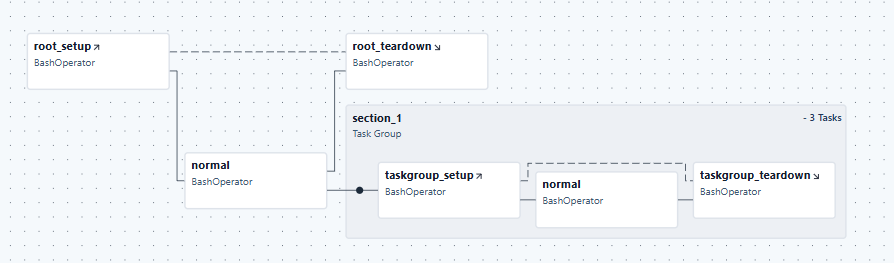
Important subtlety:
root_teardown does NOT wait for taskgroup_teardown
Because root_teardown is only linked to root_setup, not to inner setup.
This is intentional:
Setup/teardown relationships are scoped and isolated.
📌 7. Summary of Setup/Teardown Behavior in Your DAG
Root setup/teardown pair:
-
root_setupprepares something -
root_teardowncleans up that same thing -
It runs after everything depending on
root_setup
TaskGroup setup/teardown pair:
-
taskgroup_setupprepares something for the group -
taskgroup_teardowncleans up -
It runs even if
inner_normalfails
Independent life cycles:
-
Root setup/teardown does not control the TaskGroup
-
TaskGroup setup/teardown does not affect root teardown
🤓 8. Why use setup & teardown?
They make DAGs safer and more reliable:
-
Cleanup is guaranteed
-
Cleanup runs even if something crashes
-
DAGs become easier to reason about
-
Teardown tasks never accidentally run too early
-
Lifecycle boundaries are explicit and enforced
This is especially useful in:
-
Managing temporary clusters / VMs
-
Allocating / releasing cloud resources
-
Creating / deleting temp directories or batch environments
-
Opening / closing pools or exclusive resources


 浙公网安备 33010602011771号