
"""
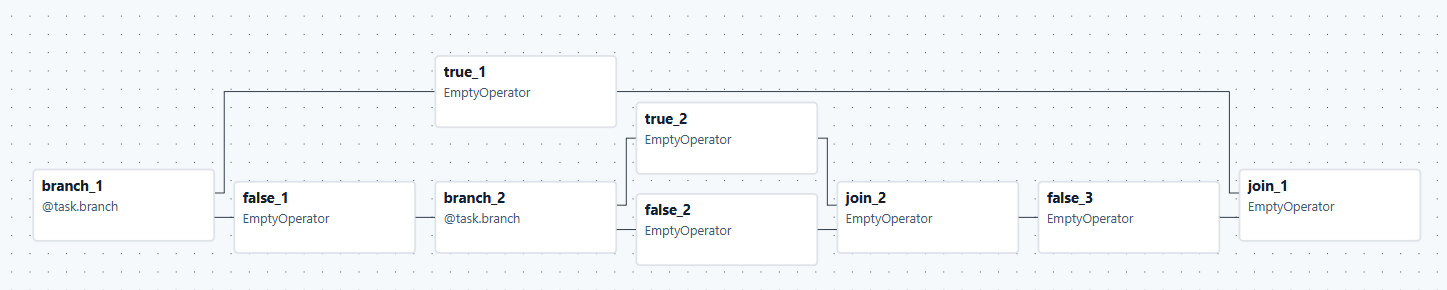
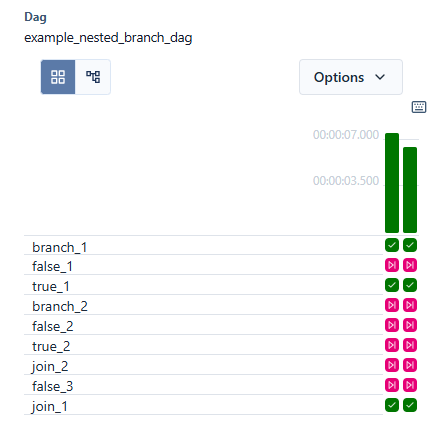
Example DAG demonstrating a workflow with nested branching. The join tasks are created with
``none_failed_min_one_success`` trigger rule such that they are skipped whenever their corresponding
branching tasks are skipped.
"""

from __future__ import annotations

import pendulum

from airflow.providers.standard.operators.empty import EmptyOperator
from airflow.sdk import DAG, TriggerRule, task

with DAG(
    dag_id="example_nested_branch_dag",
    start_date=pendulum.datetime(2021, 1, 1, tz="UTC"),
    catchup=False,
    schedule="@daily",
    tags=["example"],
) as dag:

    @task.branch()
    def branch(task_id_to_return: str) -> str:
        return task_id_to_return

    branch_1 = branch.override(task_id="branch_1")(task_id_to_return="true_1")
    join_1 = EmptyOperator(task_id="join_1", trigger_rule=TriggerRule.NONE_FAILED_MIN_ONE_SUCCESS)
    true_1 = EmptyOperator(task_id="true_1")
    false_1 = EmptyOperator(task_id="false_1")

    branch_2 = branch.override(task_id="branch_2")(task_id_to_return="true_2")
    join_2 = EmptyOperator(task_id="join_2", trigger_rule=TriggerRule.NONE_FAILED_MIN_ONE_SUCCESS)
    true_2 = EmptyOperator(task_id="true_2")
    false_2 = EmptyOperator(task_id="false_2")
    false_3 = EmptyOperator(task_id="false_3")

    branch_1 >> true_1 >> join_1
    branch_1 >> false_1 >> branch_2 >> [true_2, false_2] >> join_2 >> false_3 >> join_1
1️⃣ What override() does
-
branchis a TaskFlow task (Python function decorated with@task.branch()). -
.override()is a method on TaskFlow tasks that lets you override some parameters of the task without changing the original function. -
Common things you can override:
-
task_id(unique identifier of the task in the DAG) -
retries -
retry_delay -
execution_timeout -
doc_md, etc.
-
Essentially, it creates a new task object with the same Python callable but updated configuration.
2️⃣ Why it's used here
-
The original function is
branch(task_id_to_return: str). -
We want to instantiate it as a DAG task with a specific
task_idcalled'branch_1'. -
Without
override(), the task would take its default function name as thetask_id(here,'branch'), which may conflict if you create multiple instances.
3️⃣ Putting it together
Step by step:
-
branch.override(task_id='branch_1')→ creates a TaskFlow task object withtask_id='branch_1'. -
(task_id_to_return='true_1')→ calls the task with the argument'true_1'and returns a TaskInstance that Airflow can schedule.
So branch_1 is a DAG task instance with a custom task_id, not just a Python function call.
✅ Analogy
Think of override() as:
“I like this function, but for this DAG task, I want it to have a different name or different execution settings.”
-
Original function:
branch -
DAG task:
branch_1(with overriddentask_id)


 浙公网安备 33010602011771号