


You are given a string s and an array of strings words. All the strings of words are of the same length.
A concatenated string is a string that exactly contains all the strings of any permutation of words concatenated.
- For example, if
words = ["ab","cd","ef"], then"abcdef","abefcd","cdabef","cdefab","efabcd", and"efcdab"are all concatenated strings."acdbef"is not a concatenated string because it is not the concatenation of any permutation ofwords.
Return an array of the starting indices of all the concatenated substrings in s. You can return the answer in any order.
Example 1:
Input: s = "barfoothefoobarman", words = ["foo","bar"]
Output: [0,9]
Explanation:
The substring starting at 0 is "barfoo". It is the concatenation of ["bar","foo"] which is a permutation of words.
The substring starting at 9 is "foobar". It is the concatenation of ["foo","bar"] which is a permutation of words.
Example 2:
Input: s = "wordgoodgoodgoodbestword", words = ["word","good","best","word"]
Output: []
Explanation:
There is no concatenated substring.
Example 3:
Input: s = "barfoofoobarthefoobarman", words = ["bar","foo","the"]
Output: [6,9,12]
Explanation:
The substring starting at 6 is "foobarthe". It is the concatenation of ["foo","bar","the"].
The substring starting at 9 is "barthefoo". It is the concatenation of ["bar","the","foo"].
The substring starting at 12 is "thefoobar". It is the concatenation of ["the","foo","bar"].
Constraints:
1 <= s.length <= 1041 <= words.length <= 50001 <= words[i].length <= 30sandwords[i]consist of lowercase English letters.
ChatGPT's Solution:
from collections import Counter


class Solution(object):
    def findSubstring(self, s, words):
        """
        :type s: str
        :type words: List[str]
        :rtype: List[int]
        """

        if not s or not words:
            return []

        word_len = len(words[0])
        word_count = len(words)
        total_len = word_len * word_count
        word_map = Counter(words)
        result = []

        for i in range(word_len):
            left, right = i, i
            curr_map = Counter()
            while right + word_len <= len(s):
                word = s[right:right + word_len]
                right += word_len
                if word in word_map:
                    curr_map[word] += 1
                    while curr_map[word] > word_map[word]:
                        curr_map[s[left:left + word_len]] -= 1
                        left += word_len
                    if right - left == total_len:
                        result.append(left)
                else:
                    curr_map.clear()
                    left = right

        return result
Explanation:
-
Precompute Data:
- Store word frequencies in
word_mapusingCounter. - Calculate the total length of concatenated words.
- Store word frequencies in
-
Sliding Window Technique:
- Iterate through
swith different starting indices to cover all possible word alignments. - Expand the window by moving
rightand checking if the current word exists inwords. - If the frequency of any word exceeds the allowed count, move
leftforward. - If the window matches the total length of all words, store the starting index.
- Iterate through
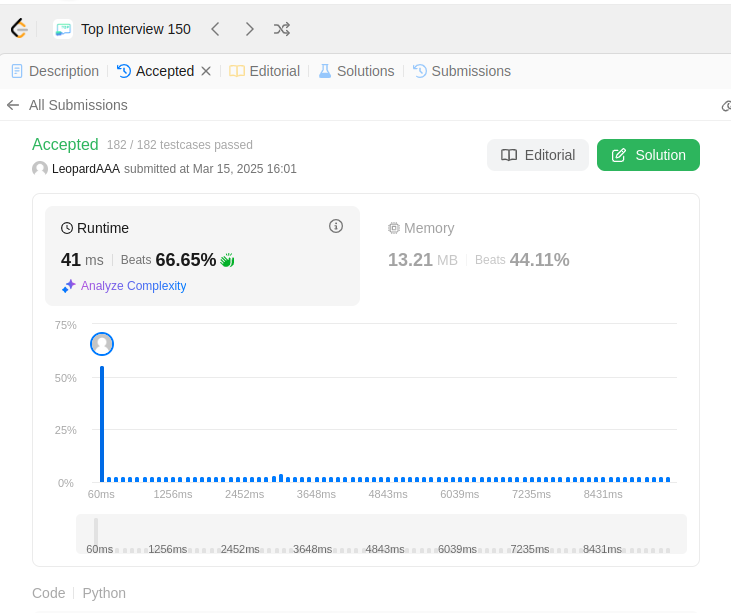
This solution efficiently finds all valid substrings in O(N * word_len), making it suitable for large inputs.


 浙公网安备 33010602011771号