


基于MATLAB解决车辆路径问题(VRP)
一、问题建模(以CVRP为例)
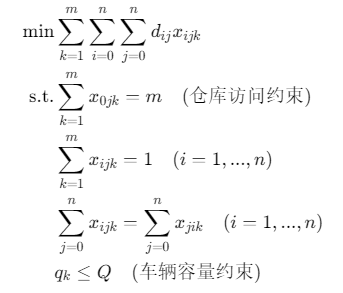
目标函数:最小化总行驶距离
约束条件:
- 每辆车从仓库出发并返回
- 单个车辆载重量不超过容量限制
- 每个客户仅被访问一次
数学模型:
二、遗传算法实现(核心代码)
1. 参数设置
% 基础参数
depot = [0,0];          % 仓库坐标
customers = [10,5;15,8;5,12;20,15;8,18;12,3;18,7;3,10]; % 客户坐标
demands = [15;20;18;25;22;10;16;12]; % 客户需求
vehicle_capacity = 50;  % 车辆容量
num_vehicles = 3;       % 车辆数
pop_size = 50;          % 种群大小
max_gen = 200;          % 最大迭代
pc = 0.85;              % 交叉概率
pm = 0.1;               % 变异概率
2. 关键函数实现
(1) 适应度函数(含惩罚项)
function fitness = calc_fitness(route, dist_matrix, demands, capacity)
    total_dist = 0;
    current_load = 0;
    current_pos = 1; % 仓库索引

    for i = 1:length(route)
        cust = route(i);
        load = demands(cust);

        % 距离计算
        total_dist = total_dist + dist_matrix(current_pos, cust+1);
        current_pos = cust+1;

        % 容量检查
        current_load = current_load + load;
        if current_load > capacity
            penalty = 1000*(current_load - capacity); % 惩罚项
            total_dist = total_dist + penalty;
        end
    end

    % 返回仓库
    total_dist = total_dist + dist_matrix(current_pos, 1);
    fitness = 1 / total_dist; % 适应度与距离成反比
end
(2) 顺序交叉(OX)操作
function offspring = ox_crossover(parent1, parent2)
    n = length(parent1);
    cut1 = randi([1, n-1]);
    cut2 = randi([cut1+1, n]);

    % 复制中间段
    offspring = zeros(1, n);
    offspring(cut1:cut2) = parent1(cut1:cut2);

    % 填充剩余基因
    ptr = cut2 + 1;
    for i = 1:n
        if ptr > n
            ptr = 1;
        end
        if ~ismember(parent2(i), offspring)
            offspring(ptr) = parent2(i);
            ptr = ptr + 1;
        end
    end
end
(3) 变异操作(交换+逆转变异)
function mutated = mutate(route, mutation_rate)
    if rand < mutation_rate
        % 交换变异
        idx = randperm(length(route), 2);
        route(idx) = route(fliplr(idx));

        % 逆转变异
        sub = route(2:end-1);
        sub = fliplr(sub);
        route(2:end-1) = sub;
    end
    mutated = route;
end
三、完整算法流程
%% 初始化种群
population = zeros(pop_size, n_customers);
for i = 1:pop_size
    population(i,:) = randperm(n_customers);
end

%% 主循环
best_fitness = inf;
for gen = 1:max_gen
    % 计算适应度
    fitness = arrayfun(@(i) calc_fitness(population(i,:), dist_matrix, demands, vehicle_capacity), 1:pop_size);

    % 更新最优解
    [min_fit, idx] = min(fitness);
    if min_fit < best_fitness
        best_fitness = min_fit;
        best_route = population(idx,:);
    end

    % 选择(锦标赛选择)
    parents = tournament_selection(population, fitness);

    % 交叉(OX交叉)
    offspring = cell(pop_size/2, 2);
    for i = 1:2:pop_size
        parents_sel = parents(randperm(size(parents,1),2), :);
        child1 = ox_crossover(parents_sel(1,:), parents_sel(2,:));
        child2 = ox_crossover(parents_sel(2,:), parents_sel(1,:));
        offspring{i} = child1;
        offspring{i+1} = child2;
    end

    % 变异
    for i = 1:pop_size
        offspring{i} = mutate(offspring{i}, pm);
    end

    % 更新种群
    population = cell2mat(offspring);
end

%% 结果可视化
plot_route(best_route, depot, customers);
disp(['最优路径总距离: ', num2str(1/best_fitness)]);
四、扩展方法对比
| 方法 | 优点 | 缺点 | 适用场景 |
|---|---|---|---|
| 遗传算法 | 全局搜索能力强 | 收敛速度较慢 | 大规模复杂问题 |
| 粒子群 | 收敛速度快 | 易陷入局部最优 | 中小规模问题 |
| 模拟退火 | 适合离散优化 | 参数敏感 | 时间窗约束问题 |
| 蚁群算法 | 正反馈机制高效 | 需要精细参数调优 | 动态路径规划 |
参考代码 基于Matlab解决VRP路径优化问题 www.youwenfan.com/contentcnp/97656.html
五、注意事项
- 数据预处理 客户坐标需包含仓库节点(通常作为索引0) 需构建完整的距离矩阵(含仓库与客户间距离)
- 性能优化 使用
parfor实现并行计算 采用稀疏矩阵存储大规模距离数据 - 结果验证 对比CPLEX精确解(适用于小规模问题) 使用Solomon测试集进行基准测试

 浙公网安备 33010602011771号