
题解:ARC226C Square Corner Packing
有意思题。激战一个小时做出来了。
尝试分析操作次数的上界,不妨转化成剩余白色格子数量 \(c\) 的下界。
显然要有 \(c\equiv nm\pmod{4}\)。
观察到每次操作,每行减少的白色格子数量为 \(0/2\),因此若 \(m\) 为奇数,则 \(c\geq n\)。同理,若 \(n\) 为奇数,则 \(c\geq m\)。
容易发现 \(n,m\) 中至少有一个是偶数的情况是平凡的,用 \(2\times 2\) 尽量铺满即可。
下面考虑 \(n,m\) 都是奇数怎么做。我们希望留下恰好 \(\max(n,m)\) 个白色格子。
不妨先考虑 \(5\times 5\) 怎么做。手玩可以得到这样的构造:
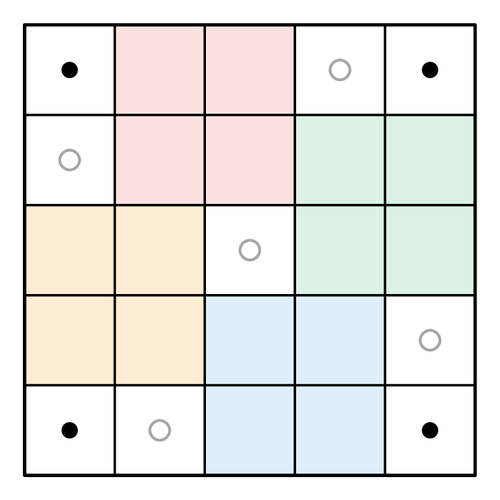
先把四个角涂黑,再风车状地做 \(4\) 次 \(2\times 2\)。
这样恰好留下来了 \(5\) 个白色格子,恰好贴紧下界。
进一步地,我们发现这个构造可以递归。具体来说,对于 \(n\equiv 1\pmod{4}\),我们可以用和 \(5\times 5\) 相似的构造来处理外围的宽度为 \(2\) 的边框,再递归到 \(n-4\) 的子问题。
例如,对于 \(9\times 9\) 的正方形,我们这样填:
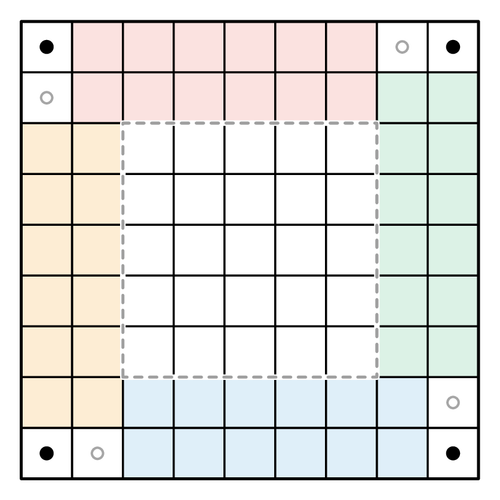
不难证明这样的递归构造恰好会留下 \(n\) 个白色格子。
对于 \(n\equiv 3\pmod{4}\) 的情况,我们先用递归构造填满左上角的 \((n-2)\times (n-2)\) 的正方形,再用 \(2\times 2\) 去铺下边和右边。此时下边和右边会空出来 \(2\) 个白色格子,加起来恰好留下 \(n\) 个白色格子。
现在回到原来的问题,不妨设 \(n\leq m\)。我们先铺 \(n\times n\) 的正方形,这里会留下 \(n\) 个白色格子。此时右边剩下 \(n\times (m-n)\) 的矩形,\(m-n\) 是偶数,直接铺就好了。这样右边又会留下 \(m-n\) 个白色格子,加起来恰好留下 \(m\) 个。\(n>m\) 同理。
时间复杂度 \(\mathcal{O}(nm)\)。
代码
#include <bits/stdc++.h>

using namespace std;

using ll = long long;
using i128 = __int128;
using ui = unsigned int;
using ull = unsigned long long;
using u128 = unsigned __int128;
using ld = long double;
using pii = pair<int, int>;
const int MAXN = 505;

template<typename T> T lowbit(T x) { return x & -x; }
template<typename T> void chkMin(T &x, T y) { x = y < x ? y : x; }
template<typename T> void chkMax(T &x, T y) { x = x < y ? y : x; }
constexpr int lg2(ll x) { return 63 ^ __builtin_clzll(x); }
constexpr ll bitCeil(ll x) { return x == 1 ? 1ll : 1ll << lg2(x - 1) + 1; }

int tc, n, m;

int main() {
	ios::sync_with_stdio(false);
	cin.tie(nullptr);

	cin >> tc;
	while (tc--) {
		cin >> n >> m;

		if ((~n & 1) || (~m & 1)) {
			int x = 0;
			if ((~n & 1) && (m & 1)) x = n;
			else if ((~m & 1) && (n & 1)) x = m;
			cout << (n * m - x >> 2) << '\n';
			for (int i = 1; i < n; i += 2) {
				for (int j = 1; j < m; j += 2) {
					cout << i << ' ' << j << ' ' << 1 << '\n';
				}
			}
		} else {
			auto [mn, mx] = minmax({n, m});
			cout << (n * m - mx >> 2) << '\n';

			auto square1 = [&](auto &&self, int n, int x, int y) -> void {
				if (n == 1) return;
				cout << x << ' ' << y << ' ' << n - 1 << '\n';
				for (int i = 1; i < n - 2; i += 2) cout << x << ' ' << y + i << ' ' << 1 << '\n';
				for (int i = 1; i < n - 2; i += 2) cout << x + i << ' ' << y + n - 2 << ' ' << 1 << '\n';
				for (int i = n - 3; i > 1; i -= 2) cout << x + n - 2 << ' ' << y + i << ' ' << 1 << '\n';
				for (int i = n - 3; i > 1; i -= 2) cout << x + i << ' ' << y << ' ' << 1 << '\n';
				self(self, n - 4, x + 2, y + 2);
			};

			auto square3 = [&](int n, int x, int y) {
				square1(square1, n - 2, x, y);
				for (int i = 1; i < n; i += 2) cout << i << ' ' << n - 1 << ' ' << 1 << '\n';
				for (int i = 1; i < n - 2; i += 2) cout << n - 1 << ' ' << i << ' ' << 1 << '\n';
			};

			if (mn % 4 == 1) square1(square1, mn, 1, 1);
			else square3(mn, 1, 1);

			if (n < m) {
				for (int i = 1; i < n; i += 2) {
					for (int j = n + 1; j < m; j += 2) {
						cout << i << ' ' << j << ' ' << 1 << '\n';
					}
				}
			} else {
				for (int i = m + 1; i < n; i += 2) {
					for (int j = 1; j < m; j += 2) {
						cout << i << ' ' << j << ' ' << 1 << '\n';
					}
				}
			}
		}
	}
	return 0;
}

 浙公网安备 33010602011771号