python数据分析 numpy库的学习(2)
这篇介绍对numpy中的数据如何进行具体的数学操作,既包括普通的四则运算,也有通用函数运算,以及一些基本的线性代数操作。
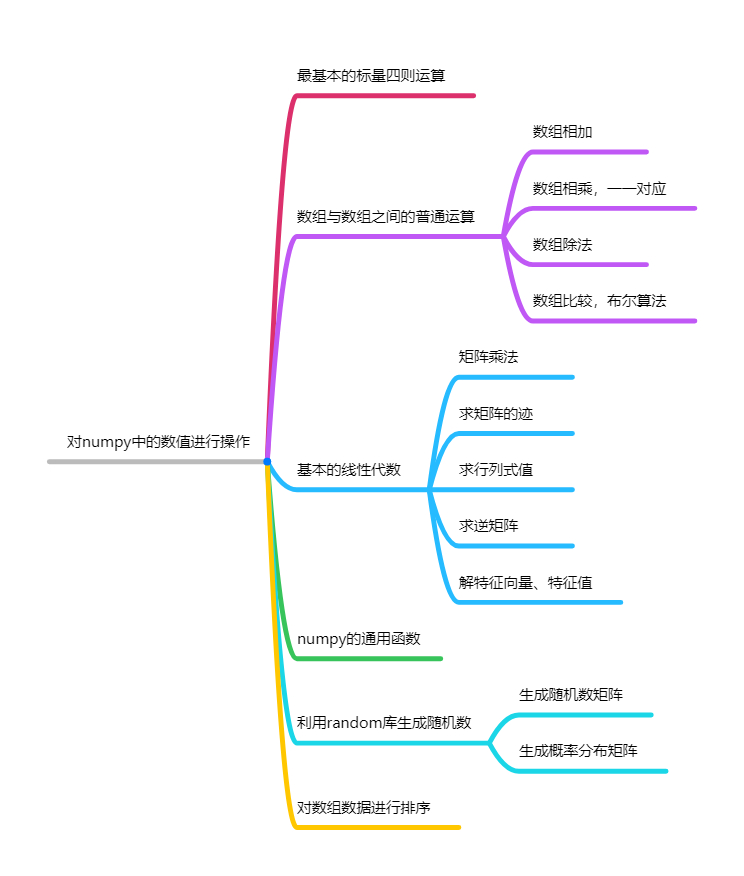
#最基本的数组运算,和标量进行四则运算
arr=np.array([[1,2,3],[4,5,6],[7,8,8]])
'''print(arr*2)
print(arr/3)
print(arr+3) #每一项都会和标量进行四则运算'''

#数组与数组之间的运算
#普通四则运算,不同型的数组是不能进行下列运算的,详见线性代数的操作
'''print(arr+arr)
print(arr-arr)
print(arr/arr)
#两个同型的数组之间是可以进行布尔运算的,会生成一个同型的布尔矩阵
print(arr>=arr)
#不同数据类型的数组进行操作之后会转化为更精细的类型,int+float会得出float。
#下面这个操作会直接修改数组本身而不是生成一个新数组
arr +=2
print(arr)

#下面介绍基本的线性代数运算
print(arr*arr) #这还不是线代乘法,只是对应位置数据相乘'''
a=np.array([1,2,3])
'''print(np.diag(a,k=0)) #让一个一维数组拉长成一个n阶阵,原元素分布在对角,其他值为0

print(np.dot(arr,arr)) #矩阵乘法
print(np.trace(arr))  #计算矩阵的迹,也就是对角线元素和

#linalg是numpy中专门用来操作矩阵的子程序包
print(np.linalg.det(arr))  #求矩阵行列式的值
print(np.linalg.inv(arr)) #求矩阵的逆,对于奇异矩阵或者未满秩矩阵都会报错'''

#求解线性方程组,这个函数输出的数组就是该线性方程组的解向量
#print(np.linalg.solve(arr,a))

#求解方程的特征向量
'''print(np.linalg.eigvals(arr))  #这个返回的是按列排列的特征值,转置了一下
print(np.linalg.eig(arr)) #这个返回的第一个数组是特征值,后面的三个数组是一一对应的特征向量'''


#python通用化的函数我就列个表表示一下,作为工具参考。下面写几个例子展示一下格式。
'''print(np.square(arr))
print(np.mod(arr,2)) #求余数后也是以同型矩阵的格式输出
#不分一元二元格式都是一样的'''
| method | description |
|---|---|
| sin(x, /[, out, where, casting, order, …]) | 正弦函数, element-wise. |
| cos(x, /[, out, where, casting, order, …]) | 余弦函数 element-wise. |
| tan(x, /[, out, where, casting, order, …]) | 正切函数, element-wise. |
| arcsin(x, /[, out, where, casting, order, …]) | 反正弦函数, element-wise. |
| arccos(x, /[, out, where, casting, order, …]) | 反余弦函数, element-wise. |
| arctan(x, /[, out, where, casting, order, …]) | 反正切函数, element-wise. |
| hypot(x1, x2, /[, out, where, casting, …]) | 传入直角三角形的“直角边”,返回其斜边。 |
| arctan2(x1, x2, /[, out, where, casting, …]) | x1 / x2的 Element-wise 反正切线正确选择象限。 |
| degrees(x, /[, out, where, casting, order, …]) | 将角度从弧度转换为度。 |
| radians(x, /[, out, where, casting, order, …]) | 将角度从度转换为弧度。 |
| unwrap(p[, discont, axis]) | 通过将值之间的增量更改为2 * pi来展开。 |
| deg2rad(x, /[, out, where, casting, order, …]) | 将角度从度转换为弧度。 |
| rad2deg(x, /[, out, where, casting, order, …]) | 将角度从弧度转换为度。 |
| method | description |
|---|---|
| signbit(x, /[, out, where, casting, order, …]) | Returns element-wise True where signbit is set (less than zero). |
| copysign(x1, x2, /[, out, where, casting, …]) | Change the sign of x1 to that of x2, element-wise. |
| frexp(x[, out1, out2], / [[, out, where, …]) | Decompose the elements of x into mantissa and twos exponent. |
| ldexp(x1, x2, /[, out, where, casting, …]) | Returns x1 * 2**x2, element-wise. |
| nextafter(x1, x2, /[, out, where, casting, …]) | Return the next floating-point value after x1 towards x2, element-wise. |
| spacing(x, /[, out, where, casting, order, …]) | Return the distance between x and the nearest adjacent number |
| method | description |
|---|---|
| add(x1, x2, /[, out, where, casting, order, …]) | Add arguments element-wise. |
| reciprocal(x, /[, out, where, casting, …]) | Return the reciprocal of the argument, element-wise. |
| positive(x, /[, out, where, casting, order, …]) | Numerical positive, element-wise. |
| negative(x, /[, out, where, casting, order, …]) | Numerical negative, element-wise. |
| multiply(x1, x2, /[, out, where, casting, …]) | Multiply arguments element-wise. |
| divide(x1, x2, /[, out, where, casting, …]) | Returns a true division of the inputs, element-wise. |
| power(x1, x2, /[, out, where, casting, …]) | First array elements raised to powers from second array, element-wise. |
| subtract(x1, x2, /[, out, where, casting, …]) | Subtract arguments, element-wise. |
| true_divide(x1, x2, /[, out, where, …]) | Returns a true division of the inputs, element-wise. |
| floor_divide(x1, x2, /[, out, where, …]) | Return the largest integer smaller or equal to the division of the inputs. |
| float_power(x1, x2, /[, out, where, …]) | First array elements raised to powers from second array, element-wise. |
| fmod(x1, x2, /[, out, where, casting, …]) | Return the element-wise remainder of division. |
| mod(x1, x2, /[, out, where, casting, order, …]) | Return element-wise remainder of division. |
| modf(x[, out1, out2], / [[, out, where, …]) | Return the fractional and integral parts of an array, element-wise. |
| remainder(x1, x2, /[, out, where, casting, …]) | Return element-wise remainder of division. |
| divmod(x1, x2[, out1, out2], / [[, out, …]) | Return element-wise quotient and remainder simultaneously. |
| method | description |
|---|---|
| angle(z[, deg]) | Return the angle of the complex argument. |
| real(val) | Return the real part of the complex argument. |
| imag(val) | Return the imaginary part of the complex argument. |
| conj(x, /[, out, where, casting, order, …]) | Return the complex conjugate, element-wise. |
| conjugate(x, /[, out, where, casting, …]) | Return the complex conjugate, element-wise |
#下面再介绍一个操作,是数组中的数据进行排序
acf=np.array([[100,2,34],[34,23,56],[17892,234,1]])
print(np.sort(acf,axis=0))#这个函数返回的还是源数组,0表示按行排,1表示按列排

print(np.argsort(acf,axis=0)) #这个函数返回的是每一列的索引数组
print(np.lexsort(acf)) #这个函数返回的是最后一行的索引数组,从小到大


 浙公网安备 33010602011771号