
langchain4j 学习系列(9)-AIService与可观测性
接上节继续,到目前为止,我们都是使用的ChatModel、ChatMessage、ChatMemory这类相对低层的low level API来实现各种功能。除了这些,langchain4j还提供了更高抽象级别的AIService,可以极大简化代码。
一、基本用法
1.1 定义业务接口


 1 /**
 2  * @author junmingyang
 3  */
 4 public interface ChineseTeacher {
 5
 6     @SystemMessage("你是一名小学语文老师")
 7     @UserMessage("请用中文回答我的问题:{{it}}")
 8     String chat(String query);
 9
10 //    @SystemMessage("你是一名小学语文老师")
11 //    @UserMessage("请用中文回答我的问题:{{query}}")
12 //    String chat(String query);
13
14 //    @SystemMessage("你是一名小学语文老师")
15 //    @UserMessage("请用中文回答我的问题:{{abc}}")
16 //    String chat(@V("abc") String query);
17 }
注:{{it}}是langchain4j内部约定的默认占位符名。当只有1个参数时,{{it}}在运行时,会自动替换成用户的prompt. 当然也可以强制指定参数名,就本示例而言,注释的二种写法,完全等效。
1.2 使用AiServices创建实例
 1     /**
 2      * 演示AIService基本用法
 3      * by 菩提树下的杨过(yjmyzz.cnblogs.com)
 4      * @param query
 5      * @return
 6      */
 7     @GetMapping(value = "/aiservice/1", produces = MediaType.APPLICATION_JSON_VALUE)
 8     public ResponseEntity<String> demo1(@RequestParam(defaultValue = "请问李清照最广为流传的词是哪一首,请给出这首词全文?") String query) {
 9         try {
10             ChineseTeacher teacher = AiServices.builder(ChineseTeacher.class)
11                     .chatModel(ollamaChatModel)
12                     .chatMemory(MessageWindowChatMemory.withMaxMessages(10))
13                     .build();
14             return ResponseEntity.ok(teacher.chat(query));
15         } catch (Exception e) {
16             return ResponseEntity.ok("{\"error\":\"chatChain error: " + e.getMessage() + "\"}");
17         }
18     }
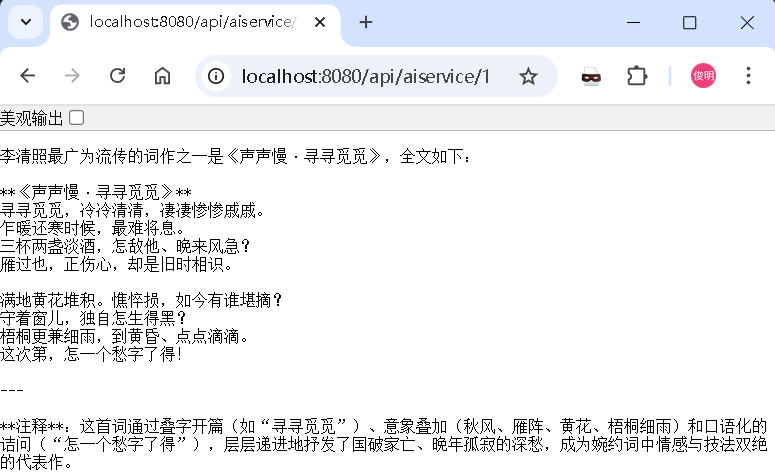
是不是很简单?运行效果:
二、结构化输出
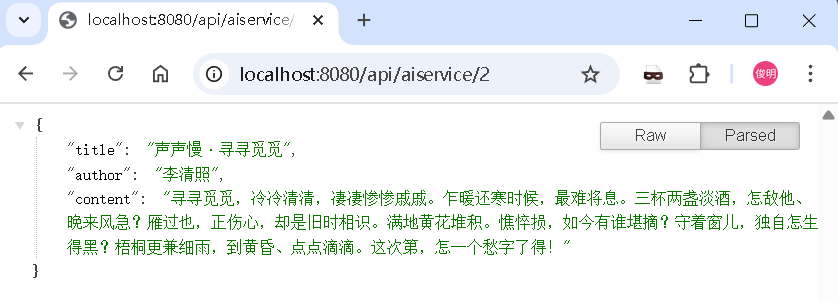
AIService还可以将输出结果,以结构化输出(即:直接输出强类型的POJO对象),继续将上述示例改造一下:
2.1 定义POJO对象
 1 /**
 2  * @author junmingyang(菩提树下的杨过)
 3  */
 4 @Data
 5 @AllArgsConstructor
 6 @NoArgsConstructor
 7 public class Poem {
 8
 9     @Description("标题")
10     private String title;
11
12     @Description("作者")
13     private String author;
14
15     @Description("内容")
16     private String content;
17 }
2.2 定义1个extrator接口
1 /**
2  * @author junmingyang
3  */
4 public interface PoemExtractor {
5     @UserMessage("请从以下内容中提取出诗歌内容:{{query}}")
6     Poem extract(@V("query") String query);
7 }
2.3 使用示例
 1     /**
 2      * 演示AIService基本用法+结构化返回
 3      *
 4      * @param query
 5      * @return
 6      */
 7     @GetMapping(value = "/aiservice/2", produces = MediaType.APPLICATION_JSON_VALUE)
 8     public ResponseEntity<Poem> demo2(@RequestParam(defaultValue = """
 9             请问李清照最广为流传的词是哪一首,
10             请给出这首词全文(以json格式输出,类似{\"author\":\"...\",\"title\":\"...\",\"content\":\"...\"})?""") String query) {
11         try {
12             Poem extract = AiServices.builder(PoemExtractor.class)
13                     .chatModel(ollamaChatModel).build()
14                     .extract(AiServices.builder(ChineseTeacher.class)
15                             .chatModel(ollamaChatModel)
16                             .chatMemory(MessageWindowChatMemory.withMaxMessages(10))
17                             .build().chat(query));
18             return ResponseEntity.ok(extract);
19         } catch (Exception e) {
20             return ResponseEntity.ok(new Poem("error", "error", e.getMessage()));
21         }
22     }
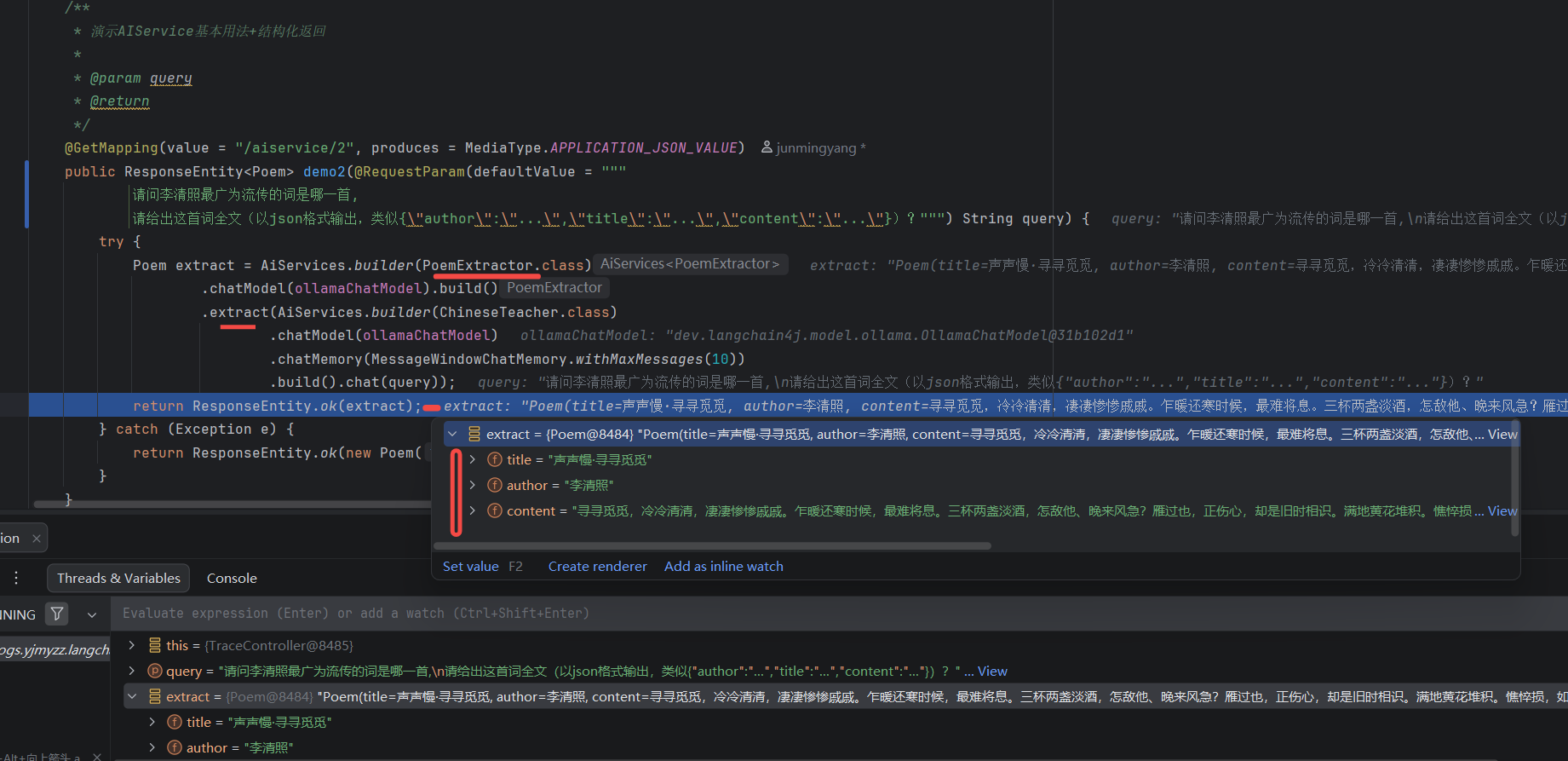
运行效果:
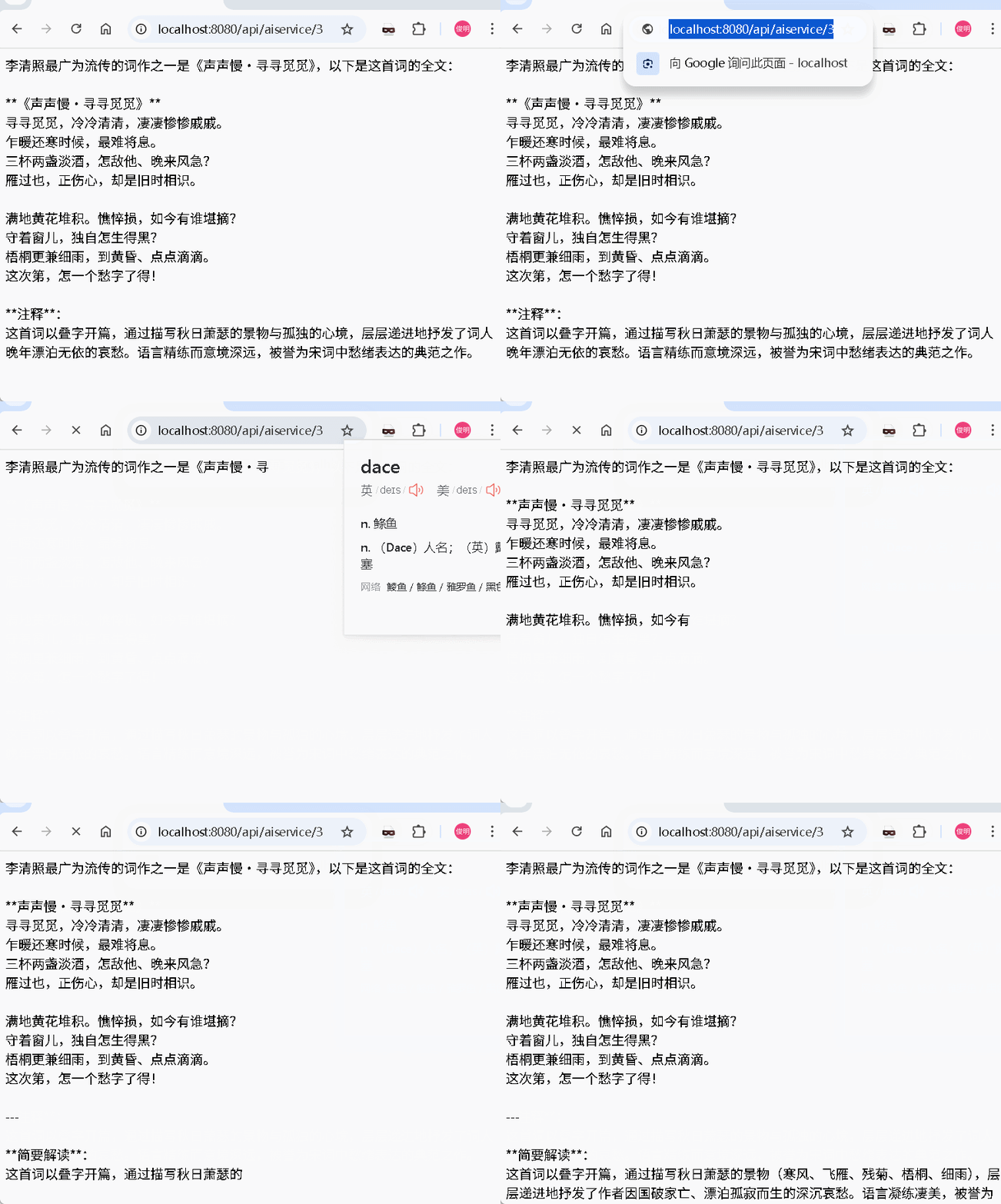
三、流式响应
 1     /**
 2      * 演示AIService基本用法+流式返回
 3      *
 4      * @param query
 5      * @return
 6      */
 7     @GetMapping(value = "/aiservice/3", produces = "text/html;charset=utf-8")
 8     public Flux<String> demo3(@RequestParam(defaultValue = "请问李清照最广为流传的词是哪一首,请给出这首词全文?") String query) {
 9         ChineseStreamTeacher teacher = AiServices.builder(ChineseStreamTeacher.class)
10                 .streamingChatModel(streamingChatModel)
11                 .build();
12
13         Sinks.Many<String> sink = Sinks.many().unicast().onBackpressureBuffer();
14         teacher.chat(query)
15                 .onPartialResponse((String s) -> sink.tryEmitNext(escapeToHtml(s)))
16                 .onCompleteResponse((ChatResponse response) -> sink.tryEmitComplete())
17                 .onError(sink::tryEmitError)
18                 .start();
19         return sink.asFlux();
20     }
四、可观测性(trace跟踪)
LLM应用中,trace跟踪是很重要,比如:每次请求消耗了多少token,哪个环节耗时最大,每次请求LLM的输入/输出是什么...
4.1 model级别的监听器
 1 /**
 2  * 自定义ChatModelListener(监听器)
 3  */
 4 public class CustomChatModelListener implements ChatModelListener {
 5     @Override
 6     public void onRequest(ChatModelRequestContext requestContext) {
 7         ChatRequest chatRequest = requestContext.chatRequest();
 8
 9         List<ChatMessage> messages = chatRequest.messages();
10         System.out.println(messages);
11
12         ChatRequestParameters parameters = chatRequest.parameters();
13         System.out.println(parameters);
14
15         System.out.println(requestContext.modelProvider());
16
17         Map<Object, Object> attributes = requestContext.attributes();
18         attributes.put("my-attribute", "my-value");
19     }
20
21     @Override
22     public void onResponse(ChatModelResponseContext responseContext) {
23         ChatResponse chatResponse = responseContext.chatResponse();
24
25         AiMessage aiMessage = chatResponse.aiMessage();
26         System.out.println(aiMessage);
27
28         ChatResponseMetadata metadata = chatResponse.metadata();
29         System.out.println(metadata);
30
31         TokenUsage tokenUsage = metadata.tokenUsage();
32         System.out.println(tokenUsage);
33
34         ChatRequest chatRequest = responseContext.chatRequest();
35         System.out.println(chatRequest);
36
37         System.out.println(responseContext.modelProvider());
38
39         Map<Object, Object> attributes = responseContext.attributes();
40         System.out.println(attributes.get("my-attribute"));
41     }
42
43     @Override
44     public void onError(ChatModelErrorContext errorContext) {
45         Throwable error = errorContext.error();
46         error.printStackTrace();
47
48         ChatRequest chatRequest = errorContext.chatRequest();
49         System.out.println(chatRequest);
50
51         System.out.println(errorContext.modelProvider());
52
53         Map<Object, Object> attributes = errorContext.attributes();
54         System.out.println(attributes.get("my-attribute"));
55     }
56 }
自定义1个listener,可以把LLM的输入、输出、错误信息都拿到,按实际业务需求做相应处理(比如:记日志,或存储便于离线分析),在注入model时,加上这个监听器
 1     @Bean("ollamaChatModel")
 2     public ChatModel chatModel() {
 3         return OllamaChatModel.builder()
 4                 .baseUrl(ollamaBaseUrl)
 5                 .modelName(ollamaModel)
 6                 .timeout(Duration.ofSeconds(timeoutSeconds))
 7                 .logRequests(true)
 8                 .logResponses(true)
 9                 //加入监听器
10                 .listeners(List.of(new CustomChatModelListener()))
11                 .build();
12     }
4.2 AiService监听器
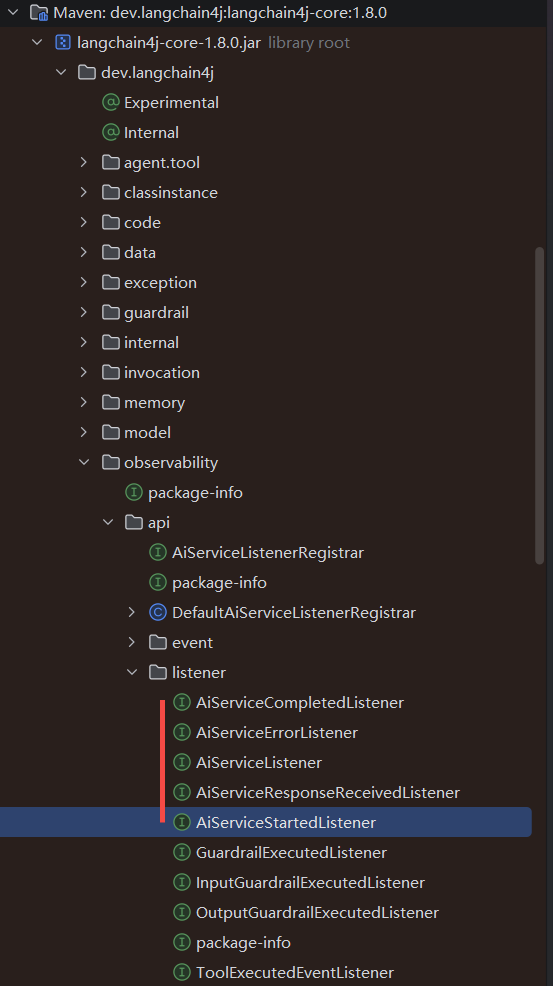
langchain4j内置这几种AiService的监听器,这里我们挑2个做为示例
 1 /**
 2  * @author junmingyang
 3  */
 4 public class CustomAiServiceStartedListener implements AiServiceStartedListener {
 5
 6     @Override
 7     public void onEvent(AiServiceStartedEvent event) {
 8         InvocationContext invocationContext = event.invocationContext();
 9         Optional<SystemMessage> systemMessage = event.systemMessage();
10         UserMessage userMessage = event.userMessage();
11
12         // 所有与同一LLM调用相关的事件,invocationId将保持一致
13         UUID invocationId = invocationContext.invocationId();
14         String aiServiceInterfaceName = invocationContext.interfaceName();
15         String aiServiceMethodName = invocationContext.methodName();
16         List<Object> aiServiceMethodArgs = invocationContext.methodArguments();
17         Object chatMemoryId = invocationContext.chatMemoryId();
18         Instant eventTimestamp = invocationContext.timestamp();
19
20         System.out.println("AiServiceStartedEvent: " +
21                 "invocationId=" + invocationId +
22                 ", aiServiceInterfaceName=" + aiServiceInterfaceName +
23                 ", aiServiceMethodName=" + aiServiceMethodName +
24                 ", aiServiceMethodArgs=" + aiServiceMethodArgs +
25                 ", chatMemoryId=" + chatMemoryId +
26                 ", eventTimestamp=" + eventTimestamp +
27                 ", userMessage=" + userMessage +
28                 ", systemMessage=" + systemMessage);
29     }
30
31
32 }
 1 public class CustomAiServiceCompletedListener implements AiServiceCompletedListener {
 2     @Override
 3     public void onEvent(AiServiceCompletedEvent event) {
 4         InvocationContext invocationContext = event.invocationContext();
 5         Optional<Object> result = event.result();
 6
 7         UUID invocationId = invocationContext.invocationId();
 8         String aiServiceInterfaceName = invocationContext.interfaceName();
 9         String aiServiceMethodName = invocationContext.methodName();
10         List<Object> aiServiceMethodArgs = invocationContext.methodArguments();
11         Object chatMemoryId = invocationContext.chatMemoryId();
12         Instant eventTimestamp = invocationContext.timestamp();
13
14         System.out.println("AiServiceCompletedListener: " +
15                 "invocationId=" + invocationId +
16                 ", aiServiceInterfaceName=" + aiServiceInterfaceName +
17                 ", aiServiceMethodName=" + aiServiceMethodName +
18                 ", aiServiceMethodArgs=" + aiServiceMethodArgs +
19                 ", chatMemoryId=" + chatMemoryId +
20                 ", eventTimestamp=" + eventTimestamp +
21                 ", result=" + result);
22     }
23 }
顾名思义,1个是start(开始)的监听器,1个是complete(完成)的监听器
 1     /**
 2      * 演示AIService基本用法+自定义监听器
 3      *
 4      * @param query
 5      * @return
 6      */
 7     @GetMapping(value = "/aiservice/4", produces = MediaType.APPLICATION_JSON_VALUE)
 8     public ResponseEntity<String> demo4(@RequestParam(defaultValue = "请问李清照最广为流传的词是哪一首,请给出这首词全文?") String query) {
 9         try {
10             ChineseTeacher teacher = AiServices.builder(ChineseTeacher.class)
11                     .chatModel(ollamaChatModel)
12                     .chatMemory(MessageWindowChatMemory.withMaxMessages(10))
13                     //加入监听器
14                     .registerListeners(List.of(new CustomAiServiceStartedListener(), new CustomAiServiceCompletedListener()))
15                     .build();
16             return ResponseEntity.ok(teacher.chat(query));
17         } catch (Exception e) {
18             return ResponseEntity.ok("{\"error\":\"chatChain error: " + e.getMessage() + "\"}");
19         }
20     }
加入以上listener后,我们来看看运行时的控制台输出
 1 AiServiceStartedEvent: invocationId=6a0e5f23-6a30-4485-8ed3-49c9a0ac6d5a, aiServiceInterfaceName=com.cnblogs.yjmyzz.langchain4j.study.service.ChineseTeacher, aiServiceMethodName=chat, aiServiceMethodArgs=[请问李清照最广为流传的词是哪一首,请给出这首词全文?], chatMemoryId=default, eventTimestamp=2026-01-11T06:19:51.685233Z, userMessage=UserMessage { name = null, contents = [TextContent { text = "请用中文回答我的问题:请问李清照最广为流传的词是哪一首,请给出这首词全文?" }], attributes = {} }, systemMessage=Optional[SystemMessage { text = "你是一名小学语文老师" }]
 2 [SystemMessage { text = "你是一名小学语文老师" }, UserMessage { name = null, contents = [TextContent { text = "请用中文回答我的问题:请问李清照最广为流传的词是哪一首,请给出这首词全文?" }], attributes = {} }]
 3 OllamaChatRequestParameters{modelName="deepseek-v3.1:671b-cloud", temperature=null, topP=null, topK=null, frequencyPenalty=null, presencePenalty=null, maxOutputTokens=null, stopSequences=[], toolSpecifications=[], toolChoice=null, responseFormat=null, mirostat=null, mirostatEta=null, mirostatTau=null, numCtx=null, repeatLastN=null, repeatPenalty=null, seed=null, minP=null, keepAlive=null, think=null}
 4 OLLAMA
 5 2026-01-11T14:19:51.860+08:00  INFO 25716 --- [langchain4j-study] [nio-8080-exec-1] d.l.http.client.log.LoggingHttpClient    : HTTP request:
 6 - method: POST
 7 - url: http://localhost:11434/api/chat
 8 - headers: [Content-Type: application/json]
 9 - body: {
10   "model" : "deepseek-v3.1:671b-cloud",
11   "messages" : [ {
12     "role" : "system",
13     "content" : "你是一名小学语文老师"
14   }, {
15     "role" : "user",
16     "content" : "请用中文回答我的问题:请问李清照最广为流传的词是哪一首,请给出这首词全文?"
17   } ],
18   "options" : {
19     "stop" : [ ]
20   },
21   "stream" : false,
22   "tools" : [ ]
23 }
24
25 2026-01-11T14:19:54.570+08:00  INFO 25716 --- [langchain4j-study] [nio-8080-exec-1] d.l.http.client.log.LoggingHttpClient    : HTTP response:
26 - status code: 200
27 - headers: [content-type: application/json; charset=utf-8], [date: Sun, 11 Jan 2026 06:19:54 GMT], [transfer-encoding: chunked]
28 - body: {"model":"deepseek-v3.1:671b-cloud","remote_model":"deepseek-v3.1:671b","remote_host":"https://ollama.com:443","created_at":"2026-01-11T06:19:54.384141206Z","message":{"role":"assistant","content":"李清照最广为传诵的词作之一是《声声慢·寻寻觅觅》,这首词以深婉哀怨的笔触抒发了国破家亡、颠沛流离的愁绪。全文如下:\n\n**《声声慢·寻寻觅觅》**  \n寻寻觅觅,冷冷清清,凄凄惨惨戚戚。  \n乍暖还寒时候,最难将息。  \n三杯两盏淡酒,怎敌他、晚来风急?  \n雁过也,正伤心,却是旧时相识。  \n\n满地黄花堆积。憔悴损,如今有谁堪摘?  \n守着窗儿,独自怎生得黑?  \n梧桐更兼细雨,到黄昏、点点滴滴。  \n这次第,怎一个愁字了得!\n\n---\n\n**注释**:  \n1. 词中叠字开篇“寻寻觅觅,冷冷清清,凄凄惨惨戚戚”,通过音律重叠强化了孤寂无依的意境;  \n2. “雁过也”借秋雁南飞暗喻往事不可追的哀痛;  \n3. 结尾“怎一个愁字了得”以反问收束,将愁绪推向极致,余韵绵长。\n\n这首词因语言精炼、情感深切,成为宋婉约词的典范之作。"},"done":true,"done_reason":"stop","total_duration":2242392515,"prompt_eval_count":33,"eval_count":272}
29
30
31 AiMessage { text = "李清照最广为传诵的词作之一是《声声慢·寻寻觅觅》,这首词以深婉哀怨的笔触抒发了国破家亡、颠沛流离的愁绪。全文如下:
32
33 **《声声慢·寻寻觅觅》**
34 寻寻觅觅,冷冷清清,凄凄惨惨戚戚。
35 乍暖还寒时候,最难将息。
36 三杯两盏淡酒,怎敌他、晚来风急?
37 雁过也,正伤心,却是旧时相识。
38
39 满地黄花堆积。憔悴损,如今有谁堪摘?
40 守着窗儿,独自怎生得黑?
41 梧桐更兼细雨,到黄昏、点点滴滴。
42 这次第,怎一个愁字了得!
43
44 ---
45
46 **注释**:
47 1. 词中叠字开篇“寻寻觅觅,冷冷清清,凄凄惨惨戚戚”,通过音律重叠强化了孤寂无依的意境;
48 2. “雁过也”借秋雁南飞暗喻往事不可追的哀痛;
49 3. 结尾“怎一个愁字了得”以反问收束,将愁绪推向极致,余韵绵长。
50
51 这首词因语言精炼、情感深切,成为宋婉约词的典范之作。", thinking = null, toolExecutionRequests = [], attributes = {} }
52 ChatResponseMetadata{id='null', modelName='deepseek-v3.1:671b-cloud', tokenUsage=TokenUsage { inputTokenCount = 33, outputTokenCount = 272, totalTokenCount = 305 }, finishReason=STOP}
53 TokenUsage { inputTokenCount = 33, outputTokenCount = 272, totalTokenCount = 305 }
54 ChatRequest { messages = [SystemMessage { text = "你是一名小学语文老师" }, UserMessage { name = null, contents = [TextContent { text = "请用中文回答我的问题:请问李清照最广为流传的词是哪一首,请给出这首词全文?" }], attributes = {} }], parameters = OllamaChatRequestParameters{modelName="deepseek-v3.1:671b-cloud", temperature=null, topP=null, topK=null, frequencyPenalty=null, presencePenalty=null, maxOutputTokens=null, stopSequences=[], toolSpecifications=[], toolChoice=null, responseFormat=null, mirostat=null, mirostatEta=null, mirostatTau=null, numCtx=null, repeatLastN=null, repeatPenalty=null, seed=null, minP=null, keepAlive=null, think=null} }
55 OLLAMA
56 my-value
57 AiServiceCompletedListener: invocationId=6a0e5f23-6a30-4485-8ed3-49c9a0ac6d5a, aiServiceInterfaceName=com.cnblogs.yjmyzz.langchain4j.study.service.ChineseTeacher, aiServiceMethodName=chat, aiServiceMethodArgs=[请问李清照最广为流传的词是哪一首,请给出这首词全文?], chatMemoryId=default, eventTimestamp=2026-01-11T06:19:51.685233Z, result=Optional[李清照最广为传诵的词作之一是《声声慢·寻寻觅觅》,这首词以深婉哀怨的笔触抒发了国破家亡、颠沛流离的愁绪。全文如下:
58
59 **《声声慢·寻寻觅觅》**
60 寻寻觅觅,冷冷清清,凄凄惨惨戚戚。
61 乍暖还寒时候,最难将息。
62 三杯两盏淡酒,怎敌他、晚来风急?
63 雁过也,正伤心,却是旧时相识。
64
65 满地黄花堆积。憔悴损,如今有谁堪摘?
66 守着窗儿,独自怎生得黑?
67 梧桐更兼细雨,到黄昏、点点滴滴。
68 这次第,怎一个愁字了得!
69
70 ---
71
72 **注释**:
73 1. 词中叠字开篇“寻寻觅觅,冷冷清清,凄凄惨惨戚戚”,通过音律重叠强化了孤寂无依的意境;
74 2. “雁过也”借秋雁南飞暗喻往事不可追的哀痛;
75 3. 结尾“怎一个愁字了得”以反问收束,将愁绪推向极致,余韵绵长。
76
77 这首词因语言精炼、情感深切,成为宋婉约词的典范之作。]
其中:
行1 - 是CustomAiServiceStartedListener的输出
行57 - 是CustomAiServiceCompletedListener的输出
行31,54,56等是CustomChatModelListener的输出,其中要注意的是:
CustomChatModelListener.onRequest中, 上下文中示例放了1个自定义属性 my-attribute -> my-value
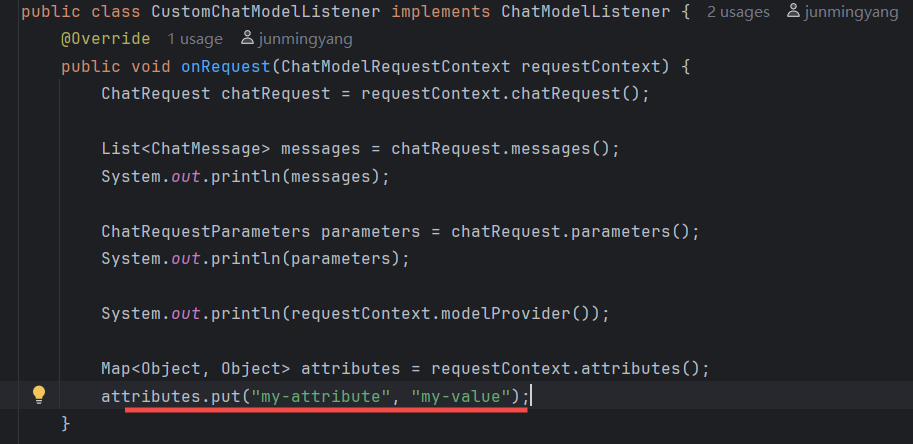
然后在onResponse中, 在输出结果中,尝试获取这个属性
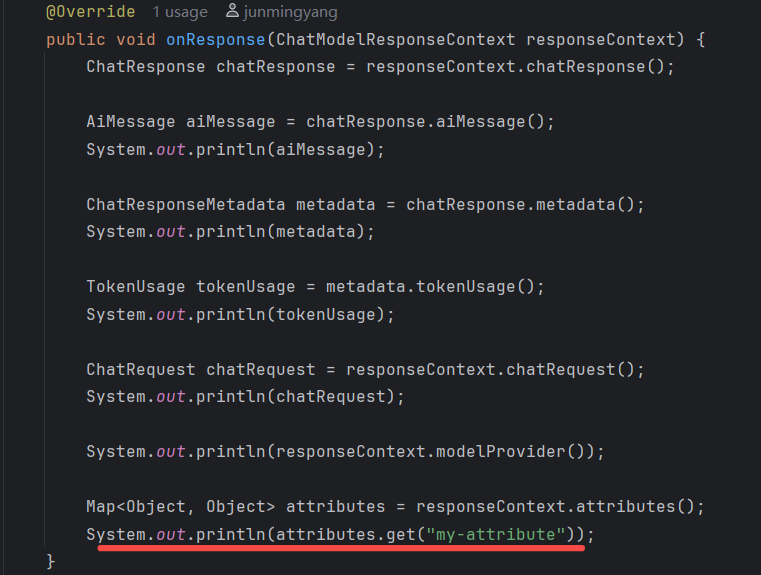
从56行的日志来看, 拿到了这个附加的自定义属性,这个特性很有用,可以在整个上下文中埋入一些业务trace key,用于串连业务上下文。
文中代码:
https://github.com/yjmyzz/langchain4j-study/tree/day09
参考:
出处:http://yjmyzz.cnblogs.com
本文版权归作者和博客园共有,欢迎转载,但未经作者同意必须保留此段声明,且在文章页面明显位置给出原文连接,否则保留追究法律责任的权利。

 浙公网安备 33010602011771号