

pointTransformerV1导出onnx并验证推理
前面介绍了pointTransformerV1训练自定义数据,在实际应用中往往还需要借助C++对其进行推理,这里记录一下导出和推理过程以及中途遇到的一些坑。
- 相关环境
python: 3.7.16
系统: Windows10和Ubuntu18.04

numpy                  1.21.6
onnx                   1.14.1
torch                  1.9.0+cu111
onnxruntime            1.14.1
onnxruntime-extensions 0.8.0
onnxsim                0.4.36
一、转换成库导出
模型导出时比较麻烦的地方在于一些自定义算子导出成onnx模型可能不支持,这就会涉及到pytorch自定义算子导出,大体可以分为以下五个步骤,具体细节参考之前的文章pytorch自定义算子
转换流程
- step1 先C++ torch该写算子,导出库文件
- step2 torch加载库文件, 如:torch.ops.load_library("./fps.dll")
- step3 torch注册算子, 如:def my_fps(g, xyz, npoints): return g.op("my_ops::fps", xyz, npoints)
- step4 torch.onnx注册算子, 如: torch.onnx.register_custom_op_symbolic("my_ops::fps", my_fps, 9)
- step5 修改模型,如:farthest_point_sample(xyz, S)) 变为 torch.ops.my_ops.fps(xyz, S)
这里给出FurthestSampling的导出脚本示例。在根目录lib/pointops/functions/pointops.py中FurthestSampling定义如下:
class FurthestSampling(Function):
    @staticmethod
    def forward(ctx, xyz, offset, new_offset):
        """
        input: xyz: (n, 3), offset: (b), new_offset: (b)
        output: idx: (m)
        """
        assert xyz.is_contiguous()
        n, b, n_max = xyz.shape[0], offset.shape[0], offset[0]
        for i in range(1, b):
            n_max = max(offset[i] - offset[i-1], n_max)
        idx = torch.cuda.IntTensor(new_offset[b-1].item()).zero_()

        n_int = n.item() if isinstance(n, torch.Tensor) else n  # 确保 n 为标量
        tmp = torch.full((n_int,), 1e10, dtype=torch.float32, device='cuda')
        pointops_cuda.furthestsampling_cuda(b, n_max, xyz, offset, new_offset, tmp, idx)
        del tmp
        return idx

furthestsampling = FurthestSampling.apply
在模型部分,直接应用了该算子,但是如果直接导出onnx模型的话肯定是不支持的。
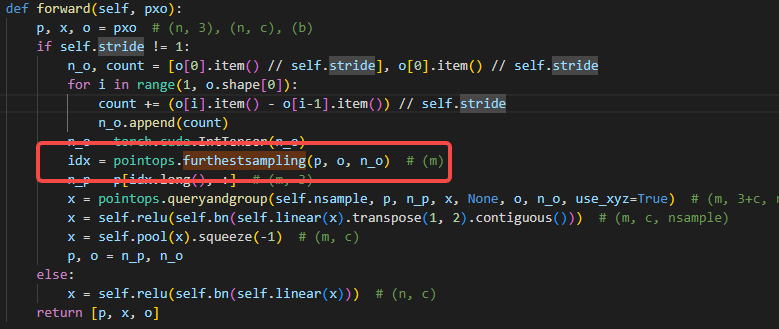
所以对其转换,只需自己实现furthestsampling_cpu_impl接口,即可将其导出成库文件:
#include <torch/script.h>
#include <vector>
#include <cmath>

torch::Tensor furthestsampling_cpu(
    torch::Tensor xyz_tensor,
    torch::Tensor offset_tensor,
    torch::Tensor new_offset_tensor
) {
    // 输入验证
    TORCH_CHECK(xyz_tensor.is_contiguous(), "XYZ tensor must be contiguous");
    TORCH_CHECK(offset_tensor.device().is_cpu(), "Offset tensor must be on CPU");
    TORCH_CHECK(xyz_tensor.size(1) == 3, "XYZ tensor must have shape [N, 3]");

    const int b = offset_tensor.size(0);
    const int n = xyz_tensor.size(0);

    auto tmp_tensor = torch::full({n}, 1e10,
                                torch::dtype(torch::kFloat32).device(torch::kCPU));

    auto idx_tensor = torch::zeros({new_offset_tensor[-1].item<int>()},
                                  torch::dtype(torch::kInt32).device(torch::kCPU));

    const float* xyz = xyz_tensor.data_ptr<float>();
    const int* offset = offset_tensor.data_ptr<int>();
    const int* new_offset = new_offset_tensor.data_ptr<int>();
    float* tmp = tmp_tensor.data_ptr<float>();
    int* idx = idx_tensor.data_ptr<int>();

    // 执行采样算法
    furthestsampling_cpu_impl(b, xyz, offset, new_offset, tmp, idx);

    return idx_tensor;
}

// 模块注册
TORCH_LIBRARY(my_ops, m) {
    m.def("FurthestSampling", furthestsampling_cpu);
}
onnx自定义算子:https://onnxruntime.ai/docs/reference/operators/add-custom-op.html
二、借助占位符导出
前面提到的导出方式是按照导出成库然后再导出onnx模型,还可以借助torch.autograd.Function定义一个占位符导出,具体操作方式如下,在FurthestSampling类里面在实现一个静态函数symbolic,
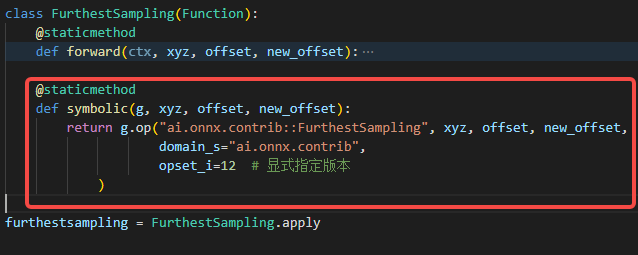
这样导出自定义算子时,也是可以的。
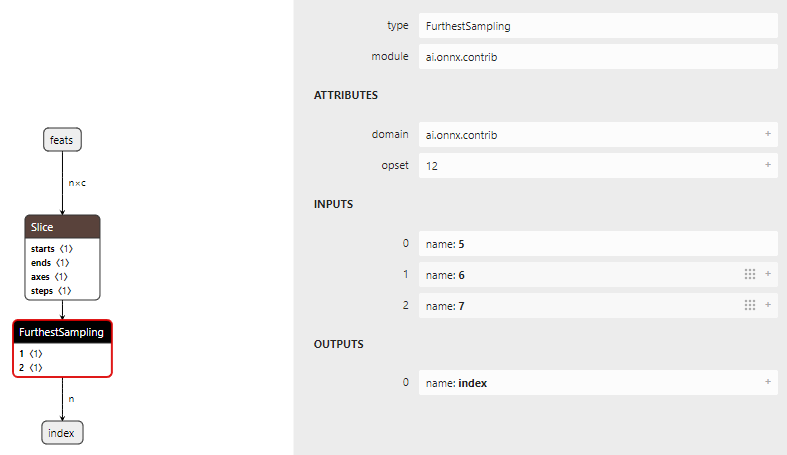
三、python onnxruntime验证
在模型导出后,我们可以借助onnxruntime对其进行验证,而对于带有自定义算子的onnx模型,直接加载会出现以下错误
加载模型时会报算子未定义:onnxruntime.capi.onnxruntime_pybind11_state.Fail: [ONNXRuntimeError] : 1 : FAIL : Load model from custom_inverse.onnx failed:Fatal error: ai.onnx.contrib:FurthestSampling is not a registered function/op
对于带有自定义算子的模型可以借助onnxruntime_extensions库对其进行装饰,进而可以在python上快速验证导出的模型是否推理正确。接下来分别对以上两种导出方式进行验证。参考:https://onnxruntime.ai/docs/extensions/add-op.html
onnxruntime_extensions提供了onnx_op装饰器,主要包含算子名称、作用域、输入输出类型。
3.1 按库导出
@onnx_op(
        op_type="FurthestSampling",                                     # 必须与 symbolic 中的 OpName 一致
        domain="ai.onnx.contrib",                                      # 必须与 symbolic 中的 domain 一致
        inputs=[PyOp.dt_float, PyOp.dt_int32, PyOp.dt_int32],           # 输入类型
        outputs=[PyOp.dt_int32],                                        # 输出类型
        since_version=12
    )
def FurthestSampling(xyz, offset, new_offset):
        """
        input: xyz: (n, 3), offset: (b), new_offset: (b)
        output: idx: (m)
        """
        print("[DEBUG] PyOp called! Output shape:", xyz.shape)
        xyz = torch.from_numpy(xyz)
        offset = torch.from_numpy(offset)
        new_offset = torch.from_numpy(new_offset)

        torch.ops.load_library("/home/learn/point-transformer/tool/libFurthestSampling.so")
        fps = torch.ops.my_ops.FurthestSampling
        idx = fps(xyz, offset, new_offset)
        return idx
3.2 占位符导出
验证时输入输出都是numpy,所以这里为了适配原有代码,进行了类型转换,注意借助onnxruntime_extensions验证,算子必须以ai.onnx.开头。对于复杂的模型,可以先单独对每一个自定义算子导出验证,验证成功后在整体导出,并借助onnx_op装饰后可以对其进行调试。
@onnx_op(
        op_type="FurthestSampling",                                     # 必须与 symbolic 中的 OpName 一致
        domain="ai.onnx.contrib",                                      # 必须与 symbolic 中的 domain 一致
        inputs=[PyOp.dt_float, PyOp.dt_int32, PyOp.dt_int32],           # 输入类型
        outputs=[PyOp.dt_int32],                                        # 输出类型
        since_version=12
    )
def FurthestSampling(xyz, offset, new_offset):
        """
        input: xyz: (n, 3), offset: (b), new_offset: (b)
        output: idx: (m)
        """
        print("[DEBUG] PyOp called! Output shape:", xyz.shape)
        xyz = torch.from_numpy(xyz).cuda()
        offset = torch.from_numpy(offset).cuda()
        new_offset = torch.from_numpy(new_offset).cuda()
        assert xyz.is_contiguous()
        n, b, n_max = xyz.shape[0], offset.shape[0], offset[0]
        for i in range(1, b):
            n_max = max(offset[i] - offset[i-1], n_max)
        idx = torch.cuda.IntTensor(new_offset[b-1].item()).zero_()

        n_int = n.item() if isinstance(n, torch.Tensor) else n  # 确保 n 为标量
        tmp = torch.full((n_int,), 1e10, dtype=torch.float32, device='cuda')

        pointops_cuda.furthestsampling_cuda(b, n_max, xyz, offset, new_offset, tmp, idx)
        del tmp
        return idx
3.3 模型推理
session_options = ort.SessionOptions()
session_options.register_custom_ops_library(get_library_path())
session_options.log_severity_level = 2  # 日志级别
sess = ort.InferenceSession("./support.onnx", providers=["CPUExecutionProvider"], sess_options=session_options)
四、其他细节
4.1 模型简化
参考:https://github.com/daquexian/onnx-simplifier,新版本会自动跳过自定义算子
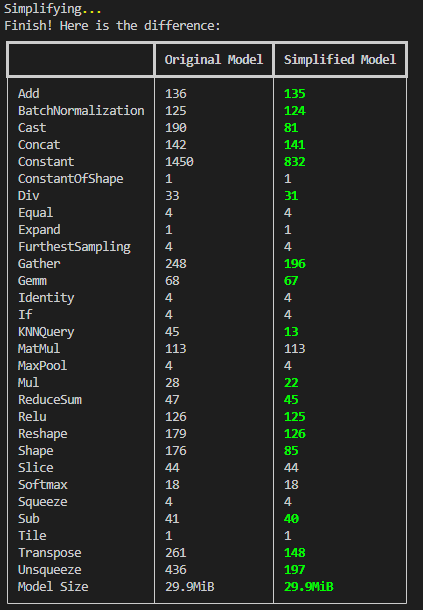
4.2 onnxruntime_extensions完整示例
ref: https://onnxruntime.ai/docs/extensions/add-op.html
def test_Inversion():
    import torch
    import torch.onnx

    # 定义自定义算子(示例:矩阵逆运算 + 恒等连接)
    class InverseFunction(torch.autograd.Function):
        @staticmethod
        def forward(ctx, x):
            inv_x = torch.inverse(x)
            return inv_x + x  # 自定义逻辑

        @staticmethod
        def symbolic(g, x):
            # 映射到 ONNX 自定义算子(域名::算子名)
            return g.op("ai.onnx.contrib::Inverse2", x)  #

    # 封装为模型
    class CustomModel(torch.nn.Module):
        def forward(self, x):
            return InverseFunction.apply(x)

    # 导出 ONNX 模型
    model = CustomModel()
    dummy_input = torch.randn(3, 3)  # 确保矩阵可逆
    torch.onnx.export(
        model,
        dummy_input,
        "custom_inverse.onnx",
        input_names=["input_matrix"],
        output_names=["output"],
        opset_version=12
    )

    import onnxruntime as ort
    import numpy as np

    @onnx_op(op_type="Inverse2", domain="ai.onnx.contrib")
    def inverse2(x: np.ndarray):
        return np.linalg.inv(x) + x

    # 加载模型时传递 SessionOptions
    # session = ort.InferenceSession("custom_inverse.onnx", providers=["CPUExecutionProvider"])

    session = ort.InferenceSession("./custom_inverse.onnx", so, providers=['CPUExecutionProvider'])

    # 准备输入(确保矩阵可逆)
    input_matrix = np.array([
        [1.0, 0.5, 0.0],
        [0.2, 1.0, 0.3],
        [0.0, 0.1, 1.0]
    ], dtype=np.float32)

    # 运行推理
    output = session.run(
        output_names=["output"],
        input_feed={"input_matrix": input_matrix}
    )[0]

    print("自定义算子输出:\n", output)

    from onnxruntime_extensions import PyOrtFunction
    model_func = PyOrtFunction.from_model("./custom_inverse.onnx")
    out = model_func(input_matrix)
    print("out: ", out)
参考链接
https://github.heygears.com/onnx/tutorials/tree/master/PyTorchCustomOperator
https://onnxruntime.ai/docs/reference/operators/add-custom-op.html
https://onnxruntime.ai/docs/extensions/add-op.html
https://onnxruntime.ai/docs/api/c/struct_ort_custom_op.html
https://github.com/daquexian/onnx-simplifier

 浙公网安备 33010602011771号