

一、什么是逆运动学?
在机器人学中,我们经常面临一个基本问题:
已知机械臂末端执行器(手爪/工具)的目标位姿,求解各个关节应该转动多少角度?
这就是逆运动学(Inverse Kinematics, IK)。
与之对应的是正运动学(Forward Kinematics, FK)——已知各关节角度,求末端位姿。
| 正运动学 (FK) | 逆运动学 (IK) | |
|---|---|---|
| 输入 | 关节角度 \((\theta_1, \theta_2, \dots, \theta_n)\) | 目标末端位姿 \((x, y, z, \alpha, \beta, \gamma)\) |
| 输出 | 末端位姿 | 关节角度 |
| 难度 | 唯一解,直接计算 | 可能无解、多解,需要求解策略 |
为什么 IK 比 FK 难?
- FK 是唯一确定的映射,IK 可能存在无穷多解(冗余机械臂)、有限多解、甚至无解
- 解的存在性取决于目标点是否在机械臂的工作空间(Workspace)内
二、前置知识:正运动学与 DH 参数
2.1 D-H 参数法
Denavit-Hartenberg (DH) 参数是描述机械臂连杆几何关系的经典方法。每个关节用 4 个参数描述:
| 参数 | 含义 |
|---|---|
| \(\theta_i\) | 绕 \(z_{i-1}\) 轴的旋转角(关节变量) |
| \(d_i\) | 沿 \(z_{i-1}\) 轴的偏移 |
| \(a_i\) | 沿 \(x_i\) 轴的连杆长度 |
| \(\alpha_i\) | 绕 \(x_i\) 轴的扭转角 |
相邻两个坐标系之间的齐次变换矩阵为:
总变换矩阵为各连杆变换的乘积:
2.2 一个简单的二连杆平面机械臂
考虑一个在平面内运动的 2-DOF 机械臂:
       关节2 (θ₂)
      /
  L₂ /
    /
   ●───────── 末端 (x, y)
  /
L₁/
/
● 关节1 (θ₁) —— 基座
正运动学方程:
三、逆运动学求解方法
3.1 解析法(Analytical / Closed-form)
对于结构简单的机械臂(如 2R 平面臂),可以直接推导出解析解。
二连杆臂的 IK 求解:
由正运动学方程,利用几何关系:
解得:
注意:\(\theta_2\) 有两个解(肘部朝上 / 肘部朝下),这就是经典的 elbow-up / elbow-down 多解问题。
优点:计算快、精确
缺点:仅适用于特殊构型(满足 Pieper 准则的 6-DOF 机械臂),通用性差
3.2 数值法——雅可比迭代法(Jacobian Iterative)
对于一般构型的机械臂,最常用的方法是基于雅可比矩阵的数值迭代法。
核心思想
正运动学给出了末端位姿 \(\mathbf{x}\) 和关节角度 \(\mathbf{q}\) 的关系:
对时间求导得到速度关系:
其中 \(J(\mathbf{q})\) 是雅可比矩阵,它描述了关节速度到末端速度的映射。
我们的目标是:已知 \(\dot{\mathbf{x}}\)(希望末端移动的方向和距离),反求 \(\dot{\mathbf{q}}\):
但 \(J\) 不一定是方阵(关节自由度 ≠ 末端自由度),所以需要用伪逆:
阻尼最小二乘法(Damped Least Squares / Levenberg-Marquardt)
伪逆法在雅可比矩阵奇异(接近奇异位形)时会不稳定,产生极大的关节速度。引入阻尼因子 \(\lambda\):
这使得在奇异点附近也能平滑求解,是工业级 IK 求解器的常用策略。
四、Python 代码实现
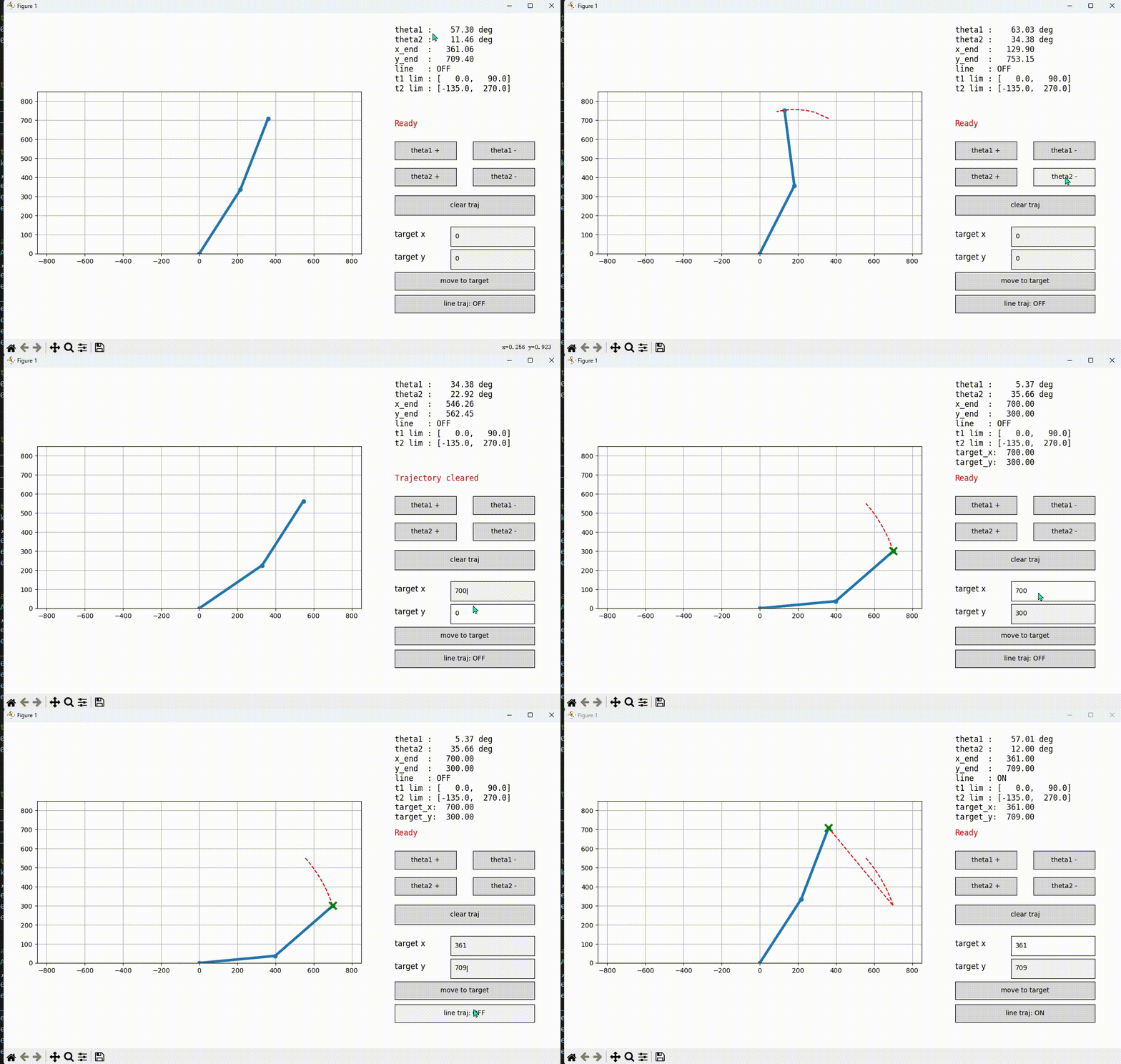
在GitHub上有相应的模拟代码可以帮助理解
https://github.com/201905335/Two_Link_RobotArm_imulator
4.1 二连杆臂解析法
import numpy as np
import matplotlib.pyplot as plt

def ik_2link_analytical(x, y, L1, L2, elbow_up=True):
    """
    二连杆平面机械臂解析法 IK
    返回: (theta1, theta2) 弧度制
    """
    # 检查目标是否在工作空间内
    dist = np.sqrt(x**2 + y**2)
    if dist > L1 + L2 or dist < abs(L1 - L2):
        raise ValueError(f"目标点 ({x}, {y}) 超出工作空间!")

    # 求 theta2
    cos_theta2 = (x**2 + y**2 - L1**2 - L2**2) / (2 * L1 * L2)
    cos_theta2 = np.clip(cos_theta2, -1, 1)  # 防止数值误差

    if elbow_up:
        theta2 = -np.arccos(cos_theta2)  # 肘部朝上
    else:
        theta2 = np.arccos(cos_theta2)   # 肘部朝下

    # 求 theta1
    k1 = L1 + L2 * np.cos(theta2)
    k2 = L2 * np.sin(theta2)
    theta1 = np.arctan2(y, x) - np.arctan2(k2, k1)

    return theta1, theta2

def fk_2link(theta1, theta2, L1, L2):
    """正运动学:计算各关节和末端位置"""
    x0, y0 = 0, 0
    x1 = L1 * np.cos(theta1)
    y1 = L1 * np.sin(theta1)
    x2 = x1 + L2 * np.cos(theta1 + theta2)
    y2 = y1 + L2 * np.sin(theta1 + theta2)
    return [(x0, y0), (x1, y1), (x2, y2)]

# 测试
L1, L2 = 1.0, 0.8
target_x, target_y = 1.2, 0.6

# 两种解
t1_up, t2_up = ik_2link_analytical(target_x, target_y, L1, L2, elbow_up=True)
t1_down, t2_down = ik_2link_analytical(target_x, target_y, L1, L2, elbow_up=False)

print(f"Elbow-up:   θ1={np.degrees(t1_up):.1f}°, θ2={np.degrees(t2_up):.1f}°")
print(f"Elbow-down: θ1={np.degrees(t1_down):.1f}°, θ2={np.degrees(t2_down):.1f}°")

# 验证
pts = fk_2link(t1_up, t2_up, L1, L2)
print(f"末端位置验证: ({pts[-1][0]:.4f}, {pts[-1][1]:.4f})")
4.2 通用 3-DOF 机械臂数值法(Jacobian 迭代)
import numpy as np

def fk_3dof(q, L):
    """
    3-DOF 平面机械臂正运动学
    q: [theta1, theta2, theta3] 关节角度
    L: [L1, L2, L3] 连杆长度
    返回末端 (x, y) 位置
    """
    theta1, theta2, theta3 = q
    x = L[0]*np.cos(theta1) + L[1]*np.cos(theta1+theta2) + L[2]*np.cos(theta1+theta2+theta3)
    y = L[0]*np.sin(theta1) + L[1]*np.sin(theta1+theta2) + L[2]*np.sin(theta1+theta2+theta3)
    return np.array([x, y])

def jacobian_3dof(q, L):
    """数值雅可比矩阵 (2x3)"""
    eps = 1e-6
    J = np.zeros((2, 3))
    f0 = fk_3dof(q, L)
    for i in range(3):
        q_plus = q.copy()
        q_plus[i] += eps
        J[:, i] = (fk_3dof(q_plus, L) - f0) / eps
    return J

def ik_jacobian(target, q_init, L, max_iter=100, tol=1e-4, lam=0.01):
    """
    阻尼最小二乘法 IK 求解
    target: 目标位置 [x, y]
    q_init: 初始关节角度猜测
    L: 连杆长度
    lam: 阻尼因子
    """
    q = np.array(q_init, dtype=float)

    for i in range(max_iter):
        pos = fk_3dof(q, L)
        error = np.array(target) - pos

        if np.linalg.norm(error) < tol:
            print(f"收敛于第 {i} 次迭代,误差: {np.linalg.norm(error):.6f}")
            return q

        J = jacobian_3dof(q, L)
        # 阻尼最小二乘: dq = J^T (JJ^T + λ²I)^{-1} e
        JJT = J @ J.T
        dq = J.T @ np.linalg.solve(JJT + lam**2 * np.eye(2), error)
        q += dq

    print(f"达到最大迭代次数,当前误差: {np.linalg.norm(error):.6f}")
    return q

# 测试
L = [1.0, 0.8, 0.5]
target = [1.5, 0.8]
q_init = [0.1, 0.1, 0.1]

solution = ik_jacobian(target, q_init, L)
print(f"\n目标位置: {target}")
print(f"求解角度 (deg): {np.degrees(solution)}")
print(f"正运动学验证: {fk_3dof(solution, L)}")
4.3 可视化
import matplotlib.pyplot as plt
import numpy as np

def plot_arm(q, L, target=None, title=""):
    """可视化机械臂"""
    theta1, theta2, theta3 = q
    joints = [(0, 0)]

    x = L[0]*np.cos(theta1)
    y = L[0]*np.sin(theta1)
    joints.append((x, y))

    x += L[1]*np.cos(theta1+theta2)
    y += L[1]*np.sin(theta1+theta2)
    joints.append((x, y))

    x += L[2]*np.cos(theta1+theta2+theta3)
    y += L[2]*np.sin(theta1+theta2+theta3)
    joints.append((x, y))

    xs, ys = zip(*joints)

    fig, ax = plt.subplots(1, 1, figsize=(8, 8))
    ax.plot(xs, ys, 'b-o', linewidth=3, markersize=12, label='机械臂')
    ax.plot(0, 0, 'ks', markersize=15, label='基座')
    ax.plot(xs[-1], ys[-1], 'r*', markersize=20, label='末端')

    if target:
        ax.plot(target[0], target[1], 'gx', markersize=15, markeredgewidth=3, label='目标点')

    ax.set_xlim(-3, 3)
    ax.set_ylim(-3, 3)
    ax.set_aspect('equal')
    ax.grid(True, alpha=0.3)
    ax.legend(fontsize=12)
    ax.set_title(title, fontsize=14)
    plt.show()

# 可视化求解结果
L = [1.0, 0.8, 0.5]
target = [1.5, 0.8]
q_init = [0.1, 0.1, 0.1]
solution = ik_jacobian(target, q_init, L)
plot_arm(solution, L, target=target, title="3-DOF IK 求解结果")
五、进阶话题
5.1 冗余机械臂与零空间
当机械臂自由度 > 末端所需自由度时(如 7-DOF 机械臂控制 6-DOF 末端位姿),称为冗余机械臂。
多出的自由度形成零空间(Null Space),可以在不影响末端位置的情况下调整臂形:
其中 \(\dot{\mathbf{q}}_0\) 是优化目标的梯度(如关节限位避让、避障等)。
5.2 关节限位处理
实际机械臂的关节有角度范围限制,需要在迭代过程中做投影:
q = np.clip(q, q_min, q_max)
5.3 常用 IK 求解库
| 库 | 语言 | 特点 |
|---|---|---|
| KDL | C++ | Orocos 项目,工业级 |
| IKFast | C++/Python | OpenRAVE 生成解析解 |
| PyBullet | Python | 内置 IK,支持 URDF |
| MoveIt | C++/Python | ROS 生态,集成多种求解器 |
| CasADi | C++/Python | 数值优化框架 |
5.4 奇异位形(Singularity)
当雅可比矩阵秩亏时,机械臂处于奇异位形,表现为:
- 某些方向无法移动
- 关节速度趋向无穷大
常见的奇异位形:
- 肩部奇异:腕关节中心位于基座轴线上
- 肘部奇异:肘关节完全伸直或折叠
- 腕部奇异:腕关节的两个轴共线
六、总结
                    逆运动学方法
                        │
           ┌────────────┼────────────┐
           │            │            │
        解析法       数值法       优化法
    (封闭解)     (Jacobian)    (非线性规划)
           │            │            │
     结构特殊时    通用方法    复杂约束
     快速精确    迭代收敛     全局搜索
| 方法 | 适用场景 | 速度 | 精度 |
|---|---|---|---|
| 解析法 | 满足 Pieper 准则的 6R 臂 | ⚡ 极快 | ✅ 精确 |
| Jacobian 迭代 | 通用机械臂 | 🔶 中等 | ✅ 高 |
| 阻尼最小二乘 | 接近奇异点 | 🔶 中等 | ✅ 高 |
| 数值优化 | 复杂约束 | 🐢 慢 | ✅ 高 |
学习建议:
- 先从二连杆臂的解析解理解 IK 的本质
- 手写 Jacobian 迭代法体会数值求解的思路
- 再使用 PyBullet / MoveIt 处理实际项目

 浙公网安备 33010602011771号