
Set集合
1.1Set集合概述和特点【应用】
-
Set集合的特点
-
元素存取无序
-
没有索引、只能通过迭代器或增强for循环遍历
-
不能存储重复元素
-
-


public class SetDemo {
    public static void main(String[] args) {
        //创建集合对象
        Set<String> set = new HashSet<String>();

        //添加元素
        set.add("hello");
        set.add("world");
        set.add("java");
        //不包含重复元素的集合
        set.add("world");

        //遍历
        for(String s : set) {
            System.out.println(s);
        }
    }
}
-
是JDK根据对象的地址或者字符串或者数字算出来的int类型的数值
-
如何获取哈希值
Object类中的public int hashCode():返回对象的哈希码值
-
哈希值的特点
-
同一个对象多次调用hashCode()方法返回的哈希值是相同的
-
默认情况下,不同对象的哈希值是不同的。而重写hashCode()方法,可以实现让不同对象的哈希值相同
-
-
获取哈希值的代码
-
public class Student {
    private String name;
    private int age;

  //省略有参无参,get/set方法

    @Override
    public int hashCode() {
        return 0;
    }
}
 1 public class HashDemo {
 2     public static void main(String[] args) {
 3         //创建学生对象
 4         Student s1 = new Student("林青霞",30);
 5
 6         //同一个对象多次调用hashCode()方法返回的哈希值是相同的
 7         System.out.println(s1.hashCode()); //1060830840
 8         System.out.println(s1.hashCode()); //1060830840
 9         System.out.println("--------");
10
11         Student s2 = new Student("林青霞",30);
12
13         //默认情况下,不同对象的哈希值是不相同的
14         //通过方法重写,可以实现不同对象的哈希值是相同的
15         System.out.println(s2.hashCode()); //2137211482
16         System.out.println("--------");
17
18         System.out.println("hello".hashCode()); //99162322
19         System.out.println("world".hashCode()); //113318802
20         System.out.println("java".hashCode()); //3254818
21
22         System.out.println("world".hashCode()); //113318802
23         System.out.println("--------");
24
25         System.out.println("重地".hashCode()); //1179395
26         System.out.println("通话".hashCode()); //1179395
27     }
28 }
-
HashSet集合的特点
-
底层数据结构是哈希表
-
对集合的迭代顺序不作任何保证,也就是说不保证存储和取出的元素顺序一致
-
没有带索引的方法,所以不能使用普通for循环遍历
-
由于是Set集合,所以是不包含重复元素的集合
-
-
HashSet集合的基本使用
public class HashSetDemo01 {
    public static void main(String[] args) {
        //创建集合对象
        HashSet<String> hs = new HashSet<String>();

        //添加元素
        hs.add("hello");
        hs.add("world");
        hs.add("java");

        hs.add("world");

        //遍历
        for(String s : hs) {
            System.out.println(s);
        }
    }
}
-
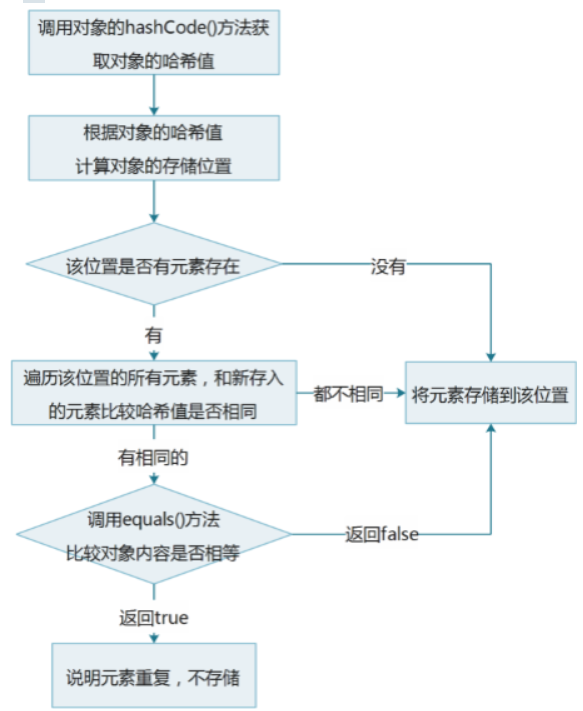
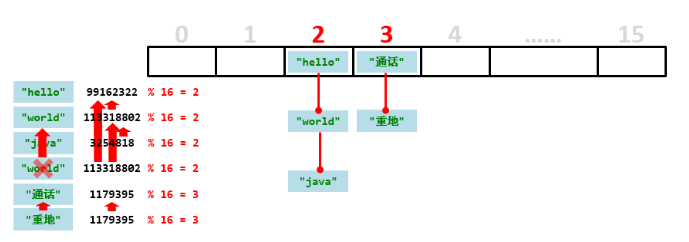
HashSet集合保证元素唯一性的原理
1.根据对象的哈希值计算存储位置
如果当前位置没有元素则直接存入
如果当前位置有元素存在,则进入第二步
2.当前元素的元素和已经存在的元素比较哈希值
如果哈希值不同,则将当前元素进行存储
如果哈希值相同,则进入第三步
3.通过equals()方法比较两个元素的内容
如果内容不相同,则将当前元素进行存储
如果内容相同,则不存储当前元素
-
HashSet集合保证元素唯一性的图解
1.6HashSet集合存储学生对象并遍历【应用】
-
-
创建一个存储学生对象的集合,存储多个学生对象,使用程序实现在控制台遍历该集合
-
要求:学生对象的成员变量值相同,我们就认为是同一个对象
-
-
代码实现
-
学生类
-
public class Student {
    private String name;
    private int age;
//省略有参无参,get/set方法

    @Override
    public boolean equals(Object o) {
        if (this == o) return true;
        if (o == null || getClass() != o.getClass()) return false;

        Student student = (Student) o;

        if (age != student.age) return false;
        return name != null ? name.equals(student.name) : student.name == null;
    }

    @Override
    public int hashCode() {
        int result = name != null ? name.hashCode() : 0;
        result = 31 * result + age;
        return result;
    }
}
public class HashSetDemo02 {
    public static void main(String[] args) {
        //创建HashSet集合对象
        HashSet<Student> hs = new HashSet<Student>();

        //创建学生对象
        Student s1 = new Student("林青霞", 30);
        Student s2 = new Student("张曼玉", 35);
        Student s3 = new Student("王祖贤", 33);

        Student s4 = new Student("王祖贤", 33);

        //把学生添加到集合
        hs.add(s1);
        hs.add(s2);
        hs.add(s3);
        hs.add(s4);

        //遍历集合(增强for)
        for (Student s : hs) {
            System.out.println(s.getName() + "," + s.getAge());
        }
    }
}
1.7LinkedHashSet集合概述和特点【应用】
-
LinkedHashSet集合特点
-
哈希表和链表实现的Set接口,具有可预测的迭代次序
-
由链表保证元素有序,也就是说元素的存储和取出顺序是一致的
-
由哈希表保证元素唯一,也就是说没有重复的元素
-
-
LinkedHashSet集合基本使用
 1 public class LinkedHashSetDemo {
 2     public static void main(String[] args) {
 3         //创建集合对象
 4         LinkedHashSet<String> linkedHashSet = new LinkedHashSet<String>();
 5
 6         //添加元素
 7         linkedHashSet.add("hello");
 8         linkedHashSet.add("world");
 9         linkedHashSet.add("java");
10
11         linkedHashSet.add("world");
12
13         //遍历集合
14         for(String s : linkedHashSet) {
15             System.out.println(s);
16         }
17     }
18 }
2.Set集合排序
2.1TreeSet集合概述和特点【应用】
-
TreeSet集合概述
-
元素有序,可以按照一定的规则进行排序,具体排序方式取决于构造方法
-
TreeSet():根据其元素的自然排序进行排序
-
TreeSet(Comparator comparator) :根据指定的比较器进行排序
-
-
没有带索引的方法,所以不能使用普通for循环遍历
-
由于是Set集合,所以不包含重复元素的集合
-
- TreeSet集合基本使用
 1 public class TreeSetDemo01 {
 2     public static void main(String[] args) {
 3         //创建集合对象
 4         TreeSet<Integer> ts = new TreeSet<Integer>();
 5
 6         //添加元素
 7         ts.add(10);
 8         ts.add(40);
 9         ts.add(30);
10         ts.add(50);
11         ts.add(20);
12
13         ts.add(30);
14
15         //遍历集合
16         for(Integer i : ts) {
17             System.out.println(i);
18         }
19     }
20 }
2.2自然排序Comparable的使用【应用】
-
案例需求
-
存储学生对象并遍历,创建TreeSet集合使用无参构造方法
-
要求:按照年龄从小到大排序,年龄相同时,按照姓名的字母顺序排序
-
-
实现步骤
-
用TreeSet集合存储自定义对象,无参构造方法使用的是自然排序对元素进行排序的
-
自然排序,就是让元素所属的类实现Comparable接口,重写compareTo(T o)方法
-
重写方法时,一定要注意排序规则必须按照要求的主要条件和次要条件来写
-
-
代码实现
学生类
public class Student implements Comparable<Student> {
    private String name;
    private int age;

    public Student() {
    }

    public Student(String name, int age) {
        this.name = name;
        this.age = age;
    }

    public String getName() {
        return name;
    }

    public void setName(String name) {
        this.name = name;
    }

    public int getAge() {
        return age;
    }

    public void setAge(int age) {
        this.age = age;
    }

    @Override
    public int compareTo(Student s) {
//        return 0;
//        return 1;
//        return -1;
        //按照年龄从小到大排序
       int num = this.age - s.age;
//        int num = s.age - this.age;
        //年龄相同时,按照姓名的字母顺序排序
       int num2 = num==0?this.name.compareTo(s.name):num;
        return num2;
    }
}
测试类
public class TreeSetDemo02 {
    public static void main(String[] args) {
        //创建集合对象
        TreeSet<Student> ts = new TreeSet<Student>();

        //创建学生对象
        Student s1 = new Student("xishi", 29);
        Student s2 = new Student("wangzhaojun", 28);
        Student s3 = new Student("diaochan", 30);
        Student s4 = new Student("yangyuhuan", 33);

        Student s5 = new Student("linqingxia",33);
        Student s6 = new Student("linqingxia",33);

        //把学生添加到集合
        ts.add(s1);
        ts.add(s2);
        ts.add(s3);
        ts.add(s4);
        ts.add(s5);
        ts.add(s6);

        //遍历集合
        for (Student s : ts) {
            System.out.println(s.getName() + "," + s.getAge());
        }
    }
}
-
用TreeSet集合存储多个学生信息(姓名,语文成绩,数学成绩),并遍历该集合
-
package com.xja.test1;

public class Student implements Comparable<Student> {
    private String name;
    private int chinese;
    private int math;

    public String getName() {
        return name;
    }

    public void setName(String name) {
        this.name = name;
    }

    public int getChinese() {
        return chinese;
    }

    public void setChinese(int chinese) {
        this.chinese = chinese;
    }

    public int getMath() {
        return math;
    }

    public void setMath(int math) {
        this.math = math;
    }

    public Student(String name, int chinese, int math) {
        super();
        this.name = name;
        this.chinese = chinese;
        this.math = math;
    }
    public Student() {
        // TODO Auto-generated constructor stub
    }

    public int getSum() {
        return this.chinese+this.math;
    }

    @Override
    public int compareTo(Student s) {
        //主要条件
        //this在前正序排列
//        int num = (this.getSum())-(s.getSum());

        //this在后逆序排列
        int num = (s.getSum())-(this.getSum());

        //次要条件
        if(num==0) {
            int num1 = s.getChinese()-this.getChinese();
            if(num1 == 0) {
                int num2 = s.getName().compareTo(this.getName());
                return num2;
            }else {
                return num1;
            }
        }else {
            return num;
        }

    }


}
测试类
package com.xja.test1;

import java.util.TreeSet;

public class TestStudent {
    public static void main(String[] args) {

        TreeSet<Student> ts = new TreeSet<>();
         //创建学生对象
        Student s1 = new Student("林青霞", 98, 100);
        Student s2 = new Student("张曼玉", 95, 95);
        Student s3 = new Student("王祖贤", 100, 93);
        Student s4 = new Student("柳岩", 100, 97);
        Student s5 = new Student("风清扬", 98, 98);
        Student s6 = new Student("左冷禅", 97, 99);
//        Student s7 = new Student("左冷禅", 97, 99);
        Student s7 = new Student("赵云", 97, 99);

        //把学生对象添加到集合
        ts.add(s1);
        ts.add(s2);
        ts.add(s3);
        ts.add(s4);
        ts.add(s5);
        ts.add(s6);
        ts.add(s7);

        //遍历集合
        for (Student s : ts) {
            System.out.println(s.getName() + "," + s.getChinese() + "," + s.getMath() + "," + s.getSum());
        }
    }
}

 浙公网安备 33010602011771号