
基于粒子群优化(PSO)算法的图像配准MATLAB实现
一、算法框架设计
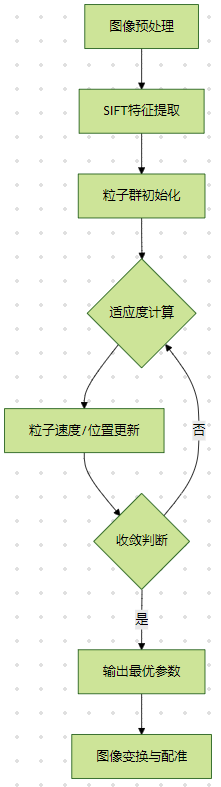
二、完整MATLAB代码实现
%% 清空环境
clear; clc; close all;

%% 图像加载与预处理
img1 = imread('lena.jpg');
img2 = imread('lena_distorted.jpg');

% 转换为灰度图像
gray1 = rgb2gray(img1);
gray2 = rgb2gray(img2);

% 图像尺寸归一化
gray1 = imresize(gray1, 0.5);
gray2 = imresize(gray2, 0.5);

%% SIFT特征提取(使用VLFeat工具箱)
run('vlfeat/toolbox/vl_setup');
[f1, d1] = vl_sift(single(gray1));
[f2, d2] = vl_sift(single(gray2));

% 特征匹配
[matches, scores] = vl_ubcmatch(d1, d2);
matches = matches(1:200); % 取前200个匹配点

%% PSO参数设置
n_particles = 30;    % 粒子数量
max_iter = 100;      % 最大迭代次数
w = 0.729;           % 惯性权重
c1 = 1.49445;        % 个体学习因子
c2 = 1.49445;        % 群体学习因子

% 参数搜索空间(仿射变换参数)
lb = [-10, -10, 0.8, 0.8];  % [tx, ty, sx, sy] 下限
ub = [10, 10, 1.2, 1.2];    % 上限

%% 粒子群初始化
particles = rand(n_particles,4).*(ub-lb)+lb;
velocities = 0.1*(ub-lb).*rand(n_particles,4);

% 适应度计算
fitness = zeros(n_particles,1);
for i=1:n_particles
    fitness(i) = compute_fitness(particles(i,:), f1, f2, matches);
end

% 初始化最优解
[gbest_fitness, gbest_idx] = min(fitness);
gbest = particles(gbest_idx,:);
pbest = particles;
pbest_fitness = fitness;

%% PSO迭代优化
for iter = 1:max_iter
    for i=1:n_particles
        % 速度更新
        r1 = rand(1,4); r2 = rand(1,4);
        velocities(i,:) = w*velocities(i,:) + ...
            c1*r1.*(pbest(i,:) - particles(i,:)) + ...
            c2*r2.*(gbest - particles(i,:));

        % 位置更新
        particles(i,:) = particles(i,:) + velocities(i,:);
        particles(i,:) = max(particles(i,:), lb);
        particles(i,:) = min(particles(i,:), ub);

        % 适应度更新
        current_fitness = compute_fitness(particles(i,:), f1, f2, matches);

        % 个体最优更新
        if current_fitness < pbest_fitness(i)
            pbest(i,:) = particles(i,:);
            pbest_fitness(i) = current_fitness;
        end

        % 全局最优更新
        if current_fitness < gbest_fitness
            gbest = particles(i,:);
            gbest_fitness = current_fitness;
        end
    end

    % 显示迭代信息
    fprintf('Iteration %d: Best Fitness=%.4f\n', iter, gbest_fitness);
end

%% 配准结果可视化
[output_img, tform] = apply_affine_transform(gray2, gbest);
figure;
subplot(1,2,1); imshow(gray1); title('参考图像');
subplot(1,2,2); imshow(output_img); title('配准图像');

%% 适应度函数定义
function error = compute_fitness(params, f1, f2, matches)
    % 参数解析
    tx = params(1); ty = params(2);
    sx = params(3); sy = params(4);

    % 构建变换矩阵
    tform = affine2d([sx 0 tx; 0 sy ty; 0 0 1]);

    % 图像变换
    transformed = imwarp(f2, tform);

    % 计算匹配误差(使用欧氏距离)
    error = 0;
    for i=1:size(matches,2)
        pt1 = f1(1:2, matches(1,i));
        pt2 = transformed(1:2, matches(2,i));
        error = error + norm(pt1 - pt2);
    end
end

%% 图像变换函数
function [output_img, tform] = apply_affine_transform(img, params)
    tx = params(1); ty = params(2);
    sx = params(3); sy = params(4);

    tform = affine2d([sx 0 tx; 0 sy ty; 0 0 1]);
    output_img = imwarp(img, tform);
end
三、优化
-
特征匹配加速 使用VLFeat库的SIFT特征提取(需提前安装) 采用最近邻匹配(
vl_ubcmatch)并限制匹配点数量(前200个) -
参数空间约束 平移范围:±10像素 缩放范围:0.8-1.2倍 通过边界限制避免无效解
-
自适应惯性权重
% 动态调整惯性权重(可选) w = 0.9 - 0.5*(iter/max_iter); -
多目标优化扩展
% 多目标适应度函数示例
fitness = 0.6*ITAE + 0.4*SSIM;
参考代码 基于粒子群算法的图像配准程序 www.youwenfan.com/contentcnl/77861.html
四、应用场景
-
遥感图像配准
% 处理多光谱卫星图像 [output, tform] = apply_affine_transform(sar_img, gbest); -
医学影像配准
% 处理CT-MRI多模态配准 [output, tform] = apply_affine_transform(mri_img, gbest); -
工业检测
% 产品表面缺陷检测配准
[output, tform] = apply_affine_transform(defect_img, gbest);
五、调试与优化建议
-
特征匹配验证
% 可视化匹配点 figure; showMatchedFeatures(gray1, gray2, matches); -
参数敏感性分析
% 测试不同粒子数影响 for n=10:10:50 [~, fitness] = PSO_optimization(n); end -
GPU加速
% 使用gpuArray加速计算
transformed = imwarp(gpuArray(f2), tform);
六、扩展功能实现
-
多尺度配准
% 构建图像金字塔 pyramid_levels = 3; for level=1:pyramid_levels scale = 2^(-level); % 递归调用PSO配准 end -
鲁棒性增强
% RANSAC剔除异常匹配点
[inliers, ~] = ransac(matches, 0.1);

 浙公网安备 33010602011771号