
[设计模式/Java] 设计模式之迭代器模式【23】
概述:迭代器模式 ∈ 行为型模式
模式定义
- 迭代器模式提供了一种统一访问集合对象元素的方式,将遍历操作封装到迭代器中,简化集合接口、并解耦集合与遍历操作。
- 迭代器模式是一种行为型设计模式
- 它提供了一种统一的方式来访问集合对象中的元素,而不是暴露集合内部的表示方式。
简单地说,就是将遍历集合的责任封装到一个单独的对象中,我们可以按照特定的方式访问集合中的元素。
模式的组成
- 抽象的集合迭代器(
Iterator):定义了遍历聚合对象所需的方法,包括hashNext()和next()方法等,用于遍历聚合对象中的元素。 - 具体的集合迭代器(
Concrete Iterator):它是实现迭代器接口的具体实现类,负责具体的遍历逻辑。
它保存了当前遍历的位置信息,并可以根据需要向前或向后遍历集合元素。
- 抽象的聚合器(
Aggregate): 一般是一个接口,提供一个iterator()方法
例如: java中的Collection接口,List接口,Set接口等。
- 具体的聚合器(
Concrete Aggregate):就是抽象容器的具体实现类
比如:
List接口的有序列表实现ArrayList,List接口的链表实现LinkList,Set接口的哈希列表的实现HashSet等。
模式特点
优点
- 简化了集合类的接口,使用者可以更加简单地遍历集合对象,而不需要了解集合内部结构和实现细节。
- 将集合和遍历操作解耦,使得我们可以更灵活地使用不同的迭代器来遍历同一个集合,根据需求选择不同的遍历方式。
- 满足开闭原则,如果需要增加新的遍历方式,只需实现一个新的具体迭代器即可,不需要修改原先聚合对象的代码。
缺点
- 具体迭代器实现的算法对外不可见,因此不利于调试和维护。
- 对于某些小型、简单的集合对象来说,使用迭代器模式可能会显得过于复杂,增加了代码的复杂性。
案例实践
CASE 生活场景-教师按照班级名单点名
- 遍历班级名单:假设你是一名班主任,你需要遍历班级名单来点名。
班级名单可以看作是一个集合,每个学生名字可以看作是集合中的一个元素。
使用迭代器模式,你可以通过迭代器对象逐个访问学生的名字,而不需要了解班级名单的具体实现细节。
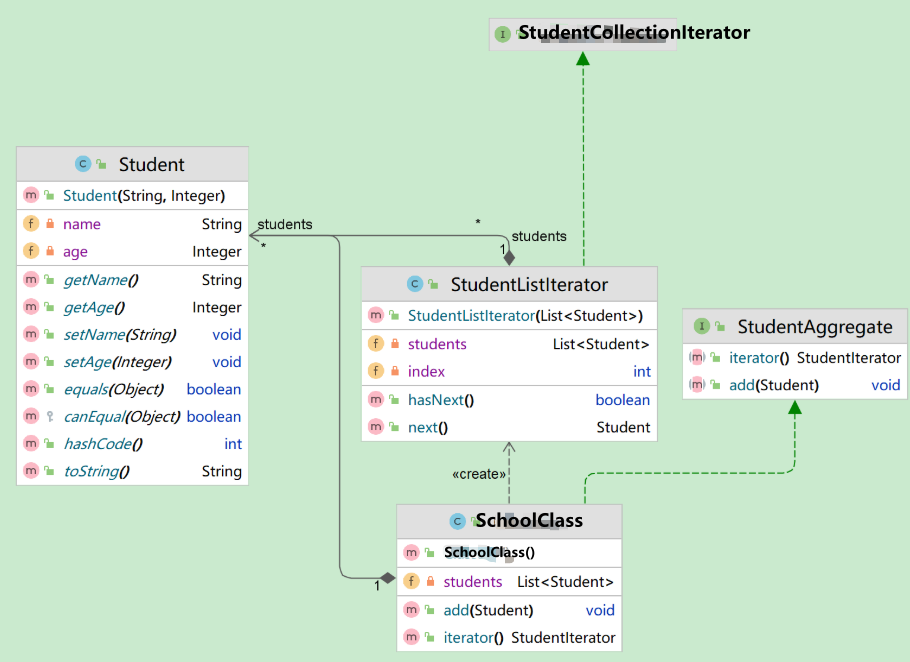
Student : 被遍历的数据对象
import lombok.Data;
import lombok.ToString;

/**
 * 学生实体类
 */
@Data
@ToString
public class Student {
    private String name;
    private Integer age;

    public Student(String name,Integer age){
        this.age=age;
        this.name=name;
    }
}
StudentCollectionIterator : 抽象的集合迭代器
创建一个抽象迭代器(学生迭代器)并继承Iterator接口(java.util包下的Iterator)
- StudentCollectionIterator
import java.util.Iterator;
/**
 * 抽象的集合迭代器(Iterator):学生集合的迭代器
 * 实现Iterator接口
 * 负责定义访问和遍历元素的接口,例如提供hasNext()和next()方法。
 */
public interface StudentCollectionIterator extends Iterator<Student> {

}
- Iterator
package java.util;

import java.util.function.Consumer;

/**
 * An iterator over a collection.  {@code Iterator} takes the place of
 * {@link Enumeration} in the Java Collections Framework.  Iterators
 * differ from enumerations in two ways:
 *
 * <ul>
 *      <li> Iterators allow the caller to remove elements from the
 *           underlying collection during the iteration with well-defined
 *           semantics.
 *      <li> Method names have been improved.
 * </ul>
 *
 * <p>This interface is a member of the
 * <a href="{@docRoot}/../technotes/guides/collections/index.html">
 * Java Collections Framework</a>.
 *
 * @param <E> the type of elements returned by this iterator
 *
 * @author  Josh Bloch
 * @see Collection
 * @see ListIterator
 * @see Iterable
 * @since 1.2
 */
public interface Iterator<E> {
    /**
     * Returns {@code true} if the iteration has more elements.
     * (In other words, returns {@code true} if {@link #next} would
     * return an element rather than throwing an exception.)
     *
     * @return {@code true} if the iteration has more elements
     */
    boolean hasNext();

    /**
     * Returns the next element in the iteration.
     *
     * @return the next element in the iteration
     * @throws NoSuchElementException if the iteration has no more elements
     */
    E next();

    /**
     * Removes from the underlying collection the last element returned
     * by this iterator (optional operation).  This method can be called
     * only once per call to {@link #next}.  The behavior of an iterator
     * is unspecified if the underlying collection is modified while the
     * iteration is in progress in any way other than by calling this
     * method.
     *
     * @implSpec
     * The default implementation throws an instance of
     * {@link UnsupportedOperationException} and performs no other action.
     *
     * @throws UnsupportedOperationException if the {@code remove}
     *         operation is not supported by this iterator
     *
     * @throws IllegalStateException if the {@code next} method has not
     *         yet been called, or the {@code remove} method has already
     *         been called after the last call to the {@code next}
     *         method
     */
    default void remove() {
        throw new UnsupportedOperationException("remove");
    }

    /**
     * Performs the given action for each remaining element until all elements
     * have been processed or the action throws an exception.  Actions are
     * performed in the order of iteration, if that order is specified.
     * Exceptions thrown by the action are relayed to the caller.
     *
     * @implSpec
     * <p>The default implementation behaves as if:
     * <pre>{@code
     *     while (hasNext())
     *         action.accept(next());
     * }</pre>
     *
     * @param action The action to be performed for each element
     * @throws NullPointerException if the specified action is null
     * @since 1.8
     */
    default void forEachRemaining(Consumer<? super E> action) {
        Objects.requireNonNull(action);
        while (hasNext())
            action.accept(next());
    }
}
StudentListIterator : 具体的集合迭代器(Concrete Iterator)
- 在这个具体的集合迭代器中,实现抽象的集合迭代器,重写
hashNext()和next()方法。
import java.util.List;
import java.util.NoSuchElementException;

/**
 * 具体迭代器(Concrete iterator):
 * 实现抽象迭代器定义的接口,负责实现对元素的访问和遍历。
 */
public class StudentListIterator implements StudentIterator{
    private List<Student> students;
    private int index;

    public StudentListIterator(List<Student> students) {
        this.students = students;
        this.index = 0;
    }

    //检查是否还有下一个元素
    @Override
    public boolean hasNext() {
        return (index < students.size());
    }

    //返回下一个元素
    @Override
    public Student next() {
        if (!hasNext()) {
            throw new NoSuchElementException();
        }
        Student student = students.get(index);
        index++;
        return student;
    }
}
StudentAggregate : 抽象的聚合器(Aggregate)
- 定义一个抽象聚合器,并定义一个
iterator()方法,用于创建具体的迭代器对象。
/**
 * 学生集合的聚合器: 抽象的聚合器(Aggregate)
 * 提供创建迭代器的接口,例如可以定义一个iterator()方法。
 */
public interface StudentAggregate {
    //用于创建具体的迭代器对象
    StudentCollectionIterator iterator();
    void add(Student student);
}
SchoolClass : 具体的聚合器(Concrete Aggregate)
- 实现抽象聚合器定义的接口,负责创建具体的迭代器对象。
import java.util.ArrayList;
import java.util.List;

/**
 * 学校班级 : 具体的聚合器(ConcreteAggregate)
 * 实现抽象聚合器定义的接口,负责创建具体的迭代器对象,并返回该对象。
 */
public class SchoolClass implements StudentAggregate {
    //本班级的学生
    private List<Student> students = new ArrayList<>();

    //创建迭代器对象
    @Override
    public StudentCollectionIterator iterator() {
        return new StudentListIterator(students);
    }

    //向班级名单中添加学生信息
    @Override
    public void add(Student student) {
        students.add(student);
    }
}
Client
//import junit.framework.TestCase;

import org.junit.Test;

//@SpringBootTest
public class Client {
    @Test
    public void testIterator(){
        SchoolClass schoolClass = new SchoolClass();
        // 添加学生信息
        schoolClass.add(new Student("张三", 18));
        schoolClass.add(new Student("李四", 19));
        schoolClass.add(new Student("王五", 20));

        // 获取迭代器,遍历学生信息
        StudentCollectionIterator iterator = schoolClass.iterator();

        while(iterator.hasNext()) {
            Student student = iterator.next();
            System.out.println("学生姓名:" + student.getName() + ",学生年龄:" + student.getAge());
        }
    }
}
out
学生姓名:张三,学生年龄:18
学生姓名:李四,学生年龄:19
学生姓名:王五,学生年龄:20
CASE 生活场景-遍历音乐播放列表
- 遍历音乐播放列表:当我们在手机或电脑上播放音乐时,通常会创建一个播放列表。
播放列表可以被视为一个集合,每首歌曲可以被视为集合中的一个元素。
使用迭代器模式,我们可以通过迭代器对象逐个访问播放列表中的歌曲,进行播放、暂停或切歌等操作。
CASE Java 集合框架中的迭代器
- 集合框架中的迭代器:在
Java中,集合包括List、Set、Map等等,每个集合类中都提供了一个获取迭代器的方法
例如:
List提供的iterator()方法、Set提供的iterator()方法等等,通过获取对应的迭代器对象,可以对集合中的元素进行遍历和访问。
CASE JDBC的ResultSet
JDBC中的ResultSet对象:在Java中,如果需要对数据库中的数据进行遍历和访问,可以使用JDBC操作数据库。
JDBC中,查询结果集使用
ResultSet对象来表示,通过使用ResultSet的next()方法,就可以像使用迭代器一样遍历和访问查询结果中的数据。
CASE 文件读取(XxxxReader#readerLine())
- 文件读取:在Java中,我们可以使用
BufferedReader类来读取文本文件。
BufferedReader类提供了一个方法readLine()来逐行读取文件内容。
实际上,BufferedReader在内部使用了迭代器模式来逐行读取文本文件的内容。
Y 推荐文献
X 参考文献

本文作者:
千千寰宇
本文链接: https://www.cnblogs.com/johnnyzen
关于博文:评论和私信会在第一时间回复,或直接私信我。
版权声明:本博客所有文章除特别声明外,均采用 BY-NC-SA 许可协议。转载请注明出处!
日常交流:大数据与软件开发-QQ交流群: 774386015 【入群二维码】参见左下角。您的支持、鼓励是博主技术写作的重要动力!
本文链接: https://www.cnblogs.com/johnnyzen
关于博文:评论和私信会在第一时间回复,或直接私信我。
版权声明:本博客所有文章除特别声明外,均采用 BY-NC-SA 许可协议。转载请注明出处!
日常交流:大数据与软件开发-QQ交流群: 774386015 【入群二维码】参见左下角。您的支持、鼓励是博主技术写作的重要动力!

 浙公网安备 33010602011771号