

1、空间三维坐标系的平移(矢量加法获取)
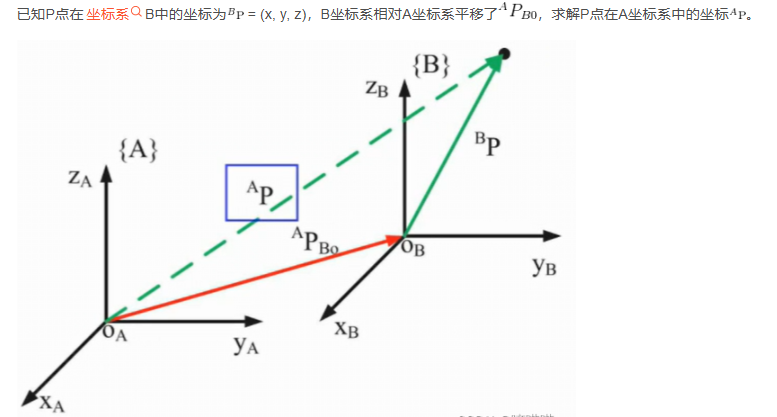
解题思路:根据适量的加法即可求解
=
+
2、空间三维坐标系的旋转(旋转矩阵)
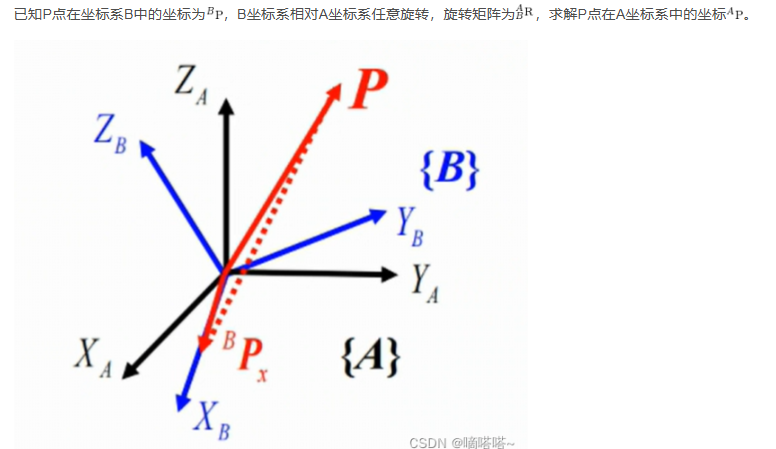
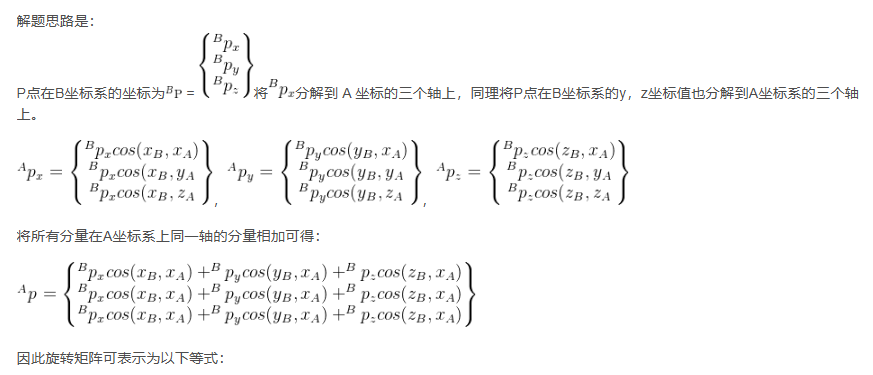
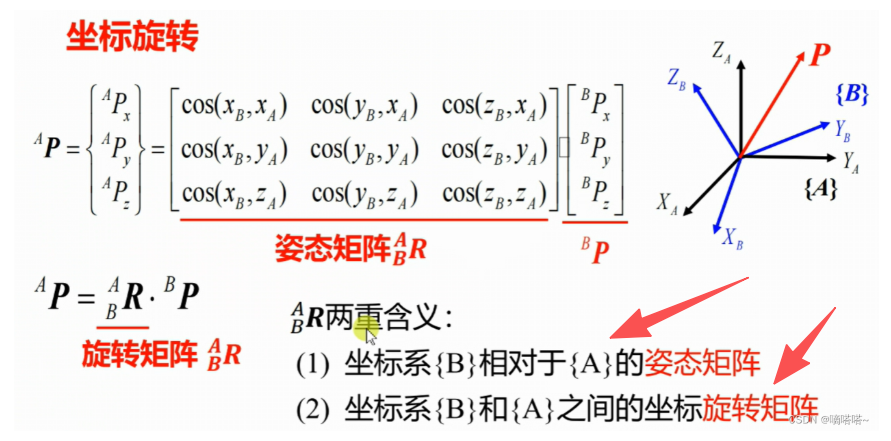
关键是:姿态矩阵(或称之为“旋转矩阵”)
3、坐标系一般变换(平移+旋转)
已知P点在坐标系B中的坐标为,B坐标系相对A坐标系任意旋转+平移,旋转矩阵为
,移动向量为
,求解P点在A坐标系中的坐标
。
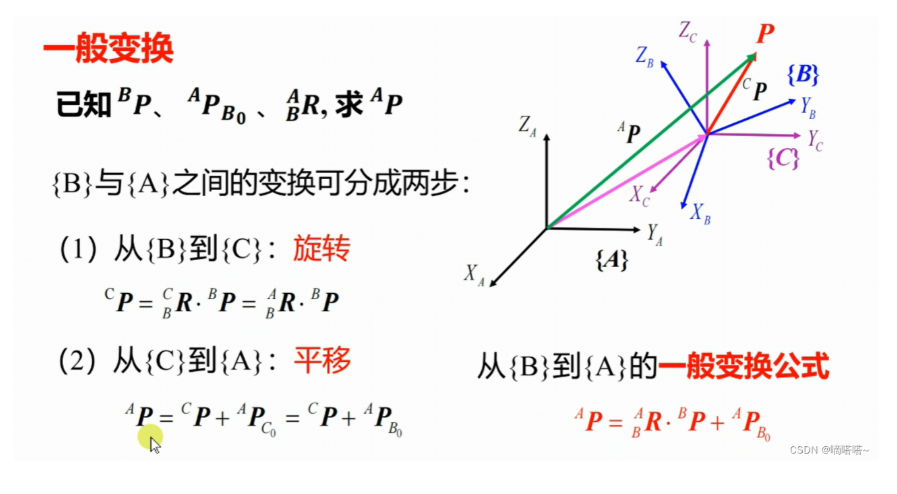
关键需要获得: 旋转矩阵(姿态矩阵)和平移向量
4、空间三维坐标系的旋转加平移,齐次变换
旋转使用矩阵乘法,平移使用矩阵加法计算,为了将旋转和平移统一成矩阵乘法的形式,将变量升维成齐次变换形式。
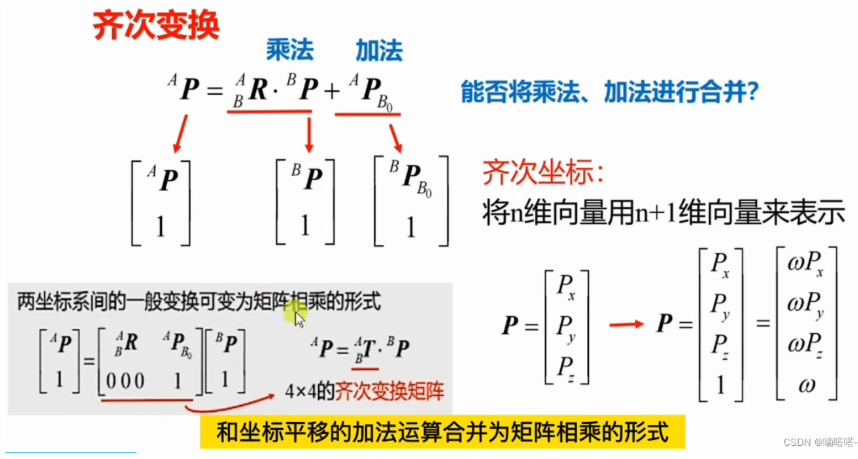
齐次变换矩阵的三个物理含义
4.1、坐标变换
作为两个坐标系之间的坐标变换矩阵。
已知P点在B坐标轴的坐标,B坐标系以 A 坐标系为基础的相对位置和姿态,求解P点在A坐标轴的坐标。
4.2、坐标系的描述
描述坐标系B相对A的位置和姿态;
以A为基坐标轴,B坐标系原点相对A坐标系原点的位置(x,y,z);姿态(Bx在A轴三个方向投影的余弦角度;同理By;Bz等9个角度);
因为在1.1中,单独考虑旋转,定义就是B轴x坐标与A坐标系三个轴的夹角;B坐标系的y,z轴同理。
4.3、运动算子
作为运动算子来表示刚体的运动情况。
5、齐次变换矩阵乘法的物理意义
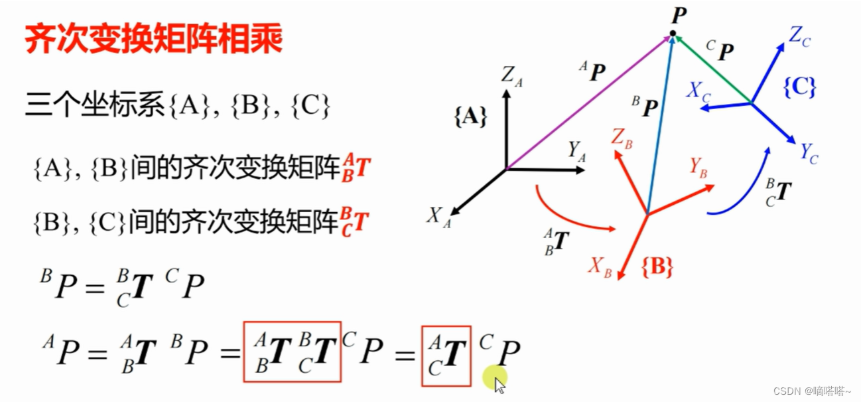
5.1、使用齐次矩阵相乘,可以实现:坐标系描述之间的转换。
已知C坐标系相对B坐标系的齐次矩阵;和B坐标系相对A坐标系的齐次矩阵;求取 C 坐标系相对 A 坐标系的齐次矩阵。
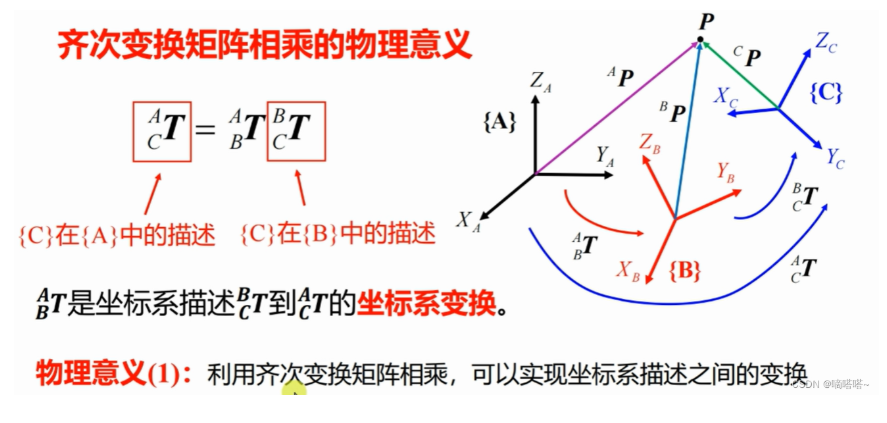
5.2、相对固定坐标系(A看作固定坐标系)先后发生的若干运动的合成(从右向左乘)
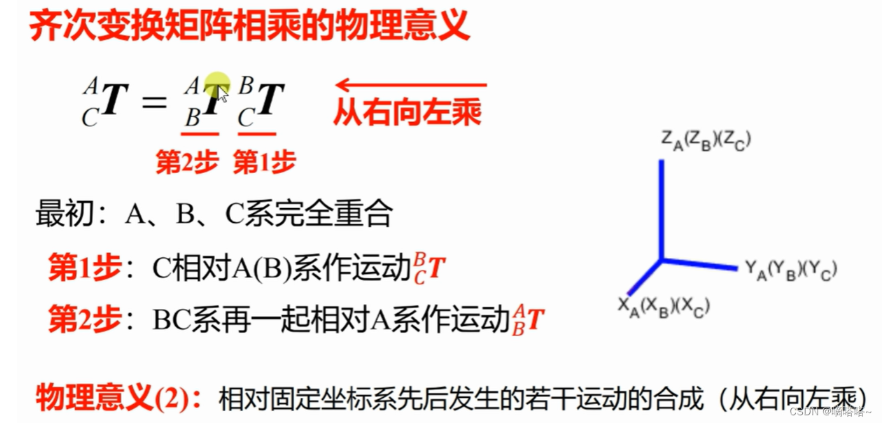
固定坐标系A;初始状态ABC坐标系重合;先将C坐标系相对B运动;再将BC相对A运动(保证BC间相对位置不变)。先运动的齐次矩阵在乘号右边。
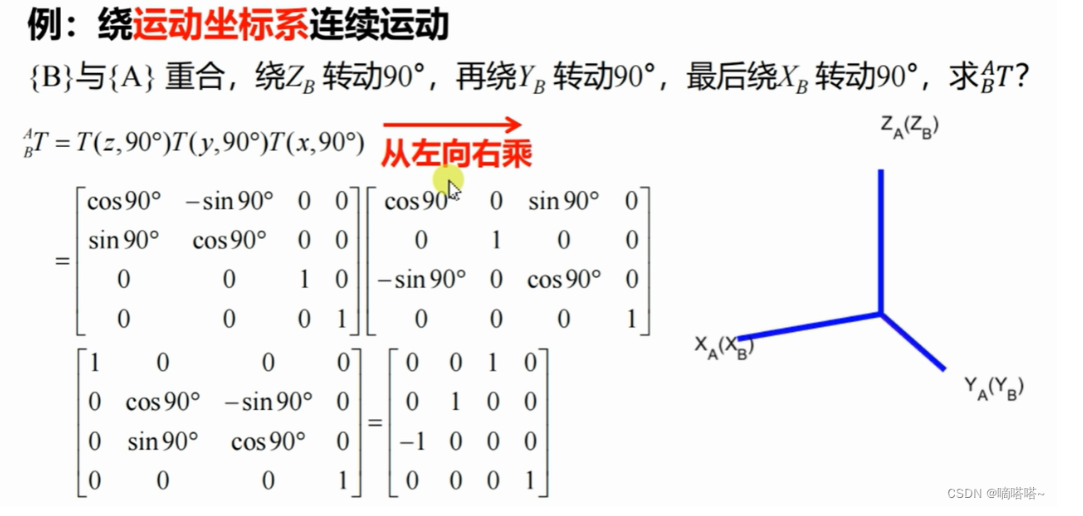
5.3、相对运动坐标系()先后发生的若干运动的合成(从左向右乘)
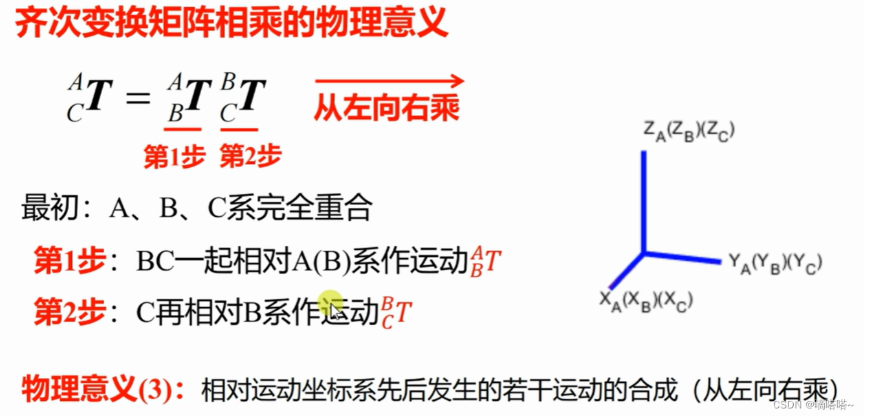
固定坐标系A;初始状态ABC坐标系重合;先将BC坐标系相对A运动;再将C相对B运动(保证BC间相对位置不变)。先运动的齐次矩阵在乘号左边。
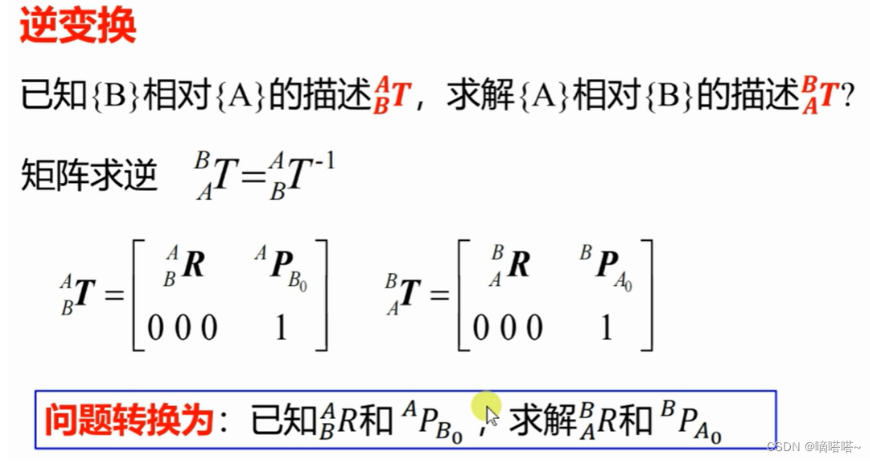
6、齐次矩阵的逆变换
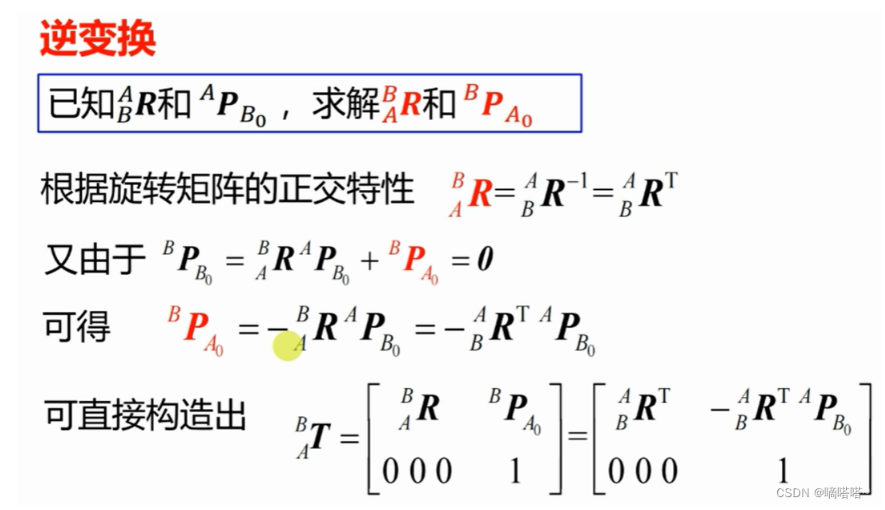
齐次矩阵的逆物理含义为:齐次矩阵代表B坐标系相对A坐标系的位置和姿态;逆代表A坐标系相对B坐标系的位置和姿态。
齐次坐标系M表示:由B中坐标转化为A坐标系坐标的目的。
其次坐标系逆矩阵表示:由A坐标系坐标转化为B坐标系的坐标目的。
7、RPY角和欧拉角
问题:坐标系的一般变换=旋转+平移;需要 9 + 3 个变量来求解。一个三维的旋转需要使用 9 个角度的余弦求解;实际这9个余弦值只有3个是独立的,过于复杂。因此引入RPY和欧拉角的概念。
已知初始状态下,A、B两个坐标系重合,A坐标系固定不动,B坐标系进行旋转,存在两种情况:
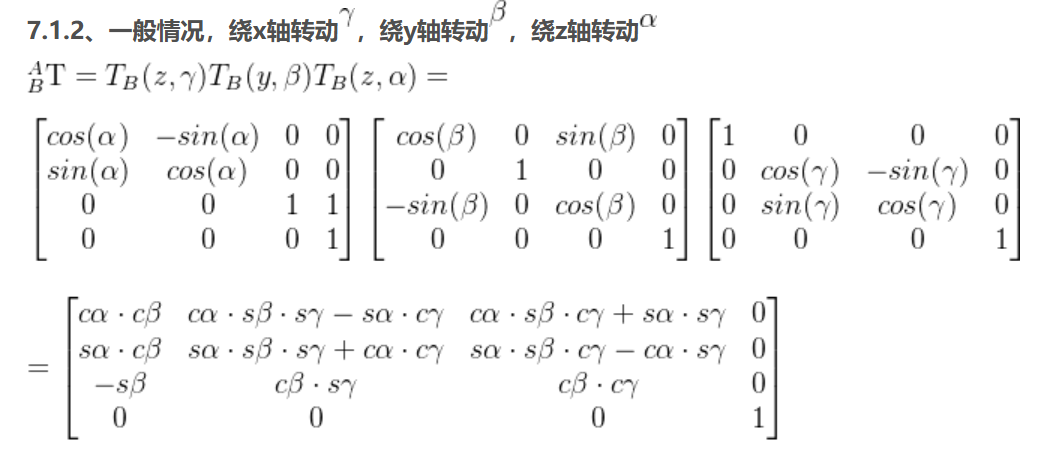
(1)RPY 角(固定轴):B坐标系绕A坐标的x,y,z三个固定轴进行旋转;固定坐标系的连续运动。
(2)欧拉 角(运动轴):B坐标系绕B坐标的z轴旋转得到坐标系,然后绕坐标系的y轴旋转得到坐标系,最后然坐标系的x轴旋转得到最终的坐标系B。
描述坐标系{B}相对于参考坐标系{A}的姿态有两种方式。
第一种是绕固定(参考)坐标轴旋转(固定旋转),称之为“RPY角描述”。
第二种是绕自身坐标轴旋转(相对旋转),称之为“欧拉角描述”。
其中:RPY角度,由于是绕固定坐标系旋转,则旋转矩阵为(cα is shorthand for cosα, sα is shorthand for sinα,and so on.)

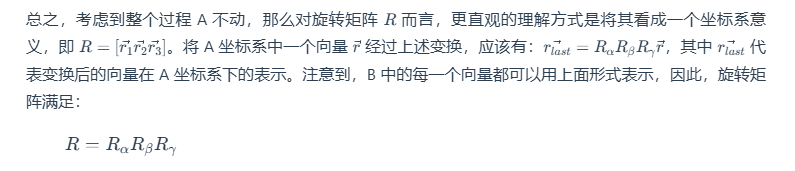
其中: 欧拉角描述,假设开始两个坐标系重合,先将{B}绕自身的Z轴旋转α,然后绕Y轴旋转β,最后绕X轴旋转γ,就能旋转到当前姿态。称其为Z-Y-X欧拉角,由于是绕自身坐标轴进行旋转,则旋转矩阵为

可以发现这两种描述方式得到的旋转矩阵是一样的,即绕固定坐标轴X-Y-Z旋转(γ,β,α)和绕自身坐标轴Z-Y-X旋转(α,β,γ)的最终结果一样,只是描述
的方法有差别而已。
绕定轴 X-Y-Z 旋转(RPY 角) 等价于 绕动轴 Z-Y-X 旋转(Euler 角)


7.1、RPY角(Axis-Angle固定轴的角度,Roll-Pitch-Yaw旋转角)描述
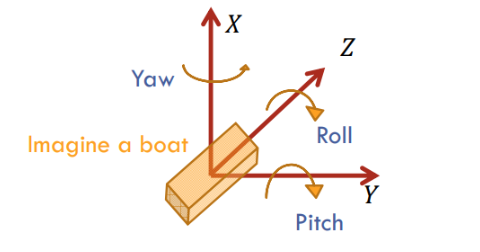
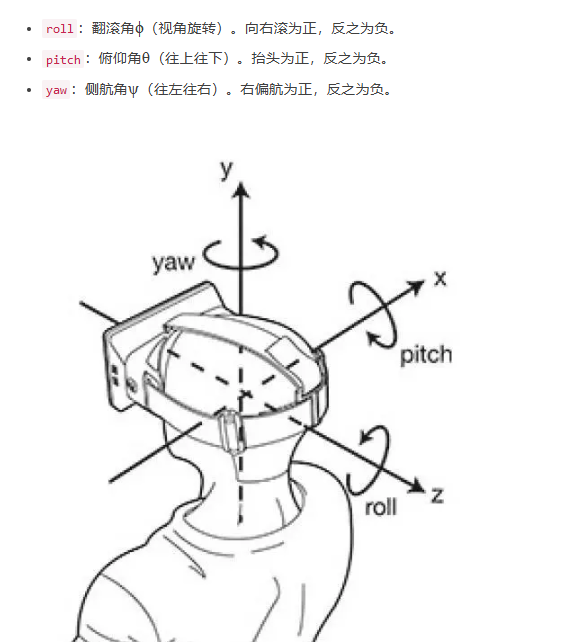
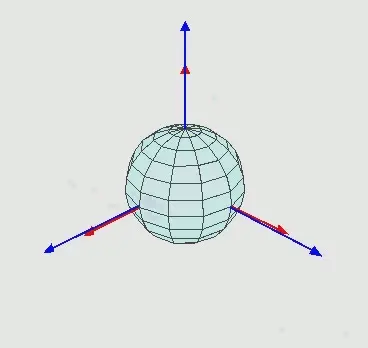
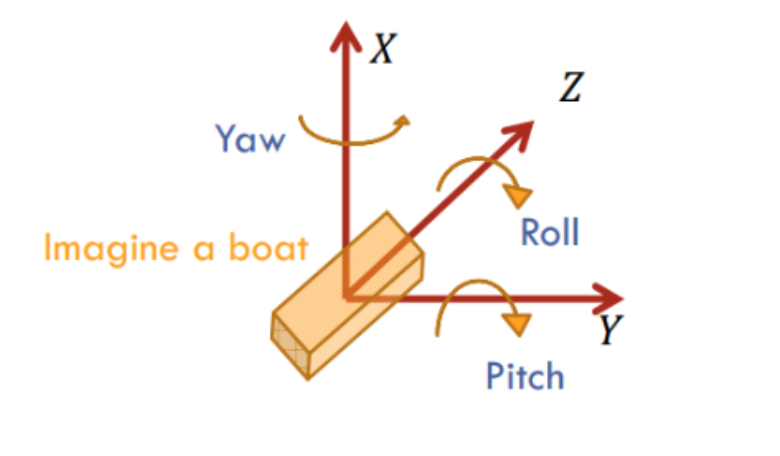
RPY角就是:按照右手坐标系目视Z轴负半轴,Y轴正上方,X轴在右侧,如下图:
其中:Roll(横滚角度-围绕Z轴)-Pitch(俯仰角度-围绕X轴)-Yaw(偏航角度-围绕Y轴)旋转角
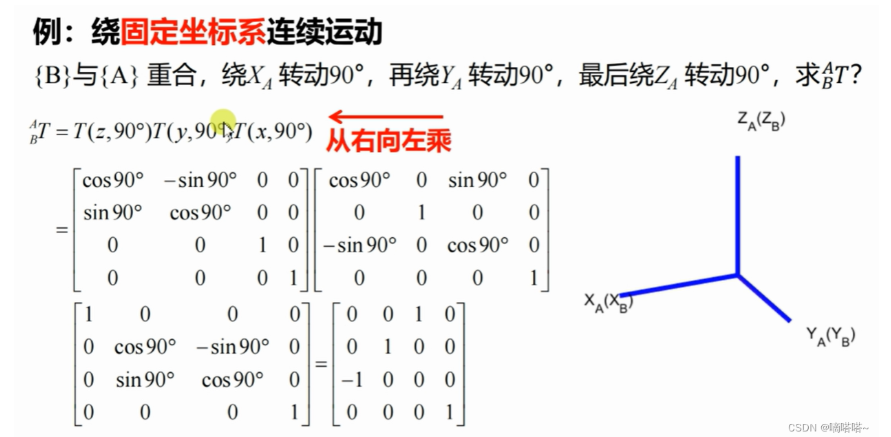
RPY 角(固定轴):B坐标系绕A坐标的x,y,z三个轴进行旋转;固定坐标系的连续运动。计算旋转矩阵需要使用2个知识点:
a、矩阵依旧采用第二章中旋转矩阵的形式,只是角度转动比较特殊。
b、5.2节知识,绕固定轴连续转动,采用从右向左的方向乘。
7.1.1、特殊情况,每次绕轴旋转90度角
根据旋转矩阵求解 三个角度;</p><p><img src="https://img2024.cnblogs.com/blog/700384/202509/700384-20250924125657061-902086347.png" alt="image" loading="lazy" data-mce-src="https://img2024.cnblogs.com/blog/700384/202509/700384-20250924125657061-902086347.png"></p><p>&nbsp;</p><h4 id="7.2%E3%80%81%E6%AC%A7%E6%8B%89%E8%A7%92"><span style="font-size: 18pt;" data-mce-style="font-size: 18pt;">7.2、欧拉角(Euler角,)</p><p> 欧拉角(运动轴):B坐标系绕B坐标的z轴旋转得到坐标系<img src="https://latex.csdn.net/eq?B_%7BZ%7D" alt="B_{Z}" class="mathcode" data-mce-src="https://latex.csdn.net/eq?B_%7BZ%7D">,然后绕坐标系<img src="https://latex.csdn.net/eq?B_%7BZ%7D" alt="B_{Z}" class="mathcode" data-mce-src="https://latex.csdn.net/eq?B_%7BZ%7D">的y轴旋转得到坐标系<img src="https://latex.csdn.net/eq?B_%7BZY%7D" alt="B_{ZY}" class="mathcode" data-mce-src="https://latex.csdn.net/eq?B_%7BZY%7D">,最后然坐标系<img src="https://latex.csdn.net/eq?B_%7BZY%7D" alt="B_{ZY}" class="mathcode" data-mce-src="https://latex.csdn.net/eq?B_%7BZY%7D">的x轴旋转得到最终的坐标系 B。计算旋转矩阵需要使用2个知识点:</p><p>a、矩阵依旧采用第二章中旋转矩阵的形式,只是角度转动比较特殊。</p><p>b、5.2节知识,<strong><span style="color: #ff0000;" data-mce-style="color: #ff0000;">绕运动轴连续转动,采用从左向右的方向乘。
https://pic2.zhimg.com/v2-35da80e428ca5750491ffd2770e187e1_b.webp
7.1.1、特殊情况,每次绕轴旋转90度角
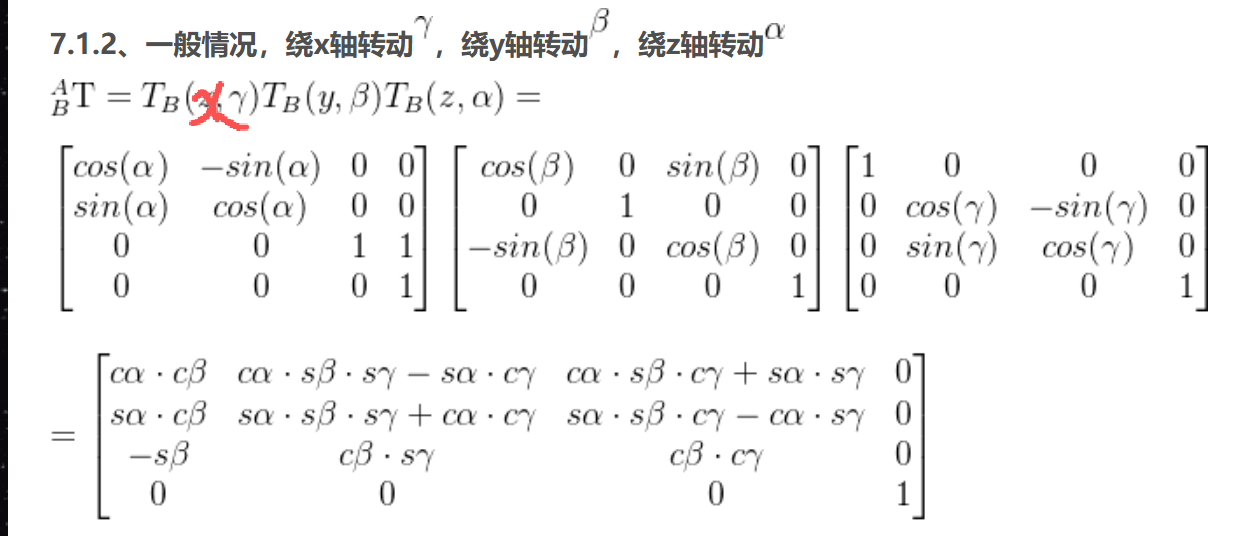
RPY角和欧拉角的旋转矩阵相同;但是角度的定义和运动方式是不同的。
8、旋转变换通式:旋转向量,向量长度为旋转角度。
旋转变量通式需要证明的2个问题:
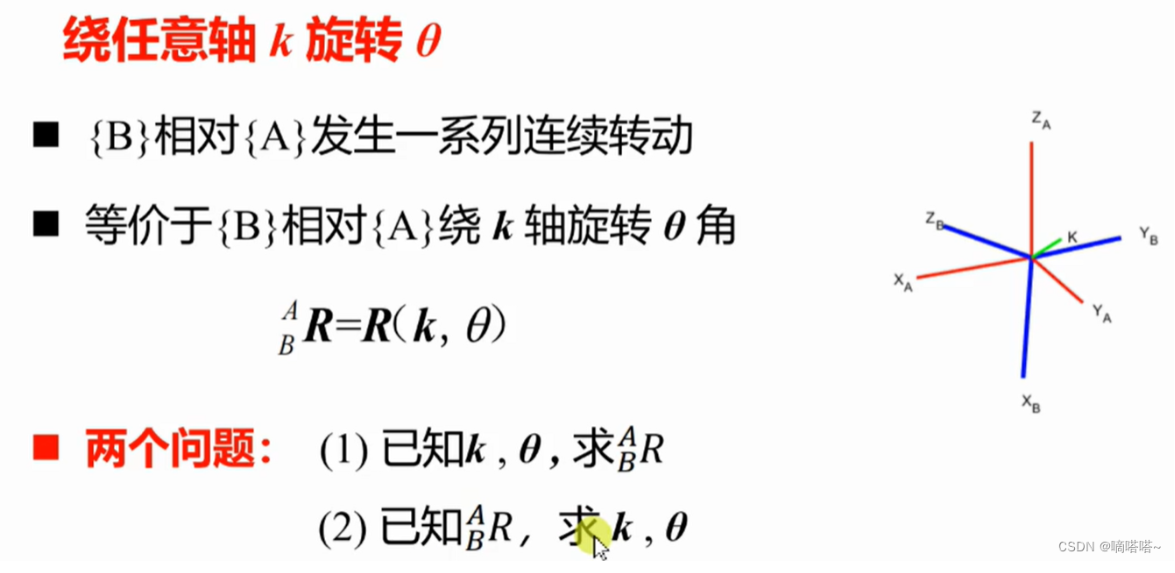
8.1、正解,已知三维的单位向量k和角度![\vartheta]() ,求解旋转矩阵<img src="https://latex.csdn.net/eq?_%7BB%7D%5E%7BA%7D%5Ctextrm%7BR%7D" alt="_{B}^{A}\textrm{R}" class="mathcode" data-mce-src="https://latex.csdn.net/eq?_%7BB%7D%5E%7BA%7D%5Ctextrm%7BR%7D"></h4><p>&nbsp; &nbsp; &nbsp;已知坐标系A,经过三维旋转得到坐标系B;三维旋转可以理解为以<span style="color: #ff0000; background-color: #ffff00;" data-mce-style="color: #ff0000; background-color: #ffff00;">A坐标系为原点的某个<strong><span style="color: #ff0000; background-color: #ffff00;" data-mce-style="color: #ff0000; background-color: #ffff00;">单位向量k,将坐标系A绕向量k旋转
,求解旋转矩阵<img src="https://latex.csdn.net/eq?_%7BB%7D%5E%7BA%7D%5Ctextrm%7BR%7D" alt="_{B}^{A}\textrm{R}" class="mathcode" data-mce-src="https://latex.csdn.net/eq?_%7BB%7D%5E%7BA%7D%5Ctextrm%7BR%7D"></h4><p>&nbsp; &nbsp; &nbsp;已知坐标系A,经过三维旋转得到坐标系B;三维旋转可以理解为以<span style="color: #ff0000; background-color: #ffff00;" data-mce-style="color: #ff0000; background-color: #ffff00;">A坐标系为原点的某个<strong><span style="color: #ff0000; background-color: #ffff00;" data-mce-style="color: #ff0000; background-color: #ffff00;">单位向量k,将坐标系A绕向量k旋转![\vartheta]() <span style="background-color: #ffff00; color: #ff0000;">角</strong>度得到坐标系B。</p><p> <span style="color: #ff0000; font-size: 14pt;" data-mce-style="color: #ff0000; font-size: 14pt;"><strong><span style="background-color: #ffff00;" data-mce-style="background-color: #ffff00;">注意:旋转轴k向量是在坐标系A中。将坐标系A围绕K进行旋转V角度后,才是坐标系B。
<span style="background-color: #ffff00; color: #ff0000;">角</strong>度得到坐标系B。</p><p> <span style="color: #ff0000; font-size: 14pt;" data-mce-style="color: #ff0000; font-size: 14pt;"><strong><span style="background-color: #ffff00;" data-mce-style="background-color: #ffff00;">注意:旋转轴k向量是在坐标系A中。将坐标系A围绕K进行旋转V角度后,才是坐标系B。
8.1.1、获取三个分量
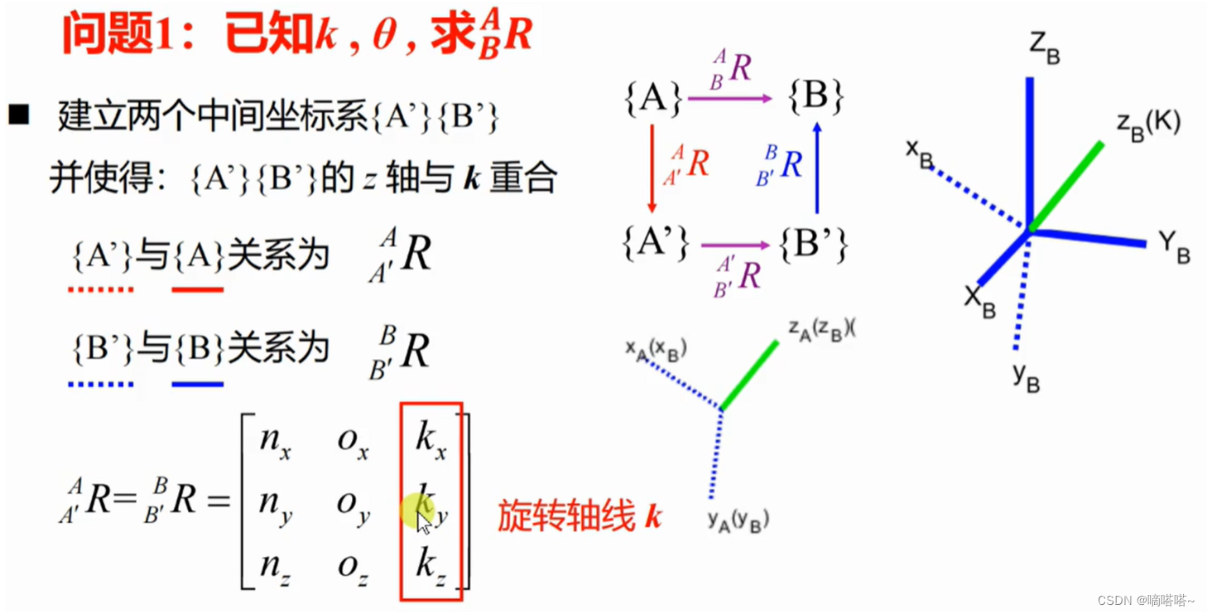
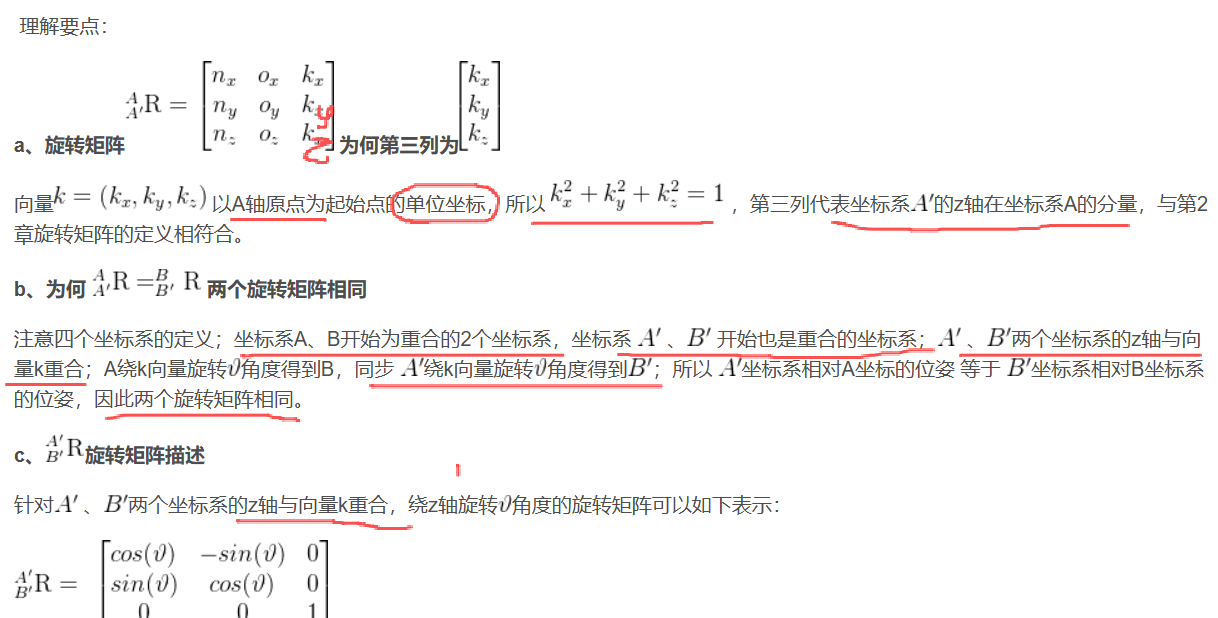
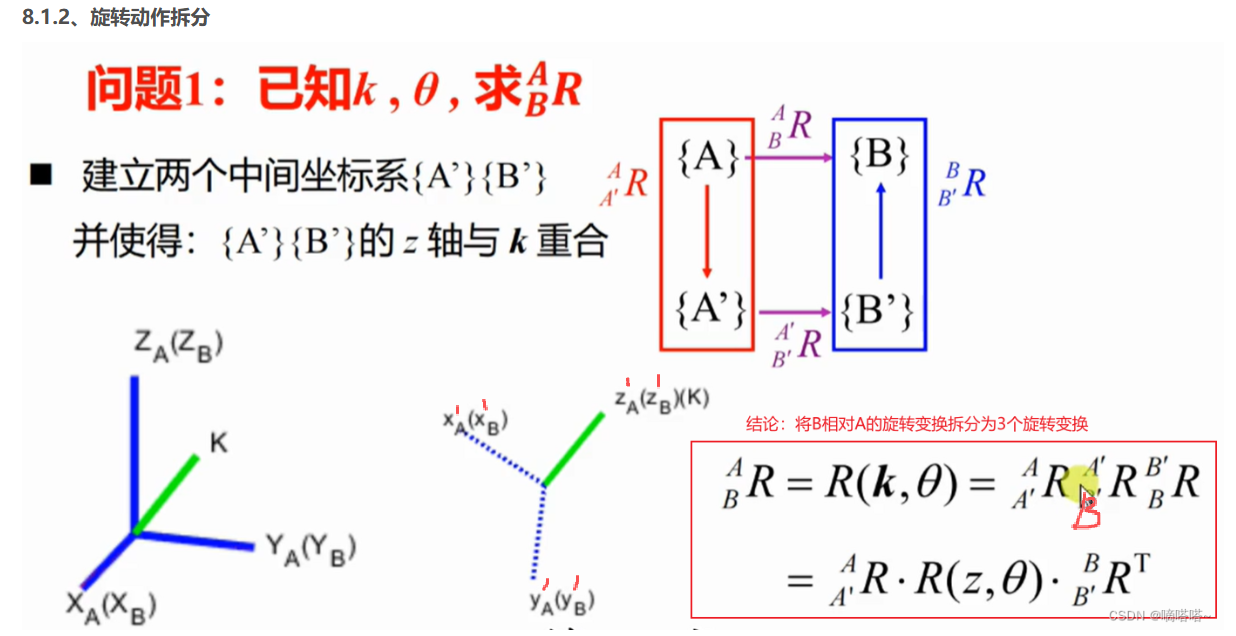
理解要点:
将 拆分为三个旋转矩阵相乘的形式,将1次旋转变换拆分成<strong><span style="background-color: #ffff00;" data-mce-style="background-color: #ffff00;">3次旋转变换。</p><p><img src="https://img2024.cnblogs.com/blog/700384/202509/700384-20250924132217019-38745746.png" alt="image" loading="lazy" data-mce-src="https://img2024.cnblogs.com/blog/700384/202509/700384-20250924132217019-38745746.png"></p><p> </p><p>以上,就是将(k,thet)转化为一般变换矩阵的过程。</p><p> </p><p><img src="https://img2024.cnblogs.com/blog/700384/202509/700384-20250924132303029-477709636.png" alt="image" loading="lazy" data-mce-src="https://img2024.cnblogs.com/blog/700384/202509/700384-20250924132303029-477709636.png"></p><p> </p><p><img src="https://img2024.cnblogs.com/blog/700384/202509/700384-20250924132416416-79270638.png" alt="image" loading="lazy" data-mce-src="https://img2024.cnblogs.com/blog/700384/202509/700384-20250924132416416-79270638.png"></p><p> </p><p><strong><span style="font-size: 18px;" data-mce-style="font-size: 18px;">9.四元数:
四元数(Quaternion)既是紧凑的,又没有奇异性,缺点是不够直观,运算比较复杂。
参考:https://zhuanlan.zhihu.com/p/93563218
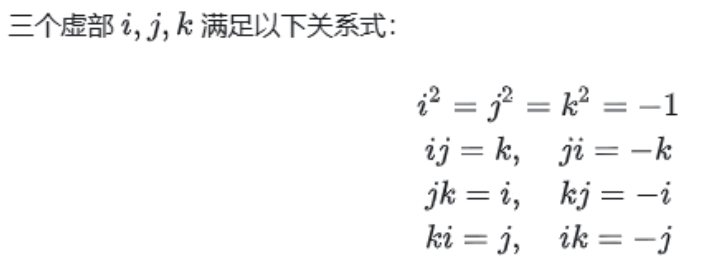
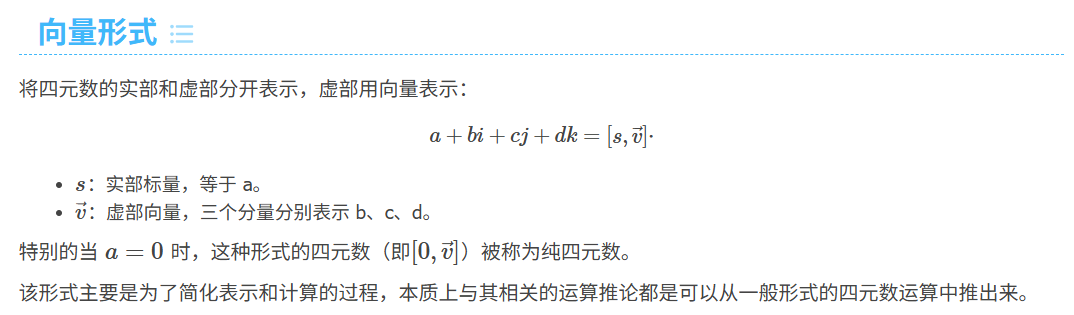
四元数本质是一种具有三个虚数的高阶复数,四元数集英文表示为 ,对于任意四元数&amp;amp;nbsp;&amp;lt;span class="math inline"&amp;gt;,可表示为如下形式:

将四元数的实部和虚部分开表示,虚部用向量表示:

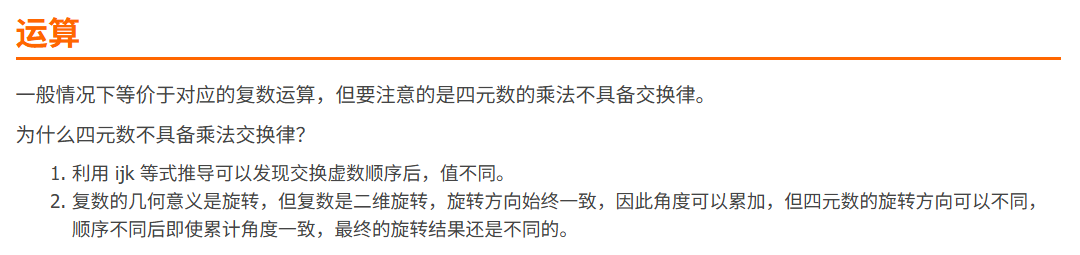
四元数的运算:
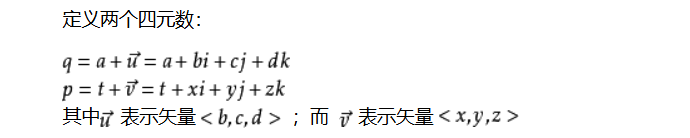


10 四元数和RPY角度互换
绕坐标轴的多次旋转(这里是RPY角旋转类型)可以等效为绕某一转轴旋转一定的角度。假设等效旋转轴方向向量为→K=[kx,ky,kz]T,等效旋转角为θ,则四元数q=(x,y,z,w),其中:
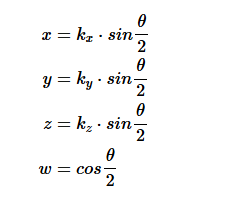

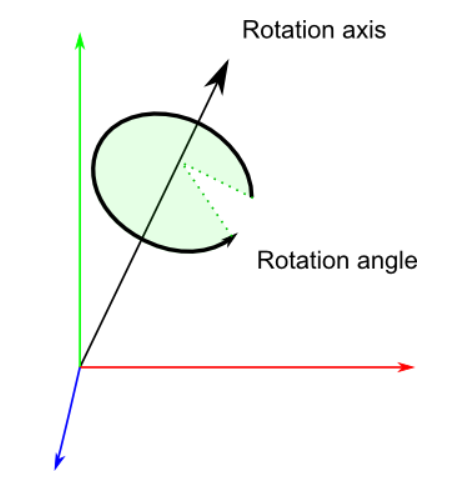
四元数存储了旋转轴(Axis-Angle)和旋转角的信息,它能方便的描述刚体绕任意轴的旋转。
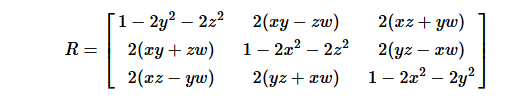
(1)四元数转换为旋转矩阵:
已知四元数为:q=(x,y,z,w)
则旋转矩阵R:
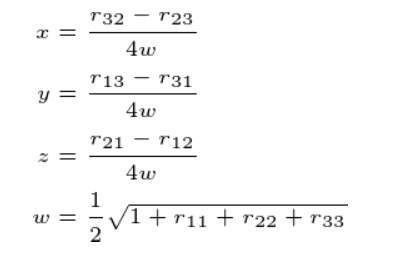
(2)旋转矩阵R转化为四元数
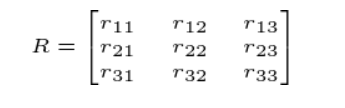
对应的四元数为:
11. 四元数与Eular 欧拉角旋转
将四元数转换为欧拉角可以参考下面的代码。需要注意欧拉角有12种旋转次序,而上面推导的公式是按照Z-Y-X顺序进行的,所以有时会在网上看到不同的转换公式(因为对应着不同的旋转次序),在使用时一定要注意旋转次序是什么。
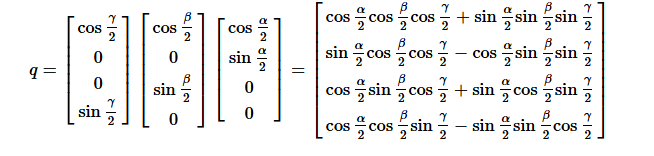
此处按照次序:将Z-Y-X欧拉角((或RPY角:绕固定坐标系的X-Y-Z依次旋转α,β,γ角))转化为四元数:
根据上面的公式可以求出逆解,即由四元数q=(q0,q1,q2,q3)或q=(w,x,y,z)到欧拉角的转换为:
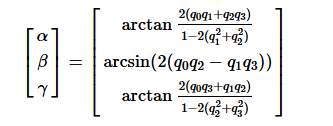
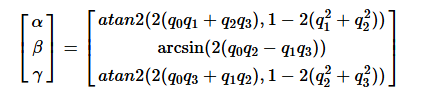
由于arctan和arcsin的取值范围在−π2和π2之间,只有180°,而绕某个轴旋转时范围是360°,因此要使用atan2函数代替arctan函数
// COMPILE: g++ -o quat2EulerTest quat2EulerTest.cpp
#include <iostream>
#include <cmath>

using namespace std;

///////////////////////////////
// Quaternion struct
// Simple incomplete quaternion struct for demo purpose
///////////////////////////////
struct Quaternion{
  Quaternion():x(0), y(0), z(0), w(1){};
  Quaternion(double x, double y, double z, double w):x(x), y(y), z(z), w(w){};

  void normalize(){
    double norm = std::sqrt(x*x + y*y + z*z + w*w);
    x /= norm;
    y /= norm;
    z /= norm;
    w /= norm;
  }

  double norm(){
    return std::sqrt(x*x + y*y + z*z + w*w);
  }

  double x;
  double y;
  double z;
  double w;

};

///////////////////////////////
// Quaternion to Euler
///////////////////////////////
enum RotSeq{zyx, zyz, zxy, zxz, yxz, yxy, yzx, yzy, xyz, xyx, xzy,xzx};

void twoaxisrot(double r11, double r12, double r21, double r31, double r32, double res[]){
  res[0] = atan2( r11, r12 );
  res[1] = acos ( r21 );
  res[2] = atan2( r31, r32 );
}

void threeaxisrot(double r11, double r12, double r21, double r31, double r32, double res[]){
  res[0] = atan2( r31, r32 );
  res[1] = asin ( r21 );
  res[2] = atan2( r11, r12 );
}

void quaternion2Euler(const Quaternion& q, double res[], RotSeq rotSeq)
{
    switch(rotSeq){
    case zyx:
      threeaxisrot( 2*(q.x*q.y + q.w*q.z),
                     q.w*q.w + q.x*q.x - q.y*q.y - q.z*q.z,
                    -2*(q.x*q.z - q.w*q.y),
                     2*(q.y*q.z + q.w*q.x),
                     q.w*q.w - q.x*q.x - q.y*q.y + q.z*q.z,
                     res);
      break;

    case zyz:
      twoaxisrot( 2*(q.y*q.z - q.w*q.x),
                   2*(q.x*q.z + q.w*q.y),
                   q.w*q.w - q.x*q.x - q.y*q.y + q.z*q.z,
                   2*(q.y*q.z + q.w*q.x),
                  -2*(q.x*q.z - q.w*q.y),
                  res);
      break;

    case zxy:
      threeaxisrot( -2*(q.x*q.y - q.w*q.z),
                      q.w*q.w - q.x*q.x + q.y*q.y - q.z*q.z,
                      2*(q.y*q.z + q.w*q.x),
                     -2*(q.x*q.z - q.w*q.y),
                      q.w*q.w - q.x*q.x - q.y*q.y + q.z*q.z,
                      res);
      break;

    case zxz:
      twoaxisrot( 2*(q.x*q.z + q.w*q.y),
                  -2*(q.y*q.z - q.w*q.x),
                   q.w*q.w - q.x*q.x - q.y*q.y + q.z*q.z,
                   2*(q.x*q.z - q.w*q.y),
                   2*(q.y*q.z + q.w*q.x),
                   res);
      break;

    case yxz:
      threeaxisrot( 2*(q.x*q.z + q.w*q.y),
                     q.w*q.w - q.x*q.x - q.y*q.y + q.z*q.z,
                    -2*(q.y*q.z - q.w*q.x),
                     2*(q.x*q.y + q.w*q.z),
                     q.w*q.w - q.x*q.x + q.y*q.y - q.z*q.z,
                     res);
      break;

    case yxy:
      twoaxisrot( 2*(q.x*q.y - q.w*q.z),
                   2*(q.y*q.z + q.w*q.x),
                   q.w*q.w - q.x*q.x + q.y*q.y - q.z*q.z,
                   2*(q.x*q.y + q.w*q.z),
                  -2*(q.y*q.z - q.w*q.x),
                  res);
      break;

    case yzx:
      threeaxisrot( -2*(q.x*q.z - q.w*q.y),
                      q.w*q.w + q.x*q.x - q.y*q.y - q.z*q.z,
                      2*(q.x*q.y + q.w*q.z),
                     -2*(q.y*q.z - q.w*q.x),
                      q.w*q.w - q.x*q.x + q.y*q.y - q.z*q.z,
                      res);
      break;

    case yzy:
      twoaxisrot( 2*(q.y*q.z + q.w*q.x),
                  -2*(q.x*q.y - q.w*q.z),
                   q.w*q.w - q.x*q.x + q.y*q.y - q.z*q.z,
                   2*(q.y*q.z - q.w*q.x),
                   2*(q.x*q.y + q.w*q.z),
                   res);
      break;

    case xyz:
      threeaxisrot( -2*(q.y*q.z - q.w*q.x),
                    q.w*q.w - q.x*q.x - q.y*q.y + q.z*q.z,
                    2*(q.x*q.z + q.w*q.y),
                   -2*(q.x*q.y - q.w*q.z),
                    q.w*q.w + q.x*q.x - q.y*q.y - q.z*q.z,
                    res);
      break;

    case xyx:
      twoaxisrot( 2*(q.x*q.y + q.w*q.z),
                  -2*(q.x*q.z - q.w*q.y),
                   q.w*q.w + q.x*q.x - q.y*q.y - q.z*q.z,
                   2*(q.x*q.y - q.w*q.z),
                   2*(q.x*q.z + q.w*q.y),
                   res);
      break;

    case xzy:
      threeaxisrot( 2*(q.y*q.z + q.w*q.x),
                     q.w*q.w - q.x*q.x + q.y*q.y - q.z*q.z,
                    -2*(q.x*q.y - q.w*q.z),
                     2*(q.x*q.z + q.w*q.y),
                     q.w*q.w + q.x*q.x - q.y*q.y - q.z*q.z,
                     res);
      break;

    case xzx:
      twoaxisrot( 2*(q.x*q.z - q.w*q.y),
                   2*(q.x*q.y + q.w*q.z),
                   q.w*q.w + q.x*q.x - q.y*q.y - q.z*q.z,
                   2*(q.x*q.z + q.w*q.y),
                  -2*(q.x*q.y - q.w*q.z),
                  res);
      break;
    default:
      std::cout << "Unknown rotation sequence" << std::endl;
      break;
   }
}

///////////////////////////////
// Helper functions
///////////////////////////////
Quaternion operator*(Quaternion& q1, Quaternion& q2){
  Quaternion q;
  q.w = q1.w*q2.w - q1.x*q2.x - q1.y*q2.y - q1.z*q2.z;
  q.x = q1.w*q2.x + q1.x*q2.w + q1.y*q2.z - q1.z*q2.y;
  q.y = q1.w*q2.y - q1.x*q2.z + q1.y*q2.w + q1.z*q2.x;
  q.z = q1.w*q2.z + q1.x*q2.y - q1.y*q2.x + q1.z*q2.w;
  return q;
}

ostream& operator <<(std::ostream& stream, const Quaternion& q) {
  cout << q.w << " "<< showpos << q.x << "i " << q.y << "j " << q.z << "k";
  cout << noshowpos;
}

double rad2deg(double rad){
  return rad*180.0/M_PI;
}

///////////////////////////////
// Main
///////////////////////////////
int main(){

  Quaternion q; // x,y,z,w
  Quaternion qx45(sin(M_PI/8), 0,0, cos(M_PI/8) );
  Quaternion qy45(0, sin(M_PI/8), 0, cos(M_PI/8));
  Quaternion qz45(0, 0, sin(M_PI/8), cos(M_PI/8));
  Quaternion qx90(sin(M_PI/4), 0,0, cos(M_PI/4) );
  Quaternion qy90(0, sin(M_PI/4), 0, cos(M_PI/4));
  Quaternion qz90(0, 0, sin(M_PI/4), cos(M_PI/4));

  double res[3];

  q = qz45*qx45;
  q.normalize();
  quaternion2Euler(q, res, zyx);
  cout << "Rotation sequence: X->Y->Z" << endl;
  cout << "x45 -> z45" << endl;
  cout << "q: " << q << endl;
  cout << "x: " << rad2deg(res[0]) << " y: " << rad2deg(res[1]) << " z: " << rad2deg(res[2]) << endl << endl;

  q = qz90*qx90;
  q.normalize();
  quaternion2Euler(q, res, zyx);
  cout << "Rotation sequence: X->Y->Z" << endl;
  cout << "x90 -> z90" << endl;
  cout << "q: " << q << endl;
  cout << "x: " << rad2deg(res[0]) << " y: " << rad2deg(res[1]) << " z: " << rad2deg(res[2]) << endl << endl;

  q = qx90*qz90;
  q.normalize();
  quaternion2Euler(q, res, xyz);
  cout << "Rotation sequence: Z->Y->X" << endl;
  cout << "z90 -> x90" << endl;
  cout << "q: " << q << endl;
  cout << "x: " << rad2deg(res[0]) << " y: " << rad2deg(res[1]) << " z: " << rad2deg(res[2]) << endl;
}
12 奇异性情况
参考:https://www.cnblogs.com/21207-iHome/p/6894128.html
下面看一种特殊的情况(参考Maths - Conversion Quaternion to Euler):假设一架飞机绕Y轴旋转了90°(俯仰角pitch=90),机头垂直向上,此时如何计算航向角和横滚角?
注意:RPY角旋转永远是固定的旋转轴。
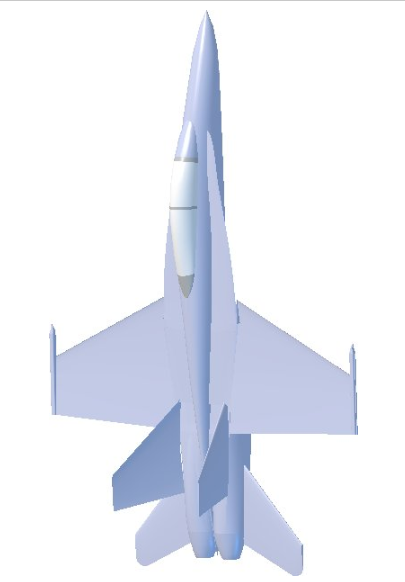
飞机围绕Pitch轴旋转90或-90度,如下图情况,此时状态的Row轴已经和Row轴重合,变为一个自由度。此时再使用上面的公式根据四元数计算欧拉角会出现问题:
arcsin(2(q0q2−q1q3))的定义域为[−1,1],因此(q0q2−q1q3)∈[−0.5,0.5],当q0q2−q1q3=0.5时(在程序中浮点数不能直接进行等于判断,要使用合理的阈值),俯仰角β为90°,将其带入正向公式计算出四元数(q0,q1,q2,q3),然后可以发现逆向公式中atan2函数中的参数全部为0,即出现了0/0的情况!无法计算。当俯仰角为-90°,即机头竖直向下时的情况也与之类似,可以推导出奇异姿态时的计算公式。比较完整的四元数转欧拉角(Z-Y-X order)的代码如下:
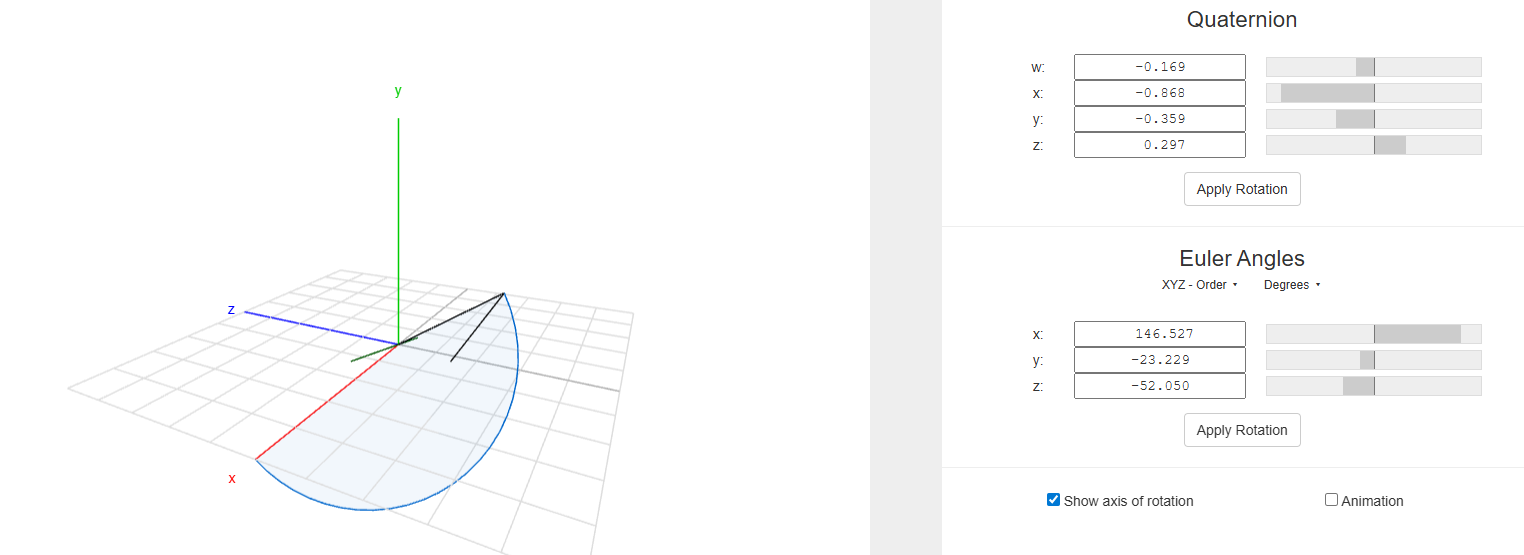
四元数在线演示:https://quaternions.online/
CameraSpacePoint QuaternionToEuler(Vector4 q) // Z-Y-X Euler angles
{
    CameraSpacePoint euler = { 0 };
    const double Epsilon = 0.0009765625f;
    const double Threshold = 0.5f - Epsilon;

    double TEST = q.w*q.y - q.x*q.z;

    if (TEST < -Threshold || TEST > Threshold) // 奇异姿态,俯仰角为±90°
    {
        int sign = Sign(TEST);

        euler.Z = -2 * sign * (double)atan2(q.x, q.w); // yaw

        euler.Y = sign * (PI / 2.0); // pitch

        euler.X = 0; // roll

    }
    else
    {
        euler.X = atan2(2 * (q.y*q.z + q.w*q.x), q.w*q.w - q.x*q.x - q.y*q.y + q.z*q.z);
        euler.Y = asin(-2 * (q.x*q.z - q.w*q.y));
        euler.Z = atan2(2 * (q.x*q.y + q.w*q.z), q.w*q.w + q.x*q.x - q.y*q.y - q.z*q.z);
    }

    return euler;
}
在DirectXMath Library中有许多与刚体姿态变换相关的函数可以直接调用:
- 四元数乘法:XMQuaternionMultiply method --Computes the product of two quaternions.
- 旋转矩阵转四元数:XMQuaternionRotationMatrix method --Computes a rotation quaternion from a rotation matrix.
- 四元数转旋转矩阵:XMMatrixRotationQuaternion method -- Builds a rotation matrix from a quaternion.
- 欧拉角转四元数:XMQuaternionRotationRollPitchYaw method --Computes a rotation quaternion based on the pitch, yaw, and roll (Euler angles).
- 四元数转Axis-Angle:XMQuaternionToAxisAngle method --Computes an axis and angle of rotation about that axis for a given quaternion.
- 欧拉角转旋转矩阵:XMMatrixRotationRollPitchYaw method --Builds a rotation matrix based on a given pitch, yaw, and roll (Euler angles).
- Axis-Angle转旋转矩阵:XMMatrixRotationAxis method --Builds a matrix that rotates around an arbitrary axis.
- 构造绕X/Y/Z轴的旋转矩阵:XMMatrixRotationX method --Builds a matrix that rotates around the x-axis.(Angles are measured clockwise when looking along the rotation axis toward the origin)
下面的代码中坐标系绕X轴旋转90°(注意这里不是按照右手定则的方向,而是沿着坐标轴向原点看过去以顺时针方式旋转,因此与传统的右手定则刚好方向相反),来进行变换:
#include "stdafx.h"
#include<iostream>

#include <DirectXMath.h>
using namespace DirectX;

#define PI 3.1415926

int _tmain(int argc, _TCHAR* argv[])
{
    //四元数相乘-------------------Computes the product of two quaternions
    XMVECTOR q1 = XMVectorSet(1, 1, 3, 2);
    XMVECTOR q2 = XMVectorSet(1, 1, 0, 2);
    XMVECTOR q3 = XMVectorSet(1, 1, 1, 1);

    XMVECTOR result = XMQuaternionMultiply(XMQuaternionMultiply(q3, q2), q1);   // Returns the product of two quaternions as q1*q2*q3

    std::cout << "Quaternion Multiply:" << std::endl;
    std::cout << XMVectorGetX(result) << "," << XMVectorGetY(result) << "," << XMVectorGetZ(result) << "," << XMVectorGetW(result) << std::endl << std::endl;


    //欧拉角转化四元数------------------Computes a rotation quaternion based on the pitch, yaw, and roll (Euler angles).
    float pitch = 90.0 * PI / 180.0; // X轴俯仰角度 Angle of rotation around the x-axis, in radians.
    float yaw = 0;                     // y轴偏航角度 Angle of rotation around the y-axis, in radians.
    float roll = 0;                     // z轴横滚角度 Angle of rotation around the z - axis, in radians.

    result = XMQuaternionRotationRollPitchYaw(pitch, yaw, roll);

    std::cout << "RPY/Euler angles to Quaternion:" << std::endl;
    std::cout << XMVectorGetX(result) << "," << XMVectorGetY(result) << "," << XMVectorGetZ(result) << "," << XMVectorGetW(result) << std::endl << std::endl;


    //从旋转矩阵计算四元数-----------------Computes a rotation quaternion from a rotation matrix.
    float matrix[16] = { 1, 0, 0, 0,   0, 0, 1, 0,   0, -1, 0, 0,   0, 0, 0, 1 };
    XMMATRIX trans(matrix); // Initializes a new instance of the XMMATRIX structure from a sixteen element float array.

    result = XMQuaternionRotationMatrix(trans); // This function only uses the upper 3x3 portion of the XMMATRIX.

    std::cout << "Matrix to Quaternion:" << std::endl;
    std::cout << XMVectorGetX(result) << "," << XMVectorGetY(result) << "," << XMVectorGetZ(result) << "," << XMVectorGetW(result) << std::endl << std::endl;


    //四元数转化旋转矩阵-----------------Builds a rotation matrix from a quaternion.
    trans = XMMatrixRotationQuaternion(result);

    XMFLOAT3X3 fView;
    XMStoreFloat3x3(&fView, trans); // Stores an XMMATRIX in an XMFLOAT3X3
    std::cout << "Quaternion to Matrix:" << std::endl;
    std::cout << fView._11 << "," << fView._12 << "," << fView._13 << std::endl
        << fView._21 << "," << fView._22 << "," << fView._23 << std::endl
        << fView._31 << "," << fView._32 << "," << fView._33 << std::endl << std::endl;


    //从四元数计算旋转轴和旋转角度-----------------Computes an axis and angle of rotation about that axis for a given quaternion.
    float Angle = 0;
    XMVECTOR Axis;

    XMQuaternionToAxisAngle(&Axis, &Angle, result);

    Axis = XMVector3Normalize(Axis); // Returns the normalized version of a 3D vector
    std::cout << "Quaternion to Axis-Angle:" << std::endl;
    std::cout << "Axis: " << XMVectorGetX(Axis) << "," << XMVectorGetY(Axis) << "," << XMVectorGetZ(Axis) << std::endl;
    std::cout << "Angle: " << Angle*180.0 / PI << std::endl << std::endl;


    //根据任意旋转轴和角度构建旋转矩阵-----------------Builds a matrix that rotates around an arbitrary axis.
    Angle = 90.0 * PI / 180.0;

    trans = XMMatrixRotationAxis(Axis, Angle);

    XMStoreFloat3x3(&fView, trans); // Stores an XMMATRIX in an XMFLOAT3X3
    std::cout << "Axis-Angle to Matrix:" << std::endl;
    std::cout << fView._11 << "," << fView._12 << "," << fView._13 << std::endl
              << fView._21 << "," << fView._22 << "," << fView._23 << std::endl
              << fView._31 << "," << fView._32 << "," << fView._33 << std::endl << std::endl;


    //从给定欧拉角构建旋转矩阵-----------------Builds a rotation matrix based on a given pitch, yaw, and roll(Euler angles).
    trans = XMMatrixRotationRollPitchYaw(pitch, yaw, roll);

    XMStoreFloat3x3(&fView, trans); // Stores an XMMATRIX in an XMFLOAT3X3
    std::cout << "RPY/Euler angles to Matrix:" << std::endl;
    std::cout << fView._11 << "," << fView._12 << "," << fView._13 << std::endl
        << fView._21 << "," << fView._22 << "," << fView._23 << std::endl
        << fView._31 << "," << fView._32 << "," << fView._33 << std::endl << std::endl;


    //围绕X轴旋转一定角度,计算旋转矩阵-----------------Builds a matrix that rotates around the x - axis.
    trans = XMMatrixRotationX(Angle); // Angles are measured clockwise when looking along the rotation axis toward the origin.

    XMStoreFloat3x3(&fView, trans); // Stores an XMMATRIX in an XMFLOAT3X3
    std::cout << "Builds a matrix that rotates around the x-axis.:" << std::endl;
    std::cout << fView._11 << "," << fView._12 << "," << fView._13 << std::endl
        << fView._21 << "," << fView._22 << "," << fView._23 << std::endl
        << fView._31 << "," << fView._32 << "," << fView._33 << std::endl << std::endl;

    return 0;
}

https://www.cnblogs.com/21207-iHome/p/6894128.html
参考:
2. CSDN博客: https://blog.csdn.net/paul1994/article/details/134111671
3.四元数和RPY角度互换: https://www.cnblogs.com/21207-iHome/p/6894128.html

 浙公网安备 33010602011771号