

https://zh.d2l.ai/chapter_recurrent-neural-networks/sequence.html

#%matplotlib inline
import torch
from torch import nn
from d2l import torch as d2l
from API_Draw import *

T = 1000  # 总共产生1000个点
#time [0,1...,999]
time = torch.arange(1, T + 1, dtype=torch.float32)
# x = sin(timei*0.01)+高斯噪声
x = torch.sin(0.01 * time) + torch.normal(0, 0.2, (T,))
#画图
#d2l.plot(time, [x], 'time', 'x', xlim=[1, 1000], figsize=(6, 3))
#d2l.plt.show()
# 画图
#draw_pic=Animator()
#draw_pic.ShowALL_Onec(time,x) # 带噪声的


tau = 4
#T = 1000  # 总共产生1000个点
# 996 - 4  == 0
features = torch.zeros((T - tau, tau))
#features = torch.zeros((2, 3)) # 2行 3列
#print(features)
'''
tensor([[0., 0., 0.],
        [0., 0., 0.]])
'''
for i in range(tau):
    #print("features:",i,",   x:",i,T - tau + i)
    features[:, i] = x[i: T - tau + i]
    '''
    features: 0列 ,   x: 0 996
    features: 1列 ,   x: 1 997
    features: 2列 ,   x: 2 998
    features: 3列 ,   x: 3 999

    结果
    features 有1000(总数)-4(步长)个样本   每个样本有4个连续序列

                    features 0-3行
                     0    1    2    3(列)
    features 0行     x0   x1   x2   x3
    features 1行     x1   x2   x3   x4
    。。。
    features 996行   x996 x997 x998 x999

    '''

#   labels torch.Size([996, 1]) -->  x[4-1000]  拉伸一维度
labels = x[tau:].reshape((-1, 1))
print(labels.shape)
#torch.Size([996, 1])


batch_size, n_train = 16, 600
# 仅使用前600个“特征-标签”对进行训练
'''
features[:n_train]  取出前600 作为
features: 0 ,   x: 0 -600 (996)
features: 1 ,   x: 1 -601 (997)
features: 2 ,   x: 2 -602 (998)
features: 3 ,   x: 3 -603 (999)
'''
#n_train=20
print(features[:n_train]) # 取出前 600行(共996行)*4列 作为训练数据

train_iter = d2l.load_array((features[:n_train], labels[:n_train]),
                            batch_size, is_train=True)

# 初始化网络权重的函数
def init_weights(m):
    if type(m) == nn.Linear:
        nn.init.xavier_uniform_(m.weight)

# 一个简单的多层感知机
# #一个拥有两个全连接层的多层感知机,ReLU激活函数和平方损失。
# 样本输入位 4个序列预测一个  输入4
def get_net():
    net = nn.Sequential(nn.Linear(4, 10),
                        nn.ReLU(),
                        nn.Linear(10, 1))
    net.apply(init_weights)
    return net

# 平方损失。注意:MSELoss计算平方误差时不带系数1/2
loss = nn.MSELoss(reduction='none')

def train(net, train_iter, loss, epochs, lr):
    trainer = torch.optim.Adam(net.parameters(), lr)
    for epoch in range(epochs):
        i=0
        for X, y in train_iter:  #每个批次默认取出8个样本

            trainer.zero_grad()
            l = loss(net(X), y)
            l.sum().backward()
            trainer.step()
            #print("epoch 训练周次",epoch,"样本 train_iter_i",i,"\n样本X \n",X,"\n真值y \n",y,"\n预测Y\n",net(X)) #0-38
            '''
            样本X  4*1*N
            tensor([[-1.0703, -0.9181, -0.8705, -1.2899],
                    [ 0.8708,  0.9502,  1.1182,  1.1485],
                    [ 0.9697,  0.8139,  0.7958,  0.8831],
                    [-0.1353, -0.1559, -0.3127, -0.4170],
                    [ 0.9435,  1.2145,  0.5497,  0.7347],
                    [ 0.8895,  0.9038,  0.9697,  0.8139],
                    [ 0.9038,  0.9697,  0.8139,  0.7958],
                    [-0.6356, -0.6913, -1.0730, -0.6599]])
            真值y 1*1*N
            tensor([[-1.2054],
                    [ 1.0709],
                    [ 1.2320],
                    [-0.7235],
                    [ 1.0557],
                    [ 0.7958],
                    [ 0.8831],
                    [-1.0967]])
            预测Y  1*1*N
            tensor([[-0.8696],
                    [ 1.0344],
                    [ 0.8013],
                    [-0.3330],
                    [ 0.8102],
                    [ 0.9025],
                    [ 0.8614],
                    [-0.7655]], grad_fn=<AddmmBackward>)
                        '''
            i=i+1
        print(f'epoch {epoch + 1}, '
              f'loss: {d2l.evaluate_loss(net, train_iter, loss):f}')

net = get_net()
train(net, train_iter, loss, 5, 0.01)

#=========================================== (1) 给我最新的4个数据,预测第5个数据,每次预测值都是真实的最新的
#预测下一个时间步的能力, 也就是单步预测(one-step-ahead prediction)。
#features  0-996
'''
    结果
    features 有1000(总数)-4(步长)个样本   每个样本有4个连续序列

                    features 0-3行
                     0    1    2    3(列)
    features 0行     x0   x1   x2   x3
    features 1行     x1   x2   x3   x4
    ...
    features 600行   x600 x601 x603 x604
    ...
    features 996行   x996 x997 x998 x999
'''
#  使用原始数据预测 604以后的数据  肯定对
onestep_preds = net(features)

# 可视化
d2l.plot([time, time[tau:]],
         [x.detach().numpy(), onestep_preds.detach().numpy()], 'time',
         'x', legend=['data', '1-step preds'], xlim=[1, 1000],
         figsize=(6, 3))
d2l.plt.show()


# # 画图
#draw_pic=Animator()
#draw_pic.ShowALL_Onec(time[tau:],onestep_preds.detach().numpy()) # 带噪声的

#=============================== (2) 给定前四个真值,预测出来第五个,然后 真值(2,3,4)+预测值(5)=预测第六个值  后续往复 ,依靠少量近期数据,无限制预测未开数据(天气预报)
#我们必须使用我们自己的预测(而不是原始数据)来进行多步预测。
# T=1000 个测试数据
multistep_preds = torch.zeros(T)
# n_train =600个 训练数据
# tau = 4 步长
#  x[: n_train + tau] x[604 * 4 ] 前604个真实数据  后面 1000-604 都是0
'''
multistep_preds
0-604     真实数据
605-1000  0
'''
multistep_preds[: n_train + tau] = x[: n_train + tau]
# 604-1000 使用后续都是0的真实数据来预测
for i in range(n_train + tau, T):
    multistep_preds[i] = net(multistep_preds[i - tau:i].reshape((1, -1)))
    #multistep_preds[i - tau:i]
    # 600-603 真实数据 600 601 602 603
    # 601-604 真实数据 601 602 603     预测数据 604
    # 。。。
    # 997-1000 预测数据 997 998 999 1000

d2l.plot([time, time[tau:], time[n_train + tau:]],
         [x.detach().numpy(), onestep_preds.detach().numpy(),
          multistep_preds[n_train + tau:].detach().numpy()], 'time',
         'x', legend=['data', '1-step preds', 'multistep preds'],
         xlim=[1, 1000], figsize=(6, 3))
d2l.plt.show()

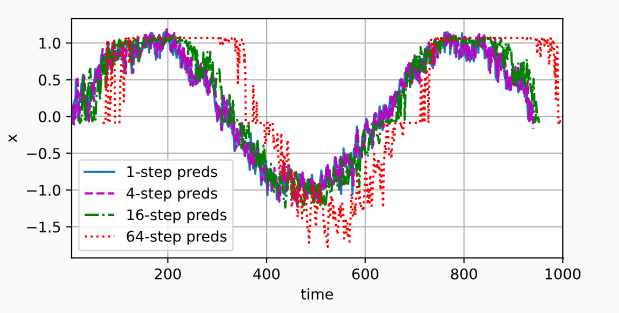
#经过几个预测步骤之后,预测的结果很快就会衰减到一个常数。
#事实是由于错误的累积
#因此误差可能会相当快地偏离真实的观测结果。


max_steps = 64
#T=1000
#tau=4
# 1000-4-64+1= 933行 , 4+64=68列  [933,68]
features = torch.zeros((T - tau - max_steps + 1, tau + max_steps))
# 列i(i<tau)是来自x的观测,其时间步从(i)到(i+T-tau-max_steps+1)
# 0-3
for i in range(tau):
    features[:, i] = x[i: i + T - tau - max_steps + 1]
    # 0:0+1000-4-64+1= 933
    # 1:1+1000-4-64+1= 934
    # 2:2+1000-4-64+1= 935
    # 3:3+1000-4-64+1= 936
    '''
    features [i行,前4列数据]  5-68列
      x0   x1   x2   x3       0
      x1   x2   x3   x4       0
     ...
     x933 x934 x935 x936      0

    '''


# 列i(i>=tau)是来自(i-tau+1)步的预测,其时间步从(i)到(i+T-tau-max_steps+1)
# 4 - 64+4=68
for i in range(tau, tau + max_steps):
    features[:, i] = net(features[:, i - tau:i]).reshape(-1)

    print(i-tau,i,features[:, i - tau:i],features[:, i - tau:i].shape) #933, 4
    '''
    features[:, i - tau:i]
    列操作                                 列操作
    真值 0-3                              预测 4
    真值 1 2 3 预测值4                     预测 5
    真值 2 3   预测值4  预测值5             预测 6
    真值 3     预测值4  预测值5   预测值6    预测 7
    预测值4    预测值5  预测值6   预测值7    预测 8
    ...
    63-66      预测 67
    '''

steps = (1, 4, 16, 64)
'''
time 4+1-1=4 : 1000 - 64 + 1=937    [4:937]
time 4+4-1=4 : 1000 - 64 + 4=940    [7:940]
time 4+16-1=4 : 1000 - 64 + 16=952  [19:952]
time 4+64-1=4 : 1000 - 64 + 64=1000 [67:1000]

features 4+1-1=4列     933行    真值 0-3  ==》 预测 4 列
features 4+4-1=7列     933行    真值 3    预测值4  预测值5   预测值6  ==》  预测 7列
features 4+16-1=19列   933行    预测值15    预测值16  预测值17   预测值18    ==》预测 19 列
features 4+64-1=67列   933行    预测值63    预测值64  预测值65   预测值66    ==》预测 67 列


'''
d2l.plot([time[tau + i - 1: T - max_steps + i] for i in steps],
         [features[:, (tau + i - 1)].detach().numpy() for i in steps], 'time', 'x',
         legend=[f'{i}-step preds' for i in steps], xlim=[5, 1000],
         figsize=(6, 3))
d2l.plt.show()
API_Draw.py
### 画图 训练损失  训练精度  测试精度
import matplotlib.pyplot as plt
import threading
import time

import matplotlib.animation as animation

class Animator:
    def __init__(self):

        self.fmts=('-', 'm--', 'g-.', 'r:') #颜色 和线性

        #1 基础绘图
        #第1步:定义x和y坐标轴上的点   x坐标轴上点的数值
        self.x=[]
        #y坐标轴上点的数值
        self.train_loss=[]
        self.train_acc =[]
        self.test_acc=[]


    def add(self, x_,train_loss_,train_acc_,test_acc_ ):


        self.x.append(x_)
        self.train_loss.append(train_loss_)
        self.train_acc.append(train_acc_)
        self.test_acc.append(test_acc_)

    # 刷新最新的图像
    def ShowALL(self):


        fig, ax = plt.subplots()

        plot1=ax.plot(self.x, self.train_loss, self.fmts[0],label="train_loss")
        plot2=ax.plot(self.x, self.train_acc, self.fmts[1],label="train_acc")
        plot3=ax.plot(self.x, self.test_acc, self.fmts[2],label="test_acc")


        plt.legend(bbox_to_anchor=(1, 1),bbox_transform=plt.gcf().transFigure)# 添加图例

        plt.grid()#网格

        plt.show()


    # 画单个图
    def ShowALL_Onec(self,x,y):


        fig, ax = plt.subplots()

        plot1=ax.plot(x, y, self.fmts[0],label="--")
        #plot2=ax.plot(self.x, self.train_acc, self.fmts[1],label="train_acc")
        #plot3=ax.plot(self.x, self.test_acc, self.fmts[2],label="test_acc")


        plt.legend(bbox_to_anchor=(1, 1),bbox_transform=plt.gcf().transFigure)# 添加图例

        plt.grid()#网格

        plt.show()


import threading

import time

class MyThread(threading.Thread):

    def __init__(self,name_):

        threading.Thread.__init__(self)


        self.name_ = name_
        print("线程名字",self.name_ )

        self.is_running = 1# 控制标志位

        self.animator=Animator() # 画图类


    def run(self):

        while self.is_running:

            print("Thread is running...")

            print(self.animator.x,self.animator.train_loss)

            self.animator.ShowALL()

        print("线程停止")


    def stop(self):

        self.is_running = False


    # 创建并启动线程


# # 调用
# my_thread = MyThread("可视化训练过程")
# my_thread.setDaemon(True)#伴随主进程自动关闭
# my_thread.start()

# i=0
# while 1:
#     i=i+1
#     my_thread.animator.add(i,i-3,i-2,i-1) # 加入新数据
#     time.sleep(1)


# my_thread.stop()# 通过标志为 手动关闭

 浙公网安备 33010602011771号