

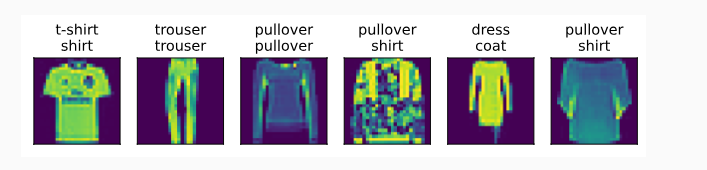
脱离网页化python 没有可视化
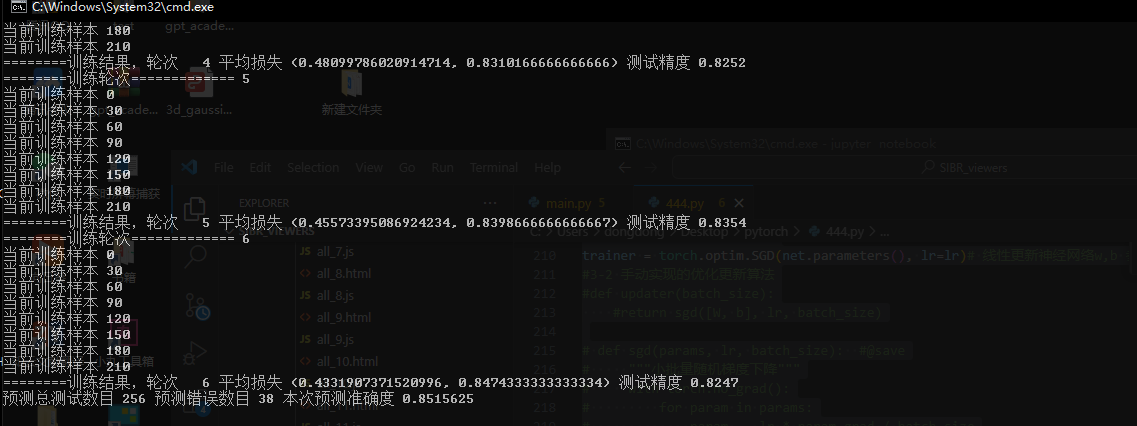
代码没有加入可视化图
需要的化参考
https://www.cnblogs.com/gooutlook/p/17729064.html

无可视化版本
#%matplotlib inline
import torch
import torchvision
from torch.utils import data
from torchvision import transforms
from d2l import torch as d2l


# 通过ToTensor实例将图像数据从PIL类型变换成32位浮点数格式,
# 并除以255使得所有像素的数值均在0~1之间
# trans = transforms.ToTensor()
# mnist_train = torchvision.datasets.FashionMNIST(
#     root="./data", train=True, transform=trans, download=True)
# mnist_test = torchvision.datasets.FashionMNIST(
#     root="./data", train=False, transform=trans, download=True)


# print(len(mnist_train), len(mnist_test))

# def show_images(imgs, num_rows, num_cols, titles=None, scale=1.5):  #@save
#     """绘制图像列表"""
#     figsize = (num_cols * scale, num_rows * scale)
#     _, axes = d2l.plt.subplots(num_rows, num_cols, figsize=figsize)
#     axes = axes.flatten()
#     for i, (ax, img) in enumerate(zip(axes, imgs)):
#         if torch.is_tensor(img):
#             # 图片张量
#             ax.imshow(img.numpy())
#         else:
#             # PIL图片
#             ax.imshow(img)
#         ax.axes.get_xaxis().set_visible(False)
#         ax.axes.get_yaxis().set_visible(False)
#         if titles:
#             ax.set_title(titles[i])
#     return axes


# X, y = next(iter(data.DataLoader(mnist_train, batch_size=18)))
# show_images(X.reshape(18, 28, 28), 2, 9, titles=(y))

import sys
#获取线程输目
def get_dataloader_workers():  #@save
    """在非Windows的平台上,使用4个进程来读取数据"""
    return 0 if sys.platform.startswith('win') else 4
#下载数据
def load_data_fashion_mnist(batch_size, resize=None):  #@save
    """下载Fashion-MNIST数据集,然后将其加载到内存中"""
    trans = [transforms.ToTensor()]
    if resize:
        trans.insert(0, transforms.Resize(resize))
    trans = transforms.Compose(trans)
    mnist_train = torchvision.datasets.FashionMNIST(
        root="./data", train=True, transform=trans, download=True)
    mnist_test = torchvision.datasets.FashionMNIST(
        root="./data", train=False, transform=trans, download=True)
    return (data.DataLoader(mnist_train, batch_size, shuffle=True,
                            num_workers=get_dataloader_workers()),
            data.DataLoader(mnist_test, batch_size, shuffle=False,
                            num_workers=get_dataloader_workers()))


# train_iter, test_iter = load_data_fashion_mnist(32, resize=64)
# for X, y in train_iter:
#     print(X.shape, X.dtype, y.shape, y.dtype)
#     break
# 精度评估0  保存每个训练样本的结果
class Accumulator:  #@save
    """在n个变量上累加"""
    def __init__(self, n):
        self.data = [0.0] * n

    def add(self, *args):
        self.data = [a + float(b) for a, b in zip(self.data, args)]

    def reset(self):
        self.data = [0.0] * len(self.data)

    def __getitem__(self, idx):
        return self.data[idx]

# 精度评估1 具体计算函数
def accuracy(y_hat, y):  #@save
    """计算预测正确的数量"""
    if len(y_hat.shape) > 1 and y_hat.shape[1] > 1:
        y_hat = y_hat.argmax(axis=1)
    cmp = y_hat.type(y.dtype) == y
    return float(cmp.type(y.dtype).sum())


# 精度评估2 总评估
def evaluate_accuracy(net, data_iter):  #@save
    """计算在指定数据集上模型的精度"""
    if isinstance(net, torch.nn.Module):
        net.eval()  # 将模型设置为评估模式
    metric = Accumulator(2)  # 正确预测数、预测总数
    with torch.no_grad():
        for X, y in data_iter:
            metric.add(accuracy(net(X), y), y.numel())
    return metric[0] / metric[1]

# 单次训练函数
def train_epoch_ch3(net, train_iter, loss, updater):  #@save
    """训练模型一个迭代周期(定义见第3章)"""
    # 将模型设置为训练模式
    if isinstance(net, torch.nn.Module):
        net.train()
    # 训练损失总和、训练准确度总和、样本数
    metric = Accumulator(3)
    i=0
    for X, y in train_iter:

        if i%30==0:print("当前训练样本",i)
        i=i+1
        # 计算梯度并更新参数
        y_hat = net(X)
        l = loss(y_hat, y)
        if isinstance(updater, torch.optim.Optimizer):
            # 使用PyTorch内置的优化器和损失函数
            updater.zero_grad()
            l.mean().backward()
            updater.step()
        else:
            # 使用定制的优化器和损失函数
            l.sum().backward()
            updater(X.shape[0])
        metric.add(float(l.sum()), accuracy(y_hat, y), y.numel())
    # 返回训练损失和训练精度
    return metric[0] / metric[2], metric[1] / metric[2]

#总训练
def train_ch3(net, train_iter, test_iter, loss, num_epochs, updater):  #@save
    """训练模型(定义见第3章)"""
    #animator = Animator(xlabel='epoch', xlim=[1, num_epochs], ylim=[0.3, 0.9],
                        #legend=['train loss', 'train acc', 'test acc'])
    for epoch in range(num_epochs):
        print("========训练轮次=============",epoch+1)
        train_metrics = train_epoch_ch3(net, train_iter, loss, updater)
        test_acc = evaluate_accuracy(net, test_iter)
        print("========训练结果,轮次  ",epoch+1,"平均损失",train_metrics,"测试精度",test_acc)
        #animator.add(epoch + 1, train_metrics + (test_acc,))
    train_loss, train_acc = train_metrics
    #在表达式条件为 false 的时候触发异常。
    # assert train_loss < 0.5, train_loss
    # assert train_acc <= 1 and train_acc > 0.7, train_acc
    # assert test_acc <= 1 and test_acc > 0.7, test_acc

#####################################
import torch
from torch import nn
from d2l import torch as d2l

# 1 系统API模型
# 1-0 PyTorch不会隐式地调整输入的形状。因此,我们在线性层前定义了展平层(flatten),来调整网络输入的形状
# 1-1 线性求解器 Linear   y=w*x+b
# 1-2 网络层数 2层  784*256  256*10
# 1-3 层与层之间的激活函数 ReLU()

net = nn.Sequential(nn.Flatten(),
                    nn.Linear(784, 256),
                    nn.ReLU(),
                    nn.Linear(256, 10))
'''
手动初始化参数
W1 = nn.Parameter(torch.randn(
    num_inputs, num_hiddens, requires_grad=True) * 0.01)
b1 = nn.Parameter(torch.zeros(num_hiddens, requires_grad=True))
W2 = nn.Parameter(torch.randn(
    num_hiddens, num_outputs, requires_grad=True) * 0.01)
b2 = nn.Parameter(torch.zeros(num_outputs, requires_grad=True))
params = [W1, b1, W2, b2]
'''
# 手动实现的单层模型
# def net(X):
#     return softmax(torch.matmul(X.reshape((-1, W.shape[0])), W) + b)
# 手动实现的多层模型
# def net(X):
#     X = X.reshape((-1, num_inputs))
#     H = relu(X@W1 + b1)  # 这里“@”代表矩阵乘法
#     return (H@W2 + b2)

# 手动ReLU激活函数
# def relu(X):
#     a = torch.zeros_like(X)
#     return torch.max(X, a)

# 0 初始化网络参数
def init_weights(m):
    if type(m) == nn.Linear:
        nn.init.normal_(m.weight, std=0.01) # 以均值0和标准差0.01随机初始化权重
# 0 初始化网络参数
net.apply(init_weights);

# 2 损失函数
batch_size, lr, num_epochs = 256, 0.1, 6   # 每次参与训练的总样本数目   更新步长 训练总批次

#2-1系统api损失函数
# (1)模型的输出减去最大 避免无穷大但是 引入 减去后具有较大的负值 (2)送入计算交叉熵损失  (3)结果会取它们的对数  避免减去后的赋负值e之后可能会四舍五入为零
loss = nn.CrossEntropyLoss(reduction='none')# 损失函数 softmax和交叉熵损失  计算
#2-2手动定义的损失函数--交叉熵
# def cross_entropy(y_hat, y):
#     return - torch.log(y_hat[range(len(y_hat)), y])
#2-2手动定义的损失函数--均方损失
# def squared_loss(y_hat, y):  #@save
#     """均方损失"""
#     return (y_hat - y.reshape(y_hat.shape)) ** 2 / 2


#3跟新函数
#3-1 系统自带的优化更新算法
trainer = torch.optim.SGD(net.parameters(), lr=lr)# 线性更新神经网络w,b 参数  w= w - lr*w.grad   b = b - lr*b.grad(梯度)
#3-2 手动实现的优化更新算法
#def updater(batch_size):
    #return sgd([W, b], lr, batch_size)

# def sgd(params, lr, batch_size):  #@save
#     """小批量随机梯度下降"""
#     with torch.no_grad():
#         for param in params:
#             param -= lr * param.grad / batch_size
#             param.grad.zero_()


# 4训练
# 4-1 加载数据
train_iter, test_iter = load_data_fashion_mnist(batch_size)
# 4-2 训练过程
train_ch3(net, train_iter, test_iter, loss, num_epochs, trainer)


# 5预测结果
def predict_ch3(net, test_iter, n=6):  #@save
    """预测标签(定义见第3章)"""
    for X, y in test_iter:
        break
    trues = d2l.get_fashion_mnist_labels(y)
    preds = d2l.get_fashion_mnist_labels(net(X).argmax(axis=1))

    error_num=0
    allTest_num=len(trues)
    for i in range(0,len(trues)):
        if trues[i]!=preds[i]:
            print("真实标签",trues[i],"预测标签",preds[i])
            error_num=error_num+1
    result_=1-error_num/allTest_num
    print("预测总测试数目",allTest_num,"预测错误数目",error_num,"本次预测准确度",result_)
    # 训练1次 256个样本/次  0.77
    # 训练3次 256个样本/次  0.82
    # 训练6次 256个样本/次  0.85

    #titles = [true +'\n' + pred for true, pred in zip(trues, preds)]
    #d2l.show_images(
        #X[0:n].reshape((n, 28, 28)), 1, n, titles=titles[0:n])

predict_ch3(net, test_iter)
带可视化版本
1添加可视化代码
API_Draw.py
https://www.cnblogs.com/gooutlook/p/17729064.html
2修改函数
from API_Draw import *


#总训练
def train_ch3(net, train_iter, test_iter, loss, num_epochs, updater):  #@save
    """训练模型(定义见第3章)"""
    #animator = Animator(xlabel='epoch', xlim=[1, num_epochs], ylim=[0.3, 0.9],
                        #legend=['train loss', 'train acc', 'test acc'])


    #drawLine=Animator()


    # 调用
    my_thread = MyThread("可视化训练过程")
    #my_thread.setDaemon(True)#伴随主进程自动关闭
    my_thread.start()


    for epoch in range(num_epochs):
        print("========训练轮次=============",epoch+1)
        train_metrics = train_epoch_ch3(net, train_iter, loss, updater)
        test_acc = evaluate_accuracy(net, test_iter)
        print("========训练结果,轮次  ",epoch+1,"平均损失",train_metrics,"测试精度",test_acc)
        #animator.add(epoch + 1, train_metrics + (test_acc,))
        train_loss, train_acc = train_metrics
        # x 训练迭代次数  train_loss_   train_acc_  test_acc_
        #drawLine.add_tread(epoch,train_loss,train_acc,test_acc)
        my_thread.animator.add(epoch,train_loss,train_acc,test_acc)

    print("==================训练结束 3秒后结束 尽快截图 然后手动关闭窗口=================")
    time.sleep(3)

    my_thread.stop()
    #在表达式条件为 false 的时候触发异常。
    # assert train_loss < 0.5, train_loss
    # assert train_acc <= 1 and train_acc > 0.7, train_acc
    # assert test_acc <= 1 and test_acc > 0.7, test_acc

 浙公网安备 33010602011771号