
cereas学习(5) vins-fusion vio融合gps全局优化

残差定义

Factors.h
/*******************************************************
 * Copyright (C) 2019, Aerial Robotics Group, Hong Kong University of Science and Technology
 *
 * This file is part of VINS.
 *
 * Licensed under the GNU General Public License v3.0;
 * you may not use this file except in compliance with the License.
 *
 * Author: Qin Tong (qintonguav@gmail.com)
 *******************************************************/

#pragma once
#include <ceres/ceres.h>
#include <ceres/rotation.h>

template <typename T> inline
void QuaternionInverse(const T q[4], T q_inverse[4])
{
	q_inverse[0] = q[0];
	q_inverse[1] = -q[1];
	q_inverse[2] = -q[2];
	q_inverse[3] = -q[3];
};


struct TError
{
    //输入观测量
	TError(double t_x, double t_y, double t_z, double var)
				  :t_x(t_x), t_y(t_y), t_z(t_z), var(var){}

	template <typename T>
	// 待优化输出的tj量
	bool operator()(const T* tj, T* residuals) const
	{
		//残差= 待优化出来的量(未知)-观测量(实际看到的有误差) min(x'-x(已知))    y=(10-x)^2
		residuals[0] = (tj[0] - T(t_x)) / T(var); //残差= (待优化tj-观测量t_x)/var gps的准确度方差
		residuals[1] = (tj[1] - T(t_y)) / T(var);
		residuals[2] = (tj[2] - T(t_z)) / T(var);

		return true;
	}

	static ceres::CostFunction* Create(const double t_x, const double t_y, const double t_z, const double var)
	{
	  return (new ceres::AutoDiffCostFunction<
	          TError, 3, 3>(
	          	new TError(t_x, t_y, t_z, var)));
	}

	double t_x, t_y, t_z, var;

};

struct RelativeRTError
{
    //输入观测值 i帧相对于j帧的平移和旋转
	RelativeRTError(double t_x, double t_y, double t_z,
					double q_w, double q_x, double q_y, double q_z,
					double t_var, double q_var)
				  :t_x(t_x), t_y(t_y), t_z(t_z),
				   q_w(q_w), q_x(q_x), q_y(q_y), q_z(q_z),
				   t_var(t_var), q_var(q_var){}

	template <typename T>
	//输出的优化参数 i帧世界旋转w_q_i i帧世界平移ti j帧世界旋转w_q_j j帧世界平移tj  残差residuals
	bool operator()(const T* const w_q_i, const T* ti, const T* w_q_j, const T* tj, T* residuals) const
	{
		T t_w_ij[3];
		t_w_ij[0] = tj[0] - ti[0]; //待优化值 j帧相对于i帧位移
		t_w_ij[1] = tj[1] - ti[1]; //待优化值 j帧相对于i帧位移
		t_w_ij[2] = tj[2] - ti[2]; //待优化值 j帧相对于i帧位移

		T i_q_w[4];
		QuaternionInverse(w_q_i, i_q_w);////待优化值 i帧世界旋转 四元数取逆

		T t_i_ij[3];
		//  i_q_w = 求逆(w_q_i)
		//  t_w_ij 第j帧相对于第i帧的位移向量
		//  t_i_ij=逆(w_q_i)* (tj[0] - ti[0])
		ceres::QuaternionRotatePoint(i_q_w, t_w_ij, t_i_ij); // t_i_ij以i帧为原点 相对于j的平移  利用四元数旋转向量

		residuals[0] = (t_i_ij[0] - T(t_x)) / T(t_var); //残差 = (观测值 (全局计算i帧位姿计算出的相对于j帧的位移)- 预测值)/t_var(人为0.1)
		residuals[1] = (t_i_ij[1] - T(t_y)) / T(t_var);
		residuals[2] = (t_i_ij[2] - T(t_z)) / T(t_var);

		T relative_q[4];
		relative_q[0] = T(q_w); // 观测值 i帧相对j帧的旋转
		relative_q[1] = T(q_x); // 观测值 i帧相对j帧的旋转
		relative_q[2] = T(q_y); // 观测值 i帧相对j帧的旋转
		relative_q[3] = T(q_z); // 观测值 i帧相对j帧的旋转

		T q_i_j[4];
		// q_i_j= 逆(w_q_i)* w_q_j    q_i_j待优化值计算出的i帧相对旋转j帧
		ceres::QuaternionProduct(i_q_w, w_q_j, q_i_j);

		T relative_q_inv[4];
		//  relative_q 最新输入的数据 观测值相对旋转 relative_q求逆
		QuaternionInverse(relative_q, relative_q_inv);

		T error_q[4];
		// error_q= relative_q_inv 观测值相对旋转的逆 * q_i_j待优化值计算出的i帧相对旋转j帧
		ceres::QuaternionProduct(relative_q_inv, q_i_j, error_q);

		residuals[3] = T(2) * error_q[1] / T(q_var);//残差= error_q 观测值算出i相对于j的旋转逆*待优化值短处的相对旋转逆 *2/q_var(人为给0.01)
		residuals[4] = T(2) * error_q[2] / T(q_var);
		residuals[5] = T(2) * error_q[3] / T(q_var);

		return true;
	}

	static ceres::CostFunction* Create(const double t_x, const double t_y, const double t_z,
									   const double q_w, const double q_x, const double q_y, const double q_z,
									   const double t_var, const double q_var)
	{
	  return (new ceres::AutoDiffCostFunction<
	          RelativeRTError, 6, 4, 3, 4, 3>(
	          	new RelativeRTError(t_x, t_y, t_z, q_w, q_x, q_y, q_z, t_var, q_var)));
	}

	double t_x, t_y, t_z, t_norm;
	double q_w, q_x, q_y, q_z;
	double t_var, q_var;

};
程序调用
数据发布

globalOptNode.cpp
/*******************************************************
 * Copyright (C) 2019, Aerial Robotics Group, Hong Kong University of Science and Technology
 *
 * This file is part of VINS.
 *
 * Licensed under the GNU General Public License v3.0;
 * you may not use this file except in compliance with the License.
 *
 * Author: Qin Tong (qintonguav@gmail.com)
 *******************************************************/

#include "ros/ros.h"
#include "globalOpt.h"
#include <sensor_msgs/NavSatFix.h>
#include <nav_msgs/Odometry.h>
#include <nav_msgs/Path.h>
#include <eigen3/Eigen/Dense>
#include <eigen3/Eigen/Geometry>
#include <iostream>
#include <stdio.h>
#include <visualization_msgs/Marker.h>
#include <visualization_msgs/MarkerArray.h>
#include <fstream>
#include <queue>
#include <mutex>

GlobalOptimization globalEstimator;
ros::Publisher pub_global_odometry, pub_global_path, pub_car;
nav_msgs::Path *global_path;
double last_vio_t = -1;
std::queue<sensor_msgs::NavSatFixConstPtr> gpsQueue;
std::mutex m_buf;

void publish_car_model(double t, Eigen::Vector3d t_w_car, Eigen::Quaterniond q_w_car)
{
    visualization_msgs::MarkerArray markerArray_msg;
    visualization_msgs::Marker car_mesh;
    car_mesh.header.stamp = ros::Time(t);
    car_mesh.header.frame_id = "world";
    car_mesh.type = visualization_msgs::Marker::MESH_RESOURCE;
    car_mesh.action = visualization_msgs::Marker::ADD;
    car_mesh.id = 0;

    car_mesh.mesh_resource = "package://global_fusion/models/car.dae";

    Eigen::Matrix3d rot;
    rot << 0, 0, -1, 0, -1, 0, -1, 0, 0;

    Eigen::Quaterniond Q;
    Q = q_w_car * rot;
    car_mesh.pose.position.x    = t_w_car.x();
    car_mesh.pose.position.y    = t_w_car.y();
    car_mesh.pose.position.z    = t_w_car.z();
    car_mesh.pose.orientation.w = Q.w();
    car_mesh.pose.orientation.x = Q.x();
    car_mesh.pose.orientation.y = Q.y();
    car_mesh.pose.orientation.z = Q.z();

    car_mesh.color.a = 1.0;
    car_mesh.color.r = 1.0;
    car_mesh.color.g = 0.0;
    car_mesh.color.b = 0.0;

    float major_scale = 2.0;

    car_mesh.scale.x = major_scale;
    car_mesh.scale.y = major_scale;
    car_mesh.scale.z = major_scale;
    markerArray_msg.markers.push_back(car_mesh);
    pub_car.publish(markerArray_msg);
}

void GPS_callback(const sensor_msgs::NavSatFixConstPtr &GPS_msg)
{
    //printf("gps_callback! \n");
    m_buf.lock();
    gpsQueue.push(GPS_msg);
    m_buf.unlock();
}

void vio_callback(const nav_msgs::Odometry::ConstPtr &pose_msg)
{
    //printf("vio_callback! \n");
    double t = pose_msg->header.stamp.toSec();
    last_vio_t = t;
    Eigen::Vector3d vio_t(pose_msg->pose.pose.position.x, pose_msg->pose.pose.position.y, pose_msg->pose.pose.position.z);
    Eigen::Quaterniond vio_q;
    vio_q.w() = pose_msg->pose.pose.orientation.w;
    vio_q.x() = pose_msg->pose.pose.orientation.x;
    vio_q.y() = pose_msg->pose.pose.orientation.y;
    vio_q.z() = pose_msg->pose.pose.orientation.z;
    globalEstimator.inputOdom(t, vio_t, vio_q);


    m_buf.lock();
    while(!gpsQueue.empty())
    {
        sensor_msgs::NavSatFixConstPtr GPS_msg = gpsQueue.front();
        double gps_t = GPS_msg->header.stamp.toSec();
        printf("vio t: %f, gps t: %f \n", t, gps_t);
        // 10ms sync tolerance
        if(gps_t >= t - 0.01 && gps_t <= t + 0.01)
        {
            //printf("receive GPS with timestamp %f\n", GPS_msg->header.stamp.toSec());
            double latitude = GPS_msg->latitude;
            double longitude = GPS_msg->longitude;
            double altitude = GPS_msg->altitude;
            //int numSats = GPS_msg->status.service;
            double pos_accuracy = GPS_msg->position_covariance[0];
            if(pos_accuracy <= 0)
                pos_accuracy = 1;
            //printf("receive covariance %lf \n", pos_accuracy);
            //if(GPS_msg->status.status > 8)
                globalEstimator.inputGPS(t, latitude, longitude, altitude, pos_accuracy);
            gpsQueue.pop();
            break;
        }
        else if(gps_t < t - 0.01)
            gpsQueue.pop();
        else if(gps_t > t + 0.01)
            break;
    }
    m_buf.unlock();

    Eigen::Vector3d global_t;
    Eigen:: Quaterniond global_q;
    globalEstimator.getGlobalOdom(global_t, global_q);

    nav_msgs::Odometry odometry;
    odometry.header = pose_msg->header;
    odometry.header.frame_id = "world";
    odometry.child_frame_id = "world";
    odometry.pose.pose.position.x = global_t.x();
    odometry.pose.pose.position.y = global_t.y();
    odometry.pose.pose.position.z = global_t.z();
    odometry.pose.pose.orientation.x = global_q.x();
    odometry.pose.pose.orientation.y = global_q.y();
    odometry.pose.pose.orientation.z = global_q.z();
    odometry.pose.pose.orientation.w = global_q.w();
    pub_global_odometry.publish(odometry);
    pub_global_path.publish(*global_path);
    publish_car_model(t, global_t, global_q);


    // write result to file
    std::ofstream foutC("/home/tony-ws1/output/vio_global.csv", ios::app);
    foutC.setf(ios::fixed, ios::floatfield);
    foutC.precision(0);
    foutC << pose_msg->header.stamp.toSec() * 1e9 << ",";
    foutC.precision(5);
    foutC << global_t.x() << ","
            << global_t.y() << ","
            << global_t.z() << ","
            << global_q.w() << ","
            << global_q.x() << ","
            << global_q.y() << ","
            << global_q.z() << endl;
    foutC.close();
}

int main(int argc, char **argv)
{
    ros::init(argc, argv, "globalEstimator");
    ros::NodeHandle n("~");

    global_path = &globalEstimator.global_path;

    ros::Subscriber sub_GPS = n.subscribe("/gps", 100, GPS_callback);
    ros::Subscriber sub_vio = n.subscribe("/vins_estimator/odometry", 100, vio_callback);
    pub_global_path = n.advertise<nav_msgs::Path>("global_path", 100);
    pub_global_odometry = n.advertise<nav_msgs::Odometry>("global_odometry", 100);
    pub_car = n.advertise<visualization_msgs::MarkerArray>("car_model", 1000);
    ros::spin();
    return 0;
}
cere优化过程
globalOpt.cpp
/*******************************************************
 * Copyright (C) 2019, Aerial Robotics Group, Hong Kong University of Science and Technology
 *
 * This file is part of VINS.
 *
 * Licensed under the GNU General Public License v3.0;
 * you may not use this file except in compliance with the License.
 *
 * Author: Qin Tong (qintonguav@gmail.com)
 *******************************************************/

#include "globalOpt.h"
#include "Factors.h"

GlobalOptimization::GlobalOptimization()
{
	initGPS = false;
    newGPS = false;
	WGPS_T_WVIO = Eigen::Matrix4d::Identity();
    threadOpt = std::thread(&GlobalOptimization::optimize, this);
}

GlobalOptimization::~GlobalOptimization()
{
    threadOpt.detach();
}

void GlobalOptimization::GPS2XYZ(double latitude, double longitude, double altitude, double* xyz)
{
    if(!initGPS)
    {
        geoConverter.Reset(latitude, longitude, altitude);
        initGPS = true;
    }
    geoConverter.Forward(latitude, longitude, altitude, xyz[0], xyz[1], xyz[2]);
    //printf("la: %f lo: %f al: %f\n", latitude, longitude, altitude);
    //printf("gps x: %f y: %f z: %f\n", xyz[0], xyz[1], xyz[2]);
}

void GlobalOptimization::inputOdom(double t, Eigen::Vector3d OdomP, Eigen::Quaterniond OdomQ)
{
	mPoseMap.lock();
    vector<double> localPose{OdomP.x(), OdomP.y(), OdomP.z(),
    					     OdomQ.w(), OdomQ.x(), OdomQ.y(), OdomQ.z()};
    localPoseMap[t] = localPose;

    //localPose相对于上一帧的位移和旋转
    Eigen::Quaterniond globalQ;
    // WGPS_T_WVIO  把局部VIO位姿转化到GPS全局以第一帧GPS为原点的ENU平面直角坐标系
    // WGPS_T_WVIO  GPS(ENU平面直角坐标系)到VIO(平年坐标系)转换 每次优化后要实时更新
    globalQ = WGPS_T_WVIO.block<3, 3>(0, 0) * OdomQ;
    Eigen::Vector3d globalP = WGPS_T_WVIO.block<3, 3>(0, 0) * OdomP + WGPS_T_WVIO.block<3, 1>(0, 3);
    vector<double> globalPose{globalP.x(), globalP.y(), globalP.z(),
                              globalQ.w(), globalQ.x(), globalQ.y(), globalQ.z()};
    globalPoseMap[t] = globalPose;
    lastP = globalP;
    lastQ = globalQ;

    geometry_msgs::PoseStamped pose_stamped;
    pose_stamped.header.stamp = ros::Time(t);
    pose_stamped.header.frame_id = "world";
    pose_stamped.pose.position.x = lastP.x();
    pose_stamped.pose.position.y = lastP.y();
    pose_stamped.pose.position.z = lastP.z();
    pose_stamped.pose.orientation.x = lastQ.x();
    pose_stamped.pose.orientation.y = lastQ.y();
    pose_stamped.pose.orientation.z = lastQ.z();
    pose_stamped.pose.orientation.w = lastQ.w();
    global_path.header = pose_stamped.header;
    global_path.poses.push_back(pose_stamped);

    mPoseMap.unlock();
}

void GlobalOptimization::getGlobalOdom(Eigen::Vector3d &odomP, Eigen::Quaterniond &odomQ)
{
    odomP = lastP;
    odomQ = lastQ;
}

void GlobalOptimization::inputGPS(double t, double latitude, double longitude, double altitude, double posAccuracy)
{
	double xyz[3];
    // gps转化到以第一帧gps为原点的ENU平面直角坐标系
	GPS2XYZ(latitude, longitude, altitude, xyz);
	vector<double> tmp{xyz[0], xyz[1], xyz[2], posAccuracy};
    //printf("new gps: t: %f x: %f y: %f z:%f \n", t, tmp[0], tmp[1], tmp[2]);
	GPSPositionMap[t] = tmp;
    newGPS = true;

}

/// @brief
void GlobalOptimization::optimize()
{
    while(true)
    {
        if(newGPS)
        {
            newGPS = false;
            printf("global optimization\n");
            TicToc globalOptimizationTime;

            ceres::Problem problem;
            ceres::Solver::Options options;
            options.linear_solver_type = ceres::SPARSE_NORMAL_CHOLESKY;
            //options.minimizer_progress_to_stdout = true;
            //options.max_solver_time_in_seconds = SOLVER_TIME * 3;
            options.max_num_iterations = 5;
            ceres::Solver::Summary summary;
            ceres::LossFunction *loss_function;
            loss_function = new ceres::HuberLoss(1.0);
            ceres::LocalParameterization* local_parameterization = new ceres::QuaternionParameterization();

            //add param
            mPoseMap.lock();
            int length = localPoseMap.size();
            // w^t_i   w^q_i
            double t_array[length][3];
            double q_array[length][4];
            map<double, vector<double>>::iterator iter;
            iter = globalPoseMap.begin();
            for (int i = 0; i < length; i++, iter++)
            {
                t_array[i][0] = iter->second[0];
                t_array[i][1] = iter->second[1];
                t_array[i][2] = iter->second[2];
                q_array[i][0] = iter->second[3];
                q_array[i][1] = iter->second[4];
                q_array[i][2] = iter->second[5];
                q_array[i][3] = iter->second[6];
                problem.AddParameterBlock(q_array[i], 4, local_parameterization);
                problem.AddParameterBlock(t_array[i], 3);
            }

            map<double, vector<double>>::iterator iterVIO, iterVIONext, iterGPS;
            int i = 0;
            for (iterVIO = localPoseMap.begin(); iterVIO != localPoseMap.end(); iterVIO++, i++)
            {
                //vio factor
                iterVIONext = iterVIO;
                iterVIONext++;
                if(iterVIONext != localPoseMap.end())
                {
                    Eigen::Matrix4d wTi = Eigen::Matrix4d::Identity();
                    Eigen::Matrix4d wTj = Eigen::Matrix4d::Identity();
                    wTi.block<3, 3>(0, 0) = Eigen::Quaterniond(iterVIO->second[3], iterVIO->second[4],
                                                               iterVIO->second[5], iterVIO->second[6]).toRotationMatrix();
                    wTi.block<3, 1>(0, 3) = Eigen::Vector3d(iterVIO->second[0], iterVIO->second[1], iterVIO->second[2]);
                    wTj.block<3, 3>(0, 0) = Eigen::Quaterniond(iterVIONext->second[3], iterVIONext->second[4],
                                                               iterVIONext->second[5], iterVIONext->second[6]).toRotationMatrix();
                    wTj.block<3, 1>(0, 3) = Eigen::Vector3d(iterVIONext->second[0], iterVIONext->second[1], iterVIONext->second[2]);
                    Eigen::Matrix4d   = wTi.inverse() * wTj;
                    Eigen::Quaterniond iQj;
                    iQj = iTj.block<3, 3>(0, 0);
                    Eigen::Vector3d iPj = iTj.block<3, 1>(0, 3);

                    ceres::CostFunction* vio_function = RelativeRTError::Create(iPj.x(), iPj.y(), iPj.z(),
                                                                                iQj.w(), iQj.x(), iQj.y(), iQj.z(),
                                                                                0.1, 0.01);
                    //代价函数(cost function)、损失函数(loss function) 和 待优化状态量
                    problem.AddResidualBlock(vio_function, NULL, q_array[i], t_array[i], q_array[i+1], t_array[i+1]);

                    /*
                    double **para = new double *[4];
                    para[0] = q_array[i];
                    para[1] = t_array[i];
                    para[3] = q_array[i+1];
                    para[4] = t_array[i+1];

                    double *tmp_r = new double[6];
                    double **jaco = new double *[4];
                    jaco[0] = new double[6 * 4];
                    jaco[1] = new double[6 * 3];
                    jaco[2] = new double[6 * 4];
                    jaco[3] = new double[6 * 3];
                    vio_function->Evaluate(para, tmp_r, jaco);

                    std::cout << Eigen::Map<Eigen::Matrix<double, 6, 1>>(tmp_r).transpose() << std::endl
                        << std::endl;
                    std::cout << Eigen::Map<Eigen::Matrix<double, 6, 4, Eigen::RowMajor>>(jaco[0]) << std::endl
                        << std::endl;
                    std::cout << Eigen::Map<Eigen::Matrix<double, 6, 3, Eigen::RowMajor>>(jaco[1]) << std::endl
                        << std::endl;
                    std::cout << Eigen::Map<Eigen::Matrix<double, 6, 4, Eigen::RowMajor>>(jaco[2]) << std::endl
                        << std::endl;
                    std::cout << Eigen::Map<Eigen::Matrix<double, 6, 3, Eigen::RowMajor>>(jaco[3]) << std::endl
                        << std::endl;
                    */

                }
                //gps factor
                double t = iterVIO->first;
                iterGPS = GPSPositionMap.find(t);
                //// GPSPositionMap 格式  map<double, vector<double>>  xyz[0], xyz[1], xyz[2], posAccuracy
                //double t_x, double t_y, double t_z, double var
                if (iterGPS != GPSPositionMap.end())
                {
                    //double t_x, double t_y, double t_z, double var
                    ceres::CostFunction* gps_function = TError::Create(iterGPS->second[0], iterGPS->second[1],
                                                                       iterGPS->second[2], iterGPS->second[3]);
                    //printf("inverse weight %f \n", iterGPS->second[3]);
                    problem.AddResidualBlock(gps_function, loss_function, t_array[i]);

                    /*
                    double **para = new double *[1];
                    para[0] = t_array[i];

                    double *tmp_r = new double[3];
                    double **jaco = new double *[1];
                    jaco[0] = new double[3 * 3];
                    gps_function->Evaluate(para, tmp_r, jaco);

                    std::cout << Eigen::Map<Eigen::Matrix<double, 3, 1>>(tmp_r).transpose() << std::endl
                        << std::endl;
                    std::cout << Eigen::Map<Eigen::Matrix<double, 3, 3, Eigen::RowMajor>>(jaco[0]) << std::endl
                        << std::endl;
                    */
                }

            }
            //mPoseMap.unlock();
            ceres::Solve(options, &problem, &summary);
            //std::cout << summary.BriefReport() << "\n";

            // update global pose
            //mPoseMap.lock();
            iter = globalPoseMap.begin();
            for (int i = 0; i < length; i++, iter++)
            {   // enu平面坐标系
            	vector<double> globalPose{t_array[i][0], t_array[i][1], t_array[i][2],
            							  q_array[i][0], q_array[i][1], q_array[i][2], q_array[i][3]};
            	iter->second = globalPose;
            	if(i == length - 1)
            	{
            	    Eigen::Matrix4d WVIO_T_body = Eigen::Matrix4d::Identity();
            	    Eigen::Matrix4d WGPS_T_body = Eigen::Matrix4d::Identity();
            	    double t = iter->first;
                    //  VIO点的局部坐标系
            	    WVIO_T_body.block<3, 3>(0, 0) = Eigen::Quaterniond(localPoseMap[t][3], localPoseMap[t][4],
            	                                                       localPoseMap[t][5], localPoseMap[t][6]).toRotationMatrix();
            	    WVIO_T_body.block<3, 1>(0, 3) = Eigen::Vector3d(localPoseMap[t][0], localPoseMap[t][1], localPoseMap[t][2]);
                    //  GPS的世界坐标系
            	    WGPS_T_body.block<3, 3>(0, 0) = Eigen::Quaterniond(globalPose[3], globalPose[4],
            	                                                        globalPose[5], globalPose[6]).toRotationMatrix();
            	    WGPS_T_body.block<3, 1>(0, 3) = Eigen::Vector3d(globalPose[0], globalPose[1], globalPose[2]);
            	    // 两个点的 变换矩阵
                    WGPS_T_WVIO = WGPS_T_body * WVIO_T_body.inverse();
            	}
            }
            updateGlobalPath();
            //printf("global time %f \n", globalOptimizationTime.toc());
            mPoseMap.unlock();
        }
        std::chrono::milliseconds dura(2000);
        std::this_thread::sleep_for(dura);
    }
	return;
}


void GlobalOptimization::updateGlobalPath()
{
    global_path.poses.clear();
    map<double, vector<double>>::iterator iter;
    for (iter = globalPoseMap.begin(); iter != globalPoseMap.end(); iter++)
    {
        geometry_msgs::PoseStamped pose_stamped;
        pose_stamped.header.stamp = ros::Time(iter->first);
        pose_stamped.header.frame_id = "world";
        pose_stamped.pose.position.x = iter->second[0];
        pose_stamped.pose.position.y = iter->second[1];
        pose_stamped.pose.position.z = iter->second[2];
        pose_stamped.pose.orientation.w = iter->second[3];
        pose_stamped.pose.orientation.x = iter->second[4];
        pose_stamped.pose.orientation.y = iter->second[5];
        pose_stamped.pose.orientation.z = iter->second[6];
        global_path.poses.push_back(pose_stamped);
    }
}
一些涉及到gps的转换nuv关系
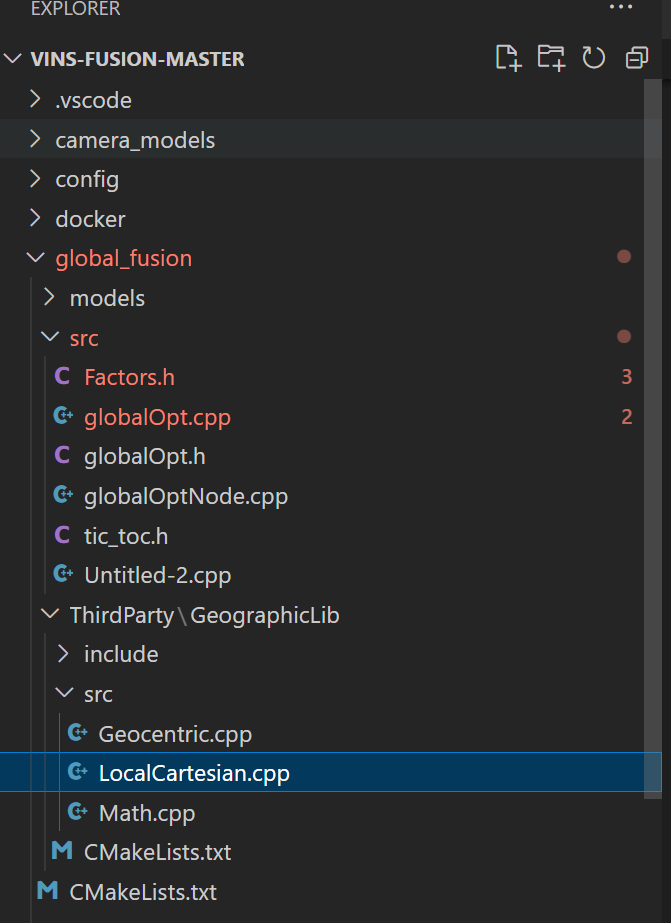
LocalCartesian.cpp
/**
 * \file LocalCartesian.cpp
 * \brief Implementation for GeographicLib::LocalCartesian class
 *
 * Copyright (c) Charles Karney (2008-2015) <charles@karney.com> and licensed
 * under the MIT/X11 License.  For more information, see
 * https://geographiclib.sourceforge.io/
 **********************************************************************/

#include "LocalCartesian.hpp"

namespace GeographicLib {

  using namespace std;

  void LocalCartesian::Reset(real lat0, real lon0, real h0) {
    _lat0 = Math::LatFix(lat0);
    _lon0 = Math::AngNormalize(lon0);
    _h0 = h0;
    _earth.Forward(_lat0, _lon0, _h0, _x0, _y0, _z0);
    real sphi, cphi, slam, clam;
    Math::sincosd(_lat0, sphi, cphi);
    Math::sincosd(_lon0, slam, clam);
    Geocentric::Rotation(sphi, cphi, slam, clam, _r);
  }

  void LocalCartesian::MatrixMultiply(real M[dim2_]) const {
    // M = r' . M
    real t[dim2_];
    copy(M, M + dim2_, t);
    for (size_t i = 0; i < dim2_; ++i) {
      size_t row = i / dim_, col = i % dim_;
      M[i] = _r[row] * t[col] + _r[row+3] * t[col+3] + _r[row+6] * t[col+6];
    }
  }

  void LocalCartesian::IntForward(real lat, real lon, real h,
                                  real& x, real& y, real& z,
                                  real M[dim2_]) const {
    real xc, yc, zc;
    _earth.IntForward(lat, lon, h, xc, yc, zc, M);
    xc -= _x0; yc -= _y0; zc -= _z0;
    x = _r[0] * xc + _r[3] * yc + _r[6] * zc;
    y = _r[1] * xc + _r[4] * yc + _r[7] * zc;
    z = _r[2] * xc + _r[5] * yc + _r[8] * zc;
    if (M)
      MatrixMultiply(M);
  }

  void LocalCartesian::IntReverse(real x, real y, real z,
                                  real& lat, real& lon, real& h,
                                  real M[dim2_]) const {
    real
      xc = _x0 + _r[0] * x + _r[1] * y + _r[2] * z,
      yc = _y0 + _r[3] * x + _r[4] * y + _r[5] * z,
      zc = _z0 + _r[6] * x + _r[7] * y + _r[8] * z;
    _earth.IntReverse(xc, yc, zc, lat, lon, h, M);
    if (M)
      MatrixMultiply(M);
  }

} // namespace GeographicLib

 浙公网安备 33010602011771号