
华容道 BFS DFS C++ Python 短程序
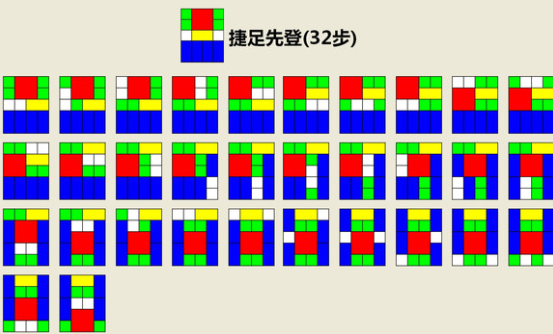
图片来自百度华容道吧。第二/三步卒子像军棋的工兵在铁道上跑——32步比我们的局面变化数少。
注释掉if (a[0][1] == 3) { print_path(); break; } // 判断找到解
则:queue_tail = 14,950,080:从此局面出发有这么多,和这个不矛盾。程序没崩当然令人欣喜,不过该数还不到1500万。“诗云”版华容道?
在Intel N100上,C++版处理上述局面耗时0.017s, queue_tail=10,440.
〔究极优化版 〕
- 10个x放在xs里,10个y放在ys里,xs和ys可同时计算 (多发射、乱序执行)
- 增加b[5][4], 不用popcnt了。1表示空,0表示占用,can_move时少些!
- 曹操能向右移动的条件是新位置的上下两格都是空,能向下移动的条件是新位置的左右两格都是空
- 能向左上移动时,大家都不用考虑W和H
- 卒特殊处理。i >= 6判断是否是卒。横竖条个数不定,卒总是4个
- 循环展开,用宏代替inline不了的函数(所有)
- 简化和减少Hash,误判些局面走弯路,换来速度的提升(此图的连通性很强)
- std::set底层是树,unordered_set底层是Hash表?Hash表用自己的。(未做)
- unordered_set::reserve(500万)效果很好,多一条语句的事
- Profile-Guided Optimization (PGO)没效果
Python程序blks没有做成函数的局部变量或参数的原因,我忘了。import了deepcopy但没有(再)用。应该不是负优化,比如100层,每层都只动了第一个块。
E = ' ' # 全角空格

class Brd:
  def __str__(m): return '\n'.join([''.join(r) for r in m.b])
  def totuple(m): return tuple(tuple(r) for r in m.b)

  def put(m, blks):
    m.b = [[E] * 4 for _ in range(5)]
    for b in blks:
      if b.x < 0 or b.x + b.w > 4 or b.y < 0 or b.y + b.h > 5: return False
      for y in range(b.y, b.y + b.h):
        for x in range(b.x, b.x + b.w):
          if m.b[y][x] != E: return False
          m.b[y][x] = b.name
    return True

class Blk:
  def __init__(m, name, x, y, w = 1, h = 1):
    m.name = name; m.x = x; m.y = y; m.w = w; m.h = h; m.old = []

  def step(m, dx, dy):
    m.old.append((m.x, m.y)); m.x += dx; m.y += dy

  def back(m): (m.x, m.y) = m.old.pop()

brd = Brd() # 全局临时brd.
# 每个blk有自己的old[],等于我们自己管理一些堆栈。
blks = [
  Blk('曹', 1, 0, 2, 2),
  Blk('关', 1, 2, 2, 1),
  Blk('张', 0, 3, 1, 2),
  Blk('黄', 1, 3, 1, 2),
  Blk('赵', 2, 3, 1, 2),
  Blk('马', 3, 3, 1, 2),
  Blk('甲', 0, 0),
  Blk('乙', 0, 1),
  Blk('丙', 3, 0),
  Blk('丁', 3, 1)
]
cc = blks[0]
brd.put(blks); seen = set(); path = []

def search (n):
  if cc.y == 3: return True

  s = str(brd) # 都可以,速度本例看不出差别
  # s = brd.totuple()
  if s in seen: return False
  seen.add(s)

  for b in blks:
    for (dx, dy) in ((-1,0),(1,0),(0,-1),(0,1)):
      b.step(dx, dy)
      if brd.put(blks):
        path.append(str(brd))
        if search(n + 1): return True
        path.pop()
      b.back()

  return False

import sys
sys.setrecursionlimit(10000)

if search(0): print(len(path), path[-1], path[0], sep='\n\n')
// alias gcc='g++ -msse4.2'
#include <stdio.h>
#include <stdint.h>
#include <stdlib.h>
#include <string.h>
#include <nmmintrin.h>
#include <set>
using namespace std;

const char* NM[] = { "曹", "关", "张", "黄", "赵", "马", "丁", "丙", "乙", "甲" };
const int W[] = { 2, 2, 1, 1, 1, 1, 1, 1, 1, 1 };
const int H[] = { 2, 1, 2, 2, 2, 2, 1, 1, 1, 1 };
const int D[4][2] = { 0, -1, 0, 1, -1, 0, 1, 0 };

struct State {
  uint64_t  xys; // xy坐标们
  int p; // 局面路径的previous
  // int next; // Hash表里的next
  bool operator< (const State& that) const { return xys < that.xys; }
  State& operator= (int a[10][2]);
  void toary(int a[10][2]);
  void operator= (const char* s);
  void print();
};

State& State::operator= (int a[10][2]) {
  xys = 0;
  for (int i = 0; i < 10; i++) {
    uint64_t  x = a[i][0], y = a[i][1];
    xys |= ((x << 3) | y) << (i * 5);
  }
  return *this;
}

void State::toary (int a[10][2]) {
  for (int i = 0; i < 10; i++) {
    uint  xy = xys >> (i * 5);
    a[i][0] = (xy >> 3) & 3; // x
    a[i][1] = xy & 7; // y
  }
}

void State::operator= (const char* s) {
  int a[10][2] = {}, p = 6;
  for (int x = 3; x >= 0; x--)
    for (int y = 4; y >= 0; y--) {
    #define CASE(c, i) case c: a[i][0] = x; a[i][1] = y; break;
    switch (s[x * 5 + y]) {
    CASE('c', 0) CASE('g', 1) // 曹关
    CASE('z', 2) CASE('h', 3) // 张黄
    CASE('l', 4) CASE('m', 5) // 子龙(l) 马
    case 'p': a[p][0] = x; a[p++][1] = y; // pawn
    }
  }
  *this = a;
}

void State::print () {
  const char* b[5][4] = {};
  int a[10][2]; toary(a);
  for (int i = 0; i < 10; i++) {
    int x = a[i][0], y = a[i][1];
    for (int yy = y; yy < y + H[i]; yy++)
      for (int xx = x; xx < x + W[i]; xx++)
        b[yy][xx] = NM[i];
  }
  for (int y = 0; y < 5; y++) {
    for (int x = 0; x < 4; x++) printf("%s", b[y][x] ? : " ");
    puts("");
  }
  puts("");
}

enum { QMAX = 100 * 1000 * 1000 };
State states[QMAX + 40];
int qh, qt = 1; // queue head, tail
set<State>  seen; // 改Hash表,和states二合一
// unordered_set<uint64_t>, states[i].xys

bool can_move (int a[10][2], int i, int j) {
  // 无论成功失败, a[i]都被修改,需要被恢复
  // 别优化,a[i][0]和a[i][1]要一起改
  const int x = (a[i][0] += D[j][0]);
  const int y = (a[i][1] += D[j][1]);
  if (x < 0 || x + W[i] > 4) return false;
  if (y < 0 || y + H[i] > 5) return false;

  uint32_t  bits = 0;
  for (int i = 0; i < 10; i++) {
    const int x = a[i][0], y = a[i][1];
    for (int yy = y; yy < y + H[i]; yy++)
      for (int xx = x; xx < x + W[i]; xx++)
        bits |= 1 << (yy * 4 + xx);
  }
  return _mm_popcnt_u32(bits) == 18;
}

// 逆序输出。图片里的一步可能等于我们的多步。
void print_path () {
  int p = qh;
  while (p != -1) {
    states[p].print();
    p = states[p].p;
  }
}

int main () {
  states[0] = "pp zz""ccghh""ccgll""pp mm";
  states[0].p = -1;
  seen.insert(states[0]);
  for (; (qt < QMAX) && (qh < qt); qh++) {
    int a[10][2]; states[qh].toary(a);

    if (a[0][1] == 3) { print_path(); break; }

    for (int i = 0; i < 10; i++)
    for (int j = 0; j < 4; j++) {
      if (can_move(a, i, j)) {
        states[qt] = a;
        if (seen.find(states[qt]) == seen.end()) {
          seen.insert(states[qt]);
          states[qt++].p = qh;
        }
        // a[0][1]和(xys & 7)都是曹操的y坐标,按它排序?
      }
      a[i][0] -= D[j][0]; a[i][1] -= D[j][1];
    }
  }

  return 0;
}

 浙公网安备 33010602011771号