实验四
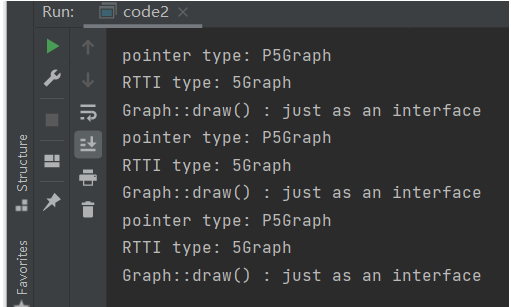
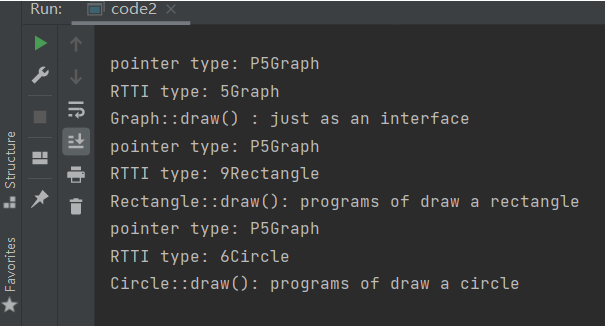
同名覆盖原则:由于基类和派生类的函数名一样,系统无法按原则(原则:先基类,然后对象,最后派生类)调用,就覆盖了。
二元作用域分辨符:可以通过派生类名和作用域分辨符来访问派生类中的同名成员。
类型兼容原则:类型兼容原则是指在需要基类对象的任何地方,都可以使用公有派生类的对象来替代。
通过公有继承,派生类得到了基类中除构造函数、析构函数之外的所有成员。这样,公有派生类实际具备了基类的所有功能,凡是基类能解决的问题,
公有派生类都可以解决。类型兼容原则中所指的替代包含以下情况。
(1)派生类的对象可以隐含转换为基类对象。
(2)派生类的对象可以初始化基类的对象。
(3)派生类的指针可以隐含转换为基类的指针。
在替代后,派生类对象就可以作为基类的对象使用,但只能使用从基类继承的成员。
virtual:定义一个函数为虚函数,不代表函数为不被实现的函数。定义他为虚函数是为了允许用基类的指针来调用子类的这个函数。
//Car.h
#ifndef CODE2_CAR_H
#define CODE2_CAR_H

#include "string"
#include "iostream"

using namespace std;

class Car {
public:
    Car(string ma, string mo, int y) {
        maker = std::move(ma);
        model = std::move(mo);
        year = y;
        odometers = 0;
    }

    ~Car() = default;

    void update_odometers(double o) {
        odometers = o;
    }

    void info() {
        cout << "maker:     " << maker << endl;
        cout << "model:     " << model << endl;
        cout << "year:      " << year << endl;
        cout << "odometers: " << odometers << endl;
    }

    string get_maker() {
        return maker;
    }

    string get_model() {
        return model;
    }

    int get_year() const {
        return year;
    }

    double get_odometers() const {
        return odometers;
    }

private:
    string maker;
    string model;
    int year;
    double odometers;
};


#endif //CODE2_CAR_H
//Battery.h
#ifndef CODE2_BATTERY_H
#define CODE2_BATTERY_H

class Battery {
public:
    Battery(int c = 70) {
        capacity = c;
    }

    ~Battery() = default;

    double get_capacity() {
        return capacity;
    }

    void change_capacity(double b) {
        capacity = b;
    }

private:
    double capacity;
};

#endif //CODE2_BATTERY_H
#ifndef CODE2_ELECTRICCAR_H
#define CODE2_ELECTRICCAR_H

#include "string"
#include "iostream"
#include "Car.h"
#include "Battery.h"

using namespace std;

class ElectricCar : public Car {
public:
    ElectricCar(string ma, string mo, int y, double b = 70) : Car(ma, mo, y) {
        battery.change_capacity(b);

    }

    ~ElectricCar() = default;

    void info() {
        cout << "maker:     " << get_maker() << endl;
        cout << "model:     " << get_model() << endl;
        cout << "year:      " << get_year() << endl;
        cout << "odometers: " << get_odometers() << endl;
        cout << "battery:   " << battery.get_capacity() << "-kw/h" << endl;
    }

private:
    Battery battery;
};


#endif //CODE2_ELECTRICCAR_H
//task3.cpp
#include <iostream>
#include "ElectricCar.h"


int main() {
    using namespace std;

    // test class of Car
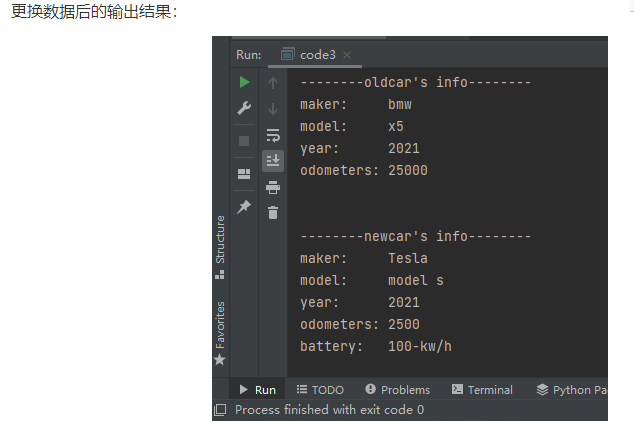
    Car oldcar("Audi", "a4", 2016);
    cout << "--------oldcar's info--------" << endl;
    oldcar.update_odometers(25000);
    oldcar.info();

    cout << endl;

    // test class of ElectricCar
    ElectricCar newcar("Tesla", "model s", 2016);
    newcar.update_odometers(2500);
    cout << "\n--------newcar's info--------\n";
    newcar.info();
}
//pets.h
#ifndef CODE4_PETS_H
#define CODE4_PETS_H

#include "iostream"
#include "string"

using namespace std;

class MachinePets {
private:
    string nickname;
public:
    MachinePets(const string s) {
        nickname = s;
    }

    ~MachinePets() = default;

    string get_nickname() {
        return nickname;
    }

    virtual string talk() {}
};

class PetCats : public MachinePets {
public:
    PetCats(const string s) : MachinePets(s) {}

    string talk() {
        return "miao wu~~~";
    }

};

class PetDogs : public MachinePets {
public:
    PetDogs(const string s) : MachinePets(s) {}

    string talk() {
        return "wang wang~~~";
    }
};

#endif //CODE4_PETS_H
//task4.cpp
#include <iostream>
#include "pets.h"

void play(MachinePets *ptr) {
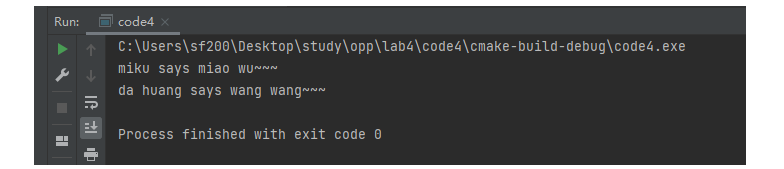
    std::cout << ptr->get_nickname() << " says " << ptr->talk() << std::endl;
}

int main() {
    PetCats cat("miku");
    PetDogs dog("da huang");

    play(&cat);
    play(&dog);
}

 浙公网安备 33010602011771号