
Python3 数据结构
builtins
list
list.append()
list.extend()
del list[index]
list.insert(index, obj)
list.pop([index=-1])
list.remove(obj)
list.reverse()
list.sort(cmp=None, key=None, reverse=False)
list.clear()
list.copy()
示例
>>> list=['a','b','c']
>>> list.append(['d, 'e'])
['a', 'b', 'c',  ['d', 'e'] ]
>>> list.extend(['d','e','f'])
>>> list
['a', 'b', 'c', 'd', 'e', 'f']
tuple
set
set.add(obj)
set.update(set_obj)
set.remove(obj)
# set.pop()  # 随机移除元素
set.discard(obj)
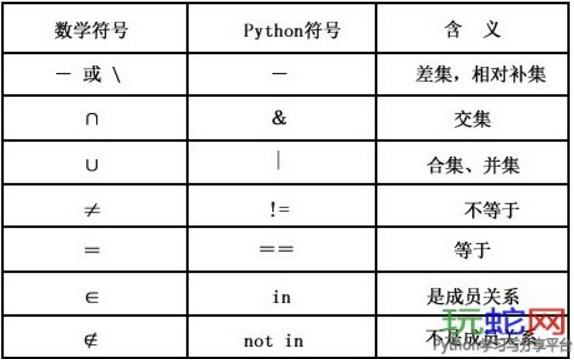
set.union()
set.difference()
set.difference_update()
set.intersection()
set.intersection_update()
set.symmetric_difference()
set.symmetric_difference_update()
set.isdisjoint()
set.issubset()
set.issuperset()
更多的,我们使用set的重载运算符:
dict
dict.clear()
dict.fromkeys(seq[, value])
key (not) in dict  # 判断是否存在该元素(key)
dict[key] = value  # 添加新元素(或改写已有元素)
dict.update(dict2)
dict.keys()  # 返回一个迭代器,内容为dict的key元素,等同于直接迭代dict
dict.values()
dict.items()  # 返回包含 key,value 的迭代器
dict.pop(key[,default])  # 删除字典给定键key所对应的值,返回值为被删除的value。若不存在该元素,返回default值。
# dict.popitem()  # 随机返回并删除字典中的一对键和值(一般删除末尾对)
示例
# 合并字典(方法之一)
dictMerged2 = dict(dict1, **dict2)

# 等同于(方法之二):
dictMerged = dict1.copy()
dictMerged.update(dict2)
str
str.count(sub[, start[, end]])
str.encode(encoding="utf-8", errors="strict")

str.format(*args, **kwargs)  # s = "this is from {}".format(__file__)
str.find(sub[, start[, end]])  # 没有查找到子串,返回-1
str.rfind(sub[, start[, end]])  # 没有查找到子串,则报Except
str.index(sub[, start[, end]])
str.replace(old, new[, count])

str.join(iterable)
str.split(sep=None, maxsplit=-1)
str.splitlines([keepends])
str.strip([chars])
str.lstrip([chars])
str.rstrip([chars])
str.partition(sep)

str.expandtabs(tabsize=8)
str.zfill(width)
str.upper()
str.lower()

str.islower(), c.isalpha(), c.isdecimal(), c.isdigit(), or c.isnumeric()
str.startswith(prefix[, start[, end]])
str.endswith(suffix[, start[, end]])

eval(source[, globals[, locals]])  # 将str作为有效表达式并返回结果
bytes / bytearray
fromhex(string)  # classmethod
encode()  # classmethod

bytes.count(sub[, start[, end]])
bytes.decode(encoding="utf-8", errors="strict")
bytearray.decode(encoding="utf-8", errors="strict")

bytes.find(sub[, start[, end]])
bytearray.find(sub[, start[, end]])
bytes.join(iterable)
bytearray.join(iterable)
bytes.replace(old, new[, count])
bytearray.replace(old, new[, count])
bytes.startswith(prefix[, start[, end]])
bytearray.startswith(prefix[, start[, end]])
enum
示例
from enum import Enum
>>> class Color(Enum):
...     RED = 1
...     GREEN = 2
...     BLUE = 3
>>> print(Color.RED)
array
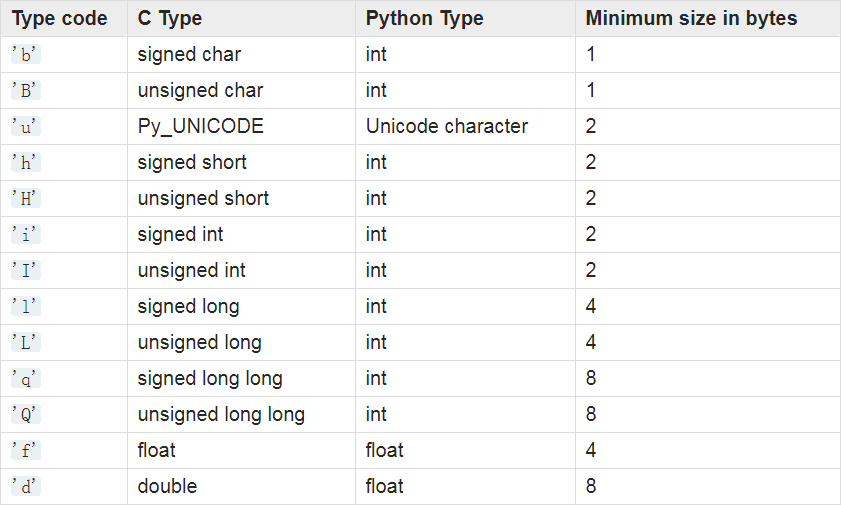
array.itemsize
array.typecode

array.array(typecode[, initializer])
array.frombytes(s)
array.fromlist(list)
array.fromstring()
array.fromunicode(s)

array.tobytes()
array.tolist()
array.tostring()
array.tounicode()

array.count(x)
array.append(x)
array.extend(iterable)
array.pop([i])
array.remove(x)
collections
namedtuple
示例
Point = namedtuple('My_Point', ['x', 'y'])
>>> p = Point(11, y=22)  # p = My_Point(x=11, y=22)
>>> p[0] + p[1]  # indexable like the plain tuple (11, 22)
33
>>> p.x + p.y  # fields also accessible by name
33
OrderedDict
keys()
values()
示例
OrderedDict([('apple', 4), ('banana', 3), ('orange', 2), ('pear', 1)])
OrderedDict(sorted(dict_test.items(), key=lambda t: t[0]))
collections.defaultdict
collections.deque
clear()
copy()
count(x)

append(x)
appendleft(x)
extend(iterable)
extendleft(iterable)
insert(i, x)
index(x[, start[, stop]])

pop()
popleft()
remove(value)
reverse()
collections.Counter
>>> from collections import Counter
>>> c = Counter()
>>> for ch in 'programming':
...     c[ch] = c[ch] + 1
...
>>> c
Counter({'g': 2, 'm': 2, 'r': 2, 'a': 1, 'i': 1, 'o': 1, 'n': 1, 'p': 1})

 浙公网安备 33010602011771号