

SciTech-Mathematics-Probability+Statistics-{Problem,Study,Experiment,Conclusion}-Variables: Confounding/Controlled/{Antecedent,Manipulated,Moderating,Intervening,Response}/Extraneous
Problem>Study>Experiment>Conclusion
Study:
- Communication and Networking: Beliefs, Interests, Requirements.
- Organization: Individuals with common goals.
- Strategy: based on certainty, reduce uncertainty also risk.
- Plan: Management
Experiment :
An experiment is a controlled scientific study.{Conditions,Processes,Outcomes}
- In statistics, we often conduct experiments to understand how changing one variable affects another variable.
- Goal: The goal of an experiment is to "keep" all variables "constant except for" the manipulated variable so that we can attribute any change in the response variable to the changes made in the manipulated variable.
controlled variable : a variable that are intentionally kept constant.
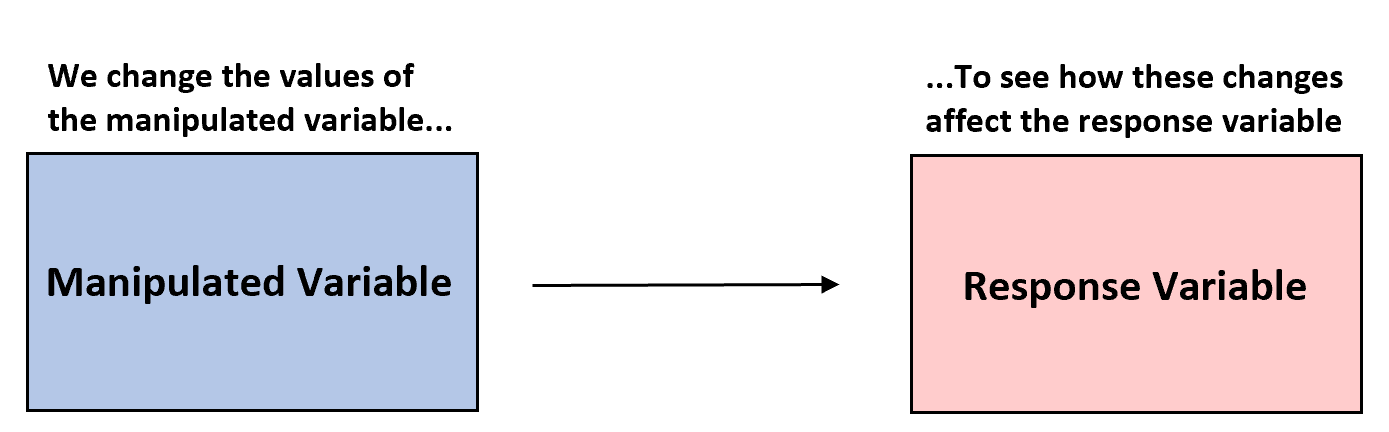
manipulated variable
a variable that we "change or manipulate" to see how that change "affects" some other variable.
it is also sometimes called an independent variable.
response variable
The variable that changes as a result of the manipulated variable being changed.
It is sometimes called a dependent variable because its value often depends on the value of the "manipulated variable".
Variables: Qualitative or Quantitative.
- Qualitative variables are variables that take on names or labels.
Examples include:Gender(Male or Female), Education Level(Bachelor's Degree, Master's Degree, Doctor's Degree, etc.), Marital Status(Single, Married, Divorced) - Quantitative variables are variables that take on numerical values.
Examples include: Age, Height, Square Footage, Population Size
SciTech-Mathematics-Probability+Statistics
-
Confounding
Confounding variable: A variable that is not included in an experiment,
yet affects the relationship between the two variables(dependent and independent) in an experiment.
This type of variable can confound the results of an experiment and lead to unreliable findings.
it can confound the results of a study and make it appear that there exists "some type of cause-and-effect" relationship between two variables that doesn't actually exist.
In order for a variable to be a confounding variable, it must meet the following requirements:- It must be correlated with the independent variable.
- It must have a causal relationship with the dependent variable.
-
Moderating Variable
moderating variable is a type of variable that affects the relationship between a dependent variable and an independent variable.- Moderating variables can be qualitative or quantitative.
- Moderating variables can affect the relationship between an independent and dependent variable in a variety of ways.
Moderating variables can have the following effects: Strengthen/Weaken/Negate the relationship between two variables.
Depending on the situation, a moderating variable can moderate the relationship between two variables in many different ways.
-
Antecedent
A variable that occurs before the independent and dependent variables under study and can help explain the relationship between the two.
You can remember this definition by remembering that the word "antecedent" literally means "previous or preexisting". -
Intervening
Intervening variables pop up in many different research situations.
Variables that come between independent and dependent variables and have a direct effect on the relationship between the two.
Often this type of variable can appear when researchers are studying the relationship between two variables and don't realize that another variable is actually intervening in the relationship. -
Extraneous
Variables that are not of interest in a study, but can affect both the independent and dependent variables.
Manipulated variable
Often in experiments there are also controlled variables, which are variables that are intentionally kept constant.
The goal of an experiment is to keep all variables constant except for the manipulated variable so that we can attribute any change in the response variable to the changes made in the manipulated variable.
Let's check out a couple examples of different experiments to gain a better understanding of manipulated variables.
| Figure0 | Example 1 | Example 2 |
|---|---|---|
 |
 |
 |
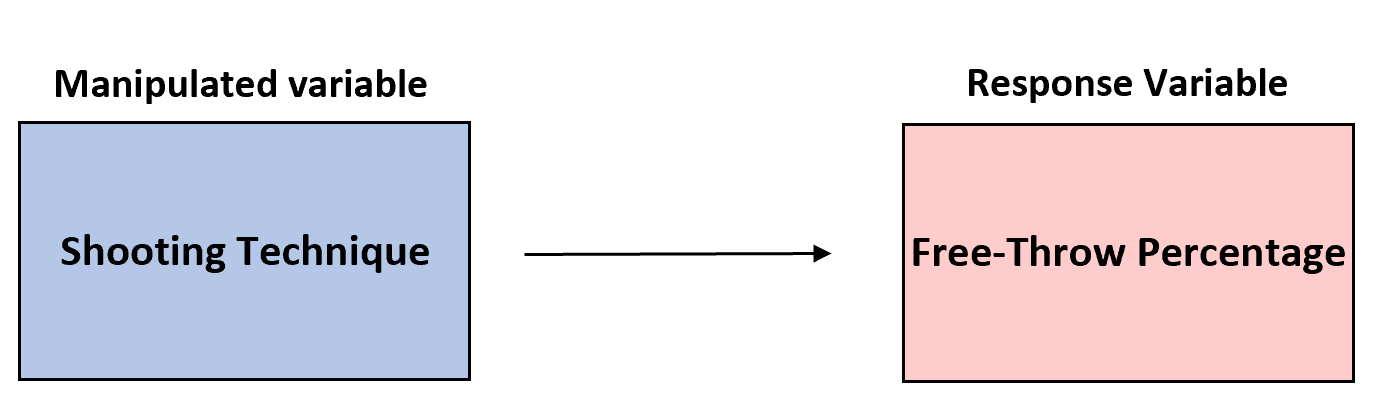
Example 1: Free-Throw Shooting
- Suppose a basketball coach wants to conduct an experiment, to determine if three different shooting techniques affect the free-throw percentage of his players.
- He divides his team into three groups and has each group use a different technique to shoot 100 free-throws.
- He then records the average free-throw percentage for each group.
In this experiment, we would have the following variables:
- Manipulated variable: The shooting technique.
This is the variable that we manipulate to see how it affects free-throw percentage. - Response variable: The free-throw percentage.
This is the variable that changes as a result of the manipulated variable being changed. - Controlled variables:
We would want to make sure that each of the three groups shoot free-throws under the same conditions.
So, variables that we might control include (1) gym lighting, (2) time of day, and (3) gym temperature.
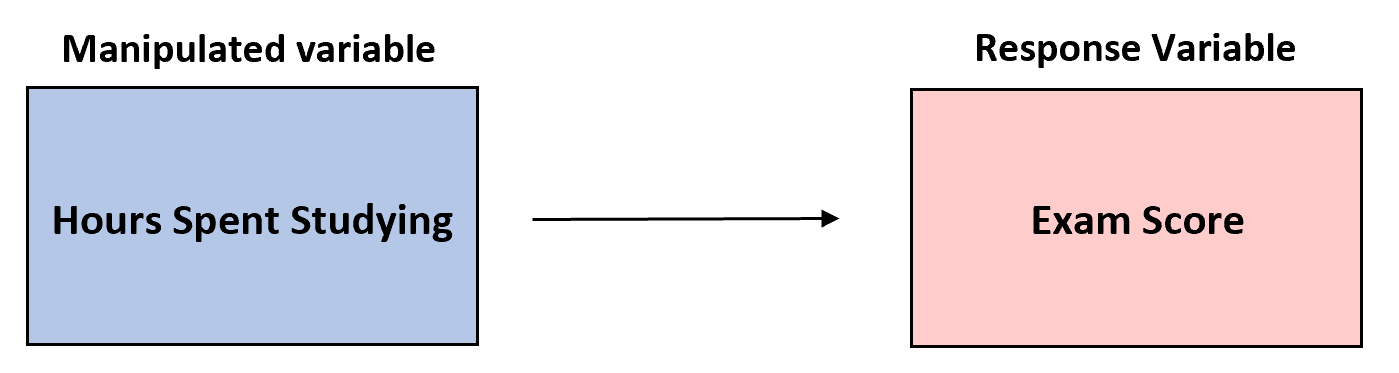
Example 2: Exam Scores
- Suppose a teacher wants to understand how the number of hours spent studying affects exam scores.
- She intentionally has groups of students study for 1, 2, 3, 4, or 5 hours prior to an exam.
She then has each group take the same exam and records the average scores for each group.
In this experiment, we would have the following variables:
- Manipulated variable: The number of hours spent studying.
This is the variable that the teacher manipulates to see how it affects exam scores. - Response variable: The exam scores.
This is the variable that changes as a result of the manipulated variable being changed. - Controlled variables:
We would want to make sure that each of the groups of students take the exam under the same conditions.
So, variables that we might control include (1) time available to complete exam, (2) number of breaks given during exam, and (3) time of day when exam is administered.

 浙公网安备 33010602011771号