
Linguistics-English-Would, Should, and Could: How to Use Them Correctly
https://7esl.com/would-should-could/
Compare Can, Could and Would
- Can: capacity
- Could: possibility
- Would: willingness
Home » Knowledge Base » Grammar » Verbs » Would, Should, and Could: How to Use T...
Would, Should, and Could: How to Use Them Correctly
Last updated on June 18, 2024 by Isabella Claire
Contents
Would, Should, and Could: Understanding the Basics
- Key Takeaways
- Would: Definitions and Usages
- Should: Definitions and Usages
- Could: Definitions and Usages
- Examples in Sentences
- Examples of “Would” in Sentences
- Examples of “Should” in Sentences
- Examples of “Could” in Sentences
- Practice and Application
- Frequently Asked Questions
Helping verbs, also known as auxiliary verbs, are used to extend the main verb’s meaning in a sentence. These action words help in expressing the main verb’s tense and mood. However, if incorrectly used, it might undermine the purpose of having it in the sentence. Therefore, it is essential to know how helping verbs should be used appropriately in a text. Three of the most commonly used helping verbs are ‘would,’ ‘should,’ and ‘could’. They sound almost the same and have the same tense, but those three modal auxiliaries don’t mean the same thing. In this article, we shall tackle how to use the said verbs.
Key Takeaways
- Never forget that ‘would,’ ‘should,’ and ‘could’ are past tense forms of the verbs ‘will,’ ‘shall,’ and ‘can,’ respectively.
- “Would” is used for hypotheticals and future possibilities that may not occur.
‘would’ is a modal auxiliary verb and is the past tense form of ‘will’. - “Should” implies advice, expectation, or probability.
The verb‘should’as the past tense form of ‘shall’** - “Could” expresses past ability or present possibility.
The verb‘could’as the past tense form of ‘can’**
Would, Should, and Could: Understanding the Basics
Would: Definitions and Usages
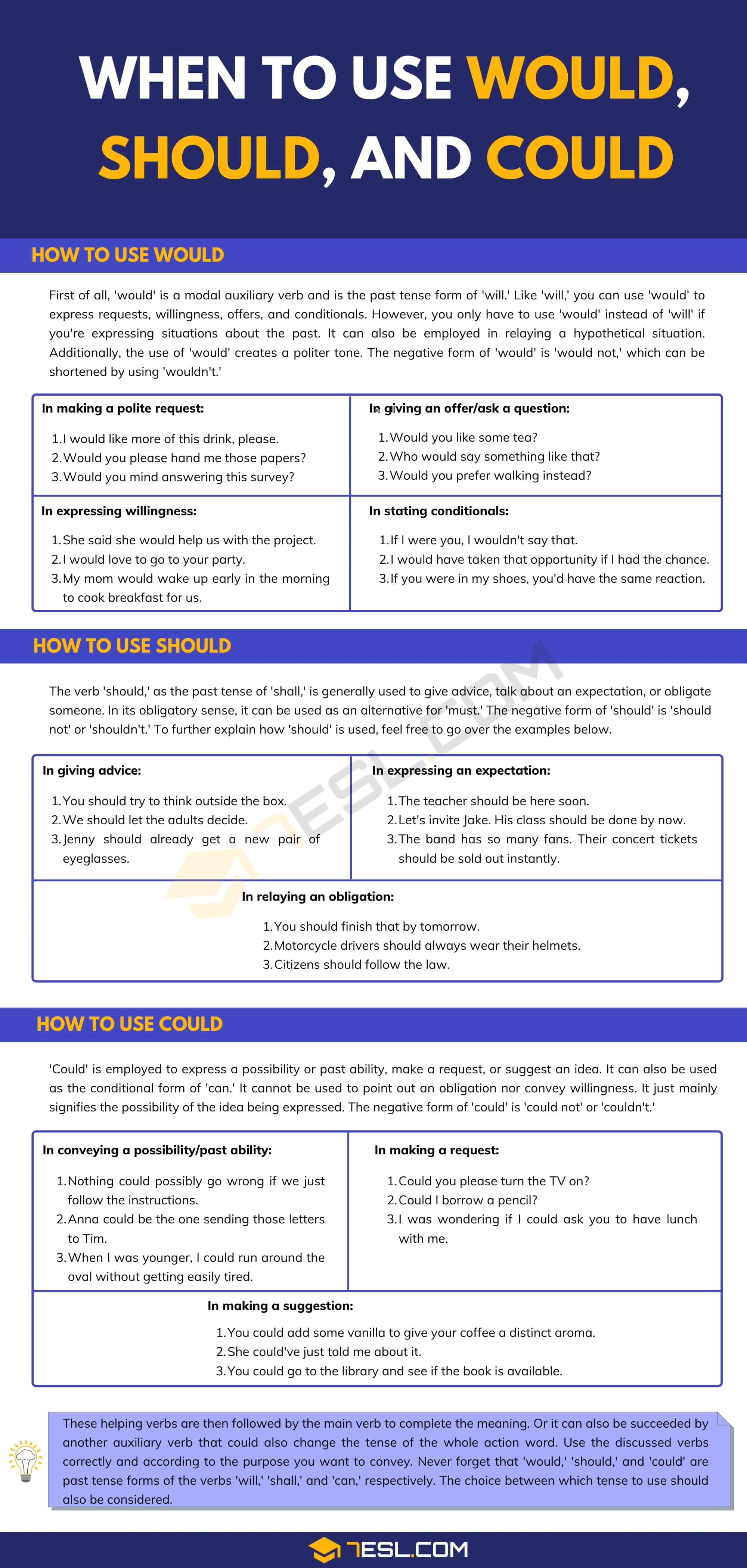
First of all, ‘would’ is a modal auxiliary verb and is the past tense form of ‘will’.
-
Like ‘will,’ you can use ‘would’ to express requests, willingness, offers, and conditionals.
-
However, you only have to use ‘would’ instead of ‘will’ if you’re expressing situations about the past.
-
It can also be employed in relaying a hypothetical situation.
-
Additionally, the use of ‘would’ creates a politer tone.
-
The negative form of ‘would’ is ‘would not,’ which can be shortened by using ‘wouldn’t.’
-
In making a polite request:
1.I would like more of this drink, please.
2.Would you please hand me those papers?
3.Would you mind answering this survey? -
In giving an offer/ask a question:
1.Would you like some tea?
2.Who would say something like that?
3.Would you prefer walking instead? -
In expressing willingness:
1.She said she would help us with the project.
2.I would love to go to your party.
3.My mom would wake up early in the morning to cook breakfast for us. -
In stating conditionals:
1.If I were you, I wouldn’t say that.
2.I would have taken that opportunity if I had the chance.
3.If you were in my shoes, you’d have the same reaction.
Should: Definitions and Usages
The verb ‘should,’ as the past tense of ‘shall’,
-
is generally used to give advice, talk about an expectation, or obligate someone.
-
In its obligatory sense, it can be used as an alternative for ‘must’.
-
The negative form of ‘should’ is ‘should not’ or ‘shouldn’t.’ To further explain how ‘should’ is used, feel free to go over the examples below.
-
In giving advice:
1.You should try to think outside the box.
2.We should let the adults decide.
3.Jenny should already get a new pair of eyeglasses. -
In expressing an expectation:
1.The teacher should be here soon.
2.Let's invite Jake. His class should be done by now.
3.The band has so many fans.
4.Their concert tickets should be sold out instantly. -
In relaying an obligation:
1.You should finish that by tomorrow.
2.Motorcycle drivers should always wear their helmets.
3.Citizens should follow the law.
Could: Definitions and Usages
-
‘Could’ is employed to express a possibility or past ability, make a request, or suggest an idea.
-
It can also be used as the conditional form of ‘can.’
-
It cannot be used to point out an obligation nor convey willingness.
-
It just mainly signifies the possibility of the idea being expressed.
-
The negative form of ‘could’ is ‘could not’ or ‘couldn’t.’
-
In conveying a possibility/past ability:
1.Nothing could go wrong if we just follow the instructions.
2.Anna could be the one sending those letters to Tim.
3.When I was younger, I could run around the oval without getting easily tired. -
In making a request:
1.Could you please turn the TV on?
2.Could I borrow a pencil?
3.I was wondering if I could ask you to have lunch with me. -
In making a suggestion:
1.You could add some vanilla to give your coffee a distinct aroma.
2.She could’ve just told me about it.
3.You could go to the library and see if the book is available.
These helping verbs are then followed by the main verb to complete the meaning.
- It can also be succeeded by another auxiliary verb that could also change the tense of the whole action word.
- Use the discussed verbs correctly and according to the purpose you want to convey.
- Never forget that ‘would,’ ‘should,’ and ‘could’ are past tense forms of the verbs ‘will,’ ‘shall,’ and ‘can,’ respectively.
- The choice between which tense to use should also be considered.
Examples in Sentences
Examples of “Would” in Sentences
1.I would go to the beach if the weather were nicer.
2.She said she would call me when she arrived.
3.He would often visit his grandparents on the weekend.
4.We would like to order dessert after our meal.
5.They would have finished the project, but they ran out of time.
Examples of “Should” in Sentences
1.You should wear a coat; it’s cold outside.
2.She should arrive by 10 AM if the train is on time.
3.He should apologize for what he said earlier.
4.We should save some money for emergencies.
5.They should read the instructions before assembling the furniture.
Examples of “Could” in Sentences
1.I could go to the movie if I finish my work early.
2.She could see the ocean from her hotel room.
3.He could have gone to the concert, but he decided to stay home.
4.We could meet for coffee next week.
5.They could not believe how much the city had changed.
Practice and Application
Multiple Choice
- (A) Would (B) Should (C) Could you help me move this heavy table?
- I (A) would (B) should (C) could have gone to the concert, but I decided to stay home.
- You (A) would (B) should (C) could see a doctor if you’re feeling unwell.
- (A) Would (B) Should (C) Could you have done anything differently to change the outcome?
- If I had the money, I (A) would (B) should (C) could travel around the world.
- (A) Would (B) Should (C) Could you be so kind as to close the window?
- He (A) would (B) should (C) could win the race if he trains hard enough.
- (A) Would (B) Should (C) Could I borrow your pen for a moment?
- You (A) would (B) should (C) could take an umbrella in case it rains.
- I (A) would (B) should (C) could have arrived earlier, but there was traffic.
Answers
- C) Could
- A) could
- B) Should
- C) Could
- A) would
- C) Could
- C) could
- C) Could
- B) Should
- A) could
Frequently Asked Questions
-
What are modal auxiliary verbs?
Modal auxiliary verbs are special verbs that add more meaning to the main verb in a sentence. They include words like could, would, and should. -
When do we use ‘could’?
Could is used:- To ask for something politely: “Could you pass the salt, please?”
- To suggest a possibility: “You could take the bus if the train is late.”
- To imply a past ability: “When I was young, I could run very fast.”
-
How is ‘would’ applied?
Would is often utilized:- To make polite requests or offers: “Would you like some coffee?”
- To describe a future event from a past perspective: “We knew it would rain today.”
- In conditional sentences: “I would travel more if I had the money.”
-
In what situations should ‘should’ be used?
Should apply when:- Giving advice: “You should check your answers before submitting the test.”
- Talking about expectations: “They should arrive by now.”
- Expressing an obligation: “You should wear a seatbelt when driving.”
-
Remember, while these auxiliary verbs enhance our sentences, each carries its nuances and rules of application. Here are examples to show the correct usage:
- Could: We could go to the park tomorrow if the weather is nice.
- Would: We would love to join you for dinner next Friday.
- Should: We should always recycle to help the environment.
About Latest Posts
Isabella Claire
At 7ESL, we empower English learners with advanced AI technology. Our innovative tools and resources help users speak fluently and improve their writing skills, supporting learners at every level in mastering English.
can,will, would, could,may,might 的区别
Posted on 2012-02-27 18:17
解答 “情态动词”表示“猜测”的试题时,
-
一要确定: 被猜测的时间,
-
情态动词表示猜测时 语气从强到弱 的顺序是:
must, will, would, ought to, should, can, may, could, might. -
二要确定: 有无客观事实根据.
- 若有客观事实根据, 则:
无论是 肯定还是否定 的猜测,
猜测语气最强 且 符合时间要求 的为最佳答案; - 若无客观事实根据, 纯凭主观臆断,
则猜测语气最弱且符合时间要求的为最佳答案.
- 若有客观事实根据, 则:
如:
-
I thought you __________ like something to read,so I have brought you some books.(MET 1986)
A.may B.might C.could D.must
由题意可知被猜测的时间是(过去)将来,没有客观事实根据,猜测语气要求最弱,所以正确选项是B. -
Peter __________ come with us tonight,but he isn't sure yet.(MET 1993)
A.must B.may C.can D.will
由题意可知被猜测的时间是将来,没有客观事实根据,猜测语气要求最弱,所以正确选项是B. -
It __________ last night,for the ground was wet this morning.
A.must have rained B.may have rained C.must rain D.might rain
由题意可知被猜测的时间是过去,有客观事实根据the ground was wet,猜测语气要求最强,所以正确选项是A. -
Mary __________ be in Paris,for I saw her in the town only a few minutes ago.(MET 1994)
A.mustn't B.can't C.shouldn't D.may not
由题意可知被猜测的时间是现在,
有客观事实根据I saw her in the town a few minutes ago,
猜测语气要求最强,
所以正确选项是B(can't是m ust的否定式). -
—There were already five people in the car but they managed to take me as well.
—It __________ a comfortable journey.(NMET 1995)
A.can't be B.shouldn't be C.mustn't have been D.couldn't have been
由题意可知: 被猜测的时间是过去,
有客观事实根据there were already five people...take me as well,
猜测语气要求最强,所以正确选项是D. -
—When can I come for the photos I need them tomorrow afternoon?
—They __________ be ready by 12:00.(NMET 1998)
A.can B.should C.might D.need
由题意可知被猜测的时间是将来,
有客观事实根据need them tomorrow afternoon,
猜测语气要求最强,所以正确选项是B. -
—Are you coming to Jeff's Part?
—I'm not sure. I __________ go to the concert instead.(NMET 2000)
A.must B.would C.might D.should
由题意可知被猜测的时间是将来,
没有客观事实根据,
猜测语气要求最弱,
所以正确选项是C.
“情态动词”的“推测”性用法
用适当的“情态动词”表示讲话者“对客观事物”的“主观看法”,
这就是“情态动词”的“推测”性用法.
常用来“表示推测”的“情态动词”有:
might, may, must, can, might, may, must
表示的可能性程度由弱变强.
must表示"一定", can则一般用于疑问句或否定句.
例如:
- They must be talking about us on the radio right now.
此刻,他们一定在电台里谈论我们的情况. - She may have missed her train.
她可能没有赶上火车. - I don't know why he is late,he might have had an accident.
我不知道他为何迟到,可能遇上了事故. - Where can John have put the matches He can't have thrown them away.
约翰会把火柴放在哪儿呢 他不可能把火柴扔掉的. - That can't be the postman,it's only seven o'clock.
才七点钟,不可能是邮递员.
表示推测的情态动词后的动词不定式可用完成式,进行式和一般式三种.
用完成式表示对过去情况的推测.例如:
6. Her father thought that she must have met a fairy.
她父亲认为她一定碰上了仙女.
7. They must have studied English for years.
他们学习英语肯定有几年了.
8. You may have left your glasses at the office.
你可能把眼镜忘在办公室了.
用进行式则表示对正在发生的动作的推测.例如:
9. He might be reading a newspaper now.
他可能正在看报纸.
10. He can't be working at this hour.
这个时候他肯定不会在工作.
推测性情态动词后用不定式的一般式有两种情况:如果不定式是状态动词,则表示对现在状态的推测.如果不定式是动作动词,则表示对将来动作的推测.例如:
11. Mary must have some problem ,she keeps crying.
玛丽不停地哭,一定有了麻烦.
12. I saw that the camel must be blind in the right eye.
我知道这只骆驼右眼肯定瞎了.
13. Our team must win the game.
=I'm sure that our team will win the game.
我们队肯定能赢这场比赛.
14. It might rain this evening.
=It's possible that it will rain this evening.
今天傍晚天可能要下雨.
上述表明,推测性情态动词是以现在(讲话时)为基础,
对过去,现在,将来的动作或状态的推测.
因此,在构成陈述部分含有推测性情态动词的反意疑问句时,
要注意反意疑问句中动词的不同形式.
例如:
15. The boy must have thought John was mad,didn't he
那孩子肯定以为约翰疯了,是吗
16. Our teacher must have looked through our papers,hasn't he
老师一定批完了我们的试卷,是吗
17. She must be playing basketball,isn't she
她一定在打篮球,是吗
选择下列各句的正确答案.
- Hurry up,our teacher _____ for us at the school gate.
A.must be waiting B.must wait C.might waiting D.can be waiting - She doesn't answer the doorbell,she _____ be asleep.
A.might to B.might C.must have D.should - "What has happened to George ""I don't know,he _____ lost."
A.can have got B.may have got C.might get D.could get - Mr Li _____ be in Beijing because I saw him in town only a few minutes ago.
A.needn't B.can't C.shouldn't D.mustn't - We can't blame John for the mistake.He wasn't here when we decided what to do.So _____ he about the plan.
A.wasn't B.was known C.can't be known D.couldn't have known - My ballpen is nowhere to be found,I _____ while I was playing football.
A.must drop it B.should have dropped it C.must have dropped it D.had dropped - It _____ be Li Ming who took my dictionary away.It be Zhang Hua who did it.
A.can't;must B.mustn't;must C.needn't;can D.may not;can - The streets are all wet;It _____ rained heavily last night.
A.should B.should have C.must D.must have - Tom must have learned Chinese for several years, _____ he
A.mustn't B.hasn't C.didn't D.don't - Mr Wang must be at home now, _____ he
A.mustn't B.doesn't C.isn't D.wasn't - She must have left for Shanghai, _____ she
A.mustn't B.hasn't C.didn't D.doesn't
Key:1.A 2.B 3.B 4.B 5.D 6.C 7.A 8.D 9.B 10.C 11.C
-
must/may/might + have done 表对过去动作、事实、状态推测
FOR EXAMPLE:
He must have arrived already. 他一定已经到了。
They may have seen him. 他们可能见到过他。
They might not have considered me as their friend. 或许他们没把我当成他们的朋友。<表示本来或许可以的,但事实已不可能了>
You might have let me known before! 你要是早点让我知道就好了。<用来表示轻微的埋怨或批评>
It was really very dangerous. You might have injured him. 真是很悬。你有可能把他打伤了。<用在含蓄条件句>
If I had been less cautious I might have seen more wise. 如果我不那么谨慎,或许反倒聪明点。<用在虚拟语气> -
could/can + have done 表埋怨,能做的没做
could/can not + have done 表"不能做的"做了, FOR EXAMPLE,
You can have given me the book earlier. 你本来可以早点把书给我的。
You can not have forgotten me. 你不可能已忘记我了。
Indications are that the accident could have been prevented. 迹象表明,本来这次事故是可以避免的。 -
should/ought to + have done 表埋怨,该做的未做
should/ought not to + have done 表"不该做的"做了, FOR EXAMPLE,
He shouldn't have come to school at 9:00 am. 他不该早上9:00来上学。
He ought to have done the work himself. 这个工作他是应该自己做的。
They oughtn't to have let you out of hospital so soon. 他们不应当让你这么早出院。
肯定的+have done表示 "本应该做" 而 "实际上没做"
否定的+have done表示 "本不应该做" 而 "实际上做了"
分类: English

 浙公网安备 33010602011771号