

【live555实战2】基于树莓派的取流-编码-推流
1.架构设计
1.1 核心类关系图
RTSP Client
    ↓ (RTSP SETUP/PLAY)
V4L2RTSPServer (main入口)
    ↓ (lookup "live")
ServerMediaSession("live")
    ↓ (addSubsession)
H264LiveVideoServerMediaSubsession("/dev/video0")
    │
    ├─ createNewStreamSource() → H264LiveVideoSource → (V4L2 + x264)
    │                              ↑
    │                              └── wrapped by ← H264VideoStreamFramer
    │
    └─ createNewRTPSink() → H264VideoRTPSink
                                  ↑
                                  └── fed by ← FramedSource (from framer)
1.2 核心类功能角色与职责
V4L2RTSPServer - (继承自DynamicRTSPServer)
角色:RTSP服务器
用于监听RTSP请求(端口554/8554),当客户端请求rtsp://.../live时,调用lookupServerMediaSession("live"),硬编码创建H264LiveVideoServerMediaSubsession
V4L2RTSPServer继承DynamicRTSPServer是因为它能按需创建ServerMediaSession,适合动态流,如Camera,而不是静态文件(DynamicRTSPServer的源文件是现成的,从mediaServer目录下直接拿来的)
H264LiveVideoServerMediaSubsession (继承自OnDemandServerMediaSubsession)
角色:媒体会话的"工厂",按需创建数据源和RTP打包器
数据源:createNewStreamSource() -> 返回H264VideoStreamFramer
RTP打包器:createNewRTPSink() -> 返回H264VideoRTPSink
它不提前创建摄像头源,只有当客户端连接时才创建,这样更节省资源
每次新客户端都新建source,因为reuseFirstSource = false
这是live555的"On-Demand模式":懒加载+多客户端独立流 --- 这样的优势是什么呢?
H264LiveVideoSource - 继承自FramedSource
角色:原始H.264帧生产者
1.打开/dev/video0
2.启动捕获线程captureThread
3.YUYV->I420转换
4.调用x264编码
5.将完整Annex B格式的H.264码流,含start code,放入队列
6.通过doGetNextFrame()/deliverFrame()异步输出帧
为什么要继承FramedSource?
因为它是live555中所有帧源的基类,提供fTo,fMaxSize,afterGettting()等标准接口,但它不是直接给RTPSink用的,必须被H264VideoStreamFramer包装
H264VideoStreamFramer - live555内置类
角色:H264流解析器
1.从H264LiveVideoSource读取数据
2.解析Annex B start code (0x00000001)
3.提取单个 NAL 单元(SPS/PPS/IDR/P-frame)
4.按需插入 SPS/PPS(如果 b_repeat_headers=1)
为什么必须要用它?
因为 H264VideoRTPSink 只接受单个 NAL 单元,不能处理带 start code 的完整流!这是解决 "source is not compatible" 的关键
H264VideoRTPSink - live555内置类
角色:RTP打包 & 发送
1.接收H264VideoStreamFramer输出的NAL单元
2.按RFC 6184 打包成RTP包,是单NAL/FU-A分片
3.通过UDP发送给客户端
H264VideoRTPSink会有兼容检测
Boolean H264VideoRTPSink::sourceIsCompatibleWithUs(MediaSource& source) {
    return source.isH264VideoStreamFramer(); // ← 必须是 framer!
}
2.源码实现
在live555根目录下创建v4l2MediaServer路径,并创建以下文件
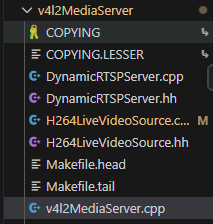
H264LiveVideoSource.hh
/**********
 * H264LiveVideoSource.hh
 * A FramedSource that captures from V4L2 and encodes with x264 in real-time.
 **********/

#ifndef _H264_LIVE_VIDEO_SOURCE_HH
#define _H264_LIVE_VIDEO_SOURCE_HH

#include "FramedSource.hh"
#include <linux/videodev2.h>
#include <x264.h>
#include <thread>
#include <queue>
#include <mutex>
#include <condition_variable>
#include <atomic>

#include "OnDemandServerMediaSubsession.hh"

class H264LiveVideoSource : public FramedSource {
public:
    static H264LiveVideoSource* createNew(UsageEnvironment& env, char const* devName = "/dev/video0");

    // Implement pure virtual function
    virtual void doGetNextFrame();

    // Callback for scheduled frame delivery
    static void deliverFrame0(void* clientData);

    // 添加这两个虚函数
    virtual char const* mediumName() const  { return "video"; }
    virtual char const* mimeType() const  { return "H264"; }

    static const int BUF_COUNT = 4;

    bool isInitialized() const { return !fDone.load(); }

protected:
    // 构造函数设为 private,只允许 createNew 调用
    H264LiveVideoSource(UsageEnvironment& env, char const* devName);

    virtual ~H264LiveVideoSource();

private:
    void captureThread();
    void closeV4L2();
    int initV4L2(char const* devName);
    int initX264(int width, int height);
    void closeX264();
    void encodeAndQueueFrame(unsigned char* y, unsigned char* u, unsigned char* v);

    // Frame delivery logic
    void deliverFrame();

    // V4L2 members
    int fFd;
    static const unsigned int kMaxBuffers = 10;
    void* fBuffers[kMaxBuffers];
    size_t fBufferLengths[kMaxBuffers];   // ← 新增:每个 buffer 的长度
    unsigned int fBufferCount;            // ← 新增:实际 buffer 数量

    // Video format
    int fWidth, fHeight;
    int fStrideY, fStrideU, fStrideV;

    // x264 members
    x264_param_t fParam;
    x264_t* fEncoder;
    x264_picture_t fPicIn,fPicOut;

    // Threading & buffering
    std::thread* fCaptureThread;
    std::queue<std::vector<uint8_t>> fFrameQueue;
    std::mutex fQueueMutex;
    std::condition_variable fQueueCond;
    std::atomic<bool> fDone{false};

};

// Forward declaration
class H264LiveVideoServerMediaSubsession;

class H264LiveVideoServerMediaSubsession : public OnDemandServerMediaSubsession {
public:
    static H264LiveVideoServerMediaSubsession* createNew(UsageEnvironment& env, char const* devName); // ← 改为传 devName
protected:
    H264LiveVideoServerMediaSubsession(UsageEnvironment& env, char const* devName);
    virtual ~H264LiveVideoServerMediaSubsession();
    virtual FramedSource* createNewStreamSource(unsigned clientSessionId, unsigned& estBitrate);
    virtual RTPSink* createNewRTPSink(Groupsock* rtpGroupsock, unsigned char rtpPayloadTypeIfDynamic, FramedSource* inputSource);
private:
    char* fDevName; // ← 存储设备名,而不是 source 指针
};


#endif
H264LiveVideoSource.cpp
/**********
 * H264LiveVideoSource.cpp
 **********/

#include "H264LiveVideoSource.hh"
#include <sys/ioctl.h>
#include <sys/mman.h>
#include <sys/select.h>
#include <fcntl.h>
#include <unistd.h>
#include <cstring>
#include <cerrno>

#include "H264VideoRTPSink.hh"
#include "H264VideoStreamFramer.hh"

// ------------------ Public API ------------------

H264LiveVideoSource* H264LiveVideoSource::createNew(UsageEnvironment& env, char const* devName) {
    H264LiveVideoSource* source = new H264LiveVideoSource(env, devName);
    if (source->fDone) {
        delete source;
        return nullptr;
    }
    return source;
}

void H264LiveVideoSource::doGetNextFrame() {
    // Schedule immediate delivery (asynchronous)
    envir().taskScheduler().scheduleDelayedTask(0, deliverFrame0, this);
}

void H264LiveVideoSource::deliverFrame0(void* clientData) {
    ((H264LiveVideoSource*)clientData)->deliverFrame();
}

// ------------------ Constructor / Destructor ------------------

H264LiveVideoSource::H264LiveVideoSource(UsageEnvironment& env, char const* devName)
    : FramedSource(env),
      fFd(-1),
      fBuffers(),
      fBufferLengths(),
      fBufferCount(0),
      fWidth(1280),
      fHeight(720),
      fStrideY(0),
      fStrideU(0),
      fStrideV(0),
      fParam(),
      fEncoder(nullptr),
      fPicIn(),
      fCaptureThread(nullptr),
      fDone(false)
{
    fprintf(stderr, "[DEBUG] H264LiveVideoSource CTOR: %p\n", this);

    // 初始化 buffer 指针
    for (unsigned int i = 0; i < kMaxBuffers; ++i) {
        fBuffers[i] = nullptr;
        fBufferLengths[i] = 0;
    }

    // 关键:如果任一初始化失败,设置 fDone = true
    if (initV4L2(devName) != 0 || initX264(fWidth, fHeight) != 0) {
        fDone = true; // 标记为无效
        return;       // 不启动线程
    }

    // debug
    struct v4l2_format fmt = {};
    fmt.type = V4L2_BUF_TYPE_VIDEO_CAPTURE;
    if (ioctl(fFd, VIDIOC_G_FMT, &fmt) == 0) {
        fprintf(stderr, "V4L2 actual: %dx%d, bytesperline=%d, sizeimage=%d\n",
                fmt.fmt.pix.width, fmt.fmt.pix.height,
                fmt.fmt.pix.bytesperline, fmt.fmt.pix.sizeimage);
    }

    fCaptureThread = new std::thread(&H264LiveVideoSource::captureThread, this);

    // 在 H264LiveVideoSource 构造函数末尾(初始化成功后)
    fprintf(stderr, "[DEBUG] medium=%s, mime=%s\n", mediumName(), mimeType());
}

H264LiveVideoSource::~H264LiveVideoSource() {
    fprintf(stderr, "[DEBUG] H264LiveVideoSource DTOR: %p\n", this);

    fDone = true;
    if (fCaptureThread) {
        fCaptureThread->join();
        delete fCaptureThread;
    }
    closeX264();
    closeV4L2();
}

// ------------------ Frame Delivery ------------------

void H264LiveVideoSource::deliverFrame() {
    if (!isCurrentlyAwaitingData()) return;

    std::unique_lock<std::mutex> lock(fQueueMutex);
    if (fFrameQueue.empty()) {
        fQueueCond.wait(lock, [this] { return !fFrameQueue.empty() || fDone; });
    }
    if (fDone || fFrameQueue.empty()) return;

    auto frame = std::move(fFrameQueue.front());
    fFrameQueue.pop();
    lock.unlock();

    unsigned int dataSize = frame.size();
    if (dataSize > fMaxSize) dataSize = fMaxSize;
    memcpy(fTo, frame.data(), dataSize);

    fFrameSize = dataSize;
    fNumTruncatedBytes = frame.size() - dataSize;
    gettimeofday(&fPresentationTime, NULL);

    afterGetting(this);
}

// ------------------ V4L2 ------------------

int H264LiveVideoSource::initV4L2(char const* devName) {
    fFd = ::open(devName, O_RDWR | O_NONBLOCK);
    if (fFd < 0) {
        envir() << "Failed to open " << devName << ": " << strerror(errno) << "\n";
        return -1;
    }

    struct v4l2_format fmt = {};
    struct v4l2_requestbuffers req = {};
    struct v4l2_buffer buf = {};
    enum v4l2_buf_type type = V4L2_BUF_TYPE_VIDEO_CAPTURE;

    fmt.type = V4L2_BUF_TYPE_VIDEO_CAPTURE;
    fmt.fmt.pix.width = fWidth;
    fmt.fmt.pix.height = fHeight;
    fmt.fmt.pix.pixelformat = V4L2_PIX_FMT_YUYV;
    fmt.fmt.pix.field = V4L2_FIELD_NONE;
    if (::ioctl(fFd, VIDIOC_S_FMT, &fmt) < 0) {
        envir() << "VIDIOC_S_FMT failed for " << devName
                << " (" << fWidth << "x" << fHeight << "): " << strerror(errno) << "\n";
        goto error;
    }

    req.count = BUF_COUNT;
    req.type = V4L2_BUF_TYPE_VIDEO_CAPTURE;
    req.memory = V4L2_MEMORY_MMAP;

    if (ioctl(fFd, VIDIOC_REQBUFS, &req) < 0) {
        envir() << "VIDIOC_REQBUFS failed: " << strerror(errno) << "\n";
        goto error;
    }
    if (req.count < static_cast<unsigned int>(BUF_COUNT)) {
        envir() << "Insufficient buffer count\n";
        goto error;
    }

    // 初始化 buffer 管理变量
    fBufferCount = req.count;
    for (unsigned int i = 0; i < fBufferCount; ++i) {
        fBuffers[i] = nullptr;
        fBufferLengths[i] = 0;
    }

    for (unsigned int i = 0; i < req.count; ++i) {
        memset(&buf, 0, sizeof(buf));
        buf.type = V4L2_BUF_TYPE_VIDEO_CAPTURE;
        buf.memory = V4L2_MEMORY_MMAP;
        buf.index = i;
        if (::ioctl(fFd, VIDIOC_QUERYBUF, &buf) < 0) goto error;
        fBuffers[i] = ::mmap(NULL, buf.length, PROT_READ | PROT_WRITE, MAP_SHARED, fFd, buf.m.offset);
        fBufferLengths[i] = buf.length;
        if (ioctl(fFd, VIDIOC_QBUF, &buf) < 0) {
            envir() << "VIDIOC_QBUF failed: " << strerror(errno) << "\n";
            goto error;
        }

    }

    if (::ioctl(fFd, VIDIOC_STREAMON, &type) < 0) goto error;
    return 0;

error:
    envir() << "V4L2 init failed\n";
    // 尝试清理已 mmap 的 buffers
    for (unsigned int i = 0; i < fBufferCount; ++i) {
        if (fBuffers[i] != nullptr && fBuffers[i] != MAP_FAILED) {
            ::munmap(fBuffers[i], fBufferLengths[i]);
            fBuffers[i] = nullptr;
        }
    }
    if (fFd >= 0) ::close(fFd);
    fFd = -1;
    return -1;
}

void H264LiveVideoSource::closeV4L2() {
    if (fFd >= 0) {
        enum v4l2_buf_type type = V4L2_BUF_TYPE_VIDEO_CAPTURE;
        ::ioctl(fFd, VIDIOC_STREAMOFF, &type);
        // 释放所有 mmap 缓冲区
        for (unsigned int i = 0; i < fBufferCount; ++i) {
            if (fBuffers[i] != nullptr && fBuffers[i] != MAP_FAILED) {
                ::munmap(fBuffers[i], fBufferLengths[i]);
                fBuffers[i] = nullptr;
            }
        }
        ::close(fFd);
        fFd = -1;
    }
}

// ======================
// YUYV 转 I420
// ======================
void yuyv_to_i420(const unsigned char* yuyv,
                  unsigned char* y, unsigned char* u, unsigned char* v,
                  int width, int height) {
    const int y_stride = width;
    const int uv_stride = width / 2;
    const int yuyv_stride = width * 2;

    for (int i = 0; i < height; ++i) {
        const unsigned char* src = yuyv + i * yuyv_stride;
        unsigned char* dst_y = y + i * y_stride;

        for (int j = 0; j < width; j += 2) {
            dst_y[j]     = src[j * 2];     // Y0
            dst_y[j + 1] = src[j * 2 + 2]; // Y1
        }

        // Only write UV for even rows (I420 subsamples vertically)
        if (i % 2 == 0) {
            unsigned char* dst_u = u + (i / 2) * uv_stride;
            unsigned char* dst_v = v + (i / 2) * uv_stride;
            for (int j = 0; j < uv_stride; ++j) {
                dst_u[j] = src[j * 4 + 1]; // U
                dst_v[j] = src[j * 4 + 3]; // V
            }
        }
    }
}

// ------------------ x264 ------------------

int H264LiveVideoSource::initX264(int width, int height) {
    x264_param_default_preset(&fParam, "ultrafast", "zerolatency");
    fParam.i_width = width;
    fParam.i_height = height;
    fParam.b_repeat_headers = 1;  // Include SPS/PPS in every keyframe
    fParam.i_fps_num = 25;
    fParam.i_fps_den = 1;
    fParam.i_threads = 1;
    fParam.b_intra_refresh = 1;
    fParam.rc.i_bitrate = 2000;
    fParam.rc.i_rc_method = X264_RC_ABR;
    fParam.i_threads = 1;
    fParam.i_level_idc = 40;
    if (x264_param_apply_profile(&fParam, "high") < 0) return -1;

    fEncoder = x264_encoder_open(&fParam);
    if (!fEncoder) return -1;
    return 0;
}

void H264LiveVideoSource::closeX264() {
    if (fEncoder) {
        x264_encoder_close(fEncoder);
        fEncoder = nullptr;
    }
}

void H264LiveVideoSource::encodeAndQueueFrame(unsigned char* y, unsigned char* u, unsigned char* v) {
    if (!fEncoder) return;

    x264_picture_init(&fPicIn);
    fPicIn.i_pts = 0;

    fPicIn.img.i_csp = X264_CSP_I420;
    fPicIn.img.i_plane = 3;
    fPicIn.img.plane[0] = y;
    fPicIn.img.plane[1] = u;
    fPicIn.img.plane[2] = v;
    fPicIn.img.i_stride[0] = fWidth;
    fPicIn.img.i_stride[1] = fWidth / 2;
    fPicIn.img.i_stride[2] = fWidth / 2;
    fPicIn.i_pts++;

    x264_nal_t* nals;
    int i_nals;
    int ret = x264_encoder_encode(fEncoder, &nals, &i_nals, &fPicIn, &fPicOut);
    if (ret < 0) {
        envir() << "x264 encode failed!\n";
        return;
    }
    if (ret == 0) return;


    std::vector<uint8_t> frame;
    for (int i = 0; i < i_nals; ++i) {
        frame.insert(frame.end(), nals[i].p_payload, nals[i].p_payload + nals[i].i_payload);
    }

    {
        std::lock_guard<std::mutex> lock(fQueueMutex);
        fFrameQueue.push(std::move(frame));
    }
    fQueueCond.notify_one();
}

// ------------------ Capture Thread ------------------

void H264LiveVideoSource::captureThread() {

    size_t y_size = fWidth * fHeight;
    size_t uv_size = y_size / 4;
    std::unique_ptr<unsigned char[]> y_plane(new unsigned char[y_size]);
    std::unique_ptr<unsigned char[]> u_plane(new unsigned char[uv_size]);
    std::unique_ptr<unsigned char[]> v_plane(new unsigned char[uv_size]);

    while (!fDone) {
        fd_set fds;
        FD_ZERO(&fds);
        FD_SET(fFd, &fds);
        struct timeval tv = {0, 50000}; // 50ms timeout
        if (::select(fFd + 1, &fds, NULL, NULL, &tv) <= 0)
        {
            if (fDone) break;
            continue;
        }

        struct v4l2_buffer buf = {};
        buf.type = V4L2_BUF_TYPE_VIDEO_CAPTURE;
        buf.memory = V4L2_MEMORY_MMAP;
        if (::ioctl(fFd, VIDIOC_DQBUF, &buf) < 0) break;

        yuyv_to_i420((uint8_t*)fBuffers[buf.index], y_plane.get(), u_plane.get(), v_plane.get(),
                         fWidth, fHeight);

        encodeAndQueueFrame(y_plane.get(), u_plane.get(), v_plane.get());
        ::ioctl(fFd, VIDIOC_QBUF, &buf);
    }
}

// ------------------ H264LiveVideoServerMediaSubsession ------------------

// 替换原来的 createNew 和构造函数
H264LiveVideoServerMediaSubsession*
H264LiveVideoServerMediaSubsession::createNew(UsageEnvironment& env, char const* devName) {
    return new H264LiveVideoServerMediaSubsession(env, devName);
}

H264LiveVideoServerMediaSubsession::H264LiveVideoServerMediaSubsession(UsageEnvironment& env, char const* devName)
    : OnDemandServerMediaSubsession(env, false), // ← 注意:reuseFirstSource = false
      fDevName(strdup(devName)) {
}

H264LiveVideoServerMediaSubsession::~H264LiveVideoServerMediaSubsession() {
    free(fDevName);
}

FramedSource* H264LiveVideoServerMediaSubsession::createNewStreamSource(unsigned /*clientSessionId*/, unsigned& estBitrate) {
    estBitrate = 2000; // kbps

    // 1. 创建原始 H.264 源
    H264LiveVideoSource* rawSource = H264LiveVideoSource::createNew(envir(), fDevName);
    if (rawSource == nullptr) return nullptr;

    // 2. 用 H264VideoStreamFramer 包装它
    return H264VideoStreamFramer::createNew(envir(), rawSource);
}

RTPSink* H264LiveVideoServerMediaSubsession::createNewRTPSink(Groupsock* rtpGroupsock, unsigned char rtpPayloadTypeIfDynamic, FramedSource* /*inputSource*/) {
    return H264VideoRTPSink::createNew(envir(), rtpGroupsock, rtpPayloadTypeIfDynamic);
}
v4l2MediaServer.cpp
/**********
 * v4l2MediaServer.cpp
 * RTSP server that streams live H.264 from V4L2 camera.
 **********/

#include <BasicUsageEnvironment.hh>
#include "DynamicRTSPServer.hh"
#include "H264LiveVideoSource.hh"
#include "GroupsockHelper.hh"

// Custom subclass of DynamicRTSPServer to handle "live" stream
class V4L2RTSPServer : public DynamicRTSPServer {
public:
    static V4L2RTSPServer* createNew(UsageEnvironment& env, Port port,
        UserAuthenticationDatabase* authDB = NULL,
        unsigned reclamationTestSeconds = 65) {
        int ourSocketIPv4 = setUpOurSocket(env, port, AF_INET);
        int ourSocketIPv6 = setUpOurSocket(env, port, AF_INET6);
        if (ourSocketIPv4 < 0 && ourSocketIPv6 < 0) return NULL;
        return new V4L2RTSPServer(env, ourSocketIPv4, ourSocketIPv6, port, authDB, reclamationTestSeconds);
    }

protected:
    V4L2RTSPServer(UsageEnvironment& env, int ourSocketIPv4, int ourSocketIPv6, Port ourPort,
                   UserAuthenticationDatabase* authDB, unsigned reclamationTestSeconds)
        : DynamicRTSPServer(env, ourSocketIPv4, ourSocketIPv6, ourPort, authDB, reclamationTestSeconds) {}

    virtual ~V4L2RTSPServer() {}

    virtual void lookupServerMediaSession(char const* streamName,
        lookupServerMediaSessionCompletionFunc* completionFunc,
        void* completionClientData,
        Boolean isFirstLookupInSession) {

        // Only support one stream name: "live"
        if (strcmp(streamName, "live") != 0) {
            // Let parent handle file-based streams (optional)
            DynamicRTSPServer::lookupServerMediaSession(streamName, completionFunc, completionClientData, isFirstLookupInSession);
            return;
        }

        ServerMediaSession* sms = getServerMediaSession(streamName);
        if (sms == NULL) {
            // Create live session
            sms = ServerMediaSession::createNew(envir(), streamName, streamName,
                "Live H.264 video from V4L2 camera");

            // 正确:只传设备名,不创建 source
            sms->addSubsession(H264LiveVideoServerMediaSubsession::createNew(envir(), "/dev/video0"));

            addServerMediaSession(sms);
        }

        if (completionFunc) (*completionFunc)(completionClientData, sms);
    }
};

int main(int argc, char** argv) {
    TaskScheduler* scheduler = BasicTaskScheduler::createNew();
    UsageEnvironment* env = BasicUsageEnvironment::createNew(*scheduler);

    UserAuthenticationDatabase* authDB = NULL;
#ifdef ACCESS_CONTROL
    authDB = new UserAuthenticationDatabase;
    authDB->addUserRecord("username", "password");
#endif

    // Try default port 554, then 8554
    RTSPServer* rtspServer;
    portNumBits rtspPortNum = 554;
    rtspServer = V4L2RTSPServer::createNew(*env, rtspPortNum, authDB);
    if (rtspServer == NULL) {
        rtspPortNum = 8554;
        rtspServer = V4L2RTSPServer::createNew(*env, rtspPortNum, authDB);
    }
    if (rtspServer == NULL) {
        *env << "Failed to create RTSP server: " << env->getResultMsg() << "\n";
        exit(1);
    }

    *env << "V4L2 Live555 Media Server\n";
    *env << "Play URL: ";
    if (weHaveAnIPv4Address(*env)) {
        char* url = rtspServer->ipv4rtspURLPrefix();
        *env << url << "live\n";
        delete[] url;
    }
    if (weHaveAnIPv6Address(*env)) {
        char* url = rtspServer->ipv6rtspURLPrefix();
        *env << url << "live\n";
        delete[] url;
    }

    // Optional HTTP tunneling
    if (rtspServer->setUpTunnelingOverHTTP(80) ||
        rtspServer->setUpTunnelingOverHTTP(8000) ||
        rtspServer->setUpTunnelingOverHTTP(8080)) {
        *env << "(RTSP-over-HTTP on port " << rtspServer->httpServerPortNum() << ")\n";
    }

    env->taskScheduler().doEventLoop();
    return 0;
}
DynamicRTSPServer.cpp和DynamicRTSPServer.hh是直接从mediaServer路径下拷贝过来的
Makefile.head - 配置与头文件路径定义
PREFIX = /usr/local
INCLUDES = -I../UsageEnvironment/include -I../groupsock/include -I../liveMedia/include -I../BasicUsageEnvironment/include
# Default library filename suffixes for each library that we link with.  The "config.*" file might redefine these later.
libliveMedia_LIB_SUFFIX = $(LIB_SUFFIX)
libBasicUsageEnvironment_LIB_SUFFIX = $(LIB_SUFFIX)
libUsageEnvironment_LIB_SUFFIX = $(LIB_SUFFIX)
libgroupsock_LIB_SUFFIX = $(LIB_SUFFIX)
##### Change the following for your environment:
Makefile.tail - 具体构建规则与依赖
这里注意RPI_SYSROOT,我的交叉编译目标平台是树莓派,由于需要链接x264和其他树莓派平台上的库
Ubuntu上如何搭建了树莓派交叉编译可以参考:
https://blog.csdn.net/qq_38089448/article/details/155754157?spm=1001.2014.3001.5501
##### End of variables to change

RPI_SYSROOT = /home/zx/rpi-sysroot

MEDIA_SERVER = v4l2MediaServer$(EXE)

ALL = $(MEDIA_SERVER)
all: $(ALL)

.$(C).$(OBJ):
	$(C_COMPILER) -c $(C_FLAGS) $<
.$(CPP).$(OBJ):
	$(CPLUSPLUS_COMPILER) -c $(CPLUSPLUS_FLAGS) $<

MEDIA_SERVER_OBJS = v4l2MediaServer.$(OBJ) H264LiveVideoSource.$(OBJ) DynamicRTSPServer.$(OBJ)

v4l2MediaServer.$(CPP):	H264LiveVideoSource.hh version.hh DynamicRTSPServer.hh
H264LiveVideoSource.$(CPP):	H264LiveVideoSource.hh
DynamicRTSPServer.$(CPP):	DynamicRTSPServer.hh

USAGE_ENVIRONMENT_DIR = ../UsageEnvironment
USAGE_ENVIRONMENT_LIB = $(USAGE_ENVIRONMENT_DIR)/libUsageEnvironment.$(libUsageEnvironment_LIB_SUFFIX)
BASIC_USAGE_ENVIRONMENT_DIR = ../BasicUsageEnvironment
BASIC_USAGE_ENVIRONMENT_LIB = $(BASIC_USAGE_ENVIRONMENT_DIR)/libBasicUsageEnvironment.$(libBasicUsageEnvironment_LIB_SUFFIX)
LIVEMEDIA_DIR = ../liveMedia
LIVEMEDIA_LIB = $(LIVEMEDIA_DIR)/libliveMedia.$(libliveMedia_LIB_SUFFIX)
GROUPSOCK_DIR = ../groupsock
GROUPSOCK_LIB = $(GROUPSOCK_DIR)/libgroupsock.$(libgroupsock_LIB_SUFFIX)
RPI_SYSROOT = /home/zx/rpi-sysroot
LOCAL_LIBS =	$(LIVEMEDIA_LIB) $(GROUPSOCK_LIB) \
		$(BASIC_USAGE_ENVIRONMENT_LIB) $(USAGE_ENVIRONMENT_LIB)
LIBS =			$(LOCAL_LIBS) -lx264 -lpthread


v4l2MediaServer$(EXE):	$(MEDIA_SERVER_OBJS) $(LOCAL_LIBS)
	$(LINK)$@ $(CONSOLE_LINK_OPTS) $(MEDIA_SERVER_OBJS) $(LIBS)

clean:
	-rm -rf *.$(OBJ) $(ALL) core *.core *~ include/*~

install: $(MEDIA_SERVER)
	  install -d $(DESTDIR)$(PREFIX)/bin
	  install -m 755 $(MEDIA_SERVER) $(DESTDIR)$(PREFIX)/bin

##### Any additional, platform-specific rules come here:
genMakefiles
- subdirs="liveMedia groupsock UsageEnvironment BasicUsageEnvironment testProgs mediaServer proxyServer hlsProxy"
+ subdirs="liveMedia groupsock UsageEnvironment BasicUsageEnvironment testProgs mediaServer v4l2MediaServer proxyServer hlsProxy"
live555/Makefile.tail
##### End of variables to change

LIVEMEDIA_DIR = liveMedia
GROUPSOCK_DIR = groupsock
USAGE_ENVIRONMENT_DIR = UsageEnvironment
BASIC_USAGE_ENVIRONMENT_DIR = BasicUsageEnvironment

TESTPROGS_DIR = testProgs

MEDIA_SERVER_DIR = mediaServer

V4L2_MEDIA_SERVER_DIR = v4l2MediaServer

PROXY_SERVER_DIR = proxyServer

HLS_PROXY_DIR = hlsProxy

all:
	cd $(LIVEMEDIA_DIR) ; $(MAKE)
	cd $(GROUPSOCK_DIR) ; $(MAKE)
	cd $(USAGE_ENVIRONMENT_DIR) ; $(MAKE)
	cd $(BASIC_USAGE_ENVIRONMENT_DIR) ; $(MAKE)
	cd $(TESTPROGS_DIR) ; $(MAKE)
	cd $(MEDIA_SERVER_DIR) ; $(MAKE)
	cd $(V4L2_MEDIA_SERVER_DIR) ; $(MAKE)
	cd $(PROXY_SERVER_DIR) ; $(MAKE)
	cd $(HLS_PROXY_DIR) ; $(MAKE)
	@echo
	@echo "For more information about this source code (including your obligations under the LGPL), please see our FAQ at http://live555.com/liveMedia/faq.html"

install:
	cd $(LIVEMEDIA_DIR) ; $(MAKE) install
	cd $(GROUPSOCK_DIR) ; $(MAKE) install
	cd $(USAGE_ENVIRONMENT_DIR) ; $(MAKE) install
	cd $(BASIC_USAGE_ENVIRONMENT_DIR) ; $(MAKE) install
	cd $(TESTPROGS_DIR) ; $(MAKE) install
	cd $(MEDIA_SERVER_DIR) ; $(MAKE) install
	cd $(V4L2_MEDIA_SERVER_DIR) ; $(MAKE) install
	cd $(PROXY_SERVER_DIR) ; $(MAKE) install
	cd $(HLS_PROXY_DIR) ; $(MAKE) install

clean:
	cd $(LIVEMEDIA_DIR) ; $(MAKE) clean
	cd $(GROUPSOCK_DIR) ; $(MAKE) clean
	cd $(USAGE_ENVIRONMENT_DIR) ; $(MAKE) clean
	cd $(BASIC_USAGE_ENVIRONMENT_DIR) ; $(MAKE) clean
	cd $(TESTPROGS_DIR) ; $(MAKE) clean
	cd $(MEDIA_SERVER_DIR) ; $(MAKE) clean
	cd $(V4L2_MEDIA_SERVER_DIR) ; $(MAKE) clean
	cd $(PROXY_SERVER_DIR) ; $(MAKE) clean
	cd $(HLS_PROXY_DIR) ; $(MAKE) clean

distclean: clean
	-rm -f $(LIVEMEDIA_DIR)/Makefile $(GROUPSOCK_DIR)/Makefile \
	  $(USAGE_ENVIRONMENT_DIR)/Makefile $(BASIC_USAGE_ENVIRONMENT_DIR)/Makefile \
	  $(TESTPROGS_DIR)/Makefile $(MEDIA_SERVER_DIR)/Makefile $(V4L2_MEDIA_SERVER_DIR)/Makefile \
	  $(PROXY_SERVER_DIR)/Makefile \
	  $(HLS_PROXY_DIR)/Makefile \
	  Makefile
3.编译运行
创建一个build.sh文件,执行后自动完成编译-安装-拷贝动作
#!/bin/bash

LIVE555_DIR=`pwd`

cd $LIVE555_DIR

INSTALL_DIR=$LIVE555_DIR/output
mkdir -p $INSTALL_DIR

#编译成静态库
export LDFLAGS="-static"

#声明交叉编译器的路径
#export PATH=/opt/arm-gcc/bin/:$PATH

./genMakefiles armlinux
make -j$(nproc) CROSS_COMPILE=aarch64-linux-gnu-

make install PREFIX=$INSTALL_DIR CROSS_COMPILE=aarch64-linux-gnu-

scp v4l2MediaServer/v4l2MediaServer pi@192.168.3.17:/home/pi/app/
在树莓派上执行./v4l2MediaServer,运行log:
pi@raspberrypi:~/app $ ./v4l2MediaServer
V4L2 Live555 Media Server
Play URL: rtsp://192.168.3.17:8554/live
rtsp://[2408:823c:1811:5a31:5455:d585:6fa9:10]:8554/live
(RTSP-over-HTTP on port 8000)
[DEBUG] H264LiveVideoSource CTOR: 0x7f99c01e80
x264 [info]: using cpu capabilities: ARMv8 NEON
x264 [info]: profile Constrained Baseline, level 4.0, 4:2:0, 8-bit
V4L2 actual: 1280x720, bytesperline=2560, sizeimage=1843200
[DEBUG] medium=video, mime=H264
[DEBUG] H264LiveVideoSource DTOR: 0x7f99c01e80
x264 [info]: frame I:1     Avg QP:28.00  size: 23358
x264 [info]: mb I  I16..4: 100.0%  0.0%  0.0%
x264 [info]: final ratefactor: 29.11
x264 [info]: coded y,uvDC,uvAC intra: 29.7% 45.1% 19.4%
x264 [info]: i16 v,h,dc,p: 40% 24% 17% 19%
x264 [info]: i8c dc,h,v,p: 49% 31% 14%  6%
x264 [info]: kb/s:4671.60
[DEBUG] H264LiveVideoSource CTOR: 0x7f99c01480
x264 [info]: using cpu capabilities: ARMv8 NEON
x264 [info]: profile Constrained Baseline, level 4.0, 4:2:0, 8-bit
V4L2 actual: 1280x720, bytesperline=2560, sizeimage=1843200
[DEBUG] medium=video, mime=H264
vlc取流效果图:

虽然能出图,但是帧率较低,晃动摄像头时还会有马赛克,需要优化编码参数
4.心得体会
live555的设计特点
1.解耦
Source(数据生产)<->Framer(格式解析)<->RTPSink(网络发送)
每一层只关心自己的输入/输出格式,互不依赖具体实现。
2.复用(Reusability)
H264VideoStreamFramer可用于文件推流(H.264文件),摄像头推流,网络接收在转发
H264VideoRTPSink不关心数据来自哪里,只要格式对就行
3.按需创建
没有客户端时,不打开摄像头,不占用CPU编码
每个客户端都有独立流,避免相互影响
4.异步事件驱动
使用 taskScheduler().scheduleDelayedTask() 实现非阻塞 I/O
摄像头捕获在线程中进行,不阻塞RTSP的控制信令

 浙公网安备 33010602011771号