
P3369 【模板】普通平衡树
P3369 【模板】普通平衡树
大意
- 插入
- 删除
- 查询排名
- 查询排名值
- 查询前驱
- 查询后继
思路
采用 Splay 和 Treap 两种方式。
Treap
首先 Treap 是一种随机化算法,我们采用 二叉搜索树 + 随机化 的方式实现,具体的来说:
首先我们给每个点都随机赋上一个点权,然后使得这棵树在满足 BST 得到基础上再去满足这个堆的性质。
复杂度证明:
设 \(D(v)\) 为节点 \(v\) 的深度。引入指示变量 \(I(u, v)\):
根据期望的线性性,节点 \(v\) 的深度期望值为:
在 Treap 中,\(u\) 是 \(v\) 的祖先,当且仅当在数值区间 \([\min(u, v), \max(u, v)]\) 之间的所有节点中,\(u\) 的随机权值 \(w(u)\) 是最大的。
- 区间内的节点个数为:\(k = |u - v| + 1\)。
由于所有节点的随机权值 \(w(i)\) 独立同分布,区间内任何一个节点成为最大值的概率是相等的。因此:
对所有可能的 \(u\) 进行求和:
利用调和级数近似公式 \(\sum_{k=1}^n \frac{1}{k} = \ln n + O(1)\):
结论: Treap 的平均深度随节点数 \(n\) 呈对数级增长。
Splay
我们考虑将每次查询的点或者插入的点都旋转到根,这样可以不让树退化。
但是如果是单旋的话会出现这样的问题
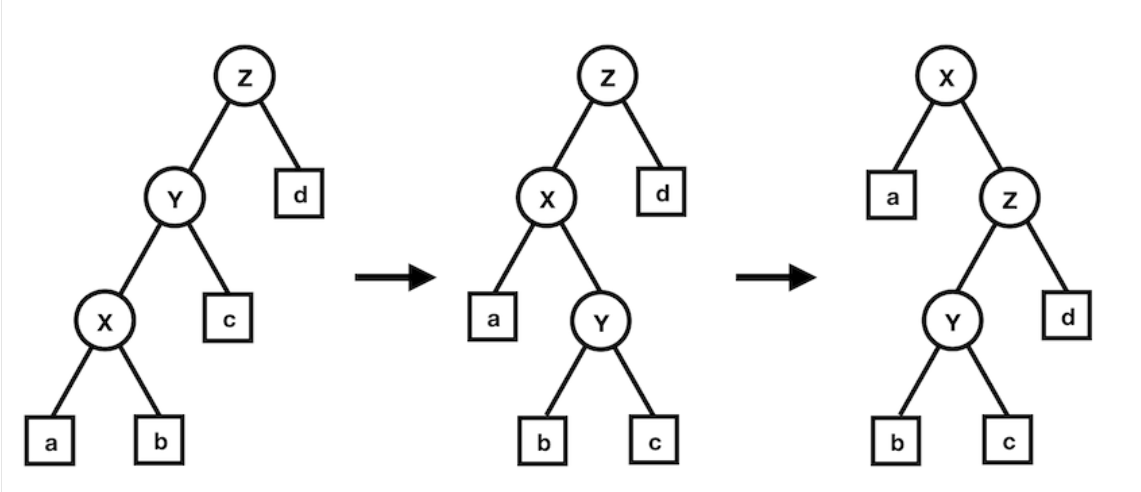
我们发现这个玩意压根就没有发生变化,这也就是说,这玩意有可能退化(太可怕了)
那么我们采用双旋的方式去解决这个问题,类似这样:
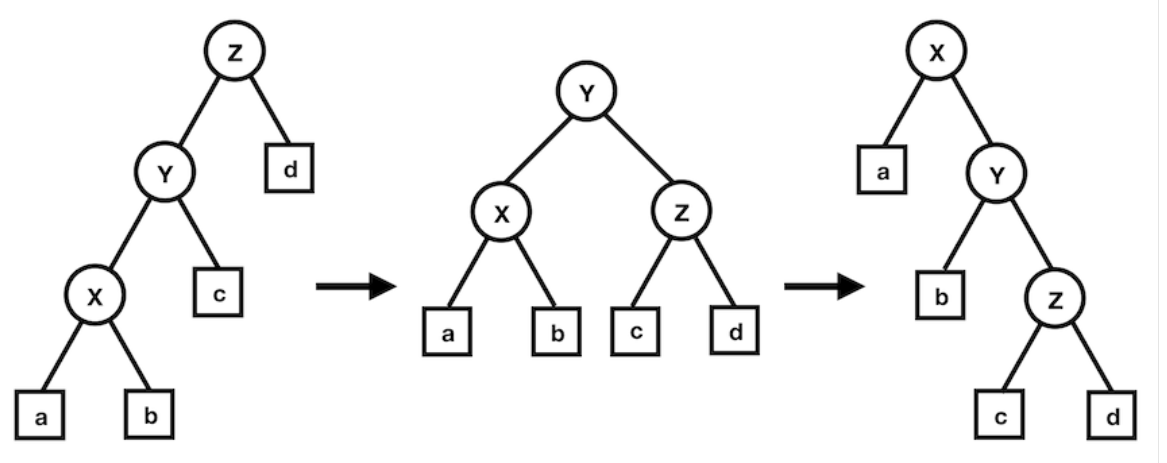
我们先把 \(x\) 的父亲更改,再处理 \(x\) 的儿子与 \(y\) 处理,最后让 \(y\) 成为 \(x\) 的儿子。
这样我们就做出了 rotate 函数,在旋转的时候,分为同侧旋转与异侧旋转,如果是同侧的话就旋转 \(y\) 再旋 \(x\),如果是异侧就双次旋转 \(x\)。
复杂度证明:
不会。
参考大佬的证明
代码
//Treap

#include <iostream>
#include <ctime>
#include <cstdlib>
using namespace std;

#define lc(x) t[x].s[0]
#define rc(x) t[x].s[1]

const int MAXN = 1e5 + 5;
const int INF = (1 << 30) - 1;

struct node{
	int s[2], v, p, cnt, sz;
	void init(int val){
		v = val, p = rand();
		cnt = sz = 1;
		s[0] = s[1] = 0;
	}
}t[MAXN];

int root, tot = 0;

void pushup(int x){
	t[x].sz = t[lc(x)].sz + t[rc(x)].sz + t[x].cnt;
}

void rotate(int &x, int d){
	int y = t[x].s[d];
	t[x].s[d] = t[y].s[d ^ 1];
	t[y].s[d ^ 1] = x;

	pushup(x);
	pushup(y);
	x = y;
}

void Insert(int &x, int val){
	if(!x){
		x = ++ tot;
		t[x].init(val);
		return;
	}

	if(t[x].v == val) t[x].cnt ++;
	else{
		int d = val > t[x].v;
		Insert(t[x].s[d], val);
		if(t[t[x].s[d]].p > t[x].p) rotate(x, d);
	}

	pushup(x);
}

void Delete(int &x, int val){
	if(!x) return;

	if(t[x].v == val){
		if(t[x].cnt > 1) t[x].cnt --;
		else{
			if(!lc(x) || !rc(x)) x = lc(x) + rc(x);
			else{
				int d = t[rc(x)].p > t[lc(x)].p;
				rotate(x, d);
				Delete(t[x].s[d ^ 1], val);
			}
		}
	}
	else Delete(t[x].s[val > t[x].v], val);

	if(x) pushup(x);
}

int Rank(int x, int val){
	if(!x) return 1;
	if(t[x].v == val) return t[lc(x)].sz + 1;
	if(val < t[x].v) return Rank(lc(x), val);
	return t[lc(x)].sz + t[x].cnt + Rank(rc(x), val);
}

int Val(int x, int k){
	if(!x) return 0;
	if(k <= t[lc(x)].sz) return Val(lc(x), k);
	else if(k <= t[lc(x)].sz + t[x].cnt) return t[x].v;
	else return Val(rc(x), k - t[lc(x)].sz - t[x].cnt);
}

int Pre(int val){
	int x = root, res = -INF;
	while(x){
		if(t[x].v < val) res = t[x].v, x = rc(x);
		else x = lc(x);
	}
	return res;
}

int Suc(int val){
	int x = root, res = INF;
	while(x){
		if(t[x].v > val) res = t[x].v, x = lc(x);
		else x = rc(x);
	}
	return res;
}

int n, op, x;

int main(){
	srand(time(0));
	ios::sync_with_stdio(0);
	cin.tie(0);

	cin >> n;
	while(n --){
		cin >> op >> x;
		if(op == 1) Insert(root, x);
		else if(op == 2) Delete(root, x);
		else if(op == 3) cout << Rank(root, x) << '\n';
		else if(op == 4) cout << Val(root, x) << '\n';
		else if(op == 5) cout << Pre(x) << '\n';
		else cout << Suc(x) << '\n';
	}

	return 0;
}

//Splay

#include<iostream>
using namespace std;

#define lc(x) t[x].s[0]
#define rc(x) t[x].s[1]

const int MAXN = 1e5 + 5;
const int INF = (1 << 30) - 1;

struct node{
	int s[2], f, v, cnt, sz;
	void init(int fa, int val){
		f = fa, v = val;
		cnt = sz = 1;
	}
}t[MAXN];

int root, tot = 0;

void pushup(int x){
	t[x].sz = t[lc(x)].sz + t[rc(x)].sz + t[x].cnt;
}

void rotate(int x){
	int y = t[x].f, z = t[y].f;
	int k = (rc(y) == x);
	t[z].s[rc(z) == y] = x;
	t[x].f = z;

	t[y].s[k] = t[x].s[k ^ 1];
	t[t[x].s[k ^ 1]].f = y;

	t[x].s[k ^ 1] = y;
	t[y].f = x;

	pushup(y);
	pushup(x);
}

void Splay(int x, int k){
	while(t[x].f != k){
		int y = t[x].f, z = t[y].f;
		if(z != k){
			((lc(z) == y) ^ (lc(y) == x)) ? rotate(x) : rotate(y);
		}
		rotate(x);
	}
	if(k == 0) root = x;
}

void Insert(int val){
	int x = root, f = 0;
	while(x && t[x].v != val){
		f = x;
		x = t[x].s[val > t[x].v];
	}
	if(x) t[x].cnt ++;
	else{
		x = ++ tot;
		if(f){
			t[f].s[val > t[f].v] = x;
		}
		t[x].init(f, val);
	}
	Splay(x, 0);
}

void Find(int val){
	int x = root;
	while(t[x].s[val > t[x].v] && t[x].v != val){
		x = t[x].s[val > t[x].v];
	}
	Splay(x, 0);
}

int Pre(int val){
	Find(val);
	int x = root;
	if(t[x].v < val) return x;
	x = lc(x);
	while(rc(x)) x = rc(x);
	Splay(x, 0);
	return x;
}

int Suc(int val){
	Find(val);
	int x = root;
	if(t[x].v > val) return x;
	x = rc(x);
	while(lc(x)) x = lc(x);
	Splay(x, 0);
	return x;
}

void Delete(int val){
	int pre = Pre(val), suc = Suc(val);
	Splay(pre, 0), Splay(suc, pre);
	int x = lc(suc);
	if(t[x].cnt > 1){
		t[x].cnt --;
		Splay(x, 0);
	}
	else{
		lc(suc) = 0;
		Splay(suc, 0);
	}
}

int Rank(int val){
	Insert(val);
	int res = t[lc(root)].sz;
	Delete(val);
	return res;
}

int Val(int k){
	int x = root;
	while(true){
		if(k <= t[lc(x)].sz){
			x = lc(x);
		}
		else if(k <= t[lc(x)].sz + t[x].cnt){
			break;
		}
		else{
			k -= (t[lc(x)].sz + t[x].cnt);
			x = rc(x);
		}
	}
	Splay(x, 0);
	return t[x].v;
}

int n, op, x;

int main(){
	ios::sync_with_stdio(0);
	cin.tie(0);
	cin >> n;
	Insert(-INF), Insert(INF);
	while(n --){
		cin >> op >> x;
		if(op == 1){
			Insert(x);
		}
		else if(op == 2){
			Delete(x);
		}
		else if(op == 3){
			cout << Rank(x) << '\n';
		}
		else if(op == 4){
			cout << Val(x + 1) << '\n';
		}
		else if(op == 5){
			cout << t[Pre(x)].v << '\n';
		}
		else{
			cout << t[Suc(x)].v << '\n';
		}
	}
	return 0;
}
本文来自一名高中生,作者:To_Carpe_Diem

 浙公网安备 33010602011771号