
无向图 Tarjan 边双连通分量详解
边双连通分量
众所周知,在有向图中,存在强连通分量,强连通分量中的任意两点是连通的。
而在无向图中,同样存在边双连通分量。
边双连通
若一个无向连通图删去任意一条边之后仍然连通,则该图边双连通。
边双连通分量
在满足边双连通的前提下尽可能大的子图。
Tarjan 求边双连通分量
前置知识
其实把求有向图强连通分量的代码拿过来改改就行了,
无向图转有向图存储下环的误判
具体而言,就是不能出现如图的情况:
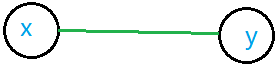
\(x,y\) 之间只有一条边,不是环,然而如果转换为有向图存储:
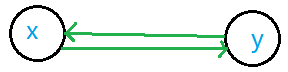
就存在了环。
因此我们需要防止其重复走,因此我们可以给边标号。
但是这样其实不是最优的,有一种更好的方式:邻接表存储边时,从 \(2\) 号开始存储,并且无向边转换为的两条有向边相邻存储。
这样的好处就是,比如说 \(x\) 号边是代表 \(u\to v\) 的,那么 \(x\oplus 1\) 号边代表的就是 \(v\to u\) 的,其中 \(\oplus\) 表示异或。
前向边与横边不存在
一棵有向图的 DFS 生成树如图:
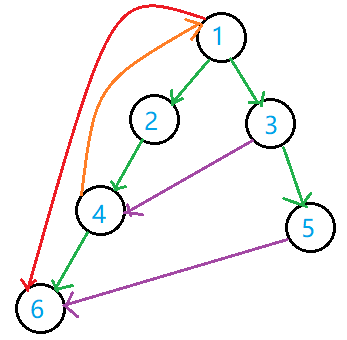
图中绿色为普通树边,橙色为回溯边,红色为前向边,紫色为横边。
考虑到无向图,实际上 DFS 生成树中只有普通树边和回溯边。
-
前向边不存在,因为无向,因此前向边反向就是一条回溯边。
-
横边不存在,因为按照 DFS 搜索顺序不会使其有可能存在。
例如图中搜索到 \(4\) 之后,按照 DFS 的原则会先后搜索 \(3,6\),不可能只搜索 \(6\) 然后回退至 \(1\) 再搜索到 \(3\),然后连横边。
即化为:

也就是说,我们不再需要判断元素是否在栈中(判断了也能过),更新 \(\textit{low}_x\) 部分的代码可以简化为:
if(!dfn[g[i].v]){
    Tarjan(g[i].v,i);
    low[x]=min(low[x],low[g[i].v]);
}else{
    low[x]=min(low[x],dfn[g[i].v]);
}
答案存储
使用 vector 套 vector 维护即可。
vector<vector<int> >ans;
边双连通分量的判定
考虑对于一个点 \(x\),若 \(\textit{dfn}_x=\textit{low}_x\),代表 \(x\) 不能回退到祖先节点,则删去边 \((x,\textit{father}_x)\) 必然不连通,因此 \(x\) 和 \(\textit{father}_x\) 在两个边双连通分量中。
那么栈中所有 \(\textit{dfn}_i\geq\textit{dfn}_x\) 的节点就是 \(x\) 的子节点,同属于一个边双连通分量。从栈里一直出栈直到 \(x\),即可找出该边双连通分量的所有结点。
AC 代码
//#include<bits/stdc++.h>
#include<algorithm>
#include<iostream>
#include<cstring>
#include<iomanip>
#include<cstdio>
#include<string>
#include<vector>
#include<cmath>
#include<ctime>
#include<deque>
#include<queue>
#include<stack>
#include<list>
using namespace std;
constexpr const int N=5e5,M=2e6;
struct graph{
	int size,h[N+1];
	struct edge{
		int v,r;
	}e[(M<<1)+2];

	graph(){
		size=1;
	}

	void create(int u,int v){
		e[++size]={v,h[u]};
		h[u]=size;
	}

	edge& operator [](int x){
		return e[x];
	}
}g;
int n;
vector<vector<int>>ans;
int dfn[N+1];
void Tarjan(int x,int id){
	static int cnt,low[N+1];
	static vector<int>s;
	dfn[x]=low[x]=++cnt;
	s.push_back(x);
	for(int i=g.h[x];i;i=g[i].r){
		if((i^1)==id){
			continue;
		}
		if(!dfn[g[i].v]){
			Tarjan(g[i].v,i);
			low[x]=min(low[x],low[g[i].v]);
		}else{
			low[x]=min(low[x],dfn[g[i].v]);
		}
	}
	if(dfn[x]==low[x]){
		vector<int>pl;
		while(s.back()!=x){
			pl.push_back(s.back());
			s.pop_back();
		}
		pl.push_back(s.back());
		s.pop_back();
		ans.push_back(pl);
	}
}
int main(){
	/*freopen("test.in","r",stdin);
	freopen("test.out","w",stdout);*/

	ios::sync_with_stdio(false);
	cin.tie(0);cout.tie(0);

	int m;
	cin>>n>>m;
	while(m--){
		int u,v;
		cin>>u>>v;
		g.create(u,v);
		g.create(v,u);
	}
	for(int i=1;i<=n;i++){
		if(!dfn[i]){
			Tarjan(i,0);
		}
	}
	cout<<ans.size()<<'\n';
	for(auto &i:ans){
		cout<<i.size()<<' ';
		for(auto j:i){
			cout<<j<<' ';
		}
		cout<<'\n';
	}

	cout.flush();

	/*fclose(stdin);
	fclose(stdout);*/
	return 0;
}

 浙公网安备 33010602011771号