
vgg16网络及pytorch神经网络
一、基于tensorflow的vgg16:识别猫狗数据集
 1 import os, shutil
 2 current_dir = (r"E:\人工智能\猫狗数据集\dogs-vs-cats")  # 当前目录
 3 current_dir[0]
 4 base_dir = current_dir[0] + ':/人工智能/cats_dogs_small'
 5 os.mkdir(base_dir)  # 创建目录
 6 # 分别创建训练集、验证集和测试集的目录
 7
 8 train_dir = os.path.join(base_dir,"train")
 9 os.mkdir(train_dir)
10 validation_dir = os.path.join(base_dir,"validation")
11 os.mkdir(validation_dir)
12 test_dir = os.path.join(base_dir,"test")
13 os.mkdir(test_dir)
14
15 # 猫、狗的训练、验证、测试图像目录
16 train_cats_dir = os.path.join(train_dir, "cats")
17 os.mkdir(train_cats_dir)
18 train_dogs_dir = os.path.join(train_dir, "dogs")
19 os.mkdir(train_dogs_dir)
20
21 validation_cats_dir = os.path.join(validation_dir, "cats")
22 os.mkdir(validation_cats_dir)
23 validation_dogs_dir = os.path.join(validation_dir, "dogs")
24 os.mkdir(validation_dogs_dir)
25
26 test_cats_dir = os.path.join(test_dir, "cats")
27 os.mkdir(test_cats_dir)
28 test_dogs_dir = os.path.join(test_dir, "dogs")
29 os.mkdir(test_dogs_dir)
 1 # 1000张当做训练集train
 2 fnames = ['cat.{}.jpg'.format(i) for i in range(1000)]
 3 for fname in fnames:
 4     # 源目录文件
 5     src = os.path.join(current_dir[0] + ":/人工智能/猫狗数据集/dogs-vs-cats/train", fname)
 6     # 目标目录
 7     dst = os.path.join(train_cats_dir, fname)
 8     shutil.copyfile(src, dst)
 9
10 # 500张当做验证集valiation
11 fnames = ['cat.{}.jpg'.format(i) for i in range(1000,1500)]
12 for fname in fnames:
13     src = os.path.join(current_dir[0] + ":人工智能/猫狗数据集/dogs-vs-cats/train", fname)
14     dst = os.path.join(validation_cats_dir, fname)
15     shutil.copyfile(src, dst)
16
17 # 500张当做测试集test
18 fnames = ['cat.{}.jpg'.format(i) for i in range(1500,2000)]
19 for fname in fnames:
20     src = os.path.join(current_dir[0] + ":/人工智能/猫狗数据集/dogs-vs-cats/train", fname)
21     dst = os.path.join(test_cats_dir, fname)
22     shutil.copyfile(src, dst)
 1 # 针对dog的3个同样操作
 2
 3 # 1、1000张当做训练集train
 4 fnames = ['dog.{}.jpg'.format(i) for i in range(1000)]
 5 for fname in fnames:
 6     src = os.path.join(current_dir[0] + ":/人工智能/猫狗数据集/dogs-vs-cats/train", fname)
 7     dst = os.path.join(train_dogs_dir, fname)
 8     shutil.copyfile(src, dst)
 9
10 # 2、500张当做验证集valiation
11 fnames = ['dog.{}.jpg'.format(i) for i in range(1000,1500)]
12 for fname in fnames:
13     src = os.path.join(current_dir[0] + ":/人工智能/猫狗数据集/dogs-vs-cats/train", fname)
14     dst = os.path.join(validation_dogs_dir, fname)
15     shutil.copyfile(src, dst)
16
17 # 3、500张当做测试集test
18 fnames = ['dog.{}.jpg'.format(i) for i in range(1500,2000)]
19 for fname in fnames:
20     src = os.path.join(current_dir[0] + ":/人工智能/猫狗数据集/dogs-vs-cats/train", fname)
21     dst = os.path.join(test_dogs_dir, fname)
22     shutil.copyfile(src, dst)
 1 #构建神经网络
 2 import tensorflow as tf
 3 from keras import layers
 4 from keras import models
 5
 6 model = models.Sequential()
 7 model.add(tf.keras.layers.Conv2D(32,(3,3),activation="relu",
 8                                input_shape=(150,150,3)))
 9 model.add(tf.keras.layers.MaxPooling2D((2,2)))
10
11 model.add(tf.keras.layers.Conv2D(64,(3,3),activation="relu"))
12 model.add(tf.keras.layers.MaxPooling2D((2,2)))
13
14 model.add(tf.keras.layers.Conv2D(128,(3,3),activation="relu"))
15 model.add(tf.keras.layers.MaxPooling2D((2,2)))
16
17 model.add(tf.keras.layers.Conv2D(128,(3,3),activation="relu"))
18 model.add(tf.keras.layers.MaxPooling2D((2,2)))
19
20 model.add(tf.keras.layers.Flatten())
21
22 model.add(tf.keras.layers.Dropout(0.5))
23
24 model.add(tf.keras.layers.Dense(512, activation="relu"))
25 model.add(tf.keras.layers.Dense(1, activation="sigmoid"))
26
27 model.compile(loss="binary_crossentropy",
28              optimizer=optimizers.RMSprop(lr=1e-4),
29              metrics=["acc"])
30
31 model.summary()
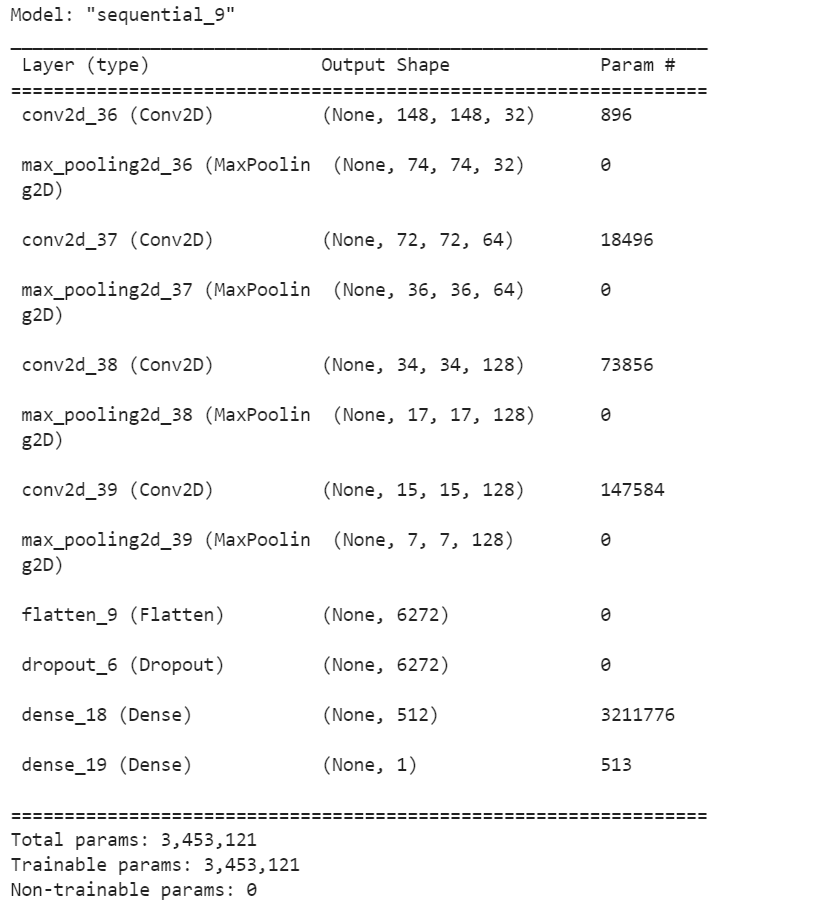
 1 from tensorflow.keras import optimizers
 2
 3 model.compile(loss="binary_crossentropy",
 4              optimizer=optimizers.RMSprop(lr=1e-4),
 5              metrics=["acc"])
 6 def generator():
 7     i=0
 8     while True:
 9         i += 1
10         yield i
11 for item in generator():
12     print(item)
13     if item>4:
14         break
15
16 from keras.preprocessing.image import ImageDataGenerator
17
18 train_datagen = ImageDataGenerator(rescale=1./255)  # 进行缩放
19 test_datagen = ImageDataGenerator(rescale=1./255)  # 进行缩放
20
21 train_generator = train_datagen.flow_from_directory(
22     train_dir,  # 待处理的目录
23     target_size=(150,150),  # 图像大小设置
24     batch_size=20,
25     class_mode="binary"  # 损失函数是binary_crossentropy 所以使用二进制标签
26 )
27
28 validation_generator = test_datagen.flow_from_directory(
29     validation_dir,  # 待处理的目录
30     target_size=(150,150),  # 图像大小设置
31     batch_size=20,
32     class_mode="binary"  # 损失函数是binary_crossentropy 所以使用二进制标签
33 )
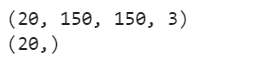
1 for data_batch, labels_batch in train_generator:
2     print(data_batch.shape)
3     print(labels_batch.shape)
4     break
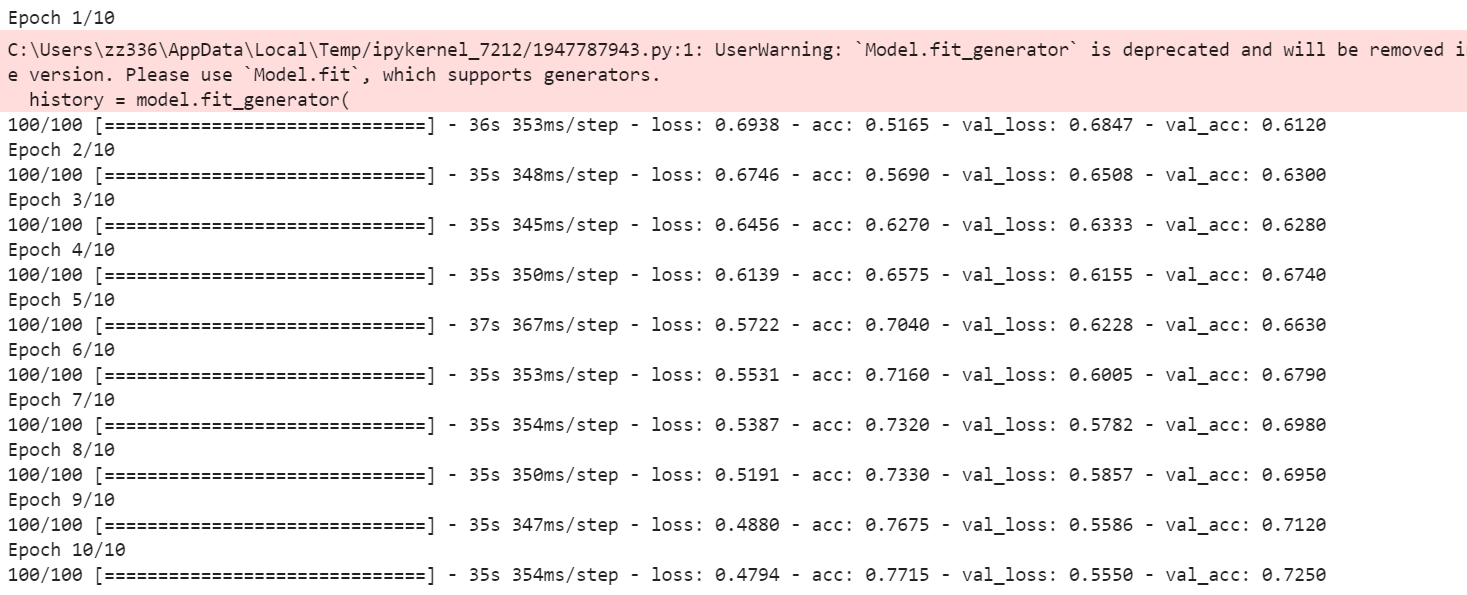
1 history = model.fit_generator(
2     train_generator,  # 第一个参数必须是Python生成器
3     steps_per_epoch=100,  # 2000 / 20
4     epochs=10,  # 迭代次数
5     validation_data=validation_generator,  # 待验证的数据集
6     validation_steps=50
7 )
 1 # 保存模型
 2 model.save("cats_and_dogs_small.h5")
 3 import matplotlib.pyplot as plt
 4 %matplotlib inline
 5 history_dict = history.history  # 字典形式
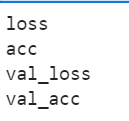
 6 for key, _ in history_dict.items():
 7     print(key)
 8
 9 acc = history_dict["acc"]
10 val_acc = history_dict["val_acc"]
11
12 loss = history_dict["loss"]
13 val_loss = history_dict["val_loss"]
 1 acc = history_dict["acc"]
 2 val_acc = history_dict["val_acc"]
 3
 4 loss = history_dict["loss"]
 5 val_loss = history_dict["val_loss"]
 6
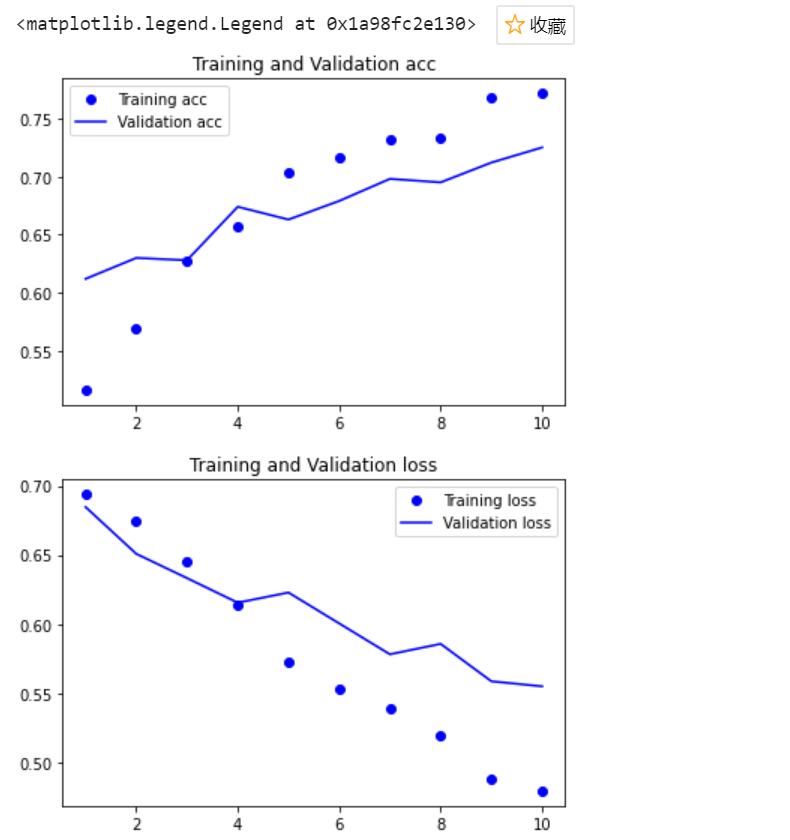
 7 epochs = range(1, len(acc)+1)
 8
 9 # acc
10 plt.plot(epochs, acc, "bo", label="Training acc")
11 plt.plot(epochs, val_acc, "b", label="Validation acc")
12 plt.title("Training and Validation acc")
13 plt.legend()
14
15 plt.figure()
16
17 # loss
18 plt.plot(epochs, loss, "bo", label="Training loss")
19 plt.plot(epochs, val_loss, "b", label="Validation loss")
20 plt.title("Training and Validation loss")
21 plt.legend()
 1 #设置数据增强
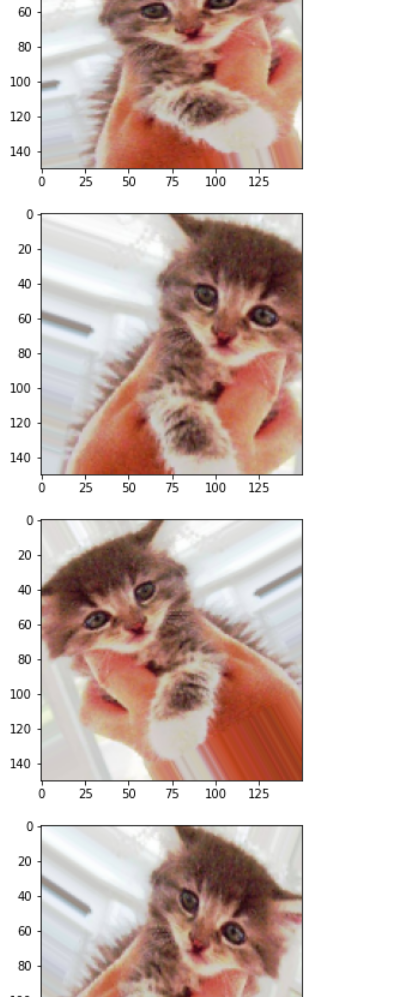
 2 datagen = ImageDataGenerator(
 3     rotation_range=40,  # 0-180的角度值
 4     width_shift_range=0.2,  # 水平和垂直方向的范围;相对于总宽度或者高度的比例
 5     height_shift_range=0.2,
 6     shear_range=0.2,  # 随机错切变换的角度
 7     zoom_range=0.2,  # 图像随机缩放的角度
 8     horizontal_flip=True,  # 随机将一半图像进行水平翻转
 9     fill_mode="nearest"  # 用于填充新创建像素的方法
10 )
11 #显示增强后图像
12 from keras.preprocessing import image
13 fnames = [os.path.join(train_cats_dir,fname) for fname in os.listdir(train_cats_dir)]
14 img_path = fnames[3]
15 # 读取图片并调整大小
16 img = image.load_img(img_path, target_size=(150,150))
17 # 转成数组
18 x = image.img_to_array(img)
19
20 # shape转成(1,150,150,3)
21 x = x.reshape((1,) + x.shape)
22
23 i = 0
24 for batch in datagen.flow(x, batch_size=1):  # 生成随机变换后的图像批量
25     plt.figure()
26     imgplot = plt.imshow(image.array_to_img(batch[0]))
27     i += 1
28     if i % 4 == 0:
29         break  # 循环是无限,需要在某个时刻终止
30 plt.show()
 1 # 训练数据的增强
 2 train_datagen = ImageDataGenerator(
 3     rescale=1. / 255,
 4     rotation_range=40,
 5     width_shift_range=0.2,
 6     height_shift_range=0.2,
 7     shear_range=0.2,
 8     zoom_range=0.2,
 9     horizontal_flip=True
10 )
11
12 # 不能增强验证数据
13 test_datagen = ImageDataGenerator(rescale=1.0 / 255)
14
15 train_generator = train_datagen.flow_from_directory(
16     train_dir,  # 目标目录
17     target_size=(150,150),  # 大小调整
18     batch_size=32,
19     class_mode="binary"
20 )
21
22 validation_generator = test_datagen.flow_from_directory(
23     validation_dir,
24     target_size=(150,150),
25     batch_size=32,
26     class_mode="binary"
27 )
28
29 # 优化:报错有修改
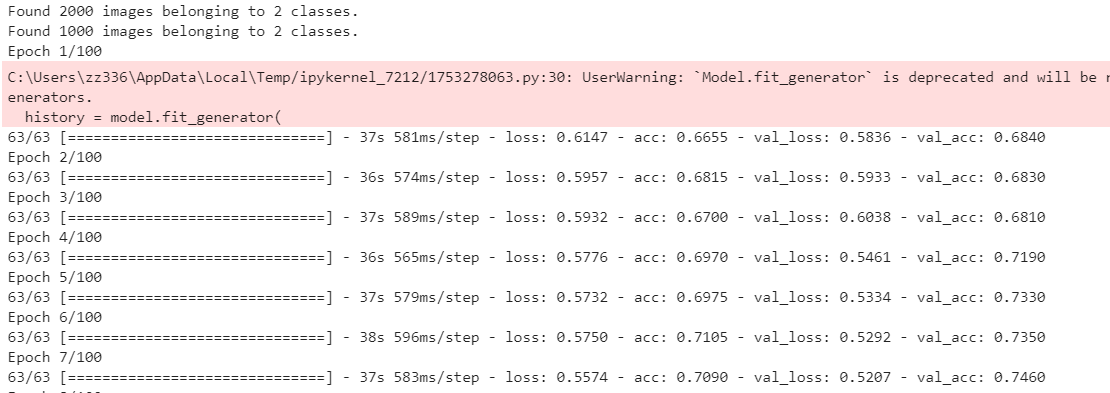
30 history = model.fit_generator(
31     train_generator,
32     # 原文 steps_per_epoch=100,
33     steps_per_epoch=63,  # steps_per_epoch=2000/32≈63 取上限
34     epochs=100,
35     validation_data=validation_generator,
36     # 原文 validation_steps=50
37     validation_steps=32  # validation_steps=1000/32≈32
38 )

1 # 保存模型
2 model.save("cats_and_dogs_small_2.h5")
3
4 history_dict = history.history  # 字典形式
5
6 acc = history_dict["acc"]
7 val_acc = history_dict["val_acc"]
8 loss = history_dict["loss"]
9 val_loss = history_dict["val_loss"]
 1 epochs = range(1, len(acc)+1)
 2
 3 # acc
 4 plt.plot(epochs, acc, "bo", label="Training acc")
 5 plt.plot(epochs, val_acc, "b", label="Validation acc")
 6 plt.title("Training and Validation acc")
 7 plt.legend()
 8
 9 plt.figure()
10
11 # loss
12 plt.plot(epochs, loss, "bo", label="Training loss")
13 plt.plot(epochs, val_loss, "b", label="Validation loss")
14 plt.title("Training and Validation loss")
15 plt.legend()
16
17 plt.show()
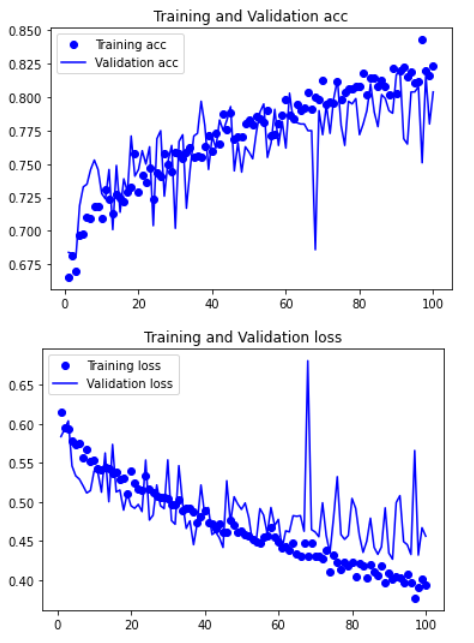
二、pytorch神经网络
 1 #定义神经网络
 2 import torch
 3 import torch.nn as nn
 4 import torch.nn.functional as F
 5
 6
 7 class Net(nn.Module):
 8
 9     def __init__(self):
10         super(Net, self).__init__()
11         # 1 input image channel, 6 output channels, 5x5 square convolution
12         # kernel
13         self.conv1 = nn.Conv2d(1, 6, 5)
14         self.conv2 = nn.Conv2d(6, 16, 5)
15         # an affine operation: y = Wx + b
16         self.fc1 = nn.Linear(16 * 5 * 5, 120)
17         self.fc2 = nn.Linear(120, 84)
18         self.fc3 = nn.Linear(84, 10)
19
20     def forward(self, x):
21         # Max pooling over a (2, 2) window
22         x = F.max_pool2d(F.relu(self.conv1(x)), (2, 2))
23         # If the size is a square you can only specify a single number
24         x = F.max_pool2d(F.relu(self.conv2(x)), 2)
25         x = x.view(-1, self.num_flat_features(x))
26         x = F.relu(self.fc1(x))
27         x = F.relu(self.fc2(x))
28         x = self.fc3(x)
29         return x
30
31     def num_flat_features(self, x):
32         size = x.size()[1:]  # all dimensions except the batch dimension
33         num_features = 1
34         for s in size:
35             num_features *= s
36         return num_features
37
38
39 net = Net()
40 print(net)
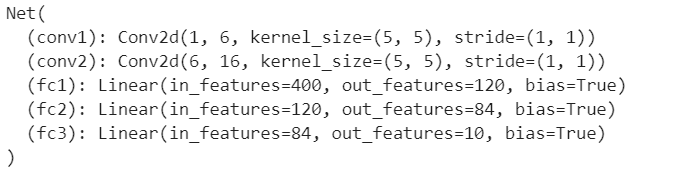
1 #一个模型可训练的参数可以通过调用 net.parameters() 返回
2 params = list(net.parameters())
3 print(len(params))
4 print(params[0].size())  # conv1's .weight

1 #尝试随机生成一个 32x32 的输入
2 input = torch.randn(1, 1, 32, 32)
3 out = net(input)
4 print(out)

 1 #把所有参数梯度缓存器置零,用随机的梯度来反向传播
 2 net.zero_grad()
 3 out.backward(torch.randn(1, 10))
 4 #损失函数
 5 output = net(input)
 6 target = torch.randn(10)  # a dummy target, for example
 7 target = target.view(1, -1)  # make it the same shape as output
 8 criterion = nn.MSELoss()
 9
10 loss = criterion(output, target)
11 print(loss)

1 print(loss.grad_fn)  # MSELoss
2 print(loss.grad_fn.next_functions[0][0])  # Linear
3 print(loss.grad_fn.next_functions[0][0].next_functions[0][0])  # ReLU

 1 #反向传播
 2 net.zero_grad()     # zeroes the gradient buffers of all parameters
 3
 4 print('conv1.bias.grad before backward')
 5 print(net.conv1.bias.grad)
 6
 7 loss.backward()
 8
 9 print('conv1.bias.grad after backward')
10 print(net.conv1.bias.grad)

 1 #更新神经网络的参数
 2 #weight = weight - learning_rate * gradient  随机梯度下降
 3 learning_rate = 0.01
 4 for f in net.parameters():
 5     f.data.sub_(f.grad.data * learning_rate)
 6
 7 import torch.optim as optim
 8
 9 # create your optimizer
10 optimizer = optim.SGD(net.parameters(), lr=0.01)
11
12 # in your training loop:
13 optimizer.zero_grad()   # zero the gradient buffers
14 output = net(input)
15 loss = criterion(output, target)
16 loss.backward()
17 optimizer.step()    # Does the update

 浙公网安备 33010602011771号