


地铁路线规划系统
个人项目—地铁路线规划系统设计及实现
问题综述:
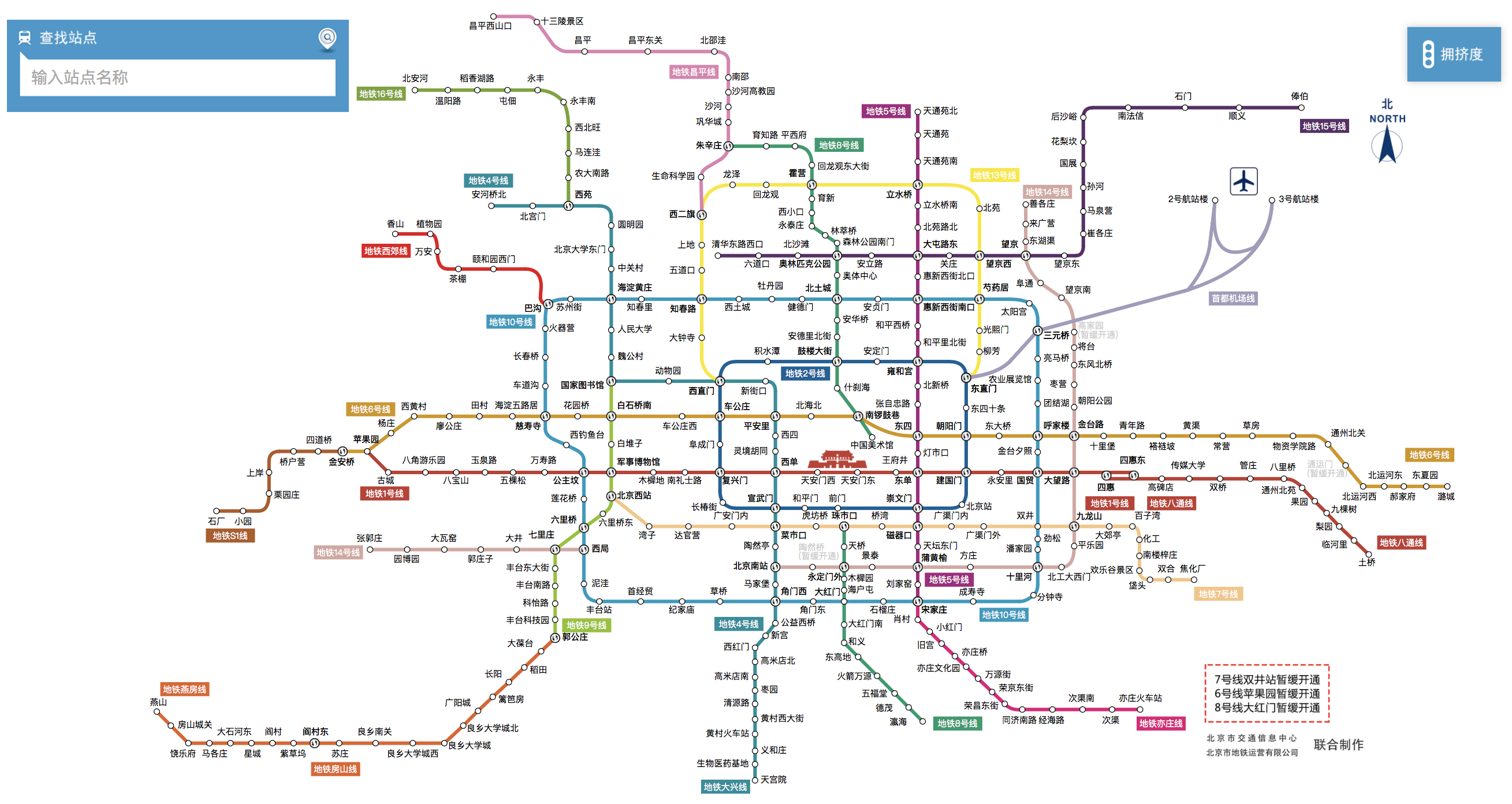
提供一个城市(以北京市为例,如上图地铁线路图所示)的地铁线路图及其相关信息,通过程序计算指定两站之间最短(最少经过站数)乘车路线,输出指定地铁线路的所有站点。首先,将地铁线路信息保存在data.txt中便于理解与使用,具体格式如下:
线路名1 站名1 站名2 站名3 ...

线路名2 站名1 站名2 站名3 ...

线路名3 站名1 站名2 站名3 ...

......
将所有线路名以及站点名都存储在data文件中后,继续之后的功能实现。
需求分析:
- 输入地铁线路名称,显示整条地铁线路站点
- 输入两个地铁站名称,并为其规划最短线路并输出
- 输入某条地铁线路,显示该条线路上的所有站点
- 若输入的线路或站点不存在,显示错误提示
解决思路:
- 实现语言:JAVA
- 收集数据并设计数据存储方式读入数据并构建地铁图的数据结构
- 设计并确定寻找最短路径算法,以广度优先遍历(BFS)算法为核心算法
- 使用测试案例对程序进行debug测试
具体实现:
1 数据存储格式及读取
Json格式是一种轻量级的数据交换格式,相对于xml格式比较简洁且易读,因此本项目采用Json格式存储数据(同时,由此本项目在编程是需要使用额外jar包),具体形式如下:
 1 {
 2   "lines": [
 3     {
 4       "lineNo": 1,
 5       "lineName": "1号线",
 6       "stations": [
 7         {
 8           "stationName": "苹果园"
 9         },
10         {
11           "stationName": "古城"
12         },
13         ......
14       ]
15     },
16     {
17       "lineNo": 2,
18       "lineName": "2号线",
19       "stations": [
20         {
21           "stationName": "积水潭"
22         },
23         {
24           "stationName": "鼓楼大街"
25         },
26         ......
27       ]
28 },
29 ......
30     {
31       "lineNo": 23,
32       "lineName": "西郊线",
33       "stations": [
34         {
35           "stationName": "香山"
36         },
37      ......
38       ]
39     }
40   ]
41 }
将地铁站点数据存放在json文件中,并可利用自建函数readJsonFile读取,其中,readJsonFile函数如下:
 1 import java.io.*;
 2
 3 public class ReadUtil {
 4     // 读取json文件
 5     public static String readJsonFile(String fileName) {
 6         String jsonStr = "";
 7         try {
 8             // 打开文件
 9             File jsonFile = new File(fileName);
10             FileReader fileReader = new FileReader(jsonFile);
11             Reader reader = new InputStreamReader(new FileInputStream(jsonFile),"utf-8");// 一般采用utf-8编码规则
12             int ch = 0;
13             StringBuffer sb = new StringBuffer();
14             while ((ch = reader.read()) != -1) {
15                 sb.append((char) ch);
16             }
17             fileReader.close();
18             reader.close();
19             jsonStr = sb.toString();
20             return jsonStr;
21         } catch (IOException e) {
22             e.printStackTrace();
23             return null;
24         }
25     }
26 }
2 数据结构方法的确定及应用
将地铁线路图中的每个地铁站点看成一个节点,各个节点之间由地铁线路相连,类似于数据结构“图”中边的存在。因此,本项目将地铁各站点与线路之间的关联类比于“图”的关系,并使用数据结构“图”对地铁线路图进行重建,具体实现代码如下:
SubwayGraph类
 1 import java.io.File;
 2 import java.util.ArrayList;
 3 import java.util.HashSet;
 4
 5
 6 public class SubwayGraph {
 7     public ArrayList<Station> stations=new ArrayList<>();// 建立站点List
 8     public HashSet<Edge> edges=new HashSet<>();
 9
10     public ArrayList<Station> getStation() {// 获取站点并存入List
11         return stations;
12     }
13
14     public int findStation(String stationName){
15         for(int i=0;i<stations.size();i++){
16             if (stations.get(i).getStationName().equals(stationName))
17                 return i;
18         }
19         return 0;
20     }
21
22     public int isInV(Station station){
23         for (int i=0;i<stations.size();i++){
24             if (stations.get(i).getStationName().equals(station.getStationName()))
25                 return i;
26         }
27         stations.add(station);
28         return 0;
29     }
30
31     public void addAdge(int a,int b,int c){
32         this.edges.add(new Edge(a,b));
33     }
34
35     public void addStation(String stationName, int lineNo, int change){
36         // change的值为0表示不可换乘,1表示可换乘
37         int flag=0;
38         if (change == 1)
39             flag=findStation(stationName);
40         if (flag == 0)
41             stations.add(new Station(stationName));
42     }
43
44     public int hashCode() {
45         final int prime = 31;
46         int result = 1;
47         long temp;
48         temp = Double.doubleToLongBits(x);
49         result = prime * result + (int) (temp ^ (temp >>> 32));
50         temp = Double.doubleToLongBits(y);
51         result = prime * result + (int) (temp ^ (temp >>> 32));
52         return result;
53     }
54
55     public void addEdge(int u,int v){
56         this.edges.add(new Edge(u,v));
57     }
58
59     public boolean equals(Object obj) {
60         if (this == obj)
61             return true;
62         if (obj == null)
63             return false;
64         if (getClass() != obj.getClass())
65             return false;
66         MapNode other = (MapNode) obj;
67         if (Double.doubleToLongBits(x) != Double.doubleToLongBits(other.x))
68             return false;
69         if (Double.doubleToLongBits(y) != Double.doubleToLongBits(other.y))
70             return false;
71         return true;
72     }
73     public HashSet<Edge> getEdges(){
74         return edges;
75     }
76 }
Edge类
 1 public class Edge {
 2     private int u;
 3     private int station;
 4     public Edge(int u,int station){
 5         this.u=u;
 6         this.station=station;
 7     }
 8     public int getU() {
 9         return u;
10     }
11
12     public void setU(int u) {
13         this.u = u;
14     }
15
16     public int getStation() {
17         return station;
18     }
19
20     public void setStation(int station) {
21         this.station = station;
22     }
23 }
Station类
 1 import java.util.ArrayList;
 2 import java.util.HashSet;
 3
 4 public class Station {
 5     private String stationName;
 6     private HashSet<Integer> line;
 7     public Station(String stationName){
 8         this.stationName=stationName;
 9         line=new HashSet<>();
10     }
11
12     public String getStationName() {
13         return stationName;
14     }
15
16     public void setStationName(String stationName) {
17         this.stationName = stationName;
18     }
19
20     public HashSet<Integer> getLine() {
21         return line;
22     }
23
24     public void addLine(int no) {
25         this.line.add(no);
26     }
27 }
Line类
 1 import java.util.ArrayList;
 2
 3 public class Line {
 4     private int lineNo;
 5     private String lineName;
 6     private ArrayList<Station> stations=new ArrayList<>();
 7
 8     public int getLineNo() {
 9         return lineNo;
10     }
11
12     public void setLineNo(int lineNo) {
13         this.lineNo = lineNo;
14     }
15
16     public String getLineName() {
17         return lineName;
18     }
19
20     public void setLineName(String lineName) {
21         this.lineName = lineName;
22     }
23
24     public ArrayList<Station> getStations() {
25         return stations;
26     }
27
28     public void addStations(Station station) {
29         this.stations.add(station);
30     }
31 }
3 类职责分析
| 类名 | 方法名 | 功能职责分析 |
| SubwayGraph | findStation(String stationName) | 通过站点名寻找已存储的站点 |
| addStation(String stationName, int lineNo, int change) | 添加站点信息,站点信息包括站点名,所属线路编号和是否可以换乘 | |
| addEdge(int u,int v) | 在图中添加对应于站点的节点 | |
| Edge | Edge(int u,int station) | 在图中对应站点 |
| getU() | 通过输入获取线路信息并先存着 | |
| setU(int u) | 使用线路信息 | |
| getStation() | 通过输入获取站点信息并先存着 | |
| setStation(int station) | 使用站点信息 | |
| Station | Station(String stationName) | 站点名 |
| getStationName() | 获取站点名 | |
| setStationName(String stationName) | 将站点名压入数组 | |
| addLine(int no) | 通过json文件读取将站点添加到对应的线路中 | |
| Line | getLineNo() | 通过输入获取线路编号并先存着 |
| setLineNo(int lineNo) | 将线路压入数组 | |
| getLineName() | 获取线路编号 | |
| setLineName(String lineName) | 将线路名压入数组 | |
| addStations(Station station) | 通过json文件读取添加站点 |
4 最短路径算法的设计与实现
在本项目中,使用使用广度优先遍历(BFS)来寻找最短路径。BFS算法虽然没有dijkstra算法那么完善,但是足以满足寻找两点之间的最短路径值。并将两站点之间的距离换乘不在考虑范围之内,简化了题目的难度。BFS算法的具体实现如下。
1)主函数
 1 public class subway {
 2     public static void main(String[] args) throws Exception {
 3         ArrayList<Line> lines=new ArrayList<>();
 4         SubwayGraph graph=new SubwayGraph();
 5         String outputFileName=null;
 6         String startStation=null;
 7         String endStation=null;
 8         String line=null;
 9         SubwayManager a=new SubwayManager();
10         System.out.println(args.length);
11         for (int i=0;i<args.length;i++){
12             if (args[i].equals("-map")){
13                 String fileName=args[i+1];
14
15                 lines=a.getLines(fileName);
16                 graph=a.createGraph(lines);
17                 i++;
18             }
19             else if (args[i].equals("-a")){
20                 line=args[i+1];
21                 i++;
22             }
23             else if (args[i].equals("-b")){
24                 startStation=args[i+1];
25                 i++;
26                 endStation=args[i+1];
27                 i++;
28             }
29             else if (args[i].equals("-o")){
30                 outputFileName=args[i+1];
31                 i++;
32             }
33             else throw new Exception("输入无效参数");
34         }
35         if (line!=null){
36             ArrayList<String> list = new ArrayList<>();
37             for (Line i:lines){
38                 if (i.getLineName().equals(line)){
39                     list.add(i.getLineName());
40                     for (Station station:i.getStations()){
41                         list.add(station.getStationName());
42                     }
43                 }
44             }
45             a.outputFile(list, outputFileName);
46         }else if (startStation!=null&&endStation!=null){
47            ArrayList<Station> plan= a.Plan(graph,startStation,endStation);
48             ArrayList<String> list = a.getChange(plan, lines);
49             a.outputFile(list, outputFileName);
50         }
51         }
52 }
2)读取Json文件
 1     public ArrayList<Line> getLines(String fileName) {
 2         ArrayList<Line> lines = new ArrayList<>();
 3         String path = this.getClass().getResource("/" + fileName).getPath();
 4         JSONObject jobj = JSON.parseObject(ReadUtil.readJsonFile(path));
 5         JSONArray Jlines = jobj.getJSONArray("lines");
 6         for (int i = 0; i < Jlines.size(); i++) {
 7             JSONObject Jline = (JSONObject) Jlines.get(i);
 8             int lineNo = Jline.getInteger("lineNo");
 9             String lineName = Jline.getString("lineName");
10             JSONArray Jstations = Jline.getJSONArray("stations");
11             Line line = new Line();
12             line.setLineName(lineName);
13             line.setLineNo(lineNo);
14             for (int j = 0; j < Jstations.size(); j++) {
15                 JSONObject station = Jstations.getJSONObject(j);
16                 line.addStations(new Station(station.getString("stationName")));
17             }
18             lines.add(line);
19         }
20         return lines;
21     }
3)BFS核心代码
 1     public static boolean bfs(Epax start, Epax end) {
 2         LinkedList<Epax> queue = new LinkedList<>();
 3         queue.addLast(start);
 4         while (!queue.isEmpty()) {
 5             Epax vertex = queue.pollFirst(); // 从队首取出一个元素
 6             if (vertex.isSerched()) {// 如果这个顶点已经完成过检索,则continue跳过
 7                 continue;
 8             }
 9             if (vertex == end) {// 如果到了终点,则可以返回了
10                 return true;
11             }
12             else {// 如果取出的元素还不是终点,则把该顶点可以到达的邻居顶点全部添加到队尾
13                 for (Epax next : vertex.getNext()) {
14                     if (next.getPredecessor() == null && next != start) {
15                         next.setPredecessor(vertex);
16                     }
17                     queue.addLast(next);
18                 }
19             }
20             vertex.setSerched(true);
21         }
22         return false;
23     }
4)出行方案制定
 1     public ArrayList<Station> Plan( SubwayGraph graph,String startSation,String endSation) {
 2         ArrayList<Station> plan=null;
 3         int a=graph.findStation(startSation);
 4         int b=graph.findStation(endSation);
 5         if (a==-1||b==-1){
 6             System.out.println("no Station");
 7         }else {
 8             plan=DIJ(graph,a,b);
 9         }
10         return plan;
11     }
5)保存结果
 1     public void outputFile(ArrayList<String> list, String ouputfile) {
 2         try {
 3             // 相对路径,如果没有则要建立一个新的output.txt文件
 4             File writeName = new File(ouputfile);
 5             // 创建新文件,有同名的文件的话直接覆盖
 6             writeName.createNewFile();
 7             try (FileWriter writer = new FileWriter(writeName);
 8                  BufferedWriter out = new BufferedWriter(writer)
 9             ) {
10                 int lineNo = -1;
11                 for (String i : list) {
12                     out.write(i + "\r\n");
13                 }
14                 out.flush(); // 把缓存区内容压入文件
15             }
16         } catch (IOException e) {
17             e.printStackTrace();
18         }
19     }
5 对项目程序进行debug测试
使用测试案例对程序进行检验,其中,输出结果输入结果第一行统计一共需要乘坐几个站点,如7(则需要经过7个站点),之后输出经过的站点。若需要换乘,则输出换乘信息。
(无换乘)测试案例
古城 复兴门
结果
11
古城
八角游乐园
八宝山
玉泉路
五棵松
万寿路
公主坟
军事博物馆
木樨地
南礼士路
复兴门
(有换乘)测试案例
万寿路 北京西站
结果
6
万寿路
公主坟
地铁10号线
莲花桥
六里桥
地铁9号线
六里桥东
北京西站
6 个人总结
本项目简要复习了数据结构和java项目设计的基本流程。

 浙公网安备 33010602011771号