
在Android中动态加载类
在Android中动态加载类
较为复杂
编写Hello类
package main;
public class Hello {
    public static void main(String[] args) {
        System.out.println("Hello World");
    }
    public String welcome(){
        return "zsh";
    }
}
运行
java Hello.java
编译运行
javac Hello.java
# 将Hello.class 放入main目录
java main.Hello
or
javac -d . Hello.java
java main.Hello
使用R8
D:\SoftWare\Android\Sdk\build-tools\36.0.0> ./d8 C:\Users\29051\Desktop\main\Hello.class --output C:\Users\29051\Desktop\main.zip
push到cache目录
/data/data/io.github.okhttplearn/cache/classes.dex
命令非常短少
Usage: d8 [options] [@<argfile>] <input-files>
 where <input-files> are any combination of dex, class, zip, jar, or apk files
 and each <argfile> is a file containing additional arguments (one per line)
 and options are:
  --debug                 # Compile with debugging information (default).
  --release               # Compile without debugging information.
  --output <file>         # Output result in <file>.
                          # <file> must be an existing directory or a zip file.
  --globals <file>        # Global synthetics <file> from a previous intermediate compilation.
                          # The <file> may be either a zip-archive of global synthetics or the
                          # global-synthetic files directly.
  --globals-output <file> # Output global synthetics in <file>.
                          # <file> must be an existing directory or a non-existent zip archive.
  --lib <file|jdk-home>   # Add <file|jdk-home> as a library resource.
  --classpath <file>      # Add <file> as a classpath resource.
  --min-api <number>      # Minimum Android API level compatibility (default: 1).
  --pg-map <file>         # Use <file> as a mapping file for distribution.
  --intermediate          # Compile an intermediate result intended for later
                          # merging.
  --file-per-class        # Produce a separate dex file per class.
                          # Synthetic classes are in their own file.
  --file-per-class-file   # Produce a separate dex file per input .class file.
                          # Synthetic classes are with their originating class.
  --no-desugaring         # Force disable desugaring.
  --desugared-lib <file>  # Specify desugared library configuration.
                          # <file> is a desugared library configuration (json).
  --desugared-lib-pg-conf-output <file>
                          # Output the Proguard configuration for L8 to <file>.
  --main-dex-rules <file> # Proguard keep rules for classes to place in the
                          # primary dex file.
  --main-dex-list <file>  # List of classes to place in the primary dex file.
  --main-dex-list-output <file>
                          # Output resulting main dex list in <file>.
  --force-enable-assertions[:[<class name>|<package name>...]]
  --force-ea[:[<class name>|<package name>...]]
                          # Forcefully enable javac generated assertion code.
  --force-disable-assertions[:[<class name>|<package name>...]]
  --force-da[:[<class name>|<package name>...]]
                          # Forcefully disable javac generated assertion code.
                          # This is the default handling of javac assertion code
                          # when generating DEX file format.
  --force-passthrough-assertions[:[<class name>|<package name>...]]
  --force-pa[:[<class name>|<package name>...]]
                          # Don't change javac generated assertion code. This
                          # is the default handling of javac assertion code when
                          # generating class file format.
  --force-assertions-handler:<handler method>[:[<class name>|<package name>...]]
  --force-ah:<handler method>[:[<class name>|<package name>...]]
                          # Change javac and kotlinc generated assertion code
                          # to invoke the method <handler method> with each
                          # assertion error instead of throwing it.
                          # The <handler method> is specified as a class name
                          # followed by a dot and the method name.
                          # The handler method must take a single argument of
                          # type java.lang.Throwable and have return type void.
  --thread-count <number> # Use <number> of threads for compilation.
                          # If not specified the number will be based on
                          # heuristics taking the number of cores into account.
  --map-diagnostics[:<type>] <from-level> <to-level>
                          # Map diagnostics of <type> (default any) reported as
                          # <from-level> to <to-level> where <from-level> and
                          # <to-level> are one of 'info', 'warning', or 'error'
                          # and the optional <type> is either the simple or
                          # fully qualified Java type name of a diagnostic.
                          # If <type> is unspecified, all diagnostics at
                          # <from-level> will be mapped.
                          # Note that fatal compiler errors cannot be mapped.
  --android-platform-build
                          # Compile as a platform build where the runtime/bootclasspath
                          # is assumed to be the version specified by --min-api.
  --art-profile <input> <output>
                          # Rewrite human readable ART profile read from <input> and write to <output>.
  --startup-profile <file>
                          # Startup profile <file> to use for dex layout.
  --version               # Print the version of d8.
  --help                  # Print this message.
方法调用
val dexFile = File(context.cacheDir, "classes.dex")
val dexClassLoader = DexClassLoader(dexFile.absolutePath, null, null, context.classLoader)
val loadedClass: Class<*> = dexClassLoader.loadClass("main.Hello")
val instance: Any = loadedClass.getDeclaredConstructor().newInstance()
val welcomeMethod: Method = loadedClass.getMethod("welcome")
val result: String? = welcomeMethod.invoke(instance) as? String
Log.i(TAG, "WorldScreen -> result: $result, codeCacheDir: ${context.codeCacheDir}")
val mainMethod: Method = loadedClass.getMethod("main", Array<String>::class.java)
val result1 = mainMethod.invoke(instance, arrayOf<String>("zsh1", "zsh2"))
Log.i(TAG, "WorldScreen -> result1: $result1")
你会惊奇的发现,niubility!
你会发现zygote64做了什么奇怪的动作.
- MD5校验
- 输出
The ClassLoaderContext is a special shared library. Increasing code cache capacity to 1024KB
而且生成了一个奇怪的目录oat.
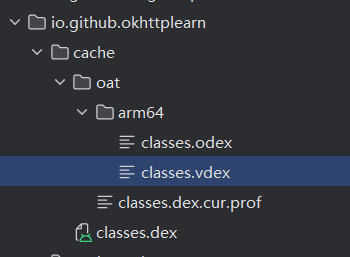
这些文件有什么作用呢?
想要解密这些,还是相当复杂的需要了解art虚拟机的知识.
加载Activity
HomeActivity.java
源码
package io.github.okhttplearn;

import android.content.Context;
import android.content.Intent;
import android.os.Bundle;
import android.widget.TextView;

import androidx.activity.ComponentActivity;
import androidx.annotation.NonNull;
import androidx.annotation.Nullable;

public class HomeActivity extends ComponentActivity {
    public static void startActivity(@NonNull Context context){
        context.startActivity(new Intent(context, HomeActivity.class));
    }
    @Override
    protected void onCreate(@Nullable Bundle savedInstanceState) {
        super.onCreate(savedInstanceState);
        final var textView = new TextView(this);
        textView.setText("Hello World");
        setContentView(textView);
    }
}
编译为class
javac -d . --class-path "D:\SoftWare\gradle\caches\8.13\transforms\574a8184410d7b8ae96f1a300e7be7af\transformed\activity-1.12.0-beta01\jars\classes.jar;D:\SoftWare\Android\Sdk\platforms\android-36\android.jar;D:\SoftWare\gradle\caches\modules-2\files-2.1\androidx.annotation\annotation-jvm\1.9.1\b17951747e38bf3986a24431b9ba0d039958aa5f\annotation-jvm-1.9.1.jar;D:\SoftWare\gradle\caches\modules-2\files-2.1\androidx.lifecycle\lifecycle-common-jvm\2.10.0-beta01\8cfb34614ace574aa320aa599cd8c1c38f7af268\lifecycle-common-jvm-2.10.0-beta01.jar;D:\SoftWare\gradle\caches\8.13\transforms\b4ccea56d1a29eae461b218513391a62\transformed\lifecycle-viewmodel\jars\classes.jar;D:\SoftWare\gradle\caches\8.13\transforms\bb8cbac7eee9253b3febd6aaae993046\transformed\savedstate\jars\classes.jar;D:\SoftWare\gradle\caches\8.13\transforms\63e23a81dd393afa409023b926aac907\transformed\navigationevent\jars\classes.jar;D:\SoftWare\gradle\caches\8.13\transforms\a3d3a03ff93f54630cda5b7e612d3b45\transformed\core-1.16.0\jars\classes.jar;D:\SoftWare\gradle\caches\modules-2\files-2.1\org.jetbrains.kotlin\kotlin-stdlib\2.2.21\fa374a986e128314c3db00a20aae55f72a258511\kotlin-stdlib-2.2.21.jar" HomeActivity.java
编译为dex
./d8 --intermediate --globals-output "C:\Users\29051\Desktop\gs" --file-per-class-file --lib "D:\SoftWare\gradle\caches\8.13\transforms\574a8184410d7b8ae96f1a300e7be7af\transformed\activity-1.12.0-beta01\jars\classes.jar;D:\SoftWare\Android\Sdk\platforms\android-36\android.jar;D:\SoftWare\gradle\caches\modules-2\files-2.1\androidx.annotation\annotation-jvm\1.9.1\b17951747e38bf3986a24431b9ba0d039958aa5f\annotation-jvm-1.9.1.jar;D:\SoftWare\gradle\caches\modules-2\files-2.1\androidx.lifecycle\lifecycle-common-jvm\2.10.0-beta01\8cfb34614ace574aa320aa599cd8c1c38f7af268\lifecycle-common-jvm-2.10.0-beta01.jar;D:\SoftWare\gradle\caches\8.13\transforms\b4ccea56d1a29eae461b218513391a62\transformed\lifecycle-viewmodel\jars\classes.jar;D:\SoftWare\gradle\caches\8.13\transforms\bb8cbac7eee9253b3febd6aaae993046\transformed\savedstate\jars\classes.jar;D:\SoftWare\gradle\caches\8.13\transforms\63e23a81dd393afa409023b926aac907\transformed\navigationevent\jars\classes.jar;D:\SoftWare\gradle\caches\8.13\transforms\a3d3a03ff93f54630cda5b7e612d3b45\transformed\core-1.16.0\jars\classes.jar;D:\SoftWare\gradle\caches\modules-2\files-2.1\org.jetbrains.kotlin\kotlin-stdlib\2.2.21\fa374a986e128314c3db00a20aae55f72a258511\kotlin-stdlib-2.2.21.jar" C:\Users\29051\Desktop\io\github\okhttplearn\HomeActivity.class --output C:\Users\29051\Downloads\io.zip
注入DexPathList的dexElements
val dexFile = File(context.cacheDir, "HomeActivity.dex")
val dexClassLoader = DexClassLoader(dexFile.absolutePath, null, null, context.classLoader)
// val loadedClass: Class<*> = dexClassLoader.loadClass("io.github.okhttplearn.HomeActivity")
// Log.i(TAG, "WorldScreen loadedClass: $loadedClass, context.classLoader: ${context.classLoader}")

// 合并classpath
val pathListField: Field = BaseDexClassLoader::class.java.getDeclaredField("pathList")
pathListField.isAccessible = true
val dexClassLoaderPathList = pathListField.get(dexClassLoader)
val systemDexClassLoaderPathList = pathListField.get(context.classLoader)

Log.i(TAG, "WorldScreen -> superclass: ${dexClassLoader::class.java.superclass},  dexClassLoaderPathList: $dexClassLoaderPathList, systemDexClassLoaderPathList: $systemDexClassLoaderPathList")
val dexElementsField: Field = dexClassLoaderPathList::class.java.getDeclaredField("dexElements")
dexElementsField.isAccessible = true
Log.i(TAG, "WorldScreen -> dexElementsField: $dexElementsField")
val dexClassLoaderElements = (dexElementsField.get(dexClassLoaderPathList) as? Array<*>)
val systemDexClassLoaderElements = dexElementsField.get(systemDexClassLoaderPathList) as? Array<*>
	Log.i(TAG, "WorldScreen -> dexClassLoaderElements: ${dexClassLoaderElements?.joinToString()}, systemDexClassLoaderElements: ${systemDexClassLoaderElements?.joinToString()}")

// copy 一份新的然后替换
val dexClassLoaderElementsLength = dexClassLoaderElements?.size ?: 0
val systemDexClassLoaderElementsLength = systemDexClassLoaderElements?.size ?: 0
Log.i(TAG, "WorldScreen -> $dexClassLoaderElementsLength, $systemDexClassLoaderElementsLength")
val finalDexClassLoaderElements = java.lang.reflect.Array.newInstance(dexClassLoaderElements!!.javaClass.componentType!!, dexClassLoaderElementsLength + systemDexClassLoaderElementsLength)
System.arraycopy(dexClassLoaderElements, 0, finalDexClassLoaderElements, 0, dexClassLoaderElementsLength)
System.arraycopy(systemDexClassLoaderElements!!, 0, finalDexClassLoaderElements, dexClassLoaderElementsLength, systemDexClassLoaderElementsLength)
Log.i(TAG, "WorldScreen -> finalDexClassLoaderElements: ${(finalDexClassLoaderElements as? Array<*>)?.joinToString()}")
dexElementsField.set(systemDexClassLoaderPathList, finalDexClassLoaderElements)

// 这行必须等set之后才能调用
val loadedClass: Class<*> = dexClassLoader.loadClass("io.github.okhttplearn.HomeActivity")

try {
	// val intent = Intent(context, context.classLoader.loadClass("io.github.okhttplearn.HomeActivity"))
	// val intent = Intent(context, dexClassLoader.loadClass("io.github.okhttplearn.HomeActivity"))
	val intent = Intent(context, loadedClass)
	context.startActivity(intent)
} catch (e: Exception){
	Log.e(TAG, "WorldScreen -> error: ", e)
}
加载Kotlin版Activity
源码
package io.github.plugin

import android.os.Bundle
import android.util.Log
import android.view.ViewGroup
import android.widget.LinearLayout
import android.widget.TextView
import android.widget.Toast
import androidx.activity.ComponentActivity
import androidx.lifecycle.lifecycleScope
import kotlinx.coroutines.launch

private const val TAG: String = "HomeActivity"

internal class HomeActivity internal constructor(): ComponentActivity() {

    override fun onCreate(savedInstanceState: Bundle?) {
        super.onCreate(savedInstanceState)
        setContentView(LinearLayout(this).apply {
            layoutParams = ViewGroup.LayoutParams(ViewGroup.LayoutParams.MATCH_PARENT, ViewGroup.LayoutParams.MATCH_PARENT)
            val textView = TextView(this@HomeActivity).apply {
                text = "Hello World12"
                setOnClickListener {
                    Toast.makeText(this@HomeActivity, "Hello World 世界2", Toast.LENGTH_SHORT).show()
                    lifecycleScope.launch {
                        Log.i(TAG, "onCreate -> thread: ${Thread.currentThread()}, student: ${Student("zsh")}")
                    }
                }
            }
            addView(textView)
        })
        Log.i(TAG, "onCreate...")
        initListener()
    }

    private fun initListener() {
    }
}
打包dex脚本
val jarTask: Provider<Jar> = tasks.register<Jar>("makeJar") {
    group = "build"
    description = "打包含 Kotlin 编译产物的 JAR 包"
    dependsOn(":plugin:compileDebugKotlin")
    val classDir: File = layout.buildDirectory.dir("/tmp/kotlin-classes/debug").get().asFile
    val jarOutput: File = layout.buildDirectory.file("outputs/plugin.jar").get().asFile
    logger.lifecycle("jarOutputName: ${jarOutput.name}")
    archiveFileName = jarOutput.name
    destinationDirectory.set(jarOutput.parentFile)
    from(classDir)
    duplicatesStrategy = DuplicatesStrategy.EXCLUDE
}
tasks.register<Exec>("makeDex"){
    group = "build"
    description = "将 JAR 转成 DEX"
    dependsOn(jarTask)
    val jarOutput: File = layout.buildDirectory.file("outputs/plugin.jar").get().asFile
    val dexOutput: File = layout.buildDirectory.file("outputs/plugin.zip").get().asFile
    val isWindows: Boolean = org.gradle.internal.os.OperatingSystem.current().isWindows
    val d8: File = file("${android.sdkDirectory}/build-tools/${android.buildToolsVersion}/d8${if (isWindows) ".bat" else ""}")
    logger.lifecycle("classesDir: $jarOutput, dexOutput: $dexOutput, d8: $d8")
    // 必须保证宿主包含插件的依赖
    val result: Exec = commandLine(d8.toString(), jarOutput.toString(), "--output", dexOutput.toString())
    logger.lifecycle("result: $result")
}
加载代码
val dexFile = File(context.cacheDir, "classes.dex")
val dexClassLoader = DexClassLoader(dexFile.absolutePath, null, null, context.classLoader)

// 合并classpath
val pathListField: Field = dexClassLoader::class.java.superclass.getDeclaredField("pathList")
Log.i(TAG, "WorldScreen -> ${dexClassLoader.parent.javaClass}, ${dexClassLoader.javaClass.superclass.javaClass}, ${dexClassLoader::class.java.superclass::class.java}")
pathListField.isAccessible = true
val dexClassLoaderPathList = pathListField.get(dexClassLoader)
val systemDexClassLoaderPathList = pathListField.get(context.classLoader)

Log.i(TAG, "WorldScreen -> superclass: ${dexClassLoader::class.java.superclass},  dexClassLoaderPathList: $dexClassLoaderPathList, systemDexClassLoaderPathList: $systemDexClassLoaderPathList")
val dexElementsField: Field = dexClassLoaderPathList::class.java.getDeclaredField("dexElements")
dexElementsField.isAccessible = true
Log.i(TAG, "WorldScreen -> dexElementsField: $dexElementsField")
val dexClassLoaderElements: Array<*>? = (dexElementsField.get(dexClassLoaderPathList) as? Array<*>)
val systemDexClassLoaderElements: Array<*>? = dexElementsField.get(systemDexClassLoaderPathList) as? Array<*>
	Log.i(TAG, "WorldScreen -> dexClassLoaderElements: ${dexClassLoaderElements?.joinToString()}, systemDexClassLoaderElements: ${systemDexClassLoaderElements?.joinToString()}")

// copy 一份新的然后替换
val dexClassLoaderElementsLength = dexClassLoaderElements?.size ?: 0
val systemDexClassLoaderElementsLength = systemDexClassLoaderElements?.size ?: 0
Log.i(TAG, "WorldScreen -> $dexClassLoaderElementsLength, $systemDexClassLoaderElementsLength")
val finalDexClassLoaderElements = java.lang.reflect.Array.newInstance(dexClassLoaderElements!!.javaClass.componentType!!, dexClassLoaderElementsLength + systemDexClassLoaderElementsLength)
System.arraycopy(dexClassLoaderElements, 0, finalDexClassLoaderElements, 0, dexClassLoaderElementsLength)
System.arraycopy(systemDexClassLoaderElements!!, 0, finalDexClassLoaderElements, dexClassLoaderElementsLength, systemDexClassLoaderElementsLength)
Log.i(TAG, "WorldScreen -> finalDexClassLoaderElements: ${(finalDexClassLoaderElements as? Array<*>)?.joinToString()}")
dexElementsField.set(systemDexClassLoaderPathList, finalDexClassLoaderElements)

// 这行必须等set之后才能调用
// val loadedClass: Class<*> = dexClassLoader.loadClass("io.github.plugin.HomeActivity")

try {
	val intent = Intent(context, dexClassLoader.loadClass("io.github.plugin.HomeActivity"))
	context.startActivity(intent)
} catch (e: Exception){
	Log.e(TAG, "WorldScreen -> error: ", e)
}
TODO hook resource
路漫漫其修远兮,吾将上下而求索!

 浙公网安备 33010602011771号