实验三
#include <stdio.h>

char score_to_grade(int score);  // 函数声明

int main() {
    int score;
    char grade;

    while(scanf("%d", &score) != EOF) {
        grade = score_to_grade(score);  // 函数调用
        printf("分数: %d, 等级: %c\n\n", score, grade);
    }

    return 0;
}

// 函数定义
char score_to_grade(int score) {
    char ans;

    switch(score/10) {
    case 10:
    case 9:   ans = 'A'; break;
    case 8:   ans = 'B'; break;
    case 7:   ans = 'C'; break;
    case 6:   ans = 'D'; break;
    default:  ans = 'E';
    }

    return ans;
}
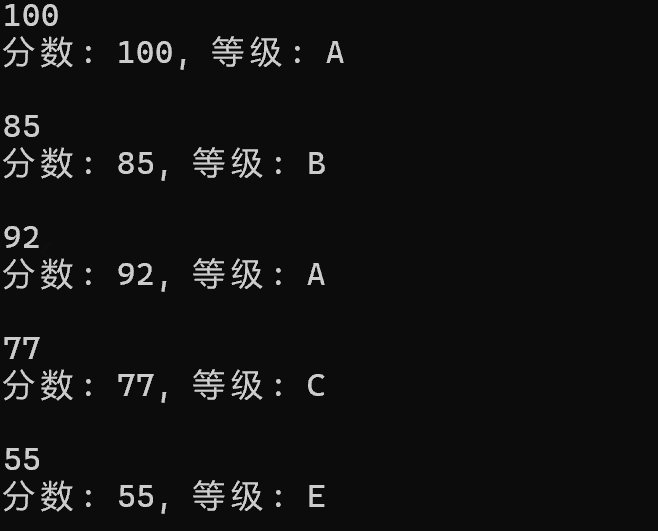
问题一:将得分按>=90为A,>=80为B,>=70为C,>=60为D,<60为E进行转化;形参类型为int, 返回值类型为char
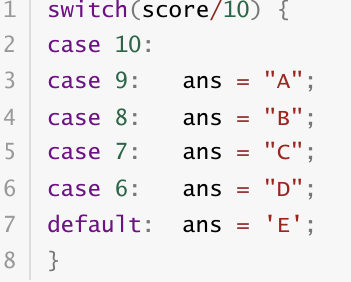
问题二:每个case执行后没有break,会以此执行之下的所有语句。ans需用‘’接收
2
#include <stdio.h>

int sum_digits(int n);  // 函数声明

int main() {
    int n;
    int ans;

    while(printf("Enter n: "), scanf("%d", &n) != EOF) {
        ans = sum_digits(n);    // 函数调用
        printf("n = %d, ans = %d\n\n", n, ans);
    }

    return 0;
}

// 函数定义
int sum_digits(int n) {
    int ans = 0;

    while(n != 0) {
        ans += n % 10;
        n /= 10;
    }

    return ans;
}
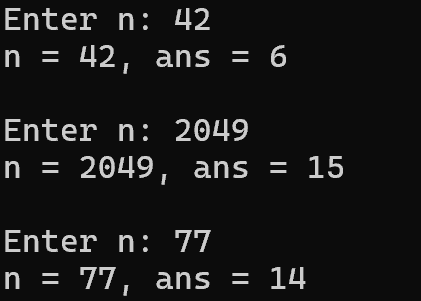
问题一:求正整数n各位数值之和
问题二:可以实现等同效果,
算法思维区别:前者使用了迭代的思维,即使用循环结构达成目标;后者则使用了递归的思维,即通过调用函数自身达成目标
3
#include <stdio.h>

int power(int x, int n);    // 函数声明

int main() {
    int x, n;
    int ans;

    while(printf("Enter x and n: "), scanf("%d%d", &x, &n) != EOF) {
        ans = power(x, n);  // 函数调用
        printf("n = %d, ans = %d\n\n", n, ans);
    }

    return 0;
}

// 函数定义
int power(int x, int n) {
    int t;

    if(n == 0)
        return 1;
    else if(n % 2)
        return x * power(x, n-1);
    else {
        t = power(x, n/2);
        return t*t;
    }
}
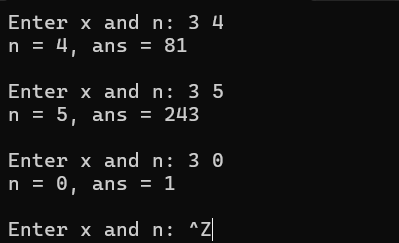
问题一:函数power的功能是计算出x的n次方
问题二:是递归模型函数
4
#include<stdio.h>
#include<stdlib.h>
int is_prime(int n);
int main(){
    int i,count=0;
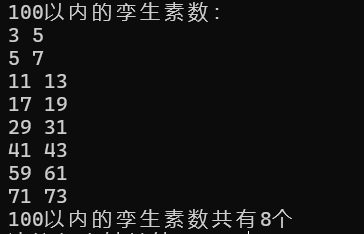
    printf("100以内的孪生素数:\n");
    for(i=2;i<=100;i++){
        if(is_prime(i)==1 && is_prime(i+2)==1){
            printf("%d %d\n",i,i+2);
            count+=1;
        }
    }
    printf("100以内的孪生素数共有%d个\n",count);
    system("pause");
    return 0;
}

int is_prime(int n){
    int j;
    for(j=2;j<=n/2;j++){

        if(n%j==0)
            return 0;
    }
    return 1;
}
5
#include<stdio.h>
#include<stdlib.h>
void hanoi(unsigned int n,char from,char temp,char to);//递归
void moveplate(unsigned int n,char from,char to);//移动
static int x=0;
int main(){

    unsigned int n;
    while(scanf("%u",&n)!=EOF){
    hanoi(n,'A','B','C');
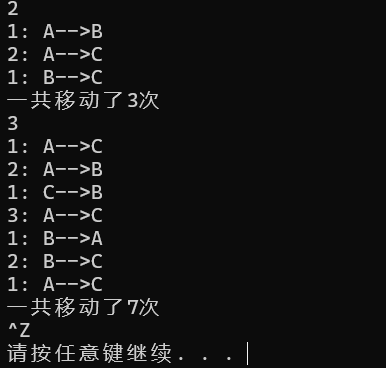
    printf("一共移动了%d次\n",x);
    x=0;
    }
    system("pause");
    return 0;
}

void hanoi(unsigned int n,char from,char temp,char to){

    if(n==1)
        moveplate(n,from,to);
    else
    {
        hanoi(n-1,from,to,temp);
        moveplate(n,from,to);
        hanoi(n-1,temp,from,to);
    }
    x+=1;
}
void moveplate(unsigned int n,char from,char to){

    printf("%u: %c-->%c\n",n,from,to);

}
6
方法一
#include <stdio.h>
int func(int n, int m);

int main() {
    int n, m;
    int ans;

    while (scanf_s("%d%d", &n, &m) != EOF) {
        ans = func(n, m);
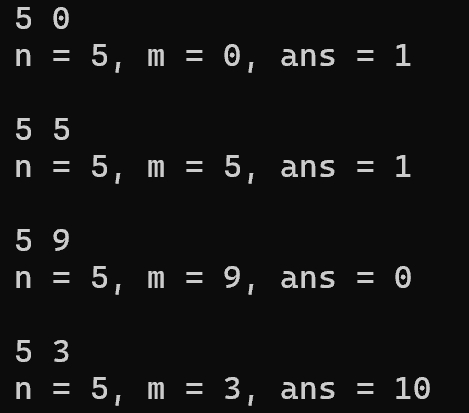
        printf("n = %d, m = %d, ans = %d\n\n", n, m, ans);
    }

    return 0;
}
int func(int n, int m)
{
    int up=n, down=m;
    int c=0;
    if (m == 0 || m == n)
        return 1;
    while ((m > 1)and (n > m - 1))
    {
        --n, --m;
        up *= n;
        down *= m;
    }
    if(down>0)
        c = up / down;
    return c;
}
方法二
#include <stdio.h>
int func(int n, int m);

int main() {
    int n, m;
    int ans;

    while (scanf_s("%d%d", &n, &m) != EOF) {
        ans = func(n, m);
        printf("n = %d, m = %d, ans = %d\n\n", n, m, ans);
    }

    return 0;
}
int func(int n, int m)
{
    int c1, c2;
    int c=0;
    int up1 = n - 1 ,down1 = m;
    int up2 = n - 1, down2 = m-1;
    if (n < m)
        return 0;
    if (m == n or m == 0)
        return 1;
    if (m == 1)
        return n;
    else
        return func(n - 1, m) + func(n - 1, m - 1);
    while ( (n > m - 1) and (m > 1))
    {
        --n, --m;
        up1 *= n,up2 *=n;
        down1 *= m,down2*=m;
    }
    c1 = up1 / down1;
    c2 = up2 / down2;
    c = c1 + c2;
    return c;
}
7
#include <stdio.h>

int gcd(int a, int b, int c);


int main() {
    int a, b, c;
    int ans;

    while (scanf_s("%d%d%d", &a, &b, &c) != EOF) {
        ans = gcd(a, b, c);
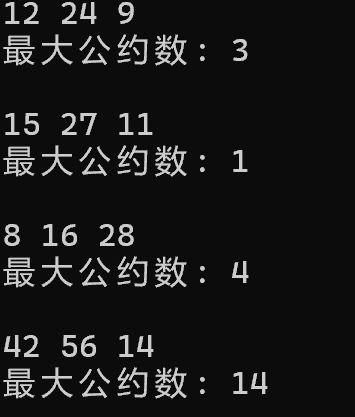
        printf("最大公约数: %d\n\n", ans);
    }

    return 0;
}


int gcd(int a,int b,int c) {
    while (a != b)
    {
        if (a > b)
            a = a - b;
        else
            b = b - a;
    }
    while (c != b)
    {
        if (c > b)
            c = c - b;
        else
            b = b - c;
    }
    while (a != c)
    {
        if (a > c)
            a = a - c;
        else
            c = c - a;
    }
    return a;
}

 浙公网安备 33010602011771号