![]()
![]()
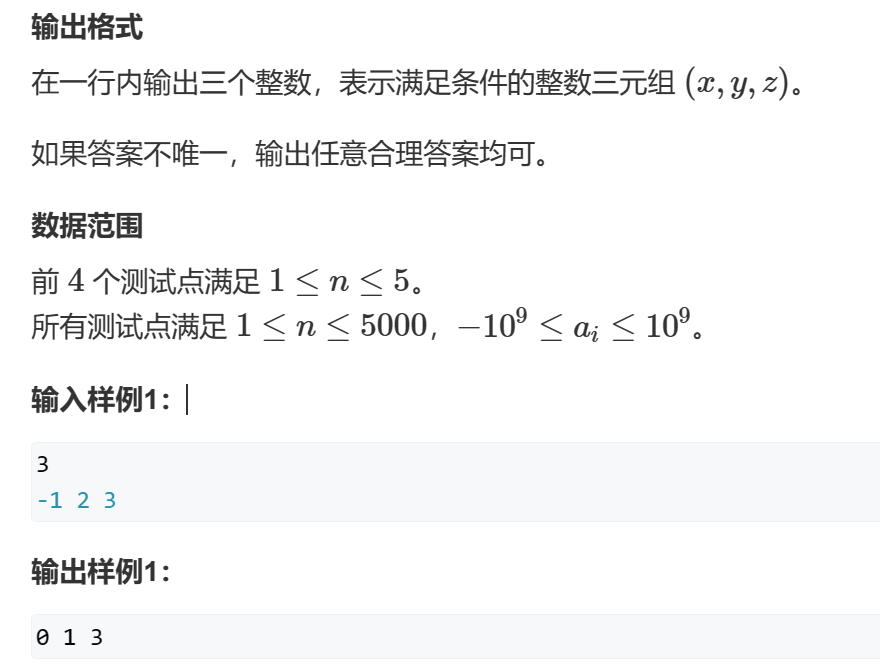
#include<iostream>
#include<cstdio>
#include<cstring>
#include<algorithm>
#include<climits>

using namespace std;

typedef long long LL;

const int N = 5010;

int n;
int a[N];
LL s[N];

LL get(int l, int r) {
    return s[r - 1] - s[l - 1];
}

int main() {
    cin.tie(0);
    cin >> n;
    for(int i = 1; i <= n; i ++ ) cin >> a[i];
    for(int i = 1; i <= n; i ++ ) s[i] = s[i - 1] + a[i];

    LL mx = LONG_LONG_MIN;
    int x = 1, y = 1, z = 1;

    for(int yy = 1; yy <= n + 1; yy ++ ) {
        int tx = 1, tz = yy;
        LL res1 = LONG_LONG_MIN, res2 = LONG_LONG_MIN;

        for(int xx = 1; xx <= yy; xx ++ ) {
            auto tt = get(1, xx) - get(xx, yy);
            if(res1 < tt) {
                res1 = tt;
                tx = xx;
            }
        }

        for(int zz = yy; zz <= n + 1; zz ++ ) {
            auto tt = get(yy, zz) - get(zz, n + 1);
            if(res2 < tt) {
                res2 = tt;
                tz = zz;
            }
        }

        if(mx < res1 + res2) {
            mx = res1 + res2;
            x = tx, y = yy, z = tz;
        }
    }

    cout << x - 1 << ' ' << y - 1 << ' ' << z - 1 << endl;

    return 0;
}
![]()
![]()
#include<iostream>
#include<cstring>
#include<algorithm>
#include<cstdio>
#include<climits>
#include<cmath>

using namespace std;

const int N = 3e5 + 10, M = N * 2;

int n, m, s;
int h[N], e[M], ne[M], w[M], idx;
bool st[N];
int ans[N];

void add(int a, int b, int c) {
    e[idx] = b, ne[idx] = h[a], w[idx] = c, h[a] = idx ++ ;
}

int dfs(int u, int type) {
    int res = 1;
    st[u] = true;
    for(int i = h[u]; ~i; i = ne[i]) {
        int j = e[i];
        if(st[j]) continue;

        if(type == 0) {
            res += dfs(j, type);
            if(w[i]) ans[abs(w[i])] = w[i];
        } else {
            if(w[i]) ans[abs(w[i])] = -w[i];
            else res += dfs(j, type);
        }
    }

    return res;
}

int main() {
    cin.tie(0);
    memset(h, -1, sizeof h);

    cin >> n >> m >> s;

    for(int i = 1; i <= m; i ++ ) {
        int t, a, b;
        cin >> t >> a >> b;
        if(t == 1) add(a, b, 0);
        else add(a, b, i), add(b, a, -i), ans[i] = i;
    }

    printf("%d\n", dfs(s, 0));
    for(int i = 1; i <= m; i ++ )
        if(ans[i] > 0) printf("+");
        else if(ans[i] < 0) printf("-");
    puts("");

    memset(st, 0, sizeof st);
    printf("%d\n", dfs(s, 1));
    for(int i = 1; i <= m; i ++ )
        if(ans[i] > 0) printf("+");
        else if(ans[i] < 0) printf("-");

    puts("");


    return 0;
}





 浙公网安备 33010602011771号