
POJ3009 Curling 2.0
Curling 2.0
| Time Limit: 1000MS | Memory Limit: 65536K | |
| Total Submissions: 4112 | Accepted: 1699 |
Description
On Planet MM-21, after their Olympic games this year, curling is getting popular. But the rules are somewhat different from ours. The game is played on an ice game board on which a square mesh is marked. They use only a single stone. The purpose of the game is to lead the stone from the start to the goal with the minimum number of moves.
Fig. 1 shows an example of a game board. Some squares may be occupied with blocks. There are two special squares namely the start and the goal, which are not occupied with blocks. (These two squares are distinct.) Once the stone begins to move, it will proceed until it hits a block. In order to bring the stone to the goal, you may have to stop the stone by hitting it against a block, and throw again.

Fig. 1: Example of board (S: start, G: goal)
The movement of the stone obeys the following rules:
- At the beginning, the stone stands still at the start square.
- The movements of the stone are restricted to x and y directions. Diagonal moves are prohibited.
- When the stone stands still, you can make it moving by throwing it. You may throw it to any direction unless it is blocked immediately(Fig. 2(a)).
- Once thrown, the stone keeps moving to the same direction until one of the following occurs:
- The stone hits a block (Fig. 2(b), (c)).
- The stone stops at the square next to the block it hit.
- The block disappears.
- The stone gets out of the board.
- The game ends in failure.
- The stone reaches the goal square.
- The stone stops there and the game ends in success.
- The stone hits a block (Fig. 2(b), (c)).
- You cannot throw the stone more than 10 times in a game. If the stone does not reach the goal in 10 moves, the game ends in failure.
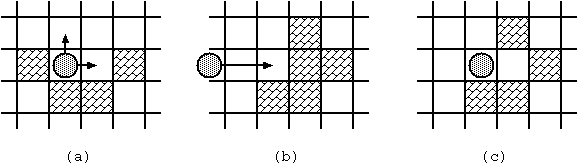
Fig. 2: Stone movements
Under the rules, we would like to know whether the stone at the start can reach the goal and, if yes, the minimum number of moves required.
With the initial configuration shown in Fig. 1, 4 moves are required to bring the stone from the start to the goal. The route is shown in Fig. 3(a). Notice when the stone reaches the goal, the board configuration has changed as in Fig. 3(b).

Fig. 3: The solution for Fig. D-1 and the final board configuration
Input
The input is a sequence of datasets. The end of the input is indicated by a line containing two zeros separated by a space. The number of datasets never exceeds 100.
Each dataset is formatted as follows.
the width(=w) and the height(=h) of the board
First row of the board
...
h-th row of the board
The width and the height of the board satisfy: 2 <= w <= 20, 1 <= h <= 20.
Each line consists of w decimal numbers delimited by a space. The number describes the status of the corresponding square.
0 vacant square 1 block 2 start position 3 goal position
The dataset for Fig. D-1 is as follows:
6 6
1 0 0 2 1 0
1 1 0 0 0 0
0 0 0 0 0 3
0 0 0 0 0 0
1 0 0 0 0 1
0 1 1 1 1 1
Output
For each dataset, print a line having a decimal integer indicating the minimum number of moves along a route from the start to the goal. If there are no such routes, print -1 instead. Each line should not have any character other than this number.
Sample Input
2 1
3 2
6 6
1 0 0 2 1 0
1 1 0 0 0 0
0 0 0 0 0 3
0 0 0 0 0 0
1 0 0 0 0 1
0 1 1 1 1 1
6 1
1 1 2 1 1 3
6 1
1 0 2 1 1 3
12 1
2 0 1 1 1 1 1 1 1 1 1 3
13 1
2 0 1 1 1 1 1 1 1 1 1 1 3
0 0
Sample Output
1
4
-1
4
10
-1
Source
  1 #include <cstdlib>
  2 #include <iostream>
  3 #include <cstdio>
  4
  5 using namespace std;
  6 int map[25][25];
  7 int fx,fy;
  8
  9 struct Node{
 10        int x;
 11        int y;
 12        };
 13 Node move_up(int w,int h,int sx,int sy,int ex,int ey)
 14 {   int x,y;
 15
 16     y=sy;
 17     x=sx;
 18     Node node;
 19     while(1)
 20     {
 21             if(y>h||y<1)
 22             {node.y=y;node.x=x;return node;}
 23             if(x>w||x<1)
 24             {node.y=y;node.x=x;return node;}
 25             if((x==ex)&&(y==ey))
 26             {node.y=y;node.x=x;return node;}
 27
 28             if(map[y][x]==1)
 29             {node.y=y;node.x=x;fx=x;fy=y+1;return node;}
 30
 31             y--;
 32     }
 33
 34
 35
 36 }
 37
 38 Node move_down(int w,int h,int sx,int sy,int ex,int ey)
 39 {int x,y;
 40
 41     y=sy;
 42     x=sx;
 43     Node node;
 44     while(1)
 45     {
 46             if(y>h||y<1)
 47             {node.y=y;node.x=x;return node;}
 48             if(x>w||x<1)
 49             {node.y=y;node.x=x;return node;}
 50             if((x==ex)&&(y==ey))
 51             {node.y=y;node.x=x;return node;}
 52             if(map[y][x]==1)
 53             {node.y=y;node.x=x;fx=x;fy=y-1;return node;}
 54
 55             y++;
 56     }
 57
 58 }
 59
 60 Node move_left(int w,int h,int sx,int sy,int ex,int ey)
 61 {   int x,y;
 62
 63     y=sy;
 64     x=sx;
 65     Node node;
 66     while(1)
 67     {
 68             if(y>h||y<1)
 69             {node.y=y;node.x=x;return node;}
 70             if(x>w||x<1)
 71             {node.y=y;node.x=x;return node;}
 72             if((x==ex)&&(y==ey))
 73             {node.y=y;node.x=x;return node;}
 74             if(map[y][x]==1)
 75             {node.y=y;node.x=x;fx=x+1;fy=y;return node;}
 76
 77             x--;
 78     }
 79
 80
 81
 82
 83
 84
 85 }
 86
 87 Node move_right(int w,int h,int sx,int sy,int ex,int ey)
 88 {int x,y;
 89
 90     y=sy;
 91     x=sx;
 92     Node node;
 93
 94     while(1)
 95     {
 96             if(y>h||y<1)
 97             {node.y=y;node.x=x;return node;}
 98             if(x>w||x<1)
 99             {node.y=y;node.x=x;return node;}
100             if((x==ex)&&(y==ey))
101             {node.y=y;node.x=x;return node;}
102             if(map[y][x]==1)
103             {node.y=y;node.x=x;fx=x-1;fy=y;return node;}
104
105             x++;
106     }
107 }
108 Node (*p[4]) (int w,int h,int sx,int sy,int ex,int ey)={move_up,move_down,move_left,move_right};//函数指针数组;
109
110 int mount;
111 int tx[4]={0,0,-1,1};
112 int ty[4]={-1,1,0,0};
113
114 int dfs(int w,int h,int sx,int sy,int ex,int ey,int num)
115 {int i,j,k;
116 Node node;
117 if(num>10)//剪枝
118 return -1;
119
120 if(num>mount)//剪枝
121 return -1;
122
123
124 for(i=0;i<4;i++)
125 {
126 if(map[sy+ty[i]][sx+tx[i]]==1)
127 continue;
128
129 node=p[i](w,h,sx,sy,ex,ey);
130
131  if(node.x>w||node.x<1)
132  continue;
133  if(node.y>h||node.y<1)
134  continue;
135  if((node.x==ex)&&(node.y==ey))
136  if(num<mount)//更新+剪枝
137  {mount=num;return 1;}
138
139  if(map[node.y][node.x]==1)
140  {map[node.y][node.x]=0;
141   dfs(w,h,fx,fy,ex,ey,num+1);
142   map[node.y][node.x]=1;
143  }
144
145
146 }
147
148 return -1;
149 }
150
151
152
153
154
155
156
157
158
159 int main(int argc, char *argv[])
160 {//freopen("C:/Users/shp/Desktop/in.txt","r",stdin);
161  //freopen("C:/Users/shp/Desktop/out.txt","w",stdout);
162  int w,h;
163 int i,j,k;
164 int sx,sy,ex,ey;
165 while(scanf("%d%d",&w,&h)!=EOF)//cin>>w>>h)
166 {               if((w==0)&&(h==0))
167                 break;
168
169                 for(i=1;i<=h;i++)
170                 for(j=1;j<=w;j++)
171                 {scanf("%d",&map[i][j]);//cin>>map[i][j];
172                 if(map[i][j]==2)
173                 sx=j,sy=i;
174                 if(map[i][j]==3)
175                 ex=j,ey=i;
176                 }
177                 fx=sx;fy=sy;
178                 mount=20;
179                 dfs(w,h,sx,sy,ex,ey,1);
180                 if(mount>10)
181                 cout<<-1<<endl;
182                 else
183                 cout<<mount<<endl;
184
185
186 }
187
188
189     system("PAUSE");
190     return EXIT_SUCCESS;
191 }

 浙公网安备 33010602011771号