

Python Knowledge
#KNOWLEDGE
* Install a new version python
python --version shows the current version
sudo apt update
sudo apt install software-properties-common
sudo add-apt-repository ppa:deadsnakes/ppa
sudo apt update
sudo apt install python3.8
*Set the default python
sudo update-alternatives --install /usr/bin/python python /usr/bin/python3.4 1
sudo update-alternatives --install /usr/bin/python python /usr/bin/python3.6 2
sudo update-alternatives --config python
The commmand will show the current default python, you can intput the number to select the new default Python.
*Install python module
pip install xxx
* List the installed pacakges
pip list
* Install a specific version package
pip install 'PackageName==1.4'
#PROGRAMING
1. accept console input
list = [int(x) for x in input("Input numbers:").split()]
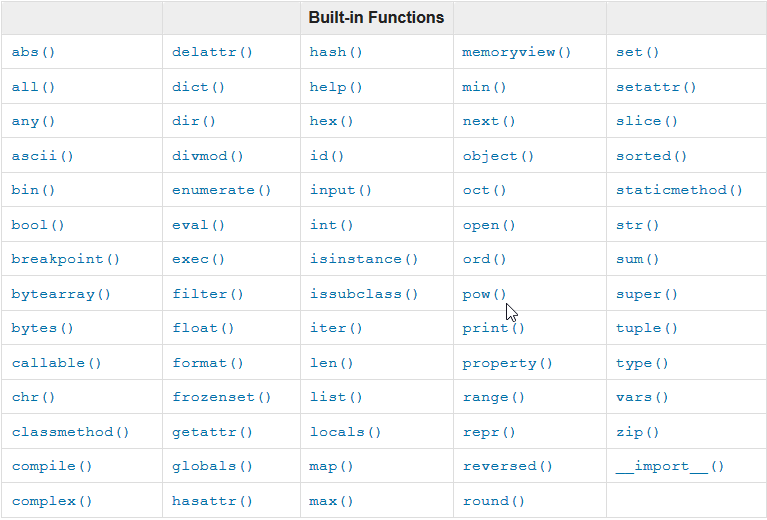
2. built-in functions
3. unit test frame
class TestMinMax(unittest.TestCase):
  def test_minmax(self):
4. main
if __name__ == '__main__':
  unittest.main()
5. data types
list |
[1, 2, 3] |
Ordered collection |
tuple |
(1, 2, 3) |
Immutable ordered collection |
dict |
{'a':1, 'b':2, 'c':3} |
Unordered (key,value) mapping |
set |
{1, 2, 3} |
Unordered collection of unique values |
return a tuple
def MinMaxCalculate(list):
  if (len(list) == 0):
    raise ValueError("Empty List")

  negtiveList = []
  positiveList = []
  for v in list:
    if (v >= 0):
      positiveList.append(v)
    else:
      negtiveList.append(v)

  if (len(positiveList) == 0): # only negative
    minValue = sum(negtiveList)
    maxValue = max(negtiveList)
  elif (len(negtiveList) == 0): # only positive
    minValue = min(positiveList)
    maxValue = sum(positiveList)
  else: # both negative and positive
    minValue = sum(negtiveList)
    maxValue = sum(positiveList)

  return (minValue, maxValue)


 浙公网安备 33010602011771号