


ResNet 动手实现
参考:https://zhuanlan.zhihu.com/p/225597229
前言
ResNet(Residual Neural Network)由微软研究院的Kaiming He等四名华人提出,通过使用ResNet Unit成功训练出了152层的神经网络,并在ILSVRC2015比赛中取得冠军,在top5上的错误率为3.57%,同时参数量比VGGNet低,效果非常突出。ResNet的结构可以极快的加速神经网络的训练,模型的准确率也有比较大的提升。同时ResNet的推广性非常好,甚至可以直接用到InceptionNet网络中。
背景:
当堆叠到一定网络深度时,就会出现两个问题。
- 梯度消失或梯度爆炸。
- 退化问题(degradation problem)。
ReLU和Batch Normalization能解决梯度消失或者梯度爆炸问题;但是对于退化问题(随着网络层数的加深,效果还会变差)并没有很好的解决办法。
理论
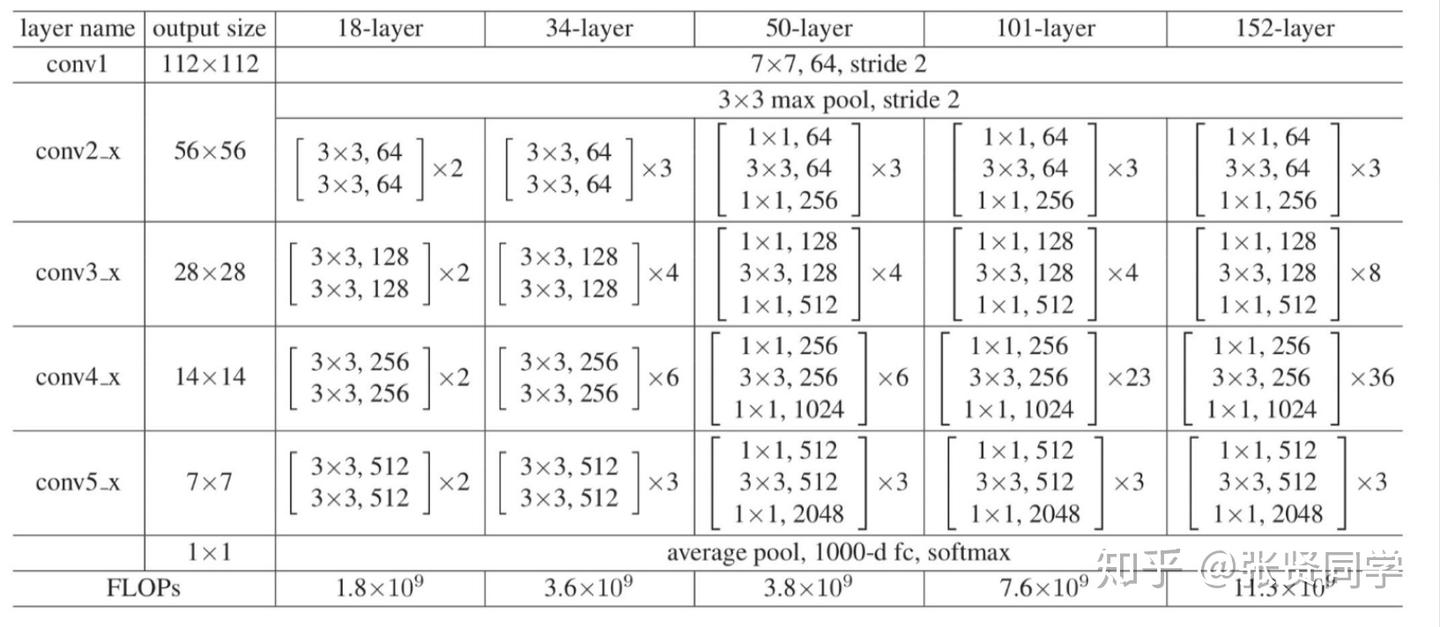
ResNet 有很多尺寸,包括 ResNet 18、ResNet 34、ResNet 50、ResNet 101、ResNet 152,网络结构对比如下:
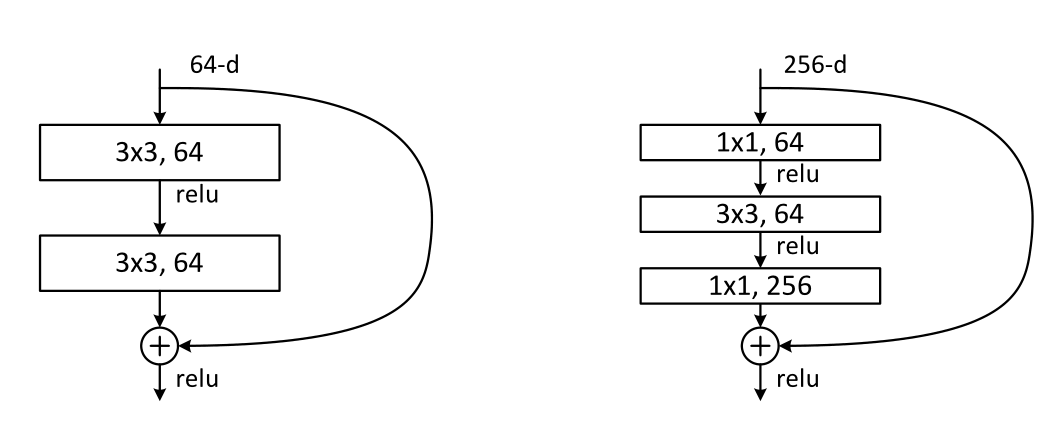
两种基本单元结构:
论文原文中给出了两种ResNet的基本单元结构,其中左边的单元用于较浅的网络(BasicBlock),如ResNet18、ResNet34,右边的单元则用于较深的网络(Bottleneck),如ResNet50、ResNet101等。
两种残差路径:
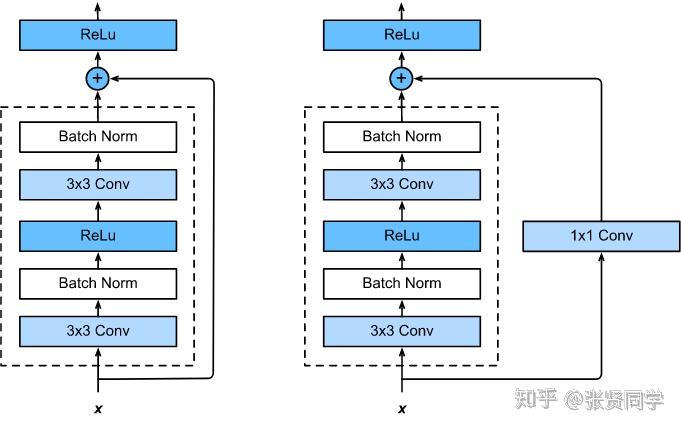
shortcut 路径大致可以分成 2 种,取决于残差路径是否改变了feature map数量和尺寸。
- 一种是将输入
x原封不动地输出。 - 另一种则需要经过 1×1 卷积来升维或者降采样,主要作用是将输出与 F(x) 路径的输出保持
shape一致,对网络性能的提升并不明显。(上图只有一条线。下面标注1x1 Conv更明显。)
两种结构如下图所示:
在ResNet 18中,数据变换大致流程如下:
- 输入的图片形状是 3×224×224。
- 图片经过
conv1层,输出图片大小为 64×112×112。(通道64,尺寸/2) - 图片经过
max pool层,输出图片大小为 64×56×56。(通道不变,尺寸/2) - 图片经过
conv2层,输出图片大小为 64×56×56。(通道不变,尺寸不变) - 图片经过
conv3层,输出图片大小为 128×28×28。(通道x2,尺寸/2) - 图片经过
conv4层,输出图片大小为 256×14×14。(通道x2,尺寸/2) - 图片经过
conv5层,输出图片大小为 512×7×7。(通道x2,尺寸/2) - 图片经过
avg pool层,输出大小为 512×1×1。(通道不变) - 图片经过
fc层,输出维度为 numclasses,表示每个分类的logits。
代码实战
模型代码
def conv3x3(in_planes: int, out_planes: int, stride: int = 1) -> nn.Conv2d:
    """3x3 convolution with padding"""
    return nn.Conv2d(in_planes, out_planes, kernel_size=3, stride=stride, padding=1, bias=False)


def conv1x1(in_planes: int, out_planes: int, stride: int = 1) -> nn.Conv2d:
    """1x1 convolution"""
    return nn.Conv2d(in_planes, out_planes, kernel_size=1, stride=stride, bias=False)


class BasicBlock(nn.Module):

    def __init__(self, in_planes: int, planes: int, stride: int = 1):
        super().__init__()
        # Both self.conv1 and self.downsample layers downsample the input when stride != 1
        self.conv1 = conv3x3(in_planes, planes, stride)
        self.bn1 = nn.BatchNorm2d(planes)
        self.relu = nn.ReLU(inplace=True)
        self.conv2 = conv3x3(planes, planes)
        self.bn2 = nn.BatchNorm2d(planes)
        self.stride = stride
        self.downsample = None
        if in_planes != planes or stride != 1:
            self.downsample = nn.Sequential(
                conv1x1(in_planes, planes, self.stride),
                nn.BatchNorm2d(planes)
            )

    def forward(self, x: torch.Tensor) -> torch.Tensor:
        identity = x

        out = self.conv1(x)
        out = self.bn1(out)
        out = self.relu(out)

        out = self.conv2(out)
        out = self.bn2(out)

        if self.downsample is not None:
            identity = self.downsample(x)

        out += identity
        out = self.relu(out)
        return out


class ResNet(nn.Module):
    def __init__(self, block: BasicBlock, layers: list[int], num_classes: int = 10):
        super().__init__()
        self.conv1 = nn.Conv2d(3, 64, kernel_size=7, stride=2, padding=3, bias=False)
        self.bn1 = nn.BatchNorm2d(64)
        self.relu = nn.ReLU(inplace=True)
        self.maxpool = nn.MaxPool2d(kernel_size=3, stride=2, padding=1)
        self.layer1 = self._make_layer(block, 64, 64, layers[0])
        self.layer2 = self._make_layer(block, 64, 128, layers[1], stride=2)
        self.layer3 = self._make_layer(block, 128, 256, layers[2], stride=2)
        self.layer4 = self._make_layer(block, 256, 512, layers[3], stride=2)
        self.avgpool = nn.AdaptiveAvgPool2d((1, 1))
        self.fc = nn.Linear(512, num_classes)

    def _make_layer(self, block, in_planes: int, planes: int, blocks: int, stride: int = 1) -> nn.Sequential:
        layers = [block(in_planes, planes, stride)]
        for _ in range(1, blocks):
            layers.append(block(planes, planes))
        return nn.Sequential(*layers)

    def forward(self, x: torch.Tensor) -> torch.Tensor:
        x = self.conv1(x)
        x = self.bn1(x)
        x = self.relu(x)
        x = self.maxpool(x)

        x = self.layer1(x)
        x = self.layer2(x)
        x = self.layer3(x)
        x = self.layer4(x)

        x = self.avgpool(x)
        x = torch.flatten(x, 1)
        x = self.fc(x)
        return x
数据代码
数据来源: https://storage.googleapis.com/download.tensorflow.org/example_images/flower_photos.tgz
总共有5个类别3670张图片,分别为daisy(雏菊)、dandelion(蒲公英)、rose(玫瑰)、sunflower(向日葵)、tulip(郁金香)。
数据预处理:
import json
import os
import random

data = []

for target in os.listdir('data/flower_photos'):
    for x in os.listdir(f'data/flower_photos/{target}'):
        cur = {
            'file': f'data/flower_photos/{target}/{x}',
            'label': target
        }
        data.append(cur)

random.shuffle(data)

n_train = int(len(data) * 0.8)

with open('data/train.jsonl', 'w', encoding='utf-8') as f:
    for x in data[:n_train]:
        f.write(json.dumps(x, ensure_ascii=False) + '\n')

with open('data/valid.jsonl', 'w', encoding='utf-8') as f:
    for x in data[n_train:]:
        f.write(json.dumps(x, ensure_ascii=False) + '\n')
自定义数据集:
class MyDataset(Dataset):
    def __init__(self, filename):
        self.data = [json.loads(x) for x in open(filename, 'r', encoding='utf-8').readlines()]
        self.img_map = {
            'daisy': 0,
            'dandelion': 1,
            'roses': 2,
            'sunflowers': 3,
            'tulips': 4
        }

    def __len__(self):
        return len(self.data)

    def __getitem__(self, idx):
        image = Image.open(self.data[idx]['file'])
        image = transforms.Resize((224, 224))(image)
        image = transforms.ToTensor()(image)
        label = torch.tensor(self.img_map[self.data[idx]['label']])
        return image, label
训练代码(完整代码)
import json
import random

import numpy as np
import torch
import torch.nn as nn
from PIL import Image
from torch.optim.lr_scheduler import CosineAnnealingLR, LinearLR, SequentialLR
from torch.utils.data import DataLoader
from torch.utils.data import Dataset
from torchvision import transforms
from torchvision.models import resnet18

seed = 100
torch.manual_seed(seed)
torch.cuda.manual_seed_all(seed)
random.seed(seed)

device = torch.device("cuda" if torch.cuda.is_available() else "cpu")


def conv3x3(in_planes: int, out_planes: int, stride: int = 1) -> nn.Conv2d:
    """3x3 convolution with padding"""
    return nn.Conv2d(in_planes, out_planes, kernel_size=3, stride=stride, padding=1, bias=False)


def conv1x1(in_planes: int, out_planes: int, stride: int = 1) -> nn.Conv2d:
    """1x1 convolution"""
    return nn.Conv2d(in_planes, out_planes, kernel_size=1, stride=stride, bias=False)


class BasicBlock(nn.Module):

    def __init__(self, in_planes: int, planes: int, stride: int = 1):
        super().__init__()
        # Both self.conv1 and self.downsample layers downsample the input when stride != 1
        self.conv1 = conv3x3(in_planes, planes, stride)
        self.bn1 = nn.BatchNorm2d(planes)
        self.relu = nn.ReLU(inplace=True)
        self.conv2 = conv3x3(planes, planes)
        self.bn2 = nn.BatchNorm2d(planes)
        self.stride = stride
        self.downsample = None
        if in_planes != planes or stride != 1:
            self.downsample = nn.Sequential(
                conv1x1(in_planes, planes, self.stride),
                nn.BatchNorm2d(planes)
            )

    def forward(self, x: torch.Tensor) -> torch.Tensor:
        identity = x

        out = self.conv1(x)
        out = self.bn1(out)
        out = self.relu(out)

        out = self.conv2(out)
        out = self.bn2(out)

        if self.downsample is not None:
            identity = self.downsample(x)

        out += identity
        out = self.relu(out)
        return out


class ResNet(nn.Module):
    def __init__(self, block: BasicBlock, layers: list[int], num_classes: int = 10):
        super().__init__()
        self.conv1 = nn.Conv2d(3, 64, kernel_size=7, stride=2, padding=3, bias=False)
        self.bn1 = nn.BatchNorm2d(64)
        self.relu = nn.ReLU(inplace=True)
        self.maxpool = nn.MaxPool2d(kernel_size=3, stride=2, padding=1)
        self.layer1 = self._make_layer(block, 64, 64, layers[0])
        self.layer2 = self._make_layer(block, 64, 128, layers[1], stride=2)
        self.layer3 = self._make_layer(block, 128, 256, layers[2], stride=2)
        self.layer4 = self._make_layer(block, 256, 512, layers[3], stride=2)
        self.avgpool = nn.AdaptiveAvgPool2d((1, 1))
        self.fc = nn.Linear(512, num_classes)

    def _make_layer(self, block, in_planes: int, planes: int, blocks: int, stride: int = 1) -> nn.Sequential:
        layers = [block(in_planes, planes, stride)]
        for _ in range(1, blocks):
            layers.append(block(planes, planes))
        return nn.Sequential(*layers)

    def forward(self, x: torch.Tensor) -> torch.Tensor:
        x = self.conv1(x)
        x = self.bn1(x)
        x = self.relu(x)
        x = self.maxpool(x)

        x = self.layer1(x)
        x = self.layer2(x)
        x = self.layer3(x)
        x = self.layer4(x)

        x = self.avgpool(x)
        x = torch.flatten(x, 1)
        x = self.fc(x)
        return x


class MyDataset(Dataset):
    def __init__(self, filename):
        self.data = [json.loads(x) for x in open(filename, 'r', encoding='utf-8').readlines()]
        self.img_map = {
            'daisy': 0,
            'dandelion': 1,
            'roses': 2,
            'sunflowers': 3,
            'tulips': 4
        }

    def __len__(self):
        return len(self.data)

    def __getitem__(self, idx):
        image = Image.open(self.data[idx]['file'])
        image = transforms.Resize((224, 224))(image)
        image = transforms.ToTensor()(image)
        label = torch.tensor(self.img_map[self.data[idx]['label']])
        return image, label


def train(epoch, epochs, net, dataloader, loss_fn, optimizer, scheduler):
    train_loss = []
    net.train()
    for step, (x, y) in enumerate(dataloader):
        x, y = x.to(device), y.to(device)
        y_hat = net(x)
        loss = loss_fn(y_hat, y)

        optimizer.zero_grad()
        loss.backward()
        optimizer.step()
        scheduler.step()

        train_loss.append(loss.item())
        if step % 1 == 0:
            print(f"epoch={epoch}/{epochs}, {step}/{len(dataloader)} of train, loss={loss.item()}")
    return train_loss


def valid(epoch, epochs, net, dataloader, loss_fn):
    valid_loss = []
    net.eval()
    for step, (x, y) in enumerate(dataloader):
        x, y = x.to(device), y.to(device)
        y_hat = net(x)
        loss = loss_fn(y_hat, y)
        valid_loss.append(loss.item())
        if step % 1 == 0:
            print(f"epoch={epoch}/{epochs}, {step}/{len(dataloader)} of valid, loss={loss.item()}")
    return valid_loss


def main():
    # 参数
    batch_size = 4
    epochs = 1
    learning_rate = 0.0001
    num_workers = 2

    train_dataset = MyDataset('data/train.jsonl')
    valid_dataset = MyDataset('data/valid.jsonl')

    train_dataloader = DataLoader(dataset=train_dataset, batch_size=batch_size, num_workers=num_workers, shuffle=True)
    valid_dataloader = DataLoader(dataset=valid_dataset, batch_size=batch_size, num_workers=num_workers, shuffle=False)

    net = ResNet(BasicBlock, [2, 2, 2, 2])
    model = net.to(device)

    loss_fn = torch.nn.CrossEntropyLoss().to(device)
    optimizer = torch.optim.AdamW(model.parameters(), lr=learning_rate)
    warm_up_iter = 20
    scheduler1 = LinearLR(optimizer, start_factor=0.01, end_factor=1, total_iters=warm_up_iter)
    scheduler2 = CosineAnnealingLR(optimizer, len(train_dataloader) * epochs - warm_up_iter)
    scheduler = SequentialLR(optimizer, schedulers=[scheduler1, scheduler2], milestones=[warm_up_iter])

    for epoch in range(epochs):
        train_loss = train(epoch, epochs, net, train_dataloader, loss_fn, optimizer, scheduler)
        print(f"epoch={epoch}/{epochs}, train epoch loss={np.mean(train_loss)}")
        valid_loss = valid(epoch, epochs, net, valid_dataloader, loss_fn)
        print(f"epoch={epoch}/{epochs}, valid epoch loss={np.mean(valid_loss)}")
        torch.save(net.state_dict(), f"resnet18.pth")


if __name__ == '__main__':
    main()
    # test()
测试代码
def test():
    net = resnet18()
    net.fc = nn.Linear(in_features=net.fc.in_features, out_features=10)
    net.load_state_dict(torch.load('resnet18.pth'))
    net.eval()
    image = Image.open('data/flower_photos/daisy/5547758_eea9edfd54_n.jpg')
    image = transforms.Resize((224, 224))(image)
    image = transforms.ToTensor()(image).unsqueeze(0)
    y_hat = net(image)
    y_hat = torch.argmax(y_hat, dim=1)
    print(y_hat)

if __name__ == '__main__':
    # main()
    test()
补充:Bottleneck
Bottleneck会对通道先降维(1/2),再扩充x4
class Bottleneck(nn.Module):
    expansion: int = 4  # Bottleneck层输出通道都是输入的4倍

    def __init__(self, in_planes: int, planes: int, stride: int = 1) -> None:
        super().__init__()
        self.conv1 = conv1x1(in_planes, planes)
        self.bn1 = nn.BatchNorm2d(planes)
        self.conv2 = conv3x3(planes, planes, stride)
        self.bn2 = nn.BatchNorm2d(planes)
        self.conv3 = conv1x1(planes, planes * self.expansion)
        self.bn3 = nn.BatchNorm2d(planes * self.expansion)
        self.relu = nn.ReLU(inplace=True)
        self.downsample = None
        if in_planes != planes * self.expansion or stride != 1:
            self.downsample = nn.Sequential(
                conv1x1(in_planes, planes * self.expansion, stride),
                nn.BatchNorm2d(planes)
            )

    def forward(self, x: torch.Tensor) -> torch.Tensor:
        identity = x

        out = self.conv1(x)
        out = self.bn1(out)
        out = self.relu(out)

        out = self.conv2(out)
        out = self.bn2(out)
        out = self.relu(out)

        out = self.conv3(out)
        out = self.bn3(out)

        if self.downsample is not None:
            identity = self.downsample(x)

        out += identity
        out = self.relu(out)

        return out

 浙公网安备 33010602011771号