
第四次作业
| 这个作业属于哪个课程 | https://edu.cnblogs.com/campus/zswxy/2018SE |
|---|---|
| 这个作业要求在哪里 | https://edu.cnblogs.com/campus/zswxy/2018SE/homework/11406 |
| 这个作业的目标 | 算法和二叉树的排序和遍历> |
| 其他参考文献 | CSDN |
| 1.寻找数组中第K大是数 | |
| 思路:定义一个数组中的个数,再输入数组,用一个while循环,再定义一个数组,用这个数组来输出,这个数组中的第一个数是第一次数组中的第l个数。 |
public class four { public static void main(String[] args) { Scanner sc = new Scanner(System.in); int n = sc.nextInt(); int[] a = new int[n+1]; for(int i = 1 ; i <= n ; i++ ){ a[i] = sc.nextInt(); } int m = sc.nextInt(); while(m-->0){ int l = sc.nextInt(); int r = sc.nextInt(); int k = sc.nextInt(); int[] b = new int[r-l+2]; int len = r - l + 1 ; for(int i = 1 ; i <=len;i++){ b[i] = a[l]; l++; } Arrays.sort(b); System.out.println(b[b.length-k]); } }
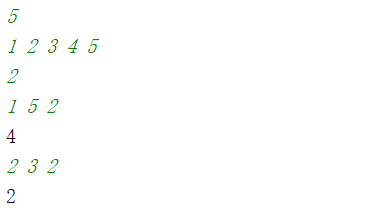
运行结果
-
二叉树的先、中、后 序遍历与层级遍历
从csdn博客中学习
https://blog.csdn.net/hongxue8888/article/details/102935259 学习理解递归方法
https://www.cnblogs.com/hezhiyao/p/7550602.html 借助队列来实现层次遍历
先序遍历:⑴访问根结点;⑵遍历左子树;⑶遍历右子树。
中恤遍历:⑴遍历左子树;⑵访问根结点;⑶遍历右子树。
后续遍历:⑴遍历左子树;⑵遍历右子树;⑶访问根结点。
层序遍历:层序遍历就是从所在二叉树的根节点出发,首先访问第一层的树根节点,然后从左到右访问第2层上的节点,接着是第三层的节点。`public class five
{
public static void main(String[] args) {
/*
作业要求:叉树的先、中、后 序遍历与层级遍历
自己实现四个方法,main方法中调用,将结果打印到控制台
/
/ 二叉树的结构
A
/
T 6
/
D
/
N 5
/ \ /
B 4 1
9
*/
Node root = into();
// 先序遍历a(root);System.out.println("先序遍历" );
b(root);System.out.println("中序遍历" );
c(root);System.out.println("后序遍历" );
d(root); System.out.println("层级遍历" );
}
private static void a(Node node) {
System.out.print(node.data);
if (node == null)
return;
if(node.l != null)
a(node.l);
if(node.r != null)
a(node.r);}
private static void b(Node node) {
if (node == null)
return;
if(node.l != null)
b(node.l);
System.out.print(node.data);
if(node.r != null)
b(node.r);
}private static void c(Node node) {
if (node == null)
return;
if(node.l != null)
c(node.l);
if(node.r != null)
c(node.r);
System.out.print(node.data);
}private static void d(Node node) {
if (node == null)
return;
LinkedListqueue = new LinkedList ();
Node current;
queue.offer(node);
while (!queue.isEmpty()) {
current = queue.poll(); //取出队列的头节点
System.out.print(current.data );//输出队列的头节点的值
if (current.l != null) {
queue.offer(current.l); //如果当前节点的左节点不为空,则左节点入队列
}
if (current.r != null) {
queue.offer(current.r); //如果当前节点的右节点不为空,则右节点入队列
}
}
}
private static Node into(){
Node root = new Node("A");
Node node1 = new Node("T");
Node node2 = new Node("D");
Node node3 = new Node("N");
Node node4 = new Node("B");
Node node5 = new Node("6");
Node node6 = new Node("5");
Node node7 = new Node("4");
Node node8 = new Node("9");
Node node9 = new Node("1");
root.l = node1;
node1.l = node2;
node2.l = node3;
node2.r = node6;
node3.r = node7;
node7.r = node8;
node6.l = node9;
node3.l = node4;
root.r = node5;
return root;
}
static class Node{
// 数据
Object data;
// 左孩子
Node l;
// 右孩子
Node r;public Node(){}
public Node(Object data) {
this.data = data;
this.l = null;
this.r = null;
}public Node(Object data, Node l, Node r) {
this.data = data;
this.l = l;
this.r = r;
}
}
}
`
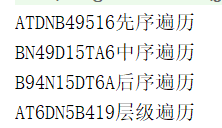
运行结果图
![]()

 浙公网安备 33010602011771号