import cv2
import numpy as np
import math

def fourier_demo():
    #1、灰度化读取文件,
    img = cv2.imread('english_rotation.jpg',0)

    #2、图像延扩
    h, w = img.shape[:2]
    new_h = cv2.getOptimalDFTSize(h)
    new_w = cv2.getOptimalDFTSize(w)
    right = new_w - w
    bottom = new_h - h
    nimg = cv2.copyMakeBorder(img, 0, bottom, 0, right, borderType=cv2.BORDER_CONSTANT, value=0)
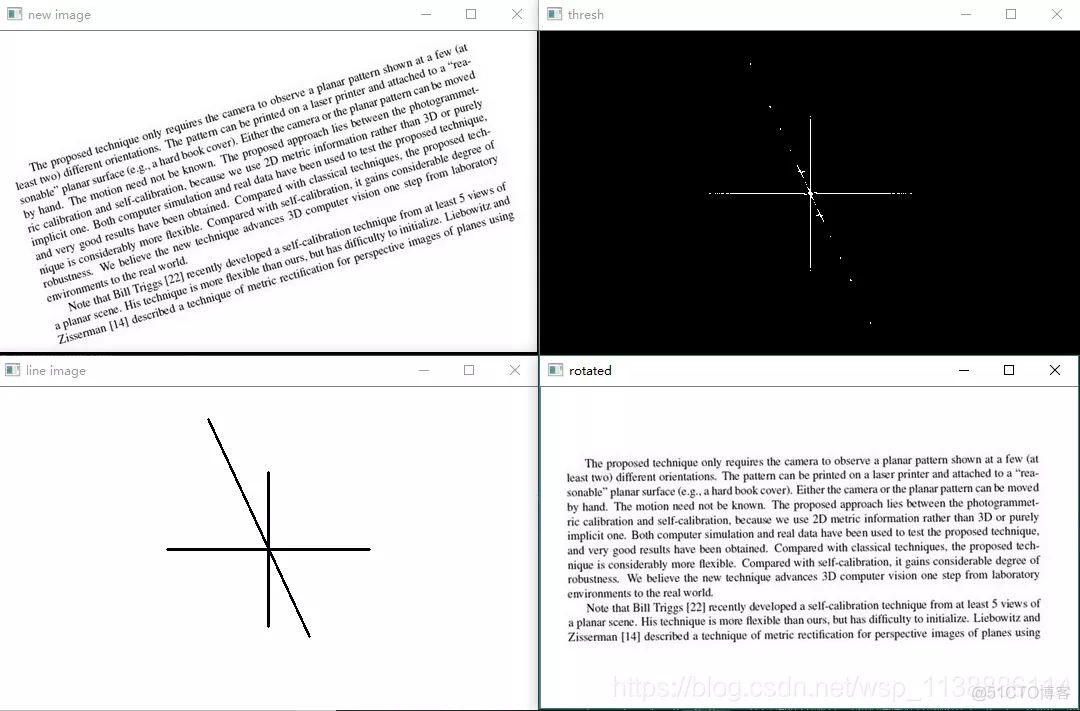
    cv2.imshow('new image', nimg)

    #3、执行傅里叶变换,并过得频域图像
    f = np.fft.fft2(nimg)
    fshift = np.fft.fftshift(f)
    magnitude = np.log(np.abs(fshift))


    #二值化
    magnitude_uint = magnitude.astype(np.uint8)
    ret, thresh = cv2.threshold(magnitude_uint, 11, 255, cv2.THRESH_BINARY)
    print(ret)

    cv2.imshow('thresh', thresh)
    print(thresh.dtype)
    #霍夫直线变换
    lines = cv2.HoughLinesP(thresh, 2, np.pi/180, 30, minLineLength=40, maxLineGap=100)
    print(len(lines))

    #创建一个新图像,标注直线
    lineimg = np.ones(nimg.shape,dtype=np.uint8)
    lineimg = lineimg * 255

    piThresh = np.pi/180
    pi2 = np.pi/2
    print(piThresh)

    for line in lines:
        x1, y1, x2, y2 = line[0]
        cv2.line(lineimg, (x1, y1), (x2, y2), (0, 255, 0), 2)
        if x2 - x1 == 0:
            continue
        else:
            theta = (y2 - y1) / (x2 - x1)
        if abs(theta) < piThresh or abs(theta - pi2) < piThresh:
            continue
        else:
            print(theta)

    angle = math.atan(theta)
    print(angle)
    angle = angle * (180 / np.pi)
    print(angle)
    angle = (angle - 90)/(w/h)
    print(angle)

    center = (w//2, h//2)
    M = cv2.getRotationMatrix2D(center, angle, 1.0)
    rotated = cv2.warpAffine(img, M, (w, h), flags=cv2.INTER_CUBIC, borderMode=cv2.BORDER_REPLICATE)
    cv2.imshow('line image', lineimg)
    cv2.imshow('rotated', rotated)

fourier_demo()
cv2.waitKey(0)
cv2.destroyAllWindows()


 浙公网安备 33010602011771号