


实验6 文件IO与异常处理
实验任务1
代码组织:
contestant.hpp 结构体Contestant定义及其重载运算符函数>>和<<实现
utils.hpp 工具函数实现(排序函数、数据读/写)
task1.cpp 应用代码 + main
contestant.hpp
#pragma once
#include <iomanip>
#include <iostream>
#include <string>

struct Contestant {
    long   id;              // 学号
    std::string name;       // 姓名
    std::string major;      // 专业
    int    solved;          // 解题数
    int    penalty;         // 总罚时
};

// 重载<<
// 要求:姓名/专业里不含空白符
inline std::ostream& operator<<(std::ostream& out, const Contestant& c) {
    out << std::left;
    out << std::setw(15) << c.id
        << std::setw(15) << c.name
        << std::setw(15) << c.major
        << std::setw(10) << c.solved
        << std::setw(10) << c.penalty;

    return out;
}

// 重载>>
inline std::istream& operator>>(std::istream& in, Contestant& c) {
    in >> c.id >> c.name >> c.major >> c.solved >> c.penalty;

    return in;
}
utils.hpp
#pragma once
#include <fstream>
#include <iostream>
#include <stdexcept>
#include <string>
#include <vector>
#include "contestant.hpp"

// ACM 排序规则:先按解题数降序,再按罚时升序
inline bool cmp_by_solve(const Contestant& a, const Contestant& b) {
    if(a.solved != b.solved)
        return a.solved > b.solved;

    return a.penalty < b.penalty;
}

// 将结果写至任意输出流
inline void write(std::ostream& os, const std::vector<Contestant>& v) {
    for (const auto& x : v)
        os << x << '\n';
}

// 将结果打印到屏幕
inline void print(const std::vector<Contestant>& v) {
    write(std::cout, v);
}

// 将结果保存到文件
inline void save(const std::string& filename, const std::vector<Contestant>& v) {
    std::ofstream os(filename);
    if (!os)
        throw std::runtime_error("fail to open " + filename);

    write(os, v);
}

// 从文件读取信息(跳过标题行)
inline std::vector<Contestant> load(const std::string& filename) {
    std::ifstream is(filename);
    if (!is)
        throw std::runtime_error("fail to open " + filename);

    std::string line;
    std::getline(is, line);          // 跳过标题

    std::vector<Contestant> v;
    Contestant t;
    int seq;
    while (is >> seq >> t)
        v.push_back(t);

    return v;
}
task1.cpp
#include <algorithm>
#include <iostream>
#include <stdexcept>
#include <vector>
#include "contestant.hpp"
#include "utils.hpp"

const std::string in_file = "./data.txt";
const std::string out_file = "./ans.txt";

void app() {
    std::vector<Contestant> contestants;

    try {
        contestants = load(in_file);
        std::sort(contestants.begin(), contestants.end(), cmp_by_solve);
        print(contestants);
        save(out_file, contestants);
    } catch (const std::exception& e) {
        std::cerr << e.what() << '\n';
        return;
    }
}

int main() {
    app();
}
运行测试结果如下:

ans.txt:
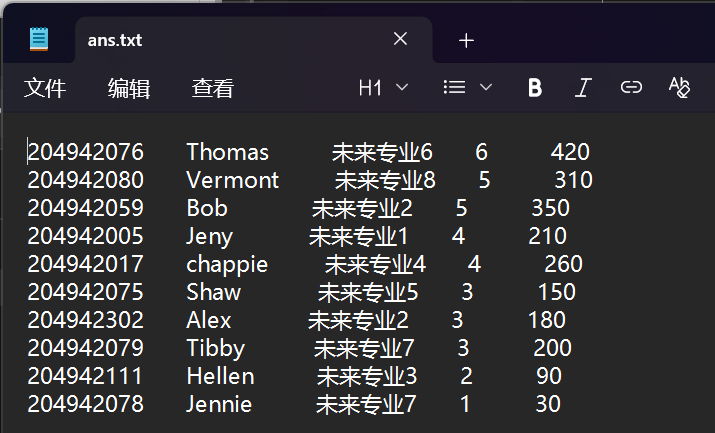
问题1(1):参数类型std::ostream&传递的是标准库输出流类对象的引用,对象std::cout本身就是标准库输出流类对象,而std::ofstream类是std::ofstream类的派生类,将派生类对象赋给基类引用不会导致数据异常问题,因此,对于std::ostream&类的形参,std::cout和std::fostream类对象都可以作为实参传入
(2):不需要改动,设备提供syd::ostream接口,标准库输出流类对象会自动处理标准输出流与设备硬件的匹配,不需要额外代码控制
问题2:(1)在文件操作函数save()和load()中打开文件失败时会throw抛出异常(2)异常被功能函数app()捕获,捕获后在标准错误流中输出异常的信息
问题3:从代码上看,所给的lambda表达式和cmp_by_solve()函数逻辑一致,功能相同,if语句和? :运算符优化后性能几乎一致,虽然cmp_by_solve()是外部定义的函数,但使用了内联,所以传递的开销也下降了,两种方案性能方面应该没有明显区别
问题4:运行测试结果如下:
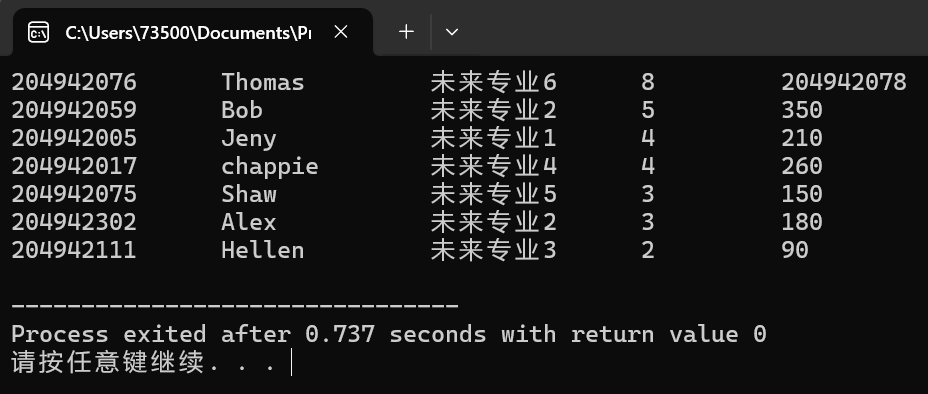
由于空白字段的干扰,语句while(is >> seq >> t)流类对象is在读入变量seq 时由于读取了字符串导致了意外的停止,同时导致数据错位,干扰了排序工作。
修改:
// 从文件读取信息(跳过标题行)
inline std::vector<Contestant> load(const std::string& filename) {
    std::ifstream is(filename);
    if (!is)
        throw std::runtime_error("fail to open " + filename);

    std::string line;
    std::getline(is, line);          // 跳过标题

    std::vector<Contestant> v;
    Contestant t;
    int seq, cnt = 0;
    std::string temp;
    while (getline(is, temp)) {
            try {
            ++cnt;
            t.clear();
            if (temp.empty()) {
                throw std::invalid_argument("第" + std::to_string(cnt) + "行是空行");
            }
            std::stringstream ss(temp);
            ss >> seq >> t;
            if (!t.common()) {
                throw std::runtime_error("第" + std::to_string(cnt) + "行数据异常");
        }
            v.push_back(t);
        } catch (const std::exception& e) {
            std::cerr << "[warning] " << e.what() << std::endl;
        }
    }
    return v;
}
//Contestant类附加功能实现
void Contestant::clear() {
    this->id = -1;
    this->name = "\0";
    this->major = "\0";
    this->solved = -1;
    this->penalty = -1;
}

bool Contestant::common() {
    return this->id != -1 &&
        this->name != "\0" &&
        this->major != "\0" &&
        this->solved != -1 &&
        this->penalty != -1;
}
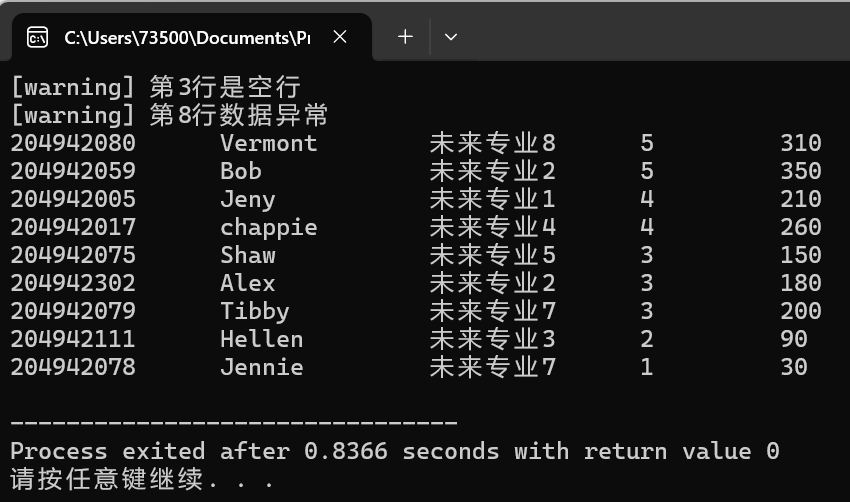
运行测试结果如下:
实验任务2
代码组织
student.hpp 学员类Student及其重载运算符函数声明
student.cpp 学员类Student及其重载运算符函数实现 (待实现)
stumgr.hpp 学员成绩管理类StuMgr声明
stumgr.cpp 学员成绩管理类StuMgr实现 (待实现)
task2.cpp 应用代码
student.hpp
#pragma once

#include <iostream>
#include <string>

class Student {
public:
    Student() = default;
    ~Student() = default;

    const std::string get_major() const;
    int get_grade() const;

    friend std::ostream& operator<<(std::ostream& os, const Student& s);
    friend std::istream& operator>>(std::istream& is, Student& s);

private:
    int id;
    std::string  name;
    std::string  major;
    int          grade;  // 0-100
};
student.cpp
#include <iostream>
#include <iomanip>

#include "student.hpp"

const std::string Student::get_major() const {
    return major;
}

int Student::get_grade() const {
    return grade;
}

std::ostream& operator<<(std::ostream& os, const Student& s) {
    return os << std::left << std::setw(8) << s.id << std::setw(10) << s.name << std::setw(10) << s.major << s.grade;
}

std::istream& operator>>(std::istream& is, Student& s) {
    return is >> s.id >> s.name >> s.major >> s.grade;
}
stumgr.hpp
#pragma once
#include <string>
#include <vector>
#include "student.hpp"

class StuMgr {
public:
    void load(const std::string& file);  // 加载数据文件(空格分隔)
    void sort();                         // 排序: 按专业字典序升序、同专业分数降序
    void print() const;                  // 打印到屏幕
    void save(const std::string& file) const; // 保存到文件

private:
    void write(std::ostream &os) const;  // 把数据写到任意输出流

private:
    std::vector<Student> students;
};
stumgr.cpp
#include <iostream>
#include <fstream>
#include <algorithm>

#include "stumgr.hpp"

void StuMgr::load(const std::string& file) {
    std::ifstream is(file);
    if (!is)
        throw std::runtime_error("fail to open " + file);
    std::string line;
    std::getline(is, line);          // 跳过标题

    Student t;
    while (is >> t)
        students.push_back(t);
}

void StuMgr::sort() {
    std::sort(students.begin(), students.end(), [](const Student& s1, const Student& s2){return s1.get_major() != s2.get_major() ? s1.get_major() < s2.get_major() : s1.get_grade() > s2.get_grade();});
}

void StuMgr::print() const {
    write(std::cout);
}

void StuMgr::save(const std::string& file) const {
    std::ofstream os(file);
    if (!os)
        throw std::runtime_error("fail to open " + file);
    write(os);
}

inline void StuMgr::write(std::ostream &os) const {
    for (const auto& x : students)
        os << x << '\n';
}
task2.cpp
#include <iostream>
#include <limits>
#include <string>
#include "stumgr.hpp"

const std::string in_file = "./data.txt";
const std::string out_file = "./ans.txt";

void menu() {
    std::cout << "\n**********简易应用**********\n"
                 "1. 加载文件\n"
                 "2. 排序\n"
                 "3. 打印到屏幕\n"
                 "4. 保存到文件\n"
                 "5. 退出\n"
                 "请选择:";
}

void app() {
    StuMgr mgr;

    while(true) {
        menu();
        int choice;
        std::cin >> choice;

        try {
            switch (choice) {
            case 1: mgr.load(in_file);
                    std::cout << "加载成功\n"; break;
            case 2: mgr.sort();
                    std::cout << "排序已完成\n"; break;
            case 3: mgr.print();
                    std::cout << "打印已完成\n"; break;
            case 4: mgr.save(out_file);
                    std::cout << "导出成功\n"; break;
            case 5: return;
            default: std::cout << "不合法输入\n";
            }
        }
        catch (const std::exception& e) {
            std::cout << "Error: " << e.what() << '\n';
        }
    }
}

int main() {
    app();
}
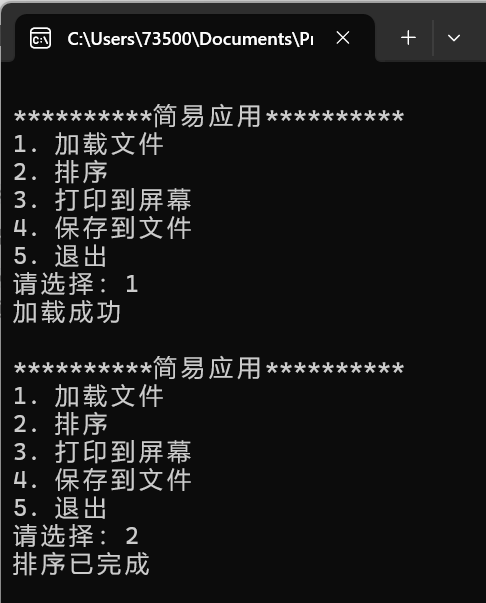
运行测试结果如下:
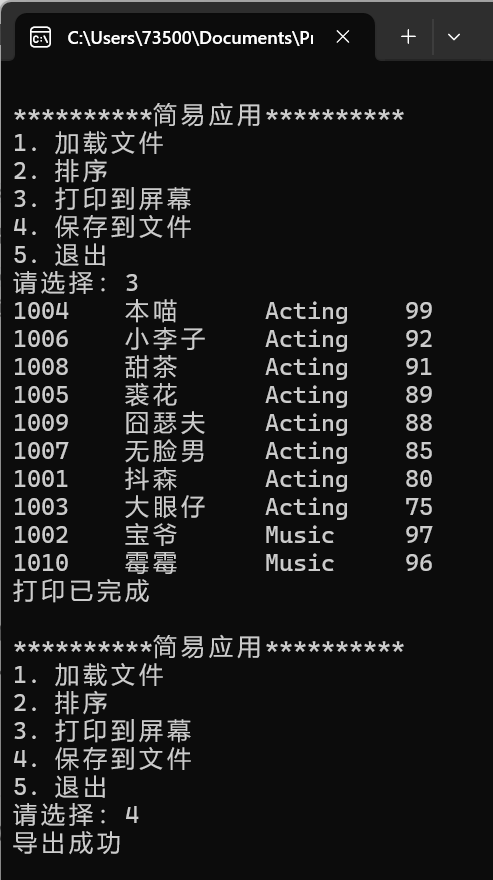
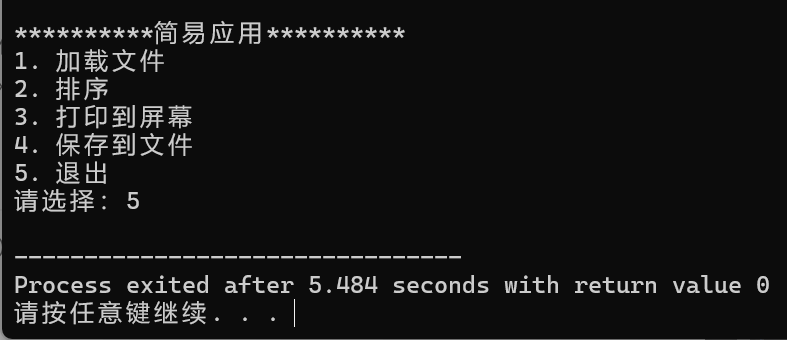
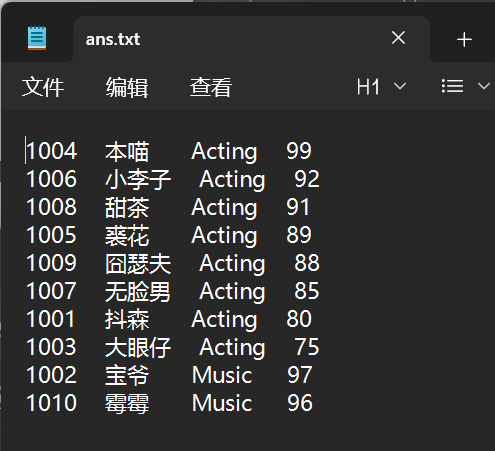
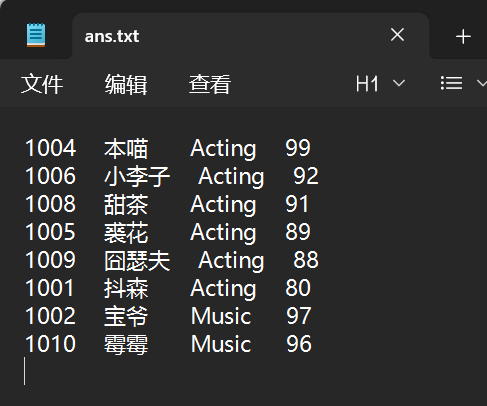
ans.txt:
为了处理data_bad.txt文件中的错误数据, 做出以下修改:
//student.hpp
//Student类中附加声明
void clear();
bool common() const;

//student.cpp
//附加成员函数实现
void Student::clear() {
	this->id = -1;
	this->name = "\0";
	this->major = "\0";
	this->grade = -1;
}
bool Student::common() const {
	return this->id != -1 &&
		this->name != "\0" &&
		this->major != "\0" &&
		this->grade != -1;
}

//stumgr.cpp
//修改功能函数load()的实现
void StuMgr::load(const std::string& file) {
    std::ifstream is(file);
    if (!is)
        throw std::runtime_error("fail to open " + file);
    std::string line;
    std::getline(is, line);          // 跳过标题

    Student t;
    int cnt = 0;
    while (getline(is, line)) {
        try {
            ++cnt;
            t.clear();
            std::stringstream ss(line);
            ss >> t;
            if (!t.common()) {
                throw std::runtime_error("line " + std::to_string(cnt) + " format error");
            } else if (t.get_grade() < 0 || t.get_grade() > 100) {
                throw std::invalid_argument("line " + std::to_string(cnt) + " grade invalid");
            } else {
                students.push_back(t);
            }
        } catch (std::exception& e) {
            std::cerr << "[warning] " << e.what() << ", skipped: " << line << std::endl;
        }
    }
}
运行测试结果如下:
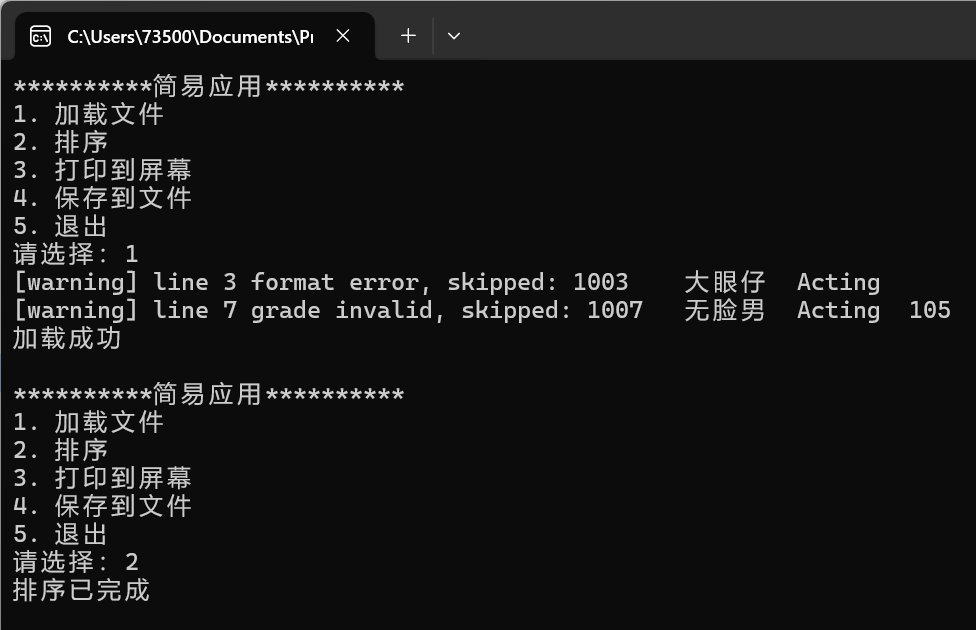
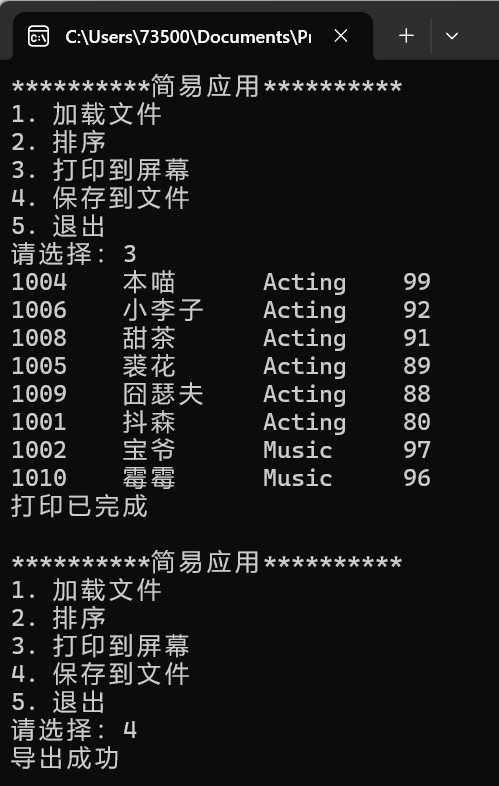
ans.txt:
实验总结
在命令行中的输入输出,归根结底就是对字符串流的格式控制,c++中提供了标准库流类的实现来自动控制输入输出功能,同时用户也可以自主重载<<和>>运算符来控制自定义类的输入输出。文件输入输出也是如此,通过封装的fstream来自动控制文件的生命周期,结束时自动关闭文件,无需手动控制,同时文件流操作也可以使用标准输入输出流的操作。
c++提供的异常处理方案try-throw-catch代码块和标准库定义的exception异常类大大增加了异常处理的灵活性,异常类的存在使得c++中的运行时异常可以返回丰富的信息,而不是像C语言一样只有一个的状态码或使用if卫语句直接退出,c++的异常处理方案可以在出现异常时恢复,增加了程序的健壮性,同时用户还可以派生异常类,以此传递更多与异常有关的信息。

 浙公网安备 33010602011771号