
上下文管理
- threading.local
- 为每个线程开辟空间,使得线程之间进行数据隔离。
- 应用:DBUtils中为每个线程创建一个数据库连接时使用。
Local是threading.local的加强版,它不光对线程,对协程也开辟了自己的空间;
# __getattr__ (是在 obj.xxx 的取值的时候调用的 );  __setattr__(obj.xxx = 123 设置值的时候调用的)


# threading.local 的加强版 (不仅包含线程 也包含协程 )


try:
	from threading import get_ident
	# from greenlet import getcurrent as get_ident
except Exception:
	from greenlet import getcurrent as get_ident


class Local(object):
	#__slots__ 里面定义的字符串,才能 self.   ; 没有定义的就不能
	__slots__ = ("__storage__", "__ident_func__")

	def __init__(self):
		object.__setattr__(self, "__storage__", {})
		object.__setattr__(self, "__ident_func__", get_ident)

	def __getattr__(self, item):
		try:
			return self.__storage__[self.__ident_func__()][item]
		except Exception:
			return None

	def __setattr__(self, key, value):
		ident = self.__ident_func__()
		storage = self.__storage__
		try:
			storage[ident][key] = value
		except Exception:
			storage[ident] = {key: value}
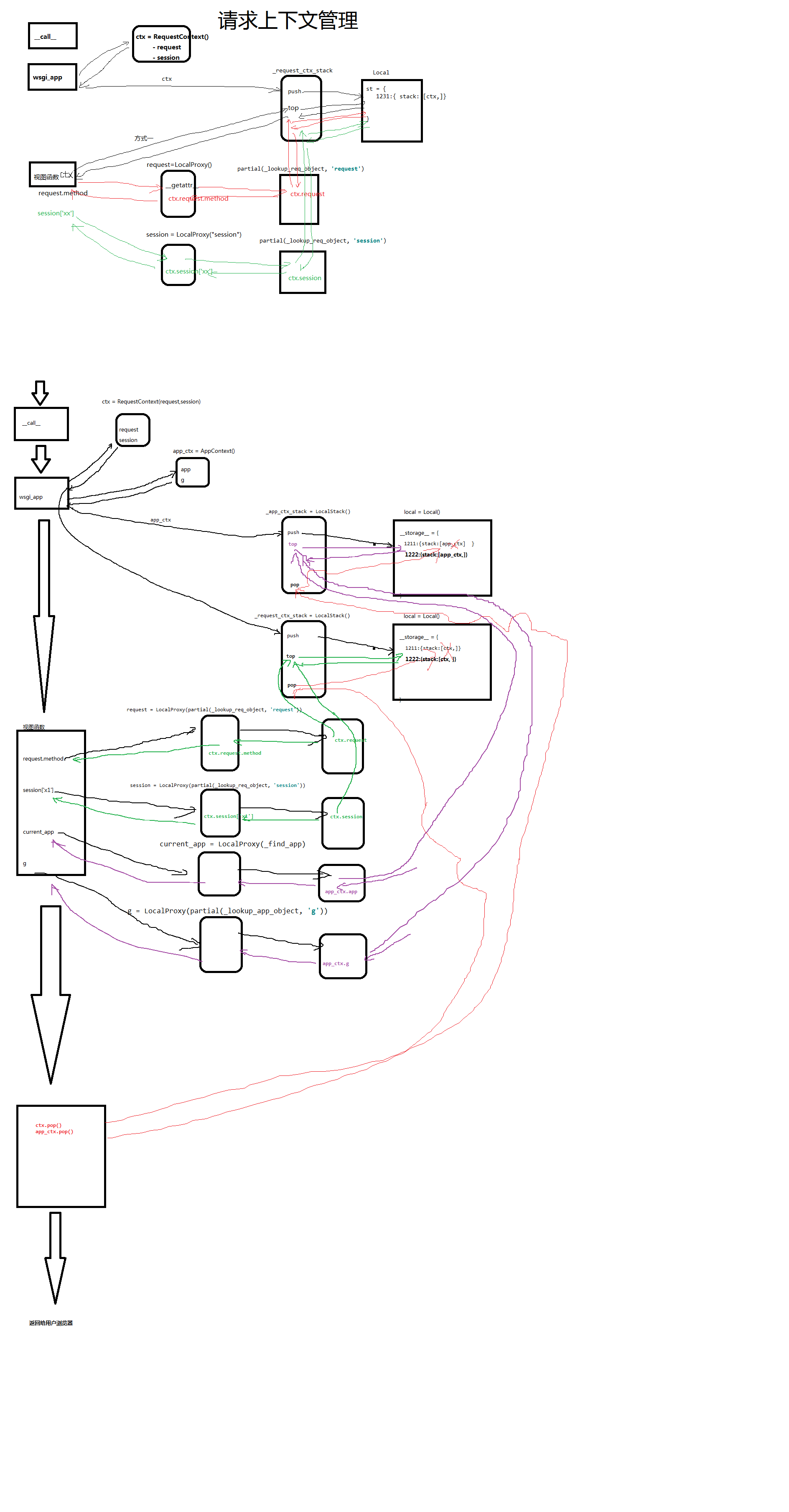
	2. 上下文管理:
			- 请求上下文(ctx=RequestContext()):request/session
			-  App上下文(app_ctx=AppContext()): app/g

		- 程序启动:
			两个Local:
				local1 = {

				}

				local2 = {

				}

			两个LocalStack:
				_request_ctx_stack
				_app_ctx_stack
		- 请求到来
			对数据进行封装:
				ctx = RequestContext(request,session)
				app_ctx = AppContext(app,g)
			保存数据:
				将包含了(app,g)数据的app_ctx对象,利用 _app_ctx_stack=LocalStack()将app_ctx添加到Local中
					storage = {
						1231:{stack:[app_ctx(app,g),]}
					}
				将包含了request,session数据的ctx对象,利用_request_ctx_stack=LocalStack(),将ctx添加到Local中
					storage = {
						1231:{stack:[ctx(request,session),]}
					}

		- 视图函数处理:


			from flask import Flask,request,session,current_app,g

			app = Flask(__name__)


			@app.route('/index')
			def index():

				# 去请求上下文中获取值 _request_ctx_stack
				request.method
				session['xxx']

				#  request = LocalProxy(partial(_lookup_req_object, "request"))

				# 去app上下文中获取值:_app_ctx_stack
				print(current_app)
				print(g)

				return "Index"


			if __name__ == '__main__':
				app.run()
				app.wsgi_app

		- 结束
			_app_ctx_stack.pop()
			_request_ctx_stack.pop()
问题:
1. Flask中g的生命周期?
每一次请求过来的时候,创建g ,该请求结束后 g 就消失了
2. g和session一样吗?
不一样,当下一次请求来的时候,上个请求的g 不存在,而session存在,session是以加密的形式存放到cookie中的
3. g和全局变量一样吗?
不一样; 全局变量 是项目一启动的时候就创建的,而g则是请求来以后创建的.
全局变量 是存放到内存中的,不会消失;而g会随着请求结束后消失.
自己写的
try:
	from threading import get_ident
	# from greenlet import getcurrent as get_ident
except Exception:
	from greenlet import getcurrent as get_ident


class Local(object):
	#__slots__ 里面定义的字符串,才能 self.   ; 没有定义的就不能
	__slots__ = ("__storage__", "__ident_func__")

	def __init__(self):
		object.__setattr__(self, "__storage__", {})
		object.__setattr__(self, "__ident_func__", get_ident)

	def __getattr__(self, item):
		try:
			return self.__storage__[self.__ident_func__()][item]
		except Exception:
			return None

	def __setattr__(self, key, value):
		ident = self.__ident_func__()
		storage = self.__storage__
		try:
			storage[ident][key] = value
		except Exception:
			storage[ident] = {key: value}


#LocalStack是帮助我们方便的去维护Local 里面的栈
class LocalStack(object):
	def __init__(self):
		self._local = Local()

	#往栈里面添加值

	def push(self,obj):
		rv = getattr(self._local,"stack",None)
		if rv is None:
			#用对象.stack =[] 来触发 Local类下面的__setattr__
			self._local.stack = rv = []
		rv.append(obj)
		return rv

	#取值,先进后出
	def pop(self):
		#stack >[]
		stack = getattr(self._local, "stack", None)
		if stack is None:
			return None

		elif len(stack) == 1:
			return stack[-1]

		else:
			return stack.pop()

	def top(self):
		try:
			return self._local.stack[-1]

		except Exception:
			return None

import functools
_request_ctx_stack = LocalStack()

class RequestContext(object):
	def __init__(self):
		self.session = "session"
		self.request = "request"

ctx = RequestContext()

#_request_ctx_stack 帮助我们维护一个 __storage__ = {}
_request_ctx_stack.push(ctx)

'''
__storage__:{

	123:{"stack":[ctx(session/request)]},
	113:{"stack":[]}

}

'''

def _lookup_req_object(arg):
	ctx = _request_ctx_stack.top()

	return getattr(ctx,arg)

#偏函数 ,自动的帮你传入参数
session = functools.partial(_lookup_req_object,"session")
request = functools.partial(_lookup_req_object,"request")
print(request())

 浙公网安备 33010602011771号