HDU--1025
Constructing Roads In JGShining's Kingdom
Time Limit: 2000/1000 MS (Java/Others) Memory Limit: 65536/32768 K (Java/Others) Total Submission(s): 17528 Accepted Submission(s): 4971
Problem Description
JGShining's kingdom consists of 2n(n is no more than 500,000) small cities which are located in two parallel lines.
Half of these cities are rich in resource (we call them rich cities) while the others are short of resource (we call them poor cities). Each poor city is short of exactly one kind of resource and also each rich city is rich in exactly one kind of resource. You may assume no two poor cities are short of one same kind of resource and no two rich cities are rich in one same kind of resource.
With the development of industry, poor cities wanna import resource from rich ones. The roads existed are so small that they're unable to ensure the heavy trucks, so new roads should be built. The poor cities strongly BS each other, so are the rich ones. Poor cities don't wanna build a road with other poor ones, and rich ones also can't abide sharing an end of road with other rich ones. Because of economic benefit, any rich city will be willing to export resource to any poor one.
Rich citis marked from 1 to n are located in Line I and poor ones marked from 1 to n are located in Line II.
The location of Rich City 1 is on the left of all other cities, Rich City 2 is on the left of all other cities excluding Rich City 1, Rich City 3 is on the right of Rich City 1 and Rich City 2 but on the left of all other cities ... And so as the poor ones.
But as you know, two crossed roads may cause a lot of traffic accident so JGShining has established a law to forbid constructing crossed roads.
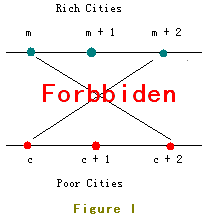
For example, the roads in Figure I are forbidden.![]()
Half of these cities are rich in resource (we call them rich cities) while the others are short of resource (we call them poor cities). Each poor city is short of exactly one kind of resource and also each rich city is rich in exactly one kind of resource. You may assume no two poor cities are short of one same kind of resource and no two rich cities are rich in one same kind of resource.
With the development of industry, poor cities wanna import resource from rich ones. The roads existed are so small that they're unable to ensure the heavy trucks, so new roads should be built. The poor cities strongly BS each other, so are the rich ones. Poor cities don't wanna build a road with other poor ones, and rich ones also can't abide sharing an end of road with other rich ones. Because of economic benefit, any rich city will be willing to export resource to any poor one.
Rich citis marked from 1 to n are located in Line I and poor ones marked from 1 to n are located in Line II.
The location of Rich City 1 is on the left of all other cities, Rich City 2 is on the left of all other cities excluding Rich City 1, Rich City 3 is on the right of Rich City 1 and Rich City 2 but on the left of all other cities ... And so as the poor ones.
But as you know, two crossed roads may cause a lot of traffic accident so JGShining has established a law to forbid constructing crossed roads.
For example, the roads in Figure I are forbidden.
Input
Each test case will begin with a line containing an integer n(1 ≤ n ≤ 500,000). Then n lines follow. Each line contains two integers p and r which represents that Poor City p needs to import resources from Rich City r. Process to the end of file.
Output
For each test case, output the result in the form of sample. You should tell JGShining what's the maximal number of road(s) can be built.
Sample Input
2
1 2
2 1
3
1 2
2 3
3 1
Sample Output
Case 1:
My king, at most 1 road can be built.
Case 2:
My king, at most 2 roads can be built.
Hint
Huge input, scanf is recommended.
#include<stdio.h>
#include<iostream>
using namespace std;
#define N 500003

int num[N];
int ans[N];

int main()
{
    int n,num1,num2,k=1;
    while(scanf("%d",&n)!=EOF)
    {
        for(int i=1;i<=n;i++)
        {
            scanf("%d%d",&num1,&num2);
            num[num1]=num2;  //构造序列,最终的目的是求此序列的最长递增序列
        }
        int len=1;
        ans[1]=num[1];
        for(int i=2;i<=n;i++)
        {
            int low=1,up=len,mid;
            while(low<=up)
            {
                mid=(low+up)/2;
                if(num[i]>ans[mid]) low=mid+1;
                else up=mid-1;
            }
            ans[low]=num[i];
            if(low>len) len++;
        }
        printf("Case %d:\n",k);
        if(len==1)  printf("My king, at most 1 road can be built.\n");
        else    printf("My king, at most %d roads can be built.\n",len);
        printf("\n");
        k++;
    }
    return 0;
}
注:本题的实质是求序列的最长递增子序列;
DP+二分法
在过程中,处理序列中的每一个元素:
(1)初始时,子序列(ans[])为序列(num[])的首元素num[1],子序列的长度为1;
(2)处理过程中(处理num中的每一个元素),如果num[i]大于子序列中的所有元素,则直接将其放在子序列的末尾,子序列的长度增一;
否则,用其替换掉子序列中大于该数的最小的元素,子序列长度不变;

 浙公网安备 33010602011771号