HDU--1050
Moving Tables
Time Limit: 2000/1000 MS (Java/Others) Memory Limit: 65536/32768 K (Java/Others) Total Submission(s): 21918 Accepted Submission(s): 7370
Problem Description
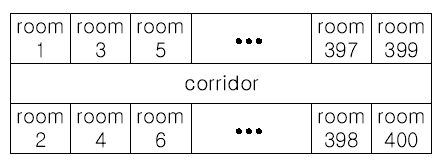
The famous ACM (Advanced Computer Maker) Company has rented a floor of a building whose shape is in the following figure. ![]()
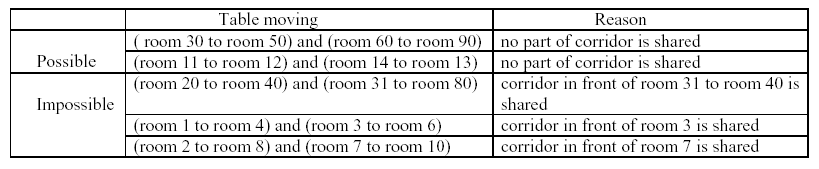
![]()
Input
The input consists of T test cases. The number of test cases ) (T is given in the first line of the input. Each test case begins with a line containing an integer N , 1<=N<=200 , that represents the number of tables to move. Each of the following N lines contains two positive integers s and t, representing that a table is to move from room number s to room number t (each room number appears at most once in the N lines). From the N+3-rd line, the remaining test cases are listed in the same manner as above.
Output
The output should contain the minimum time in minutes to complete the moving, one per line.
Sample Input
3
4
10 20
30 40
50 60
70 80
2
1 3
2 200
3
10 100
20 80
30 50
Sample Output
10
20
30
Source
#include<iostream>
#include<string.h>
using namespace std;

int a[205];
int fuc(int k)
{
    if(k%2) return (k+1)/2;
    else return k/2;
}
int main()
{
    int t,n;
    cin>>t;
    while(t--)
    {
        cin>>n;
        int x,y,z;
        memset(a,0,sizeof(a));
        for(int i=0;i<n;i++)
        {
            cin>>x>>y;
            if(x>y)
            {
                z=x;
                x=y;
                y=z;
            }
            for(int j=fuc(x);j<=fuc(y);j++) a[j]++;
        }
        int m=a[1];
        for(int i=1;i<=200;i++)
        {
            if(m<a[i]) m=a[i];
        }
        cout<<m*10<<endl;
    }
    return 0;
}
类比《活动日程表安排》的算法:先将小号房间号 按升序排列;排好后,若后一个小号房间号大于前一组的大号房间,则可以同时进行。

 浙公网安备 33010602011771号