
实验3 类和对象Ⅱ
------------恢复内容开始------------
一、实验任务4
动态int型数组类Vector_int的定义实现源码(vector_int.hpp)
#pragma once
#include<iostream>
using namespace std;
class Vector_int {
public:
    Vector_int(int n) ;
    Vector_int(int n,int start);
    Vector_int(Vector_int& obj);
    ~Vector_int();
    int& at(int i);
    void print();
private:
    int size;
    int* p;
};
Vector_int::Vector_int(int n) {
    p = new int[n] {0};
    size = n;
    cout << "Object is being created by constructor 1" << endl;
};
Vector_int::Vector_int(int n, int start) {
    p = new int[n];
    size = n;
    for (int i = 0; i < n; i++)
        p[i] = start;
    cout << "Object is being created by constructor 2" << endl;
};
Vector_int::Vector_int(Vector_int& x) {
    p = new int[x.size];
    size = x.size;
    for (int i = 0; i < size; i++)
        p[i] = x.p[i];
    cout << "Object is being created by constructor 3" << endl;
};
Vector_int::~Vector_int() {
    delete[] p;
    cout << "Object is being destructed" << endl;
}
int& Vector_int::at(int i) {
    return p[i];
};
void Vector_int::print() {
    for (int i = 0; i < size; i++)
        cout << p[i] <<" ";
    cout << endl;
};
测试类Vector_int的代码(文件task4.cpp)
#include<iostream>
#include "vector_int.hpp"
int main() {
    int n = 10;
    Vector_int x1(n);
    Vector_int x2(n,6);
    Vector_int y(x2);
    y.at(2) = 99;
    x1.print();
    x2.print();
    y.print();
}
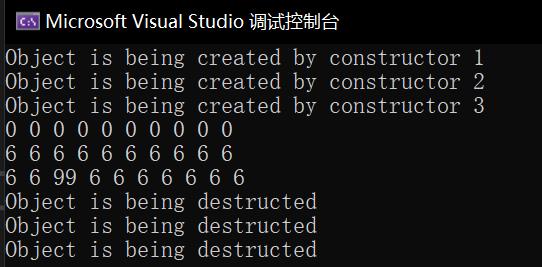
运行测试结果截图
二、实验任务5
类Matrix的定义和实现完整代码(Matrix.hpp)
#ifndef MATRIX_H
#define MATRIX_H

#include <iostream>
#include <cassert>
using namespace std;
class Matrix
{
public:
    Matrix(int n);                     // 构造函数,构造一个n*n的矩阵
    Matrix(int n, int m);              // 构造函数,构造一个n*m的矩阵
    Matrix(const Matrix &X);           // 复制构造函数,使用已有的矩阵X构造
    ~Matrix();                         //析构函数
    void set(const double *pvalue);     // 用pvalue指向的连续内存块数据为矩阵赋值
    void set(int i, int j, int value); //设置矩阵第i行第j列元素值为value
    double &at(int i, int j);          //返回矩阵第i行第j列元素的引用
    double at(int i, int j) const;     // 返回矩阵第i行第j列元素的值
    int get_lines() const;             //返回矩阵行数
    int get_cols() const;              //返回矩列数
    void print() const;                // 按行打印输出矩阵
private:
    int lines; // 矩阵行数
    int cols;  // 矩阵列数
    double *p; // 指向存放矩阵数据的内存块的首地址
};

Matrix::Matrix(int n) {
    lines = n;
    cols = n;
    p = new double[lines*cols];
}
Matrix::Matrix(int n, int m) {
    lines = n;
    cols = m;
    p = new double[lines*cols];
}
Matrix::Matrix(const Matrix& x) {
    lines = x.lines;
    cols = x.cols;
    p = new double[lines*cols];
    for (int i = 0; i < lines * cols; i++) {
        p[i] = x.p[i];
    }
}
Matrix::~Matrix() {
    delete[] p;
}
void Matrix::set(int i, int j, int value) {
    p[i * cols + j] = value;
}
void Matrix::set(const double* pvalue) {
    for (int i = 0; i < lines * cols; i++) {
        p[i] = pvalue[i];
    }
}
double& Matrix::at(int i, int j) {
    return p[i * cols + j];
}
double Matrix::at(int i, int j)const {
    return p[i * cols + j];
}
int Matrix::get_lines()const {
    return lines;
}
int Matrix::get_cols()const {
    return cols;
}
void Matrix::print()const {
    for (int i = 0; i < lines; i++)
    {
        for (int j = 0; j < cols; j++)
            cout << p[i * cols + j] << " ";
            cout << endl;
    }
}

#endif
测试代码(task5.cpp)
#include <iostream>
#include "matrix.hpp"

int main()
{
    using namespace std;

    double x[] = {1, 2, 3, 4, 5, 6, 7, 8, 9, 10, 11, 12};

    Matrix m1(3, 4);    // 创建一个3×4的矩阵
    m1.set(x);          // 用一维数组x的值按行为矩阵m1赋值
    m1.print();         // 打印矩阵m1的值
    cout << "the first line is: " << endl;
    cout << m1.at(0, 0) << " " << m1.at(0, 1) << " " << m1.at(0, 2)<< " " << m1.at(0, 3) << endl;
    cout << endl;

    Matrix m2(4, 3);
    m2.set(x);
    m2.print();
    cout << "the first line is: " << endl;
    cout << m2.at(0, 0) << " " << m2.at(0, 1) << " " << m2.at(0, 2) << endl;
    cout << endl;

    Matrix m3(m2);
    m3.set(0, 0, 999);
    m3.print();
}
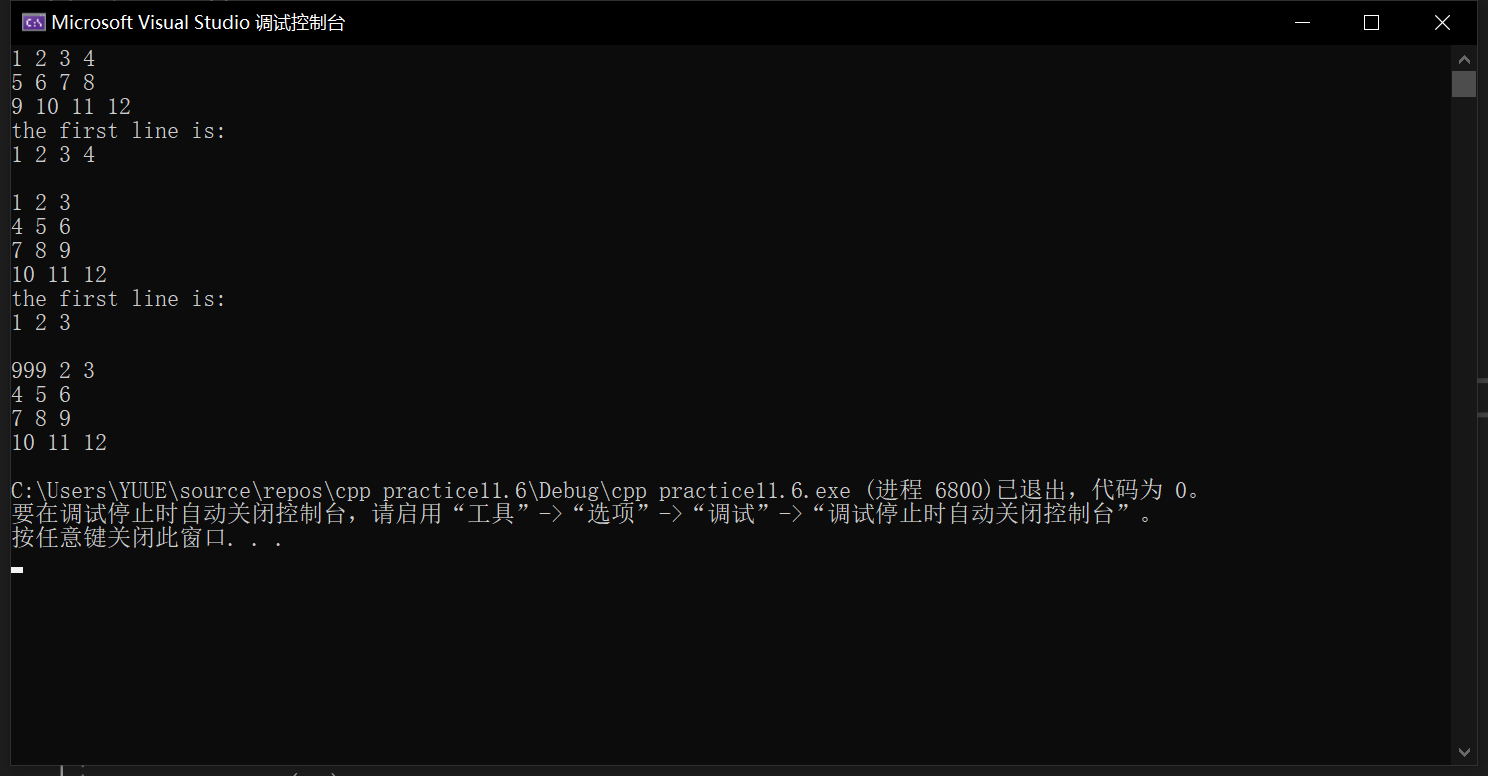
运行测试截图(换一组测试数据)
三、实验总结
1.Task1,2中,输出时加的hex一开始不太理解是啥。
2.Typeid是用来获取数据类型信息的,使用的格式是typeid(a).name()
3.Y是个一维数组,长度为1,这个存储单元存储了数组x的首地址。
4.Square1的函数,自动递归中的i是引用的形式。
而square2的i是单独的,与原来的数组x没有关系。
5.实验任务2中,如果把类ArrayOfPoints中复制构造函数的声明和实现注释起来。能运行,但是会陷入死循环,可能是y括号里的x类型是arrayofpoints,而不是int,所以系统识别不了。
6.Task3中,学习到了头文件#include <cstdlib>的使用,system("cls")代表清屏。
用 system("color 0A"),其中color后面的0是背景色代号,A是前景色代号。
string color = "color ";
color += bg;
color += fg;
以字符串的运算来构成“color 0A”
7.完成Task3时,开始没有思路,vector类构造数组如何返回数组给主函数呢,参考其他代码发现,vector类不能仅仅看做构造函数的工具,还有数组的属性包括数组本身和数组长度。

 浙公网安备 33010602011771号