
feat practicals
cr: http://fsl.fmrib.ox.ac.uk/fslcourse/2019_Beijing/lectures/FEAT1/FSL_FEAT1_Practical.pdf

1. High pass filter cutoff
- to remove the worst of the low frequency trends, and is also long enough to avoid removing the signal of interest.
- In general you need to ensure that this is not set lower than your maximum stimulation period.
- The red bar shows the width of the highpass filter (the amplitude of any signal much longer than it will get reduced) in the design matrix.
- AFTER DESIGN SETUP, press the Misc-tab where there will be a button saying Estimate High Pass Filter. Press this button and then go back to the Data-tab to see what has happened. This should now have changed to 90 seconds. FSL has calculated this for you by analysing the frequency content of the design and then selected a cutoff so that 90% of our expected signal is still in the data after filtering. (N.B. that it is just a fluke that 90% happened to translate into 90 seconds in this particular case)
2. temporal derivatives
- used to correct for timing errors caused either by slight experimental errors in synchronising the times of the scanner with the stimulus presentation and/or inter-subject differences in the delay inherent in the HRF.
- how to work??
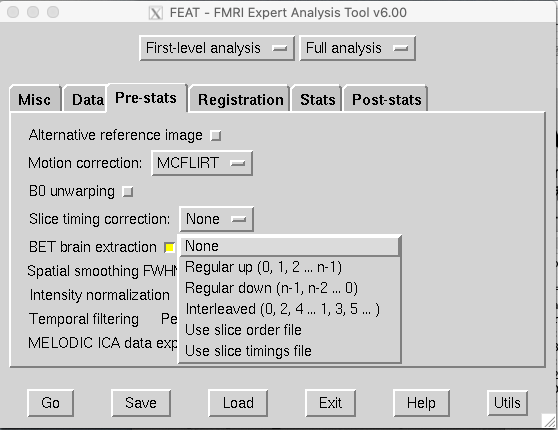
- not slice timing?? ---》有它的选项!!!(我选的none!!因为之前说过要选none吗??prac也leave it none。。)
- but also。。。(http://fsl.fmrib.ox.ac.uk/fslcourse/2019_Beijing/lectures/feat3.pdf)

3. example_func --> the middle-timepoint FMRI image
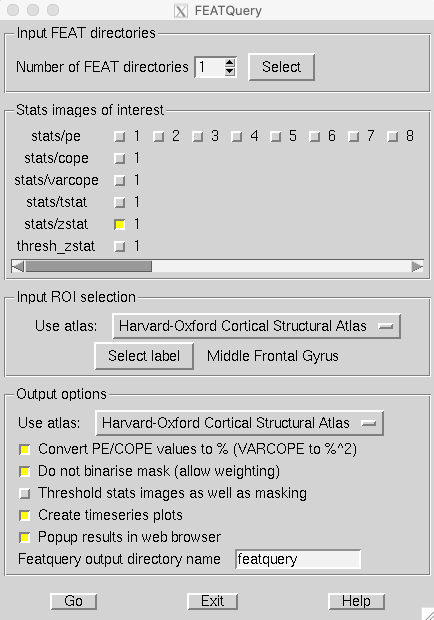
4. featquery用来做什么我还是不太懂。。
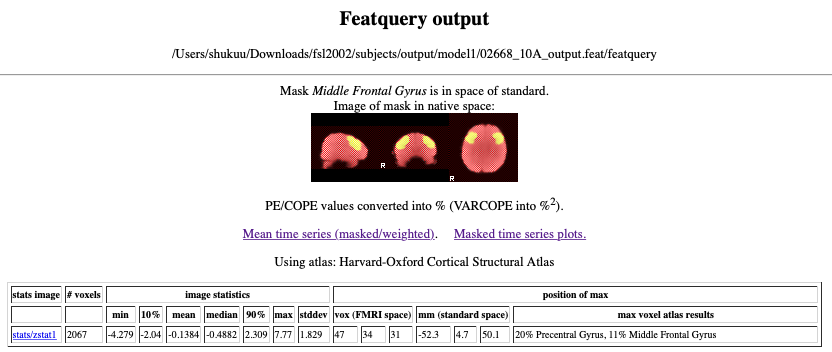
The resulting web page will contain a table summarizing each of the statistics that you asked Featquery to report on in step 1. The first column gives the statistic name. The second column gives the number of non-zero voxels in the mask. The next group of columns gives a summary of the distribution of values within the mask. Finally, the last group of columns contains the position of the maximum in voxel space, in mm space, and in the atlas space selected in step 5. Plots of the timeseries at the maximum z-stats are available by clicking the link labeled "Masked time series plot" just below the image of the mask at the top of the page.
cr: http://fsl.fmrib.ox.ac.uk/fslcourse/2019_Beijing/lectures/FEAT2/FSL_FEAT2_Practical.pdf
5. COPE (contrast of parameter estimate)
- which we pass up to any higher-level analysis.
- are calculated by performing simple algebra on the EV parameter estimates. For example, for the contrasts 1 -1, the contrast parameter estimate is calculated by subtracting the parameter estimate for EV 2 from the parameter estimate for EV1. The COPE image will show regions in the brain in which this difference is large.
6. get sirectory list in terminal
#for paired-t test
ls -d1 "$PWD"/??/??_left.feat ; ls -d1 "$PWD"/??/??_right.feat

#for level2 between session analysis
for sub in CON_417 CON_425 CON_428 CON_429 CON_430 ; do
ls -1d $PWD/level_1/run_1/$sub/*.feat ;
ls -1d $PWD/level_1/run_2/${sub}_2/*.feat ;
done
7. stats
recommend: FLAME1 + outlier deweighting
7.+ ?[all ss labeled one group, to share the same random effects] [in lev2]
- prac1. Note also that the first column, labelled Group, corresponds to groupings of inputs that will share the same random effects (RE) variance in this level of the model. Here, we let all subjects have the same RE variance (i.e. the Group column should be left as all 1s).
- prac2. As this is a fixed effects analysis the Group column is ignored so leave all these entries as 1 (if we had lots of sessions and did a mixed effects analysis instead then we would use a unique number in this column for each subject (i.e. within each subject we would estimate a separate variance)
- 矛盾??
8. post-stats
recommended threshold: 3.1,
less recommended: 2.3
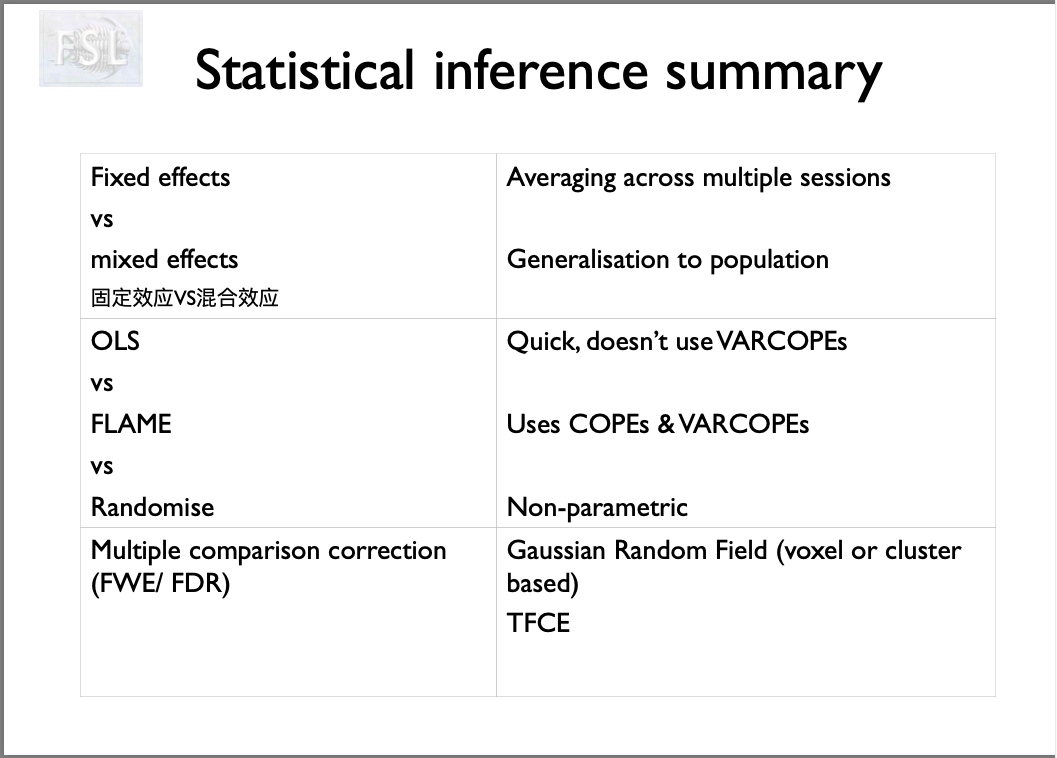
9. fixed effect vs mixed effect [level2]
- prac1: mixed effect
- prac2: fixed effect
... http://fsl.fmrib.ox.ac.uk/fslcourse/2019_Beijing/lectures/feat3.pdf
10. 用prac1的pair-t方法做lev2的话,lev3不就只有两张COPE图做组间比较了????
ok????

 浙公网安备 33010602011771号