
实用指南:11.22 脚本 手机termux项目分析(python)
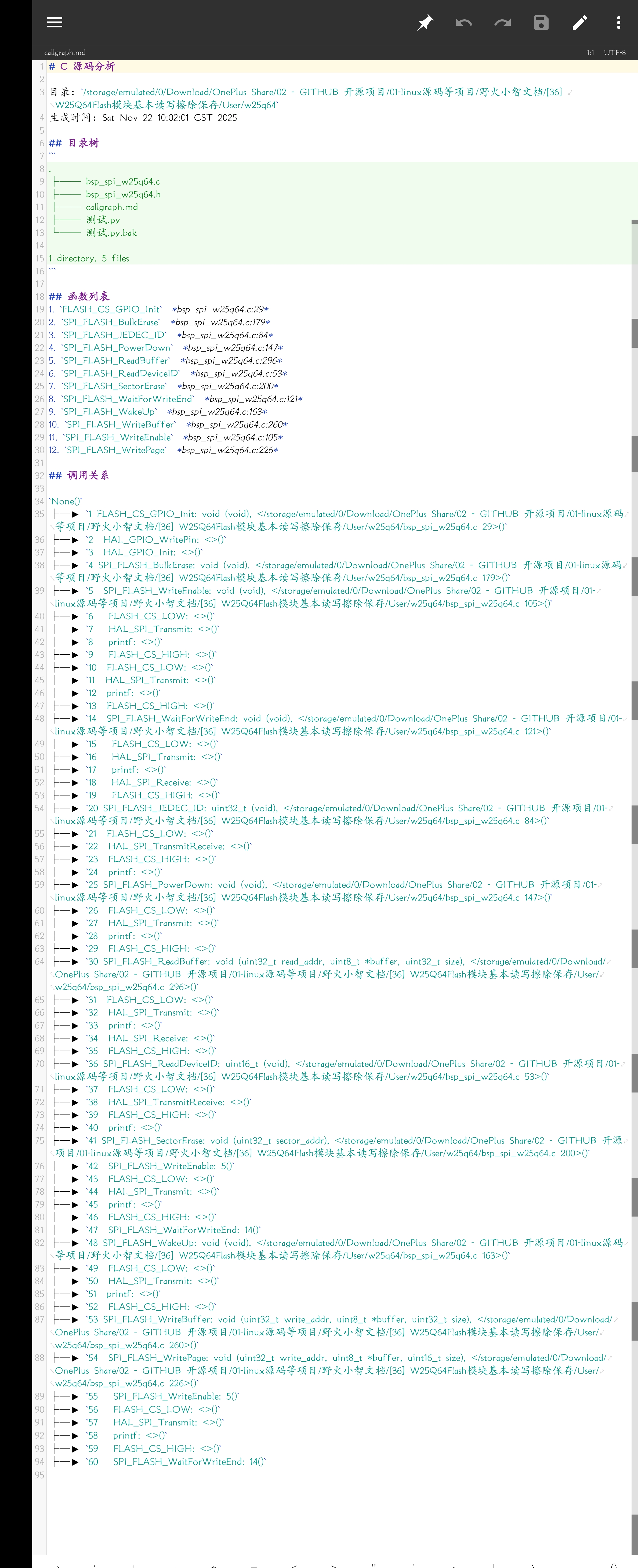
一 场景,适合坐电梯 电梯,蹲坑
二 特点,执行快,效率高
python+源文件,
三 说明,这里不要bash,性能偶尔会翻车。
博主有时间把它集成到个人APP 「已开源」
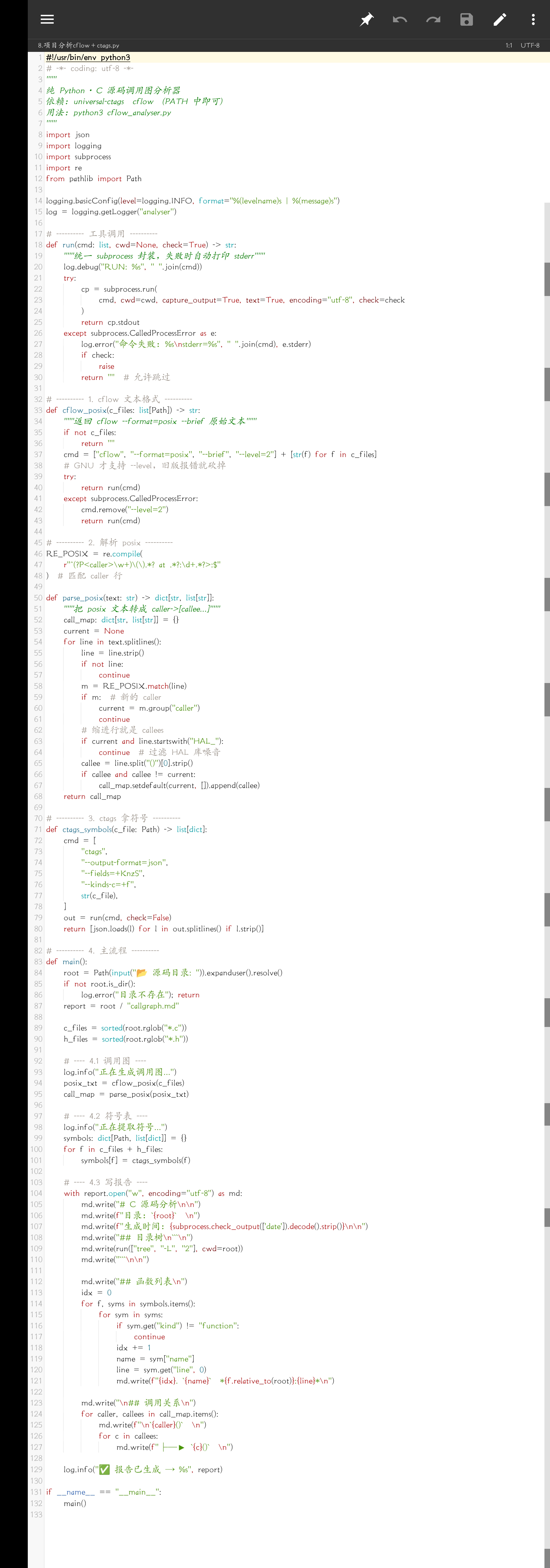
#!/usr/bin/env python3
# -*- coding: utf-8 -*-
"""
纯 Python · C 源码调用图分析器
依赖:universal-ctags cflow (PATH 中即可)
用法:python3 cflow_analyser.py
"""
import json
import logging
import subprocess
import re
from pathlib import Path
logging.basicConfig(level=logging.INFO, format="%(levelname)s | %(message)s")
log = logging.getLogger("analyser")
# ---------- 工具调用 ----------
def run(cmd: list, cwd=None, check=True) -> str:
"""统一 subprocess 封装,失败时自动打印 stderr"""
log.debug("RUN: %s", " ".join(cmd))
try:
cp = subprocess.run(
cmd, cwd=cwd, capture_output=True, text=True, encoding="utf-8", check=check
)
return cp.stdout
except subprocess.CalledProcessError as e:
log.error("命令失败:%s\nstderr=%s", " ".join(cmd), e.stderr)
if check:
raise
return "" # 允许跳过
# ---------- 1. cflow 文本格式 ----------
def cflow_posix(c_files: list[Path]) -> str:
"""返回 cflow --format=posix --brief 原始文本"""
if not c_files:
return ""
cmd = ["cflow", "--format=posix", "--brief", "--level=2"] + [str(f) for f in c_files]
# GNU 才支撑 --level,旧版报错就砍掉
try:
return run(cmd)
except subprocess.CalledProcessError:
cmd.remove("--level=2")
return run(cmd)
# ---------- 2. 解析 posix ----------
RE_POSIX = re.compile(
r"^(?P<caller>\w+)\(\).*? at .*?:\d+.*?>:$"
) # 匹配 caller 行
def parse_posix(text: str) -> dict[str, list[str]]:
"""把 posix 文本转成 caller->[callee...]"""
call_map: dict[str, list[str]] = {}
current = None
for line in text.splitlines():
line = line.strip()
if not line:
continue
m = RE_POSIX.match(line)
if m: # 新的 caller
current = m.group("caller")
continue
# 缩进行就是 callees
if current and line.startswith("HAL_"):
continue # 过滤 HAL 库噪音
callee = line.split("()")[0].strip()
if callee and callee != current:
call_map.setdefault(current, []).append(callee)
return call_map
# ---------- 3. ctags 拿符号 ----------
def ctags_symbols(c_file: Path) -> list[dict]:
cmd = [
"ctags",
"--output-format=json",
"--fields=+KnzS",
"--kinds-c=+f",
str(c_file),
]
out = run(cmd, check=False)
return [json.loads(l) for l in out.splitlines() if l.strip()]
# ---------- 4. 主流程 ----------
def main():
root = Path(input(" 源码目录: ")).expanduser().resolve()
if not root.is_dir():
log.error("目录不存在"); return
report = root / "callgraph.md"
c_files = sorted(root.rglob("*.c"))
h_files = sorted(root.rglob("*.h"))
# ---- 4.1 调用图 ----
log.info("正在生成调用图...")
posix_txt = cflow_posix(c_files)
call_map = parse_posix(posix_txt)
# ---- 4.2 符号表 ----
log.info("正在提取符号...")
symbols: dict[Path, list[dict]] = {}
for f in c_files + h_files:
symbols[f] = ctags_symbols(f)
# ---- 4.3 写报告 ----
with report.open("w", encoding="utf-8") as md:
md.write("# C 源码分析\n\n")
md.write(f"目录:`{root}` \n")
md.write(f"生成时间:{subprocess.check_output(['date']).decode().strip()}\n\n")
md.write("## 目录树\n```\n")
md.write(run(["tree", "-L", "2"], cwd=root))
md.write("```\n\n")
md.write("## 函数列表\n")
idx = 0
for f, syms in symbols.items():
for sym in syms:
if sym.get("kind") != "function":
continue
idx += 1
name = sym["name"]
line = sym.get("line", 0)
md.write(f"{idx}. `{name}` *{f.relative_to(root)}:{line}*\n")
md.write("\n## 调用关系\n")
for caller, callees in call_map.items():
md.write(f"\n`{caller}()` \n")
for c in callees:
md.write(f"├─▶ `{c}()` \n")
log.info("✅ 报告已生成 → %s", report)
if __name__ == "__main__":
main()

 浙公网安备 33010602011771号