

完整教程:完整的后端课程 | NodeJS、ExpressJS、JWT、Prisma、PostgreSQL
完整的后端课程 | NodeJS、ExpressJS、JWT、Prisma、PostgreSQL
视频地址:Complete Backend Course | NodeJS, ExpressJS, JWT, Prisma, PostgreSQL
Github源代码地址:https://github.com/machadop1407/NodeJS-ExpressJS-BackendCourse
Complete Backend Course | NodeJS, ExpressJS, JWT, Prisma, PostgreSQL
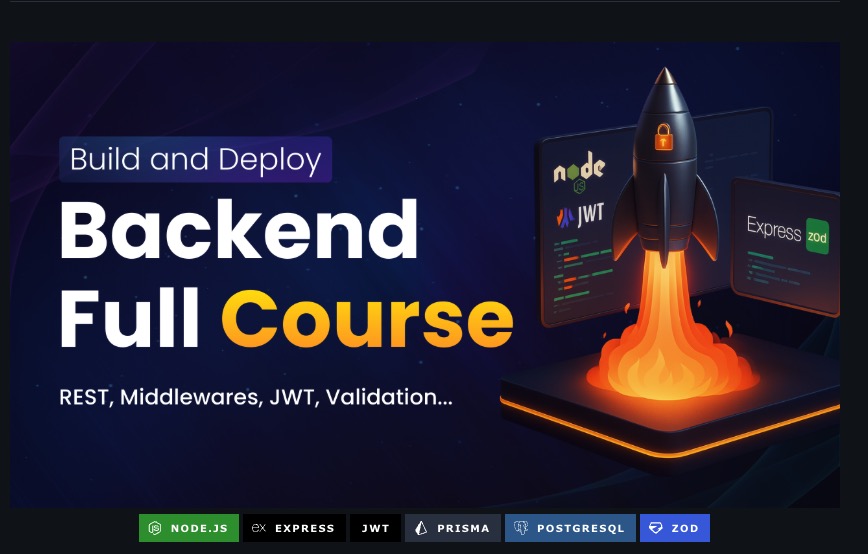
Build a Complete Backend API with Authentication, Movie Management & Watchlist Features
Follow the full video tutorial on YouTube
Table of Contents
Introduction
In this comprehensive backend course, you’ll learn how to build a complete RESTful API from scratch using Node.js, Express.js, and modern backend development practices. This video walks you through building:
User Authentication System - Secure registration, login, and JWT-based authentication
Movie Management API - Full CRUD operations for movie data
Watchlist Feature - Personal watchlist with status tracking and ratings
Perfect for developers looking to master backend development, learn API design, implement authentication, work with databases using Prisma ORM, and build production-ready backend applications.
Watch the full tutorial: YouTube
⚙️ Tech Stack
Node.js – JavaScript runtime for server-side development
Express.js – Fast, minimalist web framework for Node.js
JWT (JSON Web Tokens) – Secure authentication and authorization
Prisma – Next-generation ORM for database management
PostgreSQL – Powerful, open-source relational database
Zod – TypeScript-first schema validation library
bcryptjs – Password hashing for secure user authentication
dotenv – Environment variable management
⚡️ Features
Authentication System
User Registration - Secure user signup with email validation
User Login - JWT-based authentication with token generation
User Logout - Token invalidation and session management
Password Hashing - Secure password storage using bcryptjs
️ Protected Routes - Middleware-based route protection
Movie Management
CRUD Operations - Create, read, update, and delete movies
Movie Details - Store title, overview, release year, genres, runtime, and poster URLs
User Association - Track which user created each movie
Query Support - Filter and search movie data
Watchlist System
➕ Add to Watchlist - Save movies to personal watchlist
Status Tracking - Track watch status (Planned, Watching, Completed, Dropped)
⭐ Rating System - Rate movies with optional notes
️ Remove Items - Delete movies from watchlist
✏️ Update Items - Modify watchlist item status and ratings
️ Additional Features
✅ Request Validation - Zod schema validation for all endpoints
Error Handling - Centralized error handling middleware
JWT Middleware - Automatic token verification for protected routes
️ Database Migrations - Prisma migrations for schema management
Database Seeding - Seed script for initial data
Quick Start
Prerequisites
Node.js (v18 or higher)
PostgreSQL (v14 or higher)
⚠️ Upgrading This Project to Prisma ORM v7
Prisma ORM v7 introduces breaking changes that affect how this backend project works.
If you want to use Prisma v7 instead of v6 (used in the original tutorial), you must apply all changes below.
1. Install Prisma v7 Packages
npm install @prisma/client@7
npm install -D prisma@7
npm install @prisma/adapter-pg dotenv
2. Enable ESM in package.json (Required)
Prisma v7 is ESM-only.
{
"type": "module"
}
3. Update Your Prisma Schema
Replace the old generator:
generator client {
  provider = "prisma-client-js"
  engineType = "binary"
}
With the new v7 version:
generator client {
  provider = "prisma-client"
}
4. Create prisma.config.ts (Required in v7)
Create this file at the project root:
import 'dotenv/config'
import { defineConfig, env } from 'prisma/config'
export default defineConfig({
schema: 'prisma/schema.prisma',
migrations: {
path: 'prisma/migrations',
seed: 'tsx prisma/seed.ts',
},
datasource: {
url: env('DATABASE_URL'),
},
})
Prisma v7 no longer reads connection URLs from the schema.
5. Update Prisma Client Instantiation
Old (v4–v6):
import { PrismaClient } from '@prisma/client';
export const prisma = new PrismaClient();
New (Prisma v7):
import { PrismaClient } from './generated/prisma/client.js';
import { PrismaPg } from '@prisma/adapter-pg';
const adapter = new PrismaPg({
connectionString: process.env.DATABASE_URL
});
export const prisma = new PrismaClient({ adapter });
This is required across your project wherever Prisma Client is created.
6. Load .env Manually
Prisma v7 does not automatically load .env.
Install dotenv:
npm install dotenvAdd to your entry file (e.g., server.js):
import "dotenv/config";7. Update Node.js Version
| Requirement | Recommended |
|---|---|
| Node 20.19.0+ | Node 22.x |
Prisma v7 will not run on older Node versions.
8. Removed APIs You Might Be Using
❌ prisma.$use() middleware
→ Replace with client extensions:
const prisma = new PrismaClient().$extends({
query: {
user: {
async findMany({ args, query }) {
return query(args);
}
}
}
});
❌ Metrics API removed
If you used $metrics, it no longer exists.
✔️ Summary of Required Changes
| Change | Required |
|---|---|
| Update dependencies | ✅ |
| ESM mode | ✅ |
| New Prisma generator | ✅ |
| Add driver adapter | ✅ |
Create prisma.config.ts | ✅ |
Load .env manually | ✅ |
| Update client instantiation | ✅ |
| Replace middleware (if used) | As needed |
| Update Node version | Yes |
Installation
- Clone the repository
git clone https://github.com/yourusername/backend-course.git
cd backend-course- Install dependencies
npm install- Set up environment variables
Create a .env file in the root directory:
DATABASE_URL="postgresql://username:password@localhost:5432/database_name"
JWT_SECRET="your-super-secret-jwt-key"
PORT=5001- Set up the database
# Run Prisma migrations
npx prisma migrate dev
# (Optional) Seed the database with sample data
npm run seed:movies- Start the development server
npm run devThe API will be available at: http://localhost:5001
API Endpoints
Authentication Routes
POST /auth/register- Register a new userPOST /auth/login- Login and receive JWT tokenPOST /auth/logout- Logout (invalidate token)
Movie Routes
GET /movies- Get all moviesPOST /movies- Create a new moviePUT /movies/:id- Update a movieDELETE /movies/:id- Delete a movie
Watchlist Routes (Protected)
POST /watchlist- Add movie to watchlistPUT /watchlist/:id- Update watchlist itemDELETE /watchlist/:id- Remove movie from watchlist
️ Database Schema
User Model
id- Unique identifier (UUID)name- User’s full nameemail- Unique email addresspassword- Hashed passwordcreatedAt- Account creation timestamp
Movie Model
id- Unique identifier (UUID)title- Movie titleoverview- Movie descriptionreleaseYear- Year of releasegenres- Array of genre stringsruntime- Movie duration in minutesposterUrl- URL to movie poster imagecreatedBy- User ID of creatorcreatedAt- Creation timestamp
WatchlistItem Model
id- Unique identifier (UUID)userId- Reference to UsermovieId- Reference to Moviestatus- Watch status (PLANNED, WATCHING, COMPLETED, DROPPED)rating- Optional rating (1-10)notes- Optional personal notescreatedAt- Creation timestampupdatedAt- Last update timestamp
☁️ Deployment
Deploy on Railway
Push your code to GitHub
Go to railway.app
Create a new project and import your repository
Add PostgreSQL service
Set environment variables:
DATABASE_URL(automatically provided by Railway)JWT_SECRET(generate a secure random string)PORT(Railway will set this automatically)
Deploy your application
Your API will be live on a custom Railway subdomain!
Alternative Deployment Options
Render - Full-stack deployment with PostgreSQL
Heroku - Platform-as-a-service deployment
DigitalOcean App Platform - Simple app deployment
AWS - Enterprise-grade cloud hosting
Course & Channel
Learn More with Pedro Technologies
Course Website: www.webdevultra.com
YouTube Channel: @pedrotechnologies
Follow along for more backend tutorials, full-stack development, and practical coding projects!
Useful Links
JWT.io - JWT token decoder and debugger
License
This project is open source and available under the MIT License.
注意事项
运行后台程序
关于PostgreSql数据库,可以参考菜鸟教程的Mac OS 上安装 PostgreSQL在MacOS上安装本地PostgreSql数据库,其他操作系统Windows、Linux都类似。当然也可以使用https://console.neon.tech/app网站创建在线PostgreSql云数据库,用作测试使用。
- 从Github仓库中下载源代码
先git clone https://github.com/machadop1407/NodeJS-ExpressJS-BackendCourse.git下载源代码
git clone https://github.com/machadop1407/NodeJS-ExpressJS-BackendCourse.git可以看到对应的package.json文件如下所示:
{
"name": "backend-course",
"version": "1.0.0",
"description": "",
"main": "index.js",
"scripts": {
"test": "echo \"Error: no test specified\" && exit 1",
"dev": "nodemon src/server.js",
"seed:movies": "node prisma/seed.js"
},
"keywords": [],
"author": "",
"license": "ISC",
"type": "module",
"dependencies": {
"@prisma/client": "^6.19.0",
"bcryptjs": "^3.0.3",
"dotenv": "^17.2.3",
"express": "^5.1.0",
"jsonwebtoken": "^9.0.2",
"zod": "^4.1.12"
},
"devDependencies": {
"nodemon": "^3.1.11",
"prisma": "^6.19.0"
}
}
cd NodeJS-ExpressJS-BackendCourse 即进入到代码根目录,执行
npm install安装相关依赖比如express、bcryptjs、dotenv、jsonwebtoken、zod、@prisma/client等创建环境变量
在代码根目录首先创建一个.env的文件,内容如下:
DATABASE_URL="postgresql://username:password@localhost:5432/database_name"
JWT_SECRET="your-super-secret-jwt-key"
PORT=5001
这里的数据库URL地址需要根据自己实际的用户名和密码,还有数据库名称进行对应配置
JWT密钥可以根据需要自行设置,端口号也可以自行更改
- 启动数据库
# Run Prisma migrations
npx prisma migrate dev
# (Optional) Seed the database with sample data
npm run seed:movies- 启动开发环境
npm run devHttp Server服务器运行地址:http://localhost:5001
参考资料
- 视频地址:Complete Backend Course | NodeJS, ExpressJS, JWT, Prisma, PostgreSQL
- Github源代码地址:https://github.com/machadop1407/NodeJS-ExpressJS-BackendCourse
- Mac OS 上安装 PostgreSQL
- macOS平台安装PostgreSQL的五种方法
- https://www.prisma.io/
Next-generation ORM for Node.js & TypeScript | PostgreSQL, MySQL, MariaDB, SQL Server, SQLite, MongoDB and CockroachDB
Managed Postgres that feels native to your workflow. Instant setup, automatic scaling, integrated tooling. Build faster, ship confidently. - Prisma QuickStart
- Prisma connection-urls

 浙公网安备 33010602011771号