


C++11特性 - 详解
1.列表初始化
1.1C++98传统的{}
struct Point
{
int _x;
int _y;
};
int main()
{
int array1[] = { 1, 2, 3, 4, 5 };
int array2[5] = { 0 };
Point p = { 1, 2 };
return 0;
}1.2C++11中的{}
内置类型⽀持,⾃定义类型也⽀持,⾃定义类型本质是类型转换,中间会产⽣临时对象,最后优化
了以后变成直接构造。
{}初始化的过程中,可以省略掉=
C++11列表初始化的本意是想实现⼀个⼤统⼀的初始化⽅式,其次他在有些场景下带来的不少便利,如容器push/inset多参数构造的对象时,{}初始化会很⽅便
#include
#include
using namespace std;
struct Point
{
	int _x;
	int _y;
};
class Date
{
public:
	Date(int year = 1, int month = 1, int day = 1)
		:_year(year)
		, _month(month)
		, _day(day)
	{
		cout << "Date(int year, int month, int day)" << endl;
	}
	Date(const Date& d)
		:_year(d._year)
		, _month(d._month)
		, _day(d._day)
	{
		cout << "Date(const Date& d)" << endl;
	}
private:
	int _year;
	int _month;
	int _day;
};
int main()
{
	// C++98⽀持的
	int a1[] = { 1, 2, 3, 4, 5 };
	int a2[5] = { 0 };
	Point p = { 1, 2 };
	// C++11⽀持的
	// 内置类型⽀持
	int x1 = { 2 };
	// ⾃定义类型⽀持
	// 这⾥本质是⽤{ 2025, 1, 1}构造⼀个Date临时对象
	// 临时对象再去拷⻉构造d1,编译器优化后合⼆为⼀变成{ 2025, 1, 1}直接构造初始化
	d1
		// 运⾏⼀下,我们可以验证上⾯的理论,发现是没调⽤拷⻉构造的
		Date d1 = { 2025, 1, 1 };
	// 这⾥d2引⽤的是{ 2024, 7, 25 }构造的临时对象
	const Date& d2 = { 2024, 7, 25 };
	// 需要注意的是C++98⽀持单参数时类型转换,也可以不⽤{}
	Date d3 = { 2025 };
	Date d4 = 2025;
	// 可以省略掉=
	Point p1{ 1, 2 };
	int x2{ 2 };
	Date d6{ 2024, 7, 25 };
	const Date& d7{ 2024, 7, 25 };
	// 不⽀持,只有{}初始化,才能省略=
	// Date d8 2025;
	vector v;
	v.push_back(d1);
	v.push_back(Date(2025, 1, 1));
	// ⽐起有名对象和匿名对象传参,这⾥{}更有性价⽐
	v.push_back({ 2025, 1, 1 });
	return 0;
} 1.3std::initializer_list
C++11库中提出了⼀个std::initializer_list的类, auto il = { 10, 20, 30 }; // the
type of il is an initializer_list
这个类的本质是底层开⼀个数组,将数据拷⻉
过来,std::initializer_list内部有两个指针分别指向数组的开始和结束。
这是他的⽂档:initializer_list,std::initializer_list⽀持迭代器遍历。
容器⽀持⼀个std::initializer_list的构造函数,也就⽀持任意多个值构成的 {x1,x2,x3...} 进⾏
初始化。STL中的容器⽀持任意多个值构成的 {x1,x2,x3...} 进⾏初始化,就是通过std::initializer_list的构造函数⽀持的。
//STL中的容器都增加了⼀个initializer_list的构造
vector(initializer_list<value_type> il, const allocator_type& alloc = allocator_type());
list(initializer_list<value_type> il, const allocator_type& alloc =allocator_type());
map(initializer_list<value_type> il, const key_compare& comp =key_compare(), const allocator_type& alloc = allocator_type());// 另外,容器的赋值也⽀持initializer_list的版本vector& operator= (initializer_list<value_type> il);map& operator= (initializer_list<value_type> il);
int main()
{
	std::initializer_list mylist;
	mylist = { 10, 20, 30 };
	cout << sizeof(mylist) << endl;
	// 这⾥begin和end返回的值initializer_list对象中存的两个指针
	// 这两个指针的值跟i的地址跟接近,说明数组存在栈上
	int i = 0;
	cout << mylist.begin() << endl;
	cout << mylist.end() << endl;
	cout << &i << endl;
	// {}列表中可以有任意多个值
	// 这两个写法语义上还是有差别的,第⼀个v1是直接构造,
	// 第⼆个v2是构造临时对象+临时对象拷⻉v2+优化为直接构造
	vector v1({ 1,2,3,4,5 });
	vector v2 = { 1,2,3,4,5 };
	const vector& v3 = { 1,2,3,4,5 };
	// 这⾥是pair对象的{}初始化和map的initializer_list构造结合到⼀起⽤了
	map dict = { {"sort", "排序"}, {"string", "字符串"} };
	// initializer_list版本的赋值⽀持
	v1 = { 10,20,30,40,50 };
	return 0;
}
2.引用和移动语义
2.1左值和右值
int a = 10; //这里的a是一个左值,10是一个右值
int b = a; //这里的a和b都是左值,都可以取他的地址
int main()
{
	// 左值:可以取地址
	// 以下的p、b、c、*p、s、s[0]就是常⻅的左值
	int* p = new int(0);
	int b = 1;
	const int c = b;
	*p = 10;
	string s("111111");
	s[0] = 'x';
	cout << &c << endl;
	cout << (void*)&s[0] << endl;
	// 右值:不能取地址
	double x = 1.1, y = 2.2;
	// 以下⼏个10、x + y、fmin(x, y)、string("11111")都是常⻅的右值
	10;
	x + y;
	fmin(x, y);
	string("11111");
	//cout << &10 << endl;
	//cout << &(x+y) << endl;
	//cout << &(fmin(x, y)) << endl;
	//cout << &string("11111") << endl;
	return 0;
}2.2左值引用和右值引用
左值引用和右值引用的语法:
//左值引用
Type& r1 = x;
//右值引用
Type&& r2 = y;
move是库⾥⾯的⼀个函数模板,本质内部是进⾏强制类型转换,将左值变为右值
template
remove_reference_t<_Ty>&& move(_Ty&& _Arg)
{ // forward _Arg as movable
	return static_cast&&>(_Arg);
} int b = 2; //2是右值,但b是左值
int&& c = 3; //3是右值,但c是左值
#include
using namespace std;
int main()
{
	// 左值:可以取地址
	// 以下的p、b、c、*p、s、s[0]就是常⻅的左值
	int* p = new int(0);
	int b = 1;
	const int c = b;
	*p = 10;
	string s("111111");
	s[0] = 'x';
	double x = 1.1, y = 2.2;
	// 左值引⽤给左值取别名
	int& r1 = b;
	int*& r2 = p;
	int& r3 = *p;
	string& r4 = s;
	char& r5 = s[0];
	// 右值引⽤给右值取别名
	int&& rr1 = 10;
	double&& rr2 = x + y;
	double&& rr3 = fmin(x, y);
	string&& rr4 = string("11111");
	// 左值引⽤不能直接引⽤右值,但是const左值引⽤可以引⽤右值
	const int& rx1 = 10;
	const double& rx2 = x + y;
	const double& rx3 = fmin(x, y);
	const string& rx4 = string("11111");
	// 右值引⽤不能直接引⽤左值,但是右值引⽤可以引⽤move(左值)
	int&& rrx1 = move(b);
	int*&& rrx2 = move(p);
	int&& rrx3 = move(*p);
	string&& rrx4 = move(s);
	string&& rrx5 = (string&&)s;
	// b、r1、rr1都是变量表达式,都是左值
	cout << &b << endl;
	cout << &r1 << endl;
	cout << &rr1 << endl;
	// 这⾥要注意的是,rr1的属性是左值,所以不能再被右值引⽤绑定,除⾮move⼀下
	int& r6 = r1;
	// int&& rrx6 = rr1;
	int&& rrx6 = move(rr1);
	return 0;
}
2.3延长生命周期
int main()
{
	std::string s1 = "Test";
	// std::string&& r1 = s1; // 错误:不能绑定到左值
	const std::string& r2 = s1 + s1;
    //const 的左值引⽤延⻓⽣存期
	// r2 += "Test"; // 错误:不能通过到 const 的引⽤修改
	std::string&& r3 = s1 + s1; // OK:右值引⽤延⻓⽣存期
	r3 += "Test"; // OK:能通过到⾮ const 的引⽤修改
	std::cout << r3 << '\n';
	return 0;
}2.4左值和右值的参数匹配
C++98中,⼀个const左值引⽤作为参数的函数,那么实参传递左值和右值都可以匹配
C++11以后,分别重载左值引⽤、const左值引⽤、右值引⽤作为形参的f函数,那么实参是左值会
匹配f(左值引⽤),实参是const左值会匹配f(const 左值引⽤),实参是右值会匹配f(右值引⽤)。
需要强调,右值引⽤变量在⽤于表达式时属性是左值
#include
using namespace std;
void f(int& x)
{
	std::cout << "左值引⽤重载 f(" << x << ")\n";
}
void f(const int& x)
{
	std::cout << "到 const 的左值引⽤重载 f(" << x << ")\n";
}
void f(int&& x)
{
	std::cout << "右值引⽤重载 f(" << x << ")\n";
}
int main()
{
	int i = 1;
	const int ci = 2;
	f(i); // 调⽤ f(int&)
	f(ci); // 调⽤ f(const int&)
	f(3); // 调⽤ f(int&&),如果没有 f(int&&) 重载则会调⽤ f(const int&)
	f(std::move(i)); // 调⽤ f(int&&)
	// 右值引⽤变量在⽤于表达式时是左值
	int&& x = 1;
	f(x); // 调⽤ f(int& x)
	f(std::move(x)); // 调⽤ f(int&& x)
	return 0;
} 2.5右值引用和移动语义的使用场景
使用右值引用可以实现移动构造和移动赋值
2.5.1移动构造和移动赋值
对于像string/vector这样的深拷⻉的类或者包含深拷⻉的成员变量的类,移动构造和移动赋值才有意义,因为移动构造和移动赋值的本质是要“窃取”引⽤的 右值对象的资源,提⾼效率,⽽不是像拷⻉构造和拷⻉赋值那样去拷⻉资源
演示移动构造和移动赋值:
class string
{
public:
	string(const char* str = "")
		:_size(strlen(str))
		, _capacity(_size)
	{
		cout << "string(char* str)-构造" << endl;
		_str = new char[_capacity + 1];
		strcpy(_str, str);
	}
	string(const string& s)
		:_str(nullptr)
	{
		cout << "string(const string& s) -- 拷⻉构造" << endl;
		reserve(s._capacity);
		for (auto ch : s)
		{
			push_back(ch);
		}
	}
	// 移动构造
	string(string&& s)
	{
		cout << "string(string&& s) -- 移动构造" << endl;
		swap(s);
	}
	string& operator=(const string& s)
	{
		cout << "string& operator=(const string& s) -- 拷⻉赋值" <<
			endl;
		if (this != &s)
		{
			_str[0] = '\0';
			_size = 0;
			reserve(s._capacity);
			for (auto ch : s)
			{
				push_back(ch);
			}
		}
		return *this;
	}
	// 移动赋值
	string& operator=(string&& s)
	{
		cout << "string& operator=(string&& s) -- 移动赋值" << endl;
		swap(s);
		return *this;
	}
	~string()
	{
		cout << "~string() -- 析构" << endl;
		delete[] _str;
		_str = nullptr;
	}
private:
	char* _str = nullptr;
	size_t _size = 0;
	size_t _capacity = 0;
};
int main()
{
string s1("xxxxx");
// 拷⻉构造
string s2 = s1;
// 构造+移动构造,优化后直接构造
string s3 = bit::string("yyyyy");
// 移动构造
string s4 = move(s1);
cout << "******************************" << endl;
return 0;
}
注意:现在的编译器会在一些场景下会自行优化:
namespace csl
{
	class string
	{
	public:
		typedef char* iterator;
		typedef const char* const_iterator;
		iterator begin()
		{
			return _str;
		}
		iterator end()
		{
			return _str + _size;
		}
		const_iterator begin() const
		{
			return _str;
		}
		const_iterator end() const
		{
			return _str + _size;
		}
		string(const char* str = "")
			:_size(strlen(str))
			, _capacity(_size)
		{
			cout << "string(char* str)-构造" << endl;
			_str = new char[_capacity + 1];
			strcpy(_str, str);
		}
		void swap(string& s)
		{
			::swap(_str, s._str);
			::swap(_size, s._size);
			::swap(_capacity, s._capacity);
		}
		string(const string& s)
			:_str(nullptr)
		{
			cout << "string(const string& s) -- 拷⻉构造" << endl;
			reserve(s._capacity);
			for (auto ch : s)
			{
				push_back(ch);
			}
		}
		string& operator=(const string& s)
		{
			cout << "string& operator=(const string& s) -- 拷⻉赋值" <<
				endl;
			if (this != &s)
			{
				_str[0] = '\0';
				_size = 0;
				reserve(s._capacity);
				for (auto ch : s)
				{
					push_back(ch);
				}
			}
			return *this;
		}
		~string()
		{
			cout << "~string() -- 析构" << endl;
			delete[] _str;
			_str = nullptr;
		}
		char& operator[](size_t pos)
		{
			assert(pos < _size);
			return _str[pos];
		}
		void reserve(size_t n)
		{
			if (n > _capacity)
			{
				char* tmp = new char[n + 1];
				if (_str)
				{
					strcpy(tmp, _str);
					delete[] _str;
				}
				_str = tmp;
				_capacity = n;
			}
		}
		void push_back(char ch)
		{
			if (_size >= _capacity)
			{
				size_t newcapacity = _capacity == 0 ? 4 : _capacity *
					2;
				reserve(newcapacity);
			}
			_str[_size] = ch;
			++_size;
			_str[_size] = '\0';
		}
		string& operator+=(char ch)
		{
			push_back(ch);
			return *this;
		}
		const char* c_str() const
		{
			return _str;
		}
		size_t size() const
		{
			return _size;
		}
	private:
		char* _str = nullptr;
		size_t _size = 0;
		size_t _capacity = 0;
	};
	string addStrings(string num1, string num2)
	{
		string str;
		int end1 = num1.size() - 1, end2 = num2.size() - 1;
		int next = 0;
		while (end1 >= 0 || end2 >= 0)
		{
			int val1 = end1 >= 0 ? num1[end1--] - '0' : 0;
			int val2 = end2 >= 0 ? num2[end2--] - '0' : 0;
			int ret = val1 + val2 + next;
			next = ret / 10;
			ret = ret % 10;
			str += ('0' + ret);
		}
		if (next == 1)
			str += '1';
		reverse(str.begin(), str.end());
		cout << "******************************" << endl;
		return str;
	}
}
int main()
{
	csl::string ret = csl::addStrings("11111", "22222");
	cout << ret.c_str() << endl;
	return 0;
}
完全不优化情况下应该是:
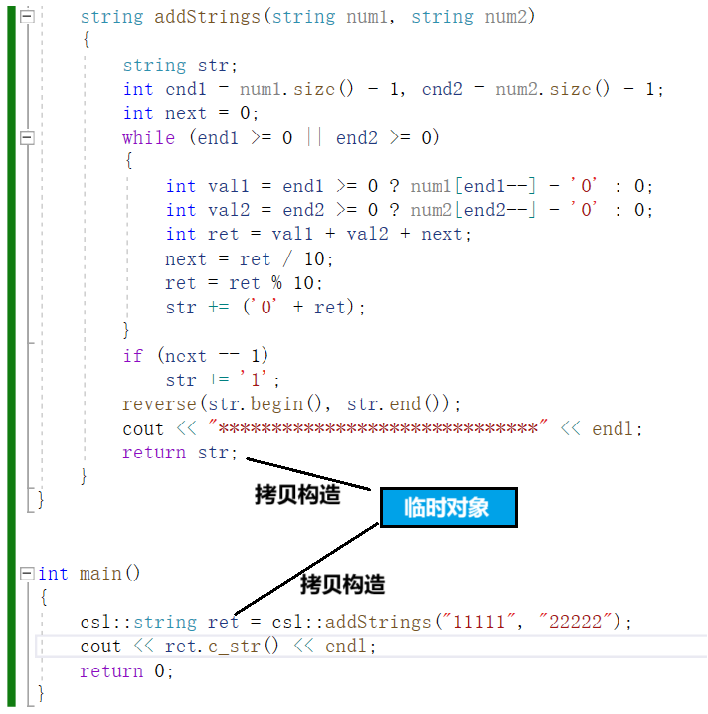
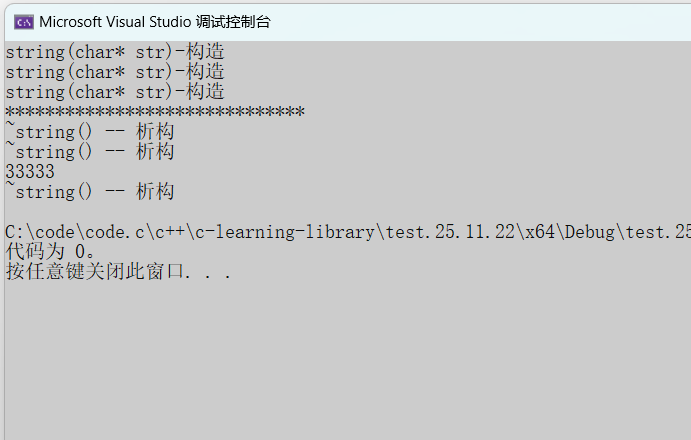
vs2022下会直接将str对象的构造,str拷⻉构造临时对象,临时对象拷⻉构造ret对象,合三为⼀,变为直接构造:
vs2022运行结果:
2.6类型分类
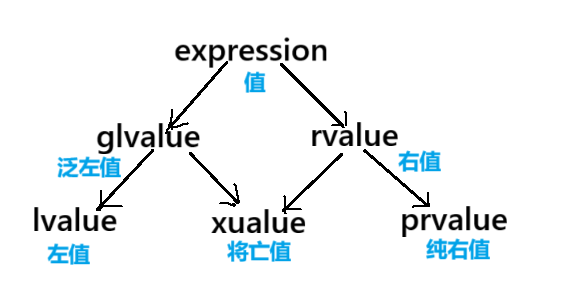
C++11以后,进⼀步对类型进⾏了划分,右值被划分纯右值和将亡值
纯右值:字⾯值常量、求值结果、临时对象
将亡值:返回右值引⽤的函数的调⽤表达式、转换为右值引⽤的转换函数的调⽤表达
2.7引用折叠
typedef int& lref;
typedef int&& rref;
int n = 0;
lref& r1 = n; // r1 的类型是 int&,左值引用
lref&& r2 = n; // r2 的类型是 int&,左值引用
rref& r3 = n; // r3 的类型是 int&,左值引用
rref&& r4 = 1; // r4 的类型是 int&&,右值引用
2.8完美转发
void Fun(int& x) { cout << "左值引用" << endl; }
void Fun(const int& x) { cout << "const 左值引用" << endl; }
void Fun(int&& x) { cout << "右值引用" << endl; }
void Fun(const int&& x) { cout << "const 右值引用" << endl; }
template
void Function(T&& t)
{
	Fun(t);
	//Fun(forward(t));  //使用完美转发
}
int main()
{
	Function(10); // 右值
	int a;
	Function(a); // 左值
	Function(std::move(a)); // 右值
	const int b = 8;
	Function(b); // const 左值
	Function(std::move(b)); // const 右值
	return 0;
} 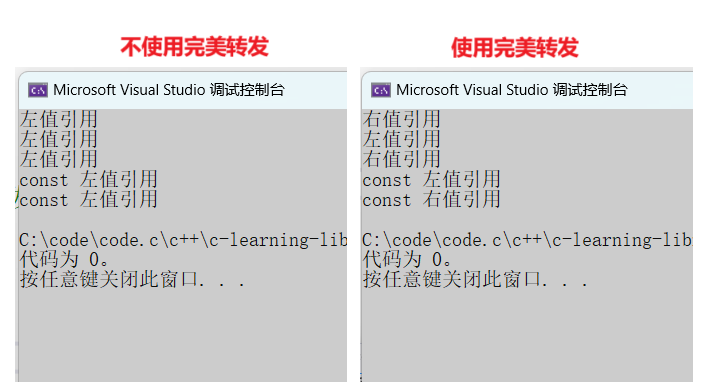
完美转发的本质就是函数模板
template <class _Ty>
_Ty&& forward(remove_reference_t<_Ty>& _Arg) noexcept
{
return static_cast<_Ty&&>(_Arg);
}
3.可变参数模板
template <class ...Args> void Func(Args... args) {}template <class ...Args> void Func(Args&... args) {}template <class ...Args> void Func(Args&&... args) {}
sizeof...计算参数包中参数的个数:
#include
using namespace std;
template
void Print(Args&&... args)
{
	cout << sizeof...(args) << endl;
}
int main()
{
	double x = 2.2;
	Print(); // 包⾥有0个参数
	Print(1); // 包⾥有1个参数
	Print(1, string("xxxxx")); // 包⾥有2个参数
	Print(1.1, string("xxxxx"), x); // 包⾥有3个参数
	return 0;
}
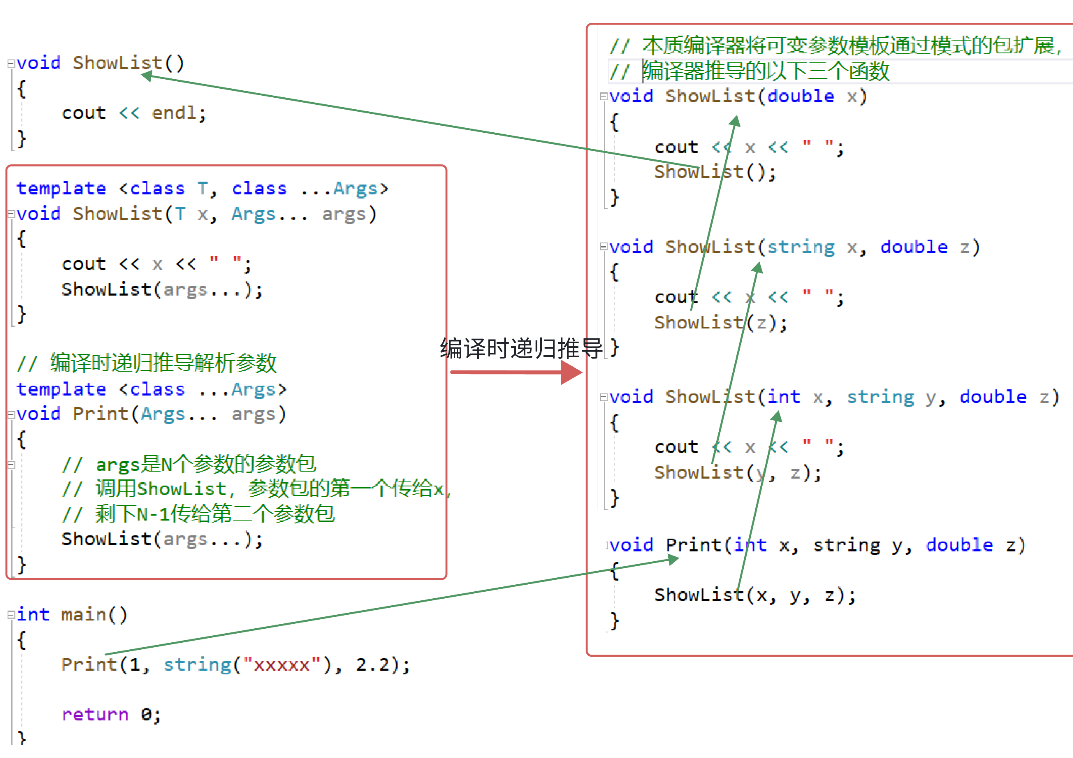
3.1包扩展
void ShowList()
{
	// 编译器时递归的终⽌条件,参数包是0个时,直接匹配这个函数
	cout << endl;
}
template
void ShowList(T x, Args... args)
{
	cout << x << " ";
	// args是N个参数的参数包
	// 调⽤ShowList,参数包的第⼀个传给x,剩下N-1传给第⼆个参数包
	ShowList(args...);
}
// 编译时递归推导解析参数
template
void Print(Args... args)
{
	ShowList(args...);
}
int main()
{
	Print();
	Print(1);
	Print(1, string("xxxxx"));
	Print(1, string("xxxxx"), 2.2);
	return 0;
}
编译时的细节:
3.2 emplace系列接口
4. lambda
4.1 lambda语法
lambda的语法:
[capture-list] (parameters) -> return type { function boby }
lambda是一个匿名函数对象,它与函数有相似之处,也有不同:
[capture-list]:捕捉列表,能够捕捉上下⽂中的变量供 lambda 函数使用
(parameters) :参数列表,如果不需要参数传递,则可以连 同()⼀起省略
int main()
{
	// ⼀个简单的lambda表达式
	auto add1 = [](int x, int y)->int {return x + y; };
	cout << add1(2, 2) << endl;
	// 1、捕捉为空也不能省略
	// 2、参数为空可以省略
	// 3、返回值可以省略,可以通过返回对象⾃动推导
	// 4、函数题不能省略
	auto func1 = []
		{
			cout << "lambda" << endl;
			return 0;
		};
	func1();
	int a = 0, b = 1;
	auto swap1 = [](int& x, int& y)
		{
			int tmp = x;
			x = y;
			y = tmp;
		};
	swap1(a, b);
	cout << a << ":" << b << endl;
	return 0;
}
4.2 lambda的应用
lambda可用于调用对象,相比于函数指针和仿函数对象,lambda更方便;还可用于线程中定义线程的执⾏函数逻辑,智能指针中定制删除器等
下面为lambda在比较大小的使用:
#include
#include
#include
#include
using namespace std;
struct Goods
{
	string _name; // 名字
	double _price; // 价格
	int _evaluate; // 评价
	// ...
	Goods(const char* str, double price, int evaluate)
		:_name(str)
		, _price(price)
		, _evaluate(evaluate)
	{}
};
//仿函数
struct ComparePriceLess
{
	bool operator()(const Goods& gl, const Goods& gr)
	{
		return gl._price < gr._price;
	}
};
//仿函数
struct ComparePriceGreater
{
	bool operator()(const Goods& gl, const Goods& gr)
	{
		return gl._price > gr._price;
	}
};
int main()
{
	vector v = { { "手机", 2.1, 5 }, { "手表", 3, 4 }, { "相机", 2.2, 3}, { "平板", 1.5, 4 } };
	// 类似这样的场景,我们实现仿函数对象或者函数指针支持商品中
	// 不同项的比较,相对还是⽐较麻烦的,那么这里lambda就很好用了
	sort(v.begin(), v.end(), ComparePriceLess());
	sort(v.begin(), v.end(), ComparePriceGreater());
	//lambda
	//价格升序
	sort(v.begin(), v.end(), [](const Goods& g1, const Goods& g2) {
		return g1._price < g2._price;});
	//价格降序
	sort(v.begin(), v.end(), [](const Goods& g1, const Goods& g2) {
		return g1._price > g2._price;});
	//评价升序
	sort(v.begin(), v.end(), [](const Goods& g1, const Goods& g2) {
		return g1._evaluate < g2._evaluate;});
	//评价降序
	sort(v.begin(), v.end(), [](const Goods& g1, const Goods& g2) {
		return g1._evaluate > g2._evaluate;});
	return 0;
}
5.包装器
5.1 function
template <class T>class function;
std::function是一个类模板,也是一个包装器,被包含在<functional>这个头⽂件中,实例化出的对象可以存储其他的可以调⽤对象,包括函数指针、仿函数、lambda 、bind 表达式等
#include
int f(int a, int b)
{
	return a + b;
}
struct Functor
{
public:
	int operator() (int a, int b)
	{
		return a + b;
	}
};
class Plus
{
public:
	Plus(int n = 100)
		:_n(n)
	{}
	static int plusi(int a, int b)
	{
		return a + b;
	}
	double plusd(double a, double b)
	{
		return (a + b) * _n;
	}
private:
	int _n;
};
int main()
{
	// 包装各种可调用对象
	function f1 = f;
	function f2 = Functor();
	function f3 = [](int a, int b) {return a + b; };
	cout << f1(1, 1) << endl;
	cout << f2(1, 1) << endl;
	cout << f3(1, 1) << endl;
	// 包装静态成员函数
	// 成员函数要指定类域并且前⾯加&才能获取地址
	function f4 = &Plus::plusi;
	cout << f4(1, 1) << endl;
	// 包装普通成员函数
	// 普通成员函数还有⼀个隐含的this指针参数,所以绑定时传对象或者对象的指针过去都可以
	function f5 = &Plus::plusd;
	Plus pd;
	cout << f5(&pd, 1.1, 1.1) << endl;
	function f6 = &Plus::plusd;
	cout << f6(pd, 1.1, 1.1) << endl;
	cout << f6(pd, 1.1, 1.1) << endl;
	function f7 = &Plus::plusd;
	cout << f7(move(pd), 1.1, 1.1) << endl;
	cout << f7(Plus(), 1.1, 1.1) << endl;
	return 0;
}
5.2 bind
#include
using placeholders::_1;
using placeholders::_2;
using placeholders::_3;
int Sub(int a, int b)
{
	return (a - b) * 10;
}
int SubX(int a, int b, int c)
{
	return (a - b - c) * 10;
}
class Plus
{
public:
	static int plusi(int a, int b)
	{
		return a + b;
	}
	double plusd(double a, double b)
	{
		return a + b;
	}
};
int main()
{
	auto sub1 = bind(Sub, _1, _2);
	cout << sub1(10, 5) << endl;
	// bind 本质返回的⼀个仿函数对象
	// 调整参数顺序(不常⽤)
	// _1代表第⼀个实参
	// _2代表第⼆个实参
	// ...
	auto sub2 = bind(Sub, _2, _1);
	cout << sub2(10, 5) << endl;
	// 调整参数个数
	auto sub3 = bind(Sub, 100, _1);
	cout << sub3(5) << endl;
	auto sub4 = bind(Sub, _1, 100);
	cout << sub4(5) << endl;
	// 分别绑死第123个参数
	auto sub5 = bind(SubX, 100, _1, _2);
	cout << sub5(5, 1) << endl;
	auto sub6 = bind(SubX, _1, 100, _2);
	cout << sub6(5, 1) << endl;
	auto sub7 = bind(SubX, _1, _2, 100);
	cout << sub7(5, 1) << endl;
	// 成员函数对象进⾏绑死,就不需要每次都传递了
	function f6 = &Plus::plusd;
	Plus pd;
	cout << f6(move(pd), 1.1, 1.1) << endl;
	cout << f6(Plus(), 1.1, 1.1) << endl;
	// bind⼀般用于,绑死⼀些固定参数
	function f7 = bind(&Plus::plusd, Plus(), _1, _2);
	cout << f7(1.1, 1.1) << endl;
	return 0;
} 
 浙公网安备 33010602011771号