

EME 05 Activities of planning
Activities of planning
Using Software Packages to Plan a Project
- yes
- Very large projects
- Distributed teams
- Extensive use of vendors and contractors
- no
- Small projects
- Short duration project increments
- Adds too much non-value-added work
- Frequent scope and requirements change
Project Planning Tools
- Sticky notes (assorted colors)
- Marking pens (assorted colors)
- Plenty of whiteboard space
Kanban(看板):An agile method of software process
看板法简介
The JPPS Meeting Components
- Attendees
Facilitator
Project manager
Another project manager
JPP consultant
Technographer
Core project team
Client representative
Resource managers
Project champion
Functional managers
Process owner - Facilities
- Equipment
- Agenda
Session #1: Negotiate the COS, Build the RBS
Session #2: Write the POS
Session #3- Part 1: Kick-off
- Part 2: Working session.
- Deliverables
- Project Proposal
Planning Session Activities
-
Review the POS for clarity
-
Create Work Breakdown Structure (WBS)
-
Estimate task duration and resource needs
-
Construct project network diagram
-
Determine critical path
-
Revise and approve project schedule
-
Finalize resource schedule
-
Gain consensus on the project plan
WBS
Definition of the WBS
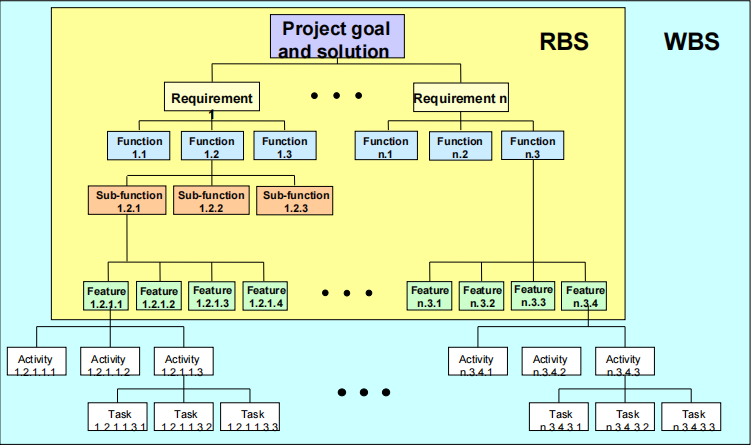
The Work Breakdown Structure (WBS) is a hierarchical description of all of the work that must be done to meet the needs of the client.
Generating the WBS
- Converting the RBS to the WBS (RBS is a subset of the WBS)
![]()
- Top-Down Approach
- Bottom-Up Approach
WBS Completion Criteria
-
Status and completion are measurable
-
The activity is bounded
-
The activity has a deliverable
-
Time and cost are easily estimated
-
Activity duration is within acceptable limits
-
Work assignments are independent
Generating the WBS
Estimate
Estimate Task Duration or Task Labor
- Estimate duration to build the schedule and determine when the project will be completed.
- Estimate labor when you have to contain expenses within a budget
Six Methods for Estimating Task Duration
- Extrapolating based on similarity to other activities
- Studying historical data
- Seeking expert advice
- Applying the Delphi Technique (next two charts)
- Applying the Three-point technique (next two charts) :
E = (O + P + 4M)/6
O: Optimistic P: Pessimistic M: Most Likely - Applying the Wide-band Delphi technique
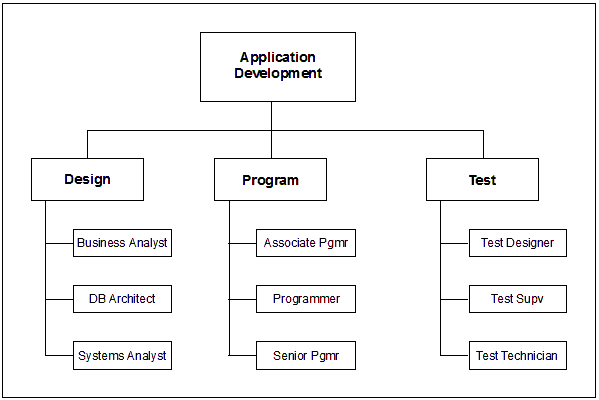
Estimating Resource Requirements
Resource Organizational Structure
Network-based Scheduling
- Gantt Charts
- Task on the Arrow
- Task on the node format
critical path calculation
Node Definition
task node
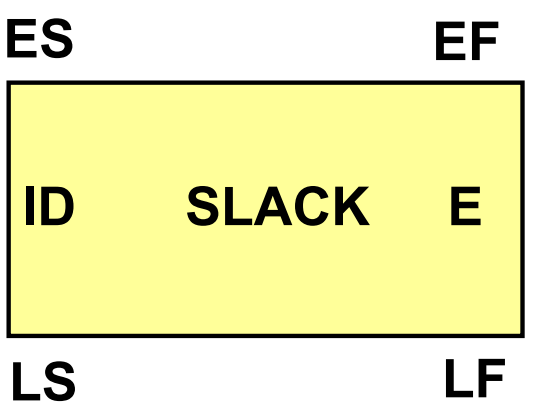
| ES(最早开始) | Duration(周期) | EF (最早完成) |
|---|---|---|
| ID | Activity | description |
| LS(最迟开始) | SLACK(缓冲期) | LF (最迟完成) |
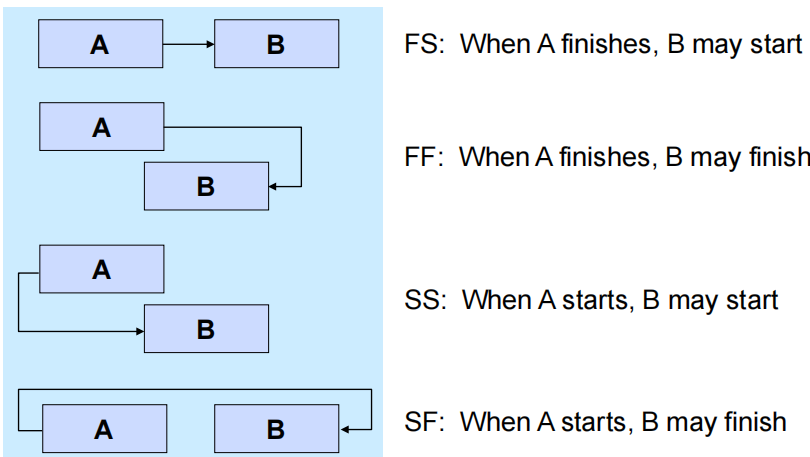
Dependency Relationships
Paths Through the Network
- The Forward Pass – Early Schedule
ES + duration – 1 = EF
- Backward Pass – Late Schedule
LF - duration + 1 = LS
Slack Time
Slack= LF - (ES + duration)
- Total Slack: Time that a task can be delayed without
impacting the early schedule of the project - Free Slack: Time a task can be delayed without
impacting the early schedule of its successor tasks.

 浙公网安备 33010602011771号