

SEE02 Principles of SEE
Principles of SEE
PRINCIPLES
1.Optimization
involves the following concepts:
- Trade-offs.
- Budget Constraints.
- Opportunity Cost.
- Cost-Benefit Analysis.
Theoretical basis
- Pareto Principle, also called 80/20 rule, a principle of management.
- Pareto Optimality, assuming that the inherent group of people and allocatable resources make at least one person better without making anyone worse in the process of changing from one distribution state to another.
- Kaldor-Hicks Principle, The total cost of the third party does not exceed the total income of the transaction, or the income obtained from the result can fully compensate for the losses suffered
questions
- What objectives is the user trying to satisfy?
- What decisions do we control which affect these objectives?
- What items dictate constraints on our range of choices?
- What criteria should we use to evaluate candidate solutions? How are the criterion values related to the decision variables involved in candidate solutions?
- What decision provides us with the most satisfactory outcome with respect to the criteria we have established?
2.Allocation
3.Verification
Software engineers test their ideas with data.
Economists refer to such evidence-based analysis as empirical analysis or empiricism.
- Natural experiments
- statistical investigation
- economic experiment
Business decision-making
Profit Margin
Process
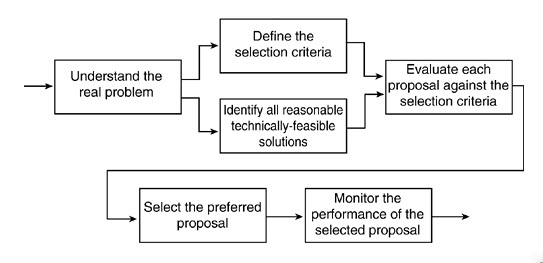
Selection Criteria
Typical Selection Criteria
- Financial
- Technical
- ESG
Cash Flow
Cash-flow instance: A specific amount of money flowing into or out of the organization at a specific time as a direct result of a proposal.
Cash-flow stream: The set of cash-flow instances over time, that would be caused by a proposal

 浙公网安备 33010602011771号