

EME02 Overview of Project Planning
Overview of Project Planning
Definition
Project Management
Project management is an organized common-sense approach that utilizes the appropriate client involvement in order to meet sponsor needs and deliver the expected incremental business value.
the Fundamental
Project management should answer the following six questions:
- What business is being addressed by this project?
- What do you need to do?
- What will you do?
- How will you do it?
- How will you know you did it?
- How well did you do?
Managing the Creeps
- Scope Creep
- Hope Creep
- Effort Creep
- Feature Creep
Requirements
A requirement is:
- A condition or capability needed by a stakeholder to solve a problem or achieve an objective.
- A condition or capability that must be met or possessed by a solution or solution component to satisfy a contract, standard, specification, or other formally imposed documents.
- A documented representation of a condition or capability as in (1) or (2)
Business Value Definition:
A requirement is a desired end-state whose successful integration into the solution meets one or more needs and delivers specific, measurable and incremental business value to the organization.
Project Management Life Cycle(PMLC)
Definition
A project management life cycle is a sequence of processes that includes:
- Scoping
- Planning
- Launching
- Monitoring & Controlling
- Closing
five PMLC types
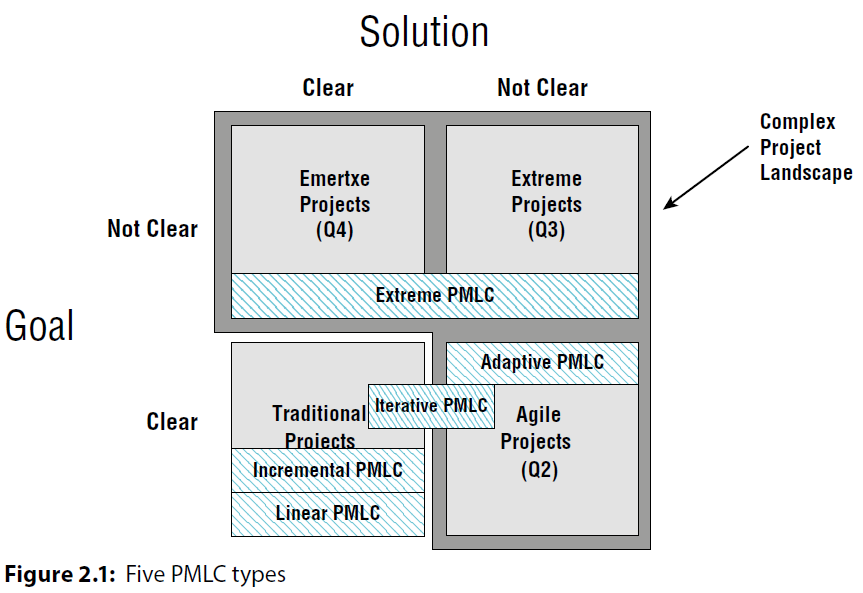
TPM – Traditional Project Management
Characteristics
- Low Complexity
- Few Scope Change Requests
- Well-Understood Technology Infrastructure
- Low Risk
- Experienced and Skilled Project Teams
- Plan-driven TPM Projects
Linear PMLC Model

Incremental PMLC Model

APM – Agile Project Management
Characteristics
- A Critical Problem without a Known Solution
- A Previously Untapped Business Opportunity
- Change-driven APM Projects
- Critical to the Organization
- Meaningful Client Involvement is Essential
- Use Small Co-located Teams
Iterative PMLC Model

Adaptive PMLC Model

xPM – Extreme Project Management
Characteristics
- R&D Project
- Very High Risk
Extreme PMLC Model

MPx-Emertxe Project Management
Characteristics
- A New Technology without a Known Application
- A Solution out Looking for a Problem to Solve
Differences
- The models form a natural ordering (Linear, Incremental, Iterative, Adaptive, Extreme) by degree of solution uncertainty
- The processes that form repetitive groups recognize the effect of increasing uncertainty as you traverse the natural ordering
- Complete project planning is replaced by just-in-time project planning as the degree of uncertainty increases
- Risk management becomes more significant as degree of solution uncertainty increases
- The need for meaningful client involvement increases as degree of solution uncertainty increases
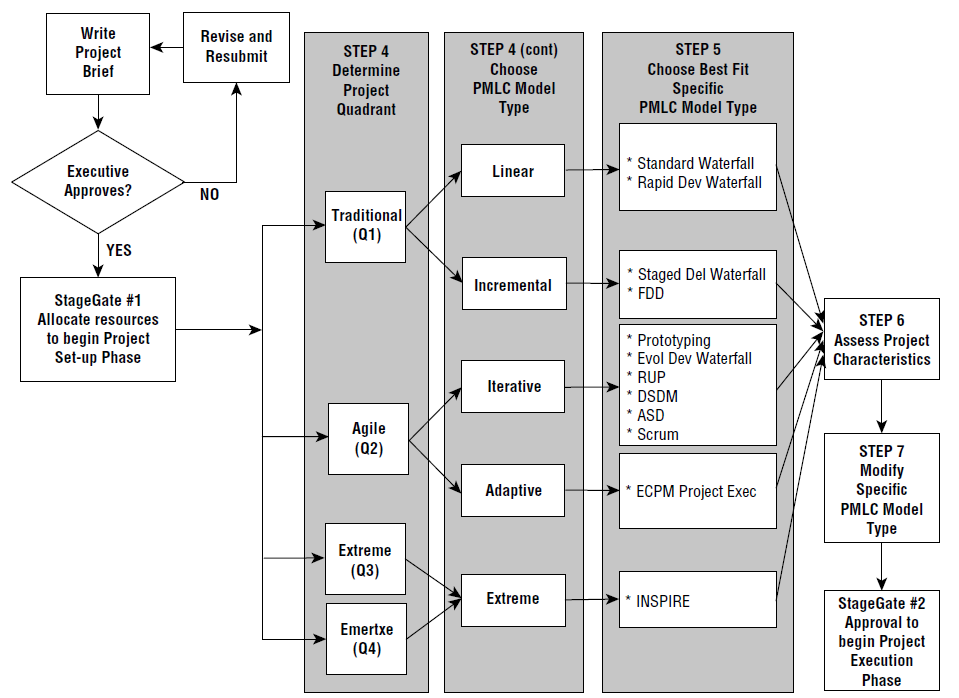
Choosing the Best-Fit Model

 浙公网安备 33010602011771号