
实验2 类和对象_基础编程1
实验任务1
t.h源代码
// 类T: 声明
class T {
// 对象属性、方法
public:
    T(int x = 0, int y = 0);   // 普通构造函数
    T(const T &t);  // 复制构造函数
    T(T &&t);       // 移动构造函数
    ~T();           // 析构函数

    void adjust(int ratio);      // 按系数成倍调整数据
    void display() const;           // 以(m1, m2)形式显示T类对象信息

private:
    int m1, m2;

// 类属性、方法
public:
    static int get_cnt();          // 显示当前T类对象总数

public:
    static const std::string doc;       // 类T的描述信息
    static const int max_cnt;           // 类T对象上限

private:
    static int cnt;         // 当前T类对象数目

// 类T友元函数声明
    friend void func();
};

// 普通函数声明
void func();
t.cpp源代码
// 类T: 实现
// 普通函数实现

#include "t.h"
#include <iostream>
#include <string>

using std::cout;
using std::endl;
using std::string;

// static成员数据类外初始化
const std::string T::doc{"a simple class sample"};
const int T::max_cnt = 999;
int T::cnt = 0;


// 对象方法
T::T(int x, int y): m1{x}, m2{y} {
    ++cnt;
    cout << "T constructor called.\n";
}

T::T(const T &t): m1{t.m1}, m2{t.m2} {
    ++cnt;
    cout << "T copy constructor called.\n";
}

T::T(T &&t): m1{t.m1}, m2{t.m2} {
    ++cnt;
    cout << "T move constructor called.\n";
}

T::~T() {
    --cnt;
    cout << "T destructor called.\n";
}

void T::adjust(int ratio) {
    m1 *= ratio;
    m2 *= ratio;
}

void T::display() const {
    cout << "(" << m1 << ", " << m2 << ")" ;
}

// 类方法
int T::get_cnt() {
   return cnt;
}

// 友元
void func() {
    T t5(42);
    t5.m2 = 2049;
    cout << "t5 = "; t5.display(); cout << endl;
}
task1.cpp源代码
#include "t.h"
#include <iostream>

using std::cout;
using std::endl;

void test();

int main() {
    test();
    cout << "\nmain: \n";
    cout << "T objects'current count: " << T::get_cnt() << endl;
}

void test() {
    cout << "test class T: \n";
    cout << "T info: " << T::doc << endl;
    cout << "T objects'max count: " << T::max_cnt << endl;
    cout << "T objects'current count: " << T::get_cnt() << endl << endl;


    T t1;
    cout << "t1 = "; t1.display(); cout << endl;

    T t2(3, 4);
    cout << "t2 = "; t2.display(); cout << endl;

    T t3(t2);
    t3.adjust(2);
    cout << "t3 = "; t3.display(); cout << endl;

    T t4(std::move(t2));
    cout << "t3 = "; t4.display(); cout << endl;

    cout << "T objects'current count: " << T::get_cnt() << endl;

    func();
}
运行测试结果截图:
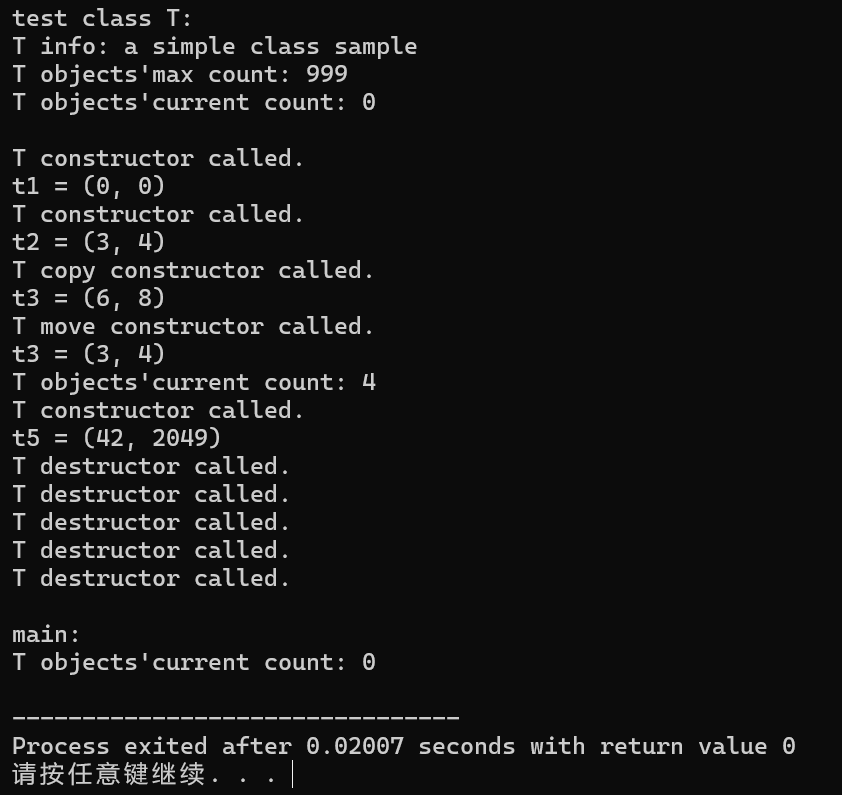
问题1:能去掉line36
问题2:普通构造函数:在对象被创建时利用特定的值构造对象,将对象初始化为一个特定的状态。
复制构造函数:使用一个已经存在的对象,去初始化同类的一个新对象。
移动构造函数:受一个右值引用作为参数,并能够将资源从该引用转移到新创建的对象中。
与析构函数的调用时机:都是在对象的生存期即将结束的时刻被调用的。
问题3:不能
实验任务2
Complex.h
#ifndef COMPLEX_H
#define COMPLEX_H

#include <iostream>
#include <string>
#include <cmath>
using namespace std;

class Complex {
	public:
		static const string doc;

        Complex(double x = 0, double y = 0) : real(x), imag(y) {}

		Complex(const Complex &c);

		double get_real() const {
			return real;
		}

		double get_imag() const {
			return imag;
		}

		void add(const Complex &c2);

		friend Complex add(const Complex &c1,const Complex &c2);

		friend bool is_equal(const Complex &c1,const Complex &c2);

		friend bool is_not_equal(const Complex &c1,const Complex &c2);

		friend void output(const Complex &c);

		friend double abs(const Complex &c);

	private:

		double real;
		double imag;

};
#endif
Complex.cpp
#include "Complex.h"

const std:: string Complex::doc = "a simplified complex class";

Complex::Complex(const Complex &c) : real(c.real) , imag(c.imag) {

}

void Complex::add(const Complex &c2){
	real += c2.real;
	imag += c2.imag;
}

Complex add(const Complex &c1,const Complex &c2){
	return Complex(c1.real+c2.real,c1.imag+c2.imag);
}

bool is_equal(const Complex &c1,const Complex &c2){
	if(c1.real == c2.real && c1.imag == c2.imag){
		return true;
	}else{
		return false;
	}
}

bool is_not_equal(const Complex &c1,const Complex &c2){
	if(c1.real == c2.real && c1.imag == c2.imag){
		return false;
	}else{
		return true;
	}
}

void output(const Complex &c){
	if(c.imag < 0){
		cout << c.real << c.imag << "i" << endl;
	}else{
		cout << c.real << " + " << c.imag << "i" << endl;
	}

}

double abs(const Complex &c){
	return sqrt(c.real*c.real+c.imag*c.imag);
}
task2.cpp
#include "Complex.h"
#include <iostream>
#include <string>
using std::cout;
using std::endl;
using std::boolalpha;

void test() {
    cout << "类成员测试: " << endl;
    cout << Complex::doc << endl;

    cout << endl;

    cout << "Complex对象测试: " << endl;
    Complex c1;
    Complex c2(3, -4);
    const Complex c3(3.5);
    Complex c4(c3);

    cout << "c1 = "; output(c1); cout << endl;
    cout << "c2 = "; output(c2); cout << endl;
    cout << "c3 = "; output(c3); cout << endl;
    cout << "c4 = "; output(c4); cout << endl;
    cout << "c4.real = " << c4.get_real() << ", c4.imag = " << c4.get_imag() << endl;

    cout << endl;

    cout << "复数运算测试: " << endl;
    cout << "abs(c2) = " << abs(c2) << endl;
    c1.add(c2);
    cout << "c1 += c2, c1 = "; output(c1); cout << endl;
    cout << boolalpha;
    cout << "c1 == c2 : " << is_equal(c1, c2) << endl;
    cout << "c1 != c3 : " << is_not_equal(c1, c3) << endl;
    c4 = add(c2, c3);
    cout << "c4 = c2 + c3, c4 = "; output(c4); cout << endl;
}

int main() {
    test();
}
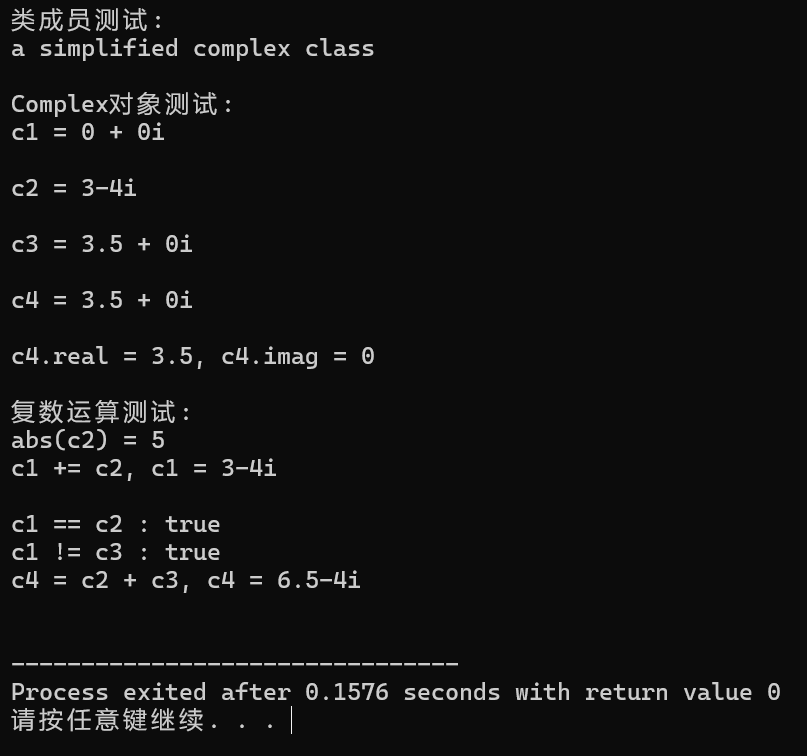
运行测试结果截图:
实验任务3
task3.cpp源代码
#include <iostream>
#include <complex>

using std::cout;
using std::endl;
using std::boolalpha;
using std::complex;

void test() {
    cout << "标准库模板类comple测试: " << endl;
    complex<double> c1;
    complex<double> c2(3, -4);
    const complex<double> c3(3.5);
    complex<double> c4(c3);

    cout << "c1 = " << c1 << endl;
    cout << "c2 = " << c2 << endl;
    cout << "c3 = " << c3 << endl;
    cout << "c4 = " << c4 << endl;
    cout << "c4.real = " << c4.real() << ", c4.imag = " << c4.imag() << endl;
    cout << endl;

    cout << "复数运算测试: " << endl;
    cout << "abs(c2) = " << abs(c2) << endl;
    c1 += c2;
    cout << "c1 += c2, c1 = " << c1 << endl;
    cout << boolalpha;
    cout << "c1 == c2 : " << (c1 == c2) << endl;
    cout << "c1 != c3 : " << (c1 != c3) << endl;
    c4 = c2 + c3;
    cout << "c4 = c2 + c3, c4 = " << c4 << endl;
}

int main() {
    test();
}
运行测试结果截图:
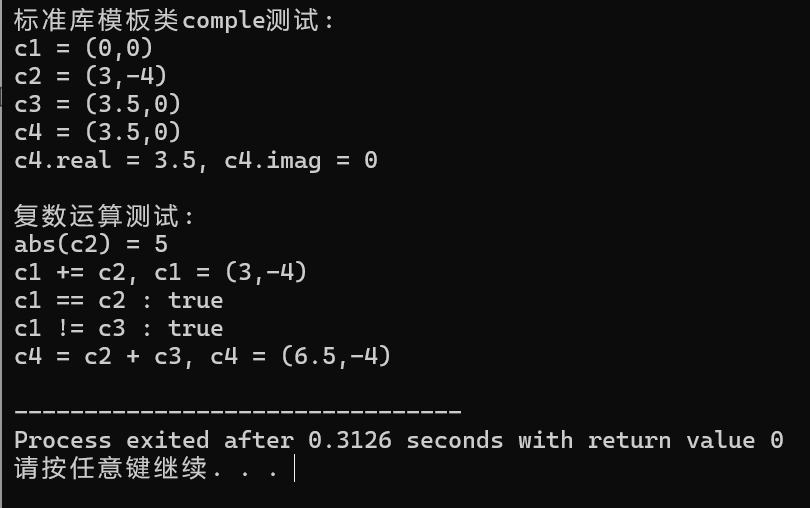
启发:要多运用标准库中的模板类,这样可以大大减少代码的复杂程度,简化代码的同时也方便读者理解
实验任务4
Faction.h
#pragma once
#include <string>

using namespace std;

class Fraction{
	public:

		static const string doc;

		static int gcd(int a,int b);

		static Fraction simplify(Fraction result);

		Fraction(int u = 1,int d = 1);

		Fraction(const Fraction &f);

		Fraction negative() const;

		int numerator() const;

		int denominator() const;

		friend void output(const Fraction &f);

		friend Fraction add(const Fraction &f1,const Fraction &f2);

		friend Fraction sub(const Fraction &f1,const Fraction &f2);

		friend Fraction mul(const Fraction &f1,const Fraction &f2);

		friend Fraction div(const Fraction &f1,const Fraction &f2);

	private:

		int up;

		int down;


};
Fraction.cpp
#include "Fraction.h"
#include <iostream>
#include <string>
#include<cstdio>

using std::cout;
using std::endl;
using std::string;

const std::string Fraction::doc{"Fraction类 v 0.01版.目前仅支持分数对象的构造、输出、加/减/乘/除运算."};

int Fraction :: gcd(int a, int b){
    return !b ? a : gcd(b, a%b);
}

Fraction Fraction :: simplify (Fraction result){
    if(result.down < 0){
        result.up = - result.up;
        result.down = - result.down;
    }

    if(result.up == 0){
        result.down = 1;
    }else{
        int d = gcd(abs(result.up), abs(result.down));
        result.up /= d;
        result.down /= d;
    }

    return result;
}

Fraction :: Fraction (int u,int d): up(u) , down(d) {}

Fraction :: Fraction (const Fraction &f) : up(f.up),down(f.down){}

Fraction Fraction :: negative() const {
	return Fraction(-up,down);
}

void output(const Fraction &f){
	if(f.up == 0){
		cout << 0;
	}else if(f.down == 0){
		cout << "分母不能为零" << endl;
	}else if(f.down == 1){
		cout << f.up;
	}else {
		Fraction t;
		t = Fraction :: simplify(f);
		cout << t.up << "/" << t.down;
	}

}

int Fraction::numerator() const {
    return up;
}

int Fraction::denominator() const {
    return down;
}

Fraction add(const Fraction &f1,const Fraction &f2){
	int new_up = f1.up * f2.down + f2.up * f1.down;
    int new_down = f1.down * f2.down;
    return Fraction(new_up, new_down);
}

Fraction sub(const Fraction &f1,const Fraction &f2){
	int new_up = f1.up * f2.down - f2.up * f1.down;
    int new_down = f1.down * f2.down;
    return Fraction(new_up, new_down);
}

Fraction mul(const Fraction &f1,const Fraction &f2){
	int new_up = f1.up * f2.up;
    int new_down = f1.down * f2.down;
    return Fraction(new_up, new_down);
}

Fraction div(const Fraction &f1,const Fraction &f2){
    int new_up = f1.up * f2.down;
    int new_down = f1.down * f2.up;
    return Fraction(new_up, new_down);
}
task.cpp
#include "Fraction.h"
#include <iostream>

using std::cout;
using std::endl;


void test1() {
    cout << "Fraction类测试: " << endl;
    cout << Fraction::doc << endl << endl;

    Fraction f1(5);
    Fraction f2(3, -4), f3(-18, 12);
    Fraction f4(f3);
    cout << "f1 = "; output(f1); cout << endl;
    cout << "f2 = "; output(f2); cout << endl;
    cout << "f3 = "; output(f3); cout << endl;
    cout << "f4 = "; output(f4); cout << endl;

    Fraction f5(f4.negative());
    cout << "f5 = "; output(f5); cout << endl;
    cout << "f5.get_up() = " << f5.get_up() << ", f5.get_down() = " << f5.get_down() << endl;

    cout << "f1 + f2 = "; output(add(f1, f2)); cout << endl;
    cout << "f1 - f2 = "; output(sub(f1, f2)); cout << endl;
    cout << "f1 * f2 = "; output(mul(f1, f2)); cout << endl;
    cout << "f1 / f2 = "; output(div(f1, f2)); cout << endl;
    cout << "f4 + f5 = "; output(add(f4, f5)); cout << endl;
}

void test2() {
    Fraction f6(42, 55), f7(0, 3);
    cout << "f6 = "; output(f6); cout << endl;
    cout << "f7 = "; output(f7); cout << endl;
    cout << "f6 / f7 = "; output(div(f6, f7)); cout << endl;
}

int main() {
    cout << "测试1: Fraction类基础功能测试\n";
    test1();

    cout << "\n测试2: 分母为0测试: \n";
    test2();
}
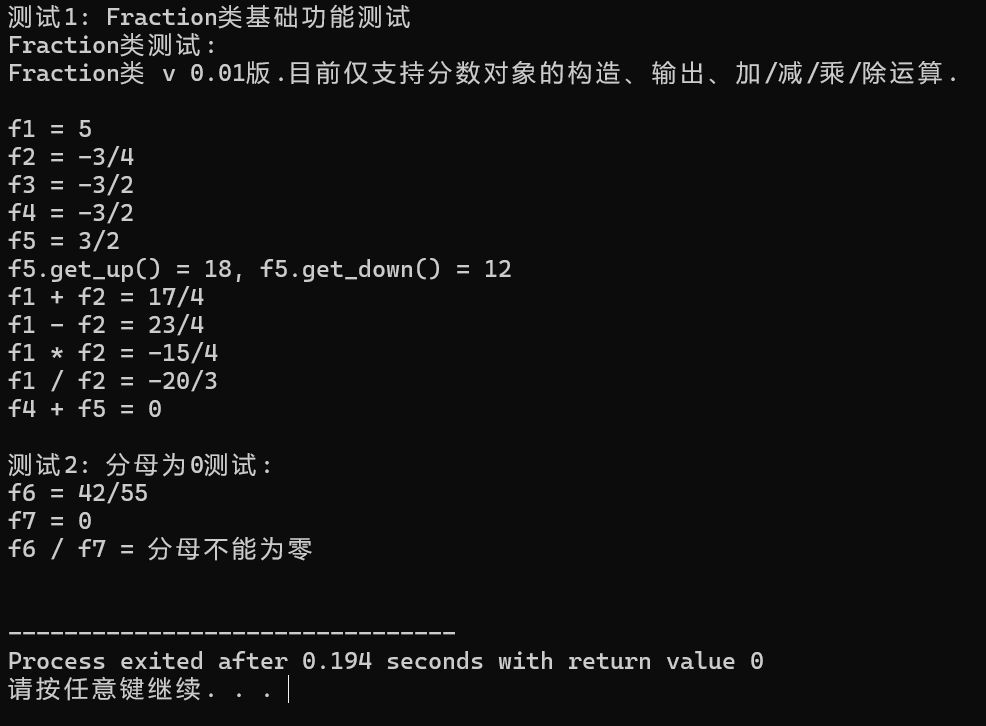
运行测试结果截图:
实验任务5
account.h
#ifndef __ACCOUNT_H__
#define __ACCOUNT_H__
class SavingAccount
{
private:
    int id;
    double balance;
    double rate;
    int lastDate;
    double accumulation;
    static double total;
    void record(int date, double amount);
    double accumulate(int date) const {
        return accumulation + balance * (date - lastDate);
    }
public:
    SavingAccount(int date, int id, double rate);
    int getId()const { return id; }
    double getBalance()const { return balance; }
    double getRate() const { return rate; }
    static double getTotal() { return total; }
    void deposit(int date, double amount);
    void withdraw(int date, double amount);
    void settle(int date);
    void show() const;
};


#endif
account.cpp
#include "account.h"
#include <cmath>
#include <iostream>
using namespace std;
double SavingAccount::total = 0;
SavingAccount::SavingAccount(int date, int id, double rate) :id(id), balance(0), rate(rate), lastDate(date), accumulation(0)
{
    cout << date << "\t#" << id << "is created" << endl;
}
void SavingAccount::record(int date, double amount)
{
    accumulation = accumulate(date);
    lastDate = date;
    amount = floor(amount * 100 + 0.5) / 100;    //保留小数点后两位
    balance += amount;
    total += amount;
    cout << date << "\t#" << id << "\t"<<amount<<"\t"<<balance << endl;
}
void SavingAccount::deposit(int date, double amount)
{
    record(date, amount);
}
void SavingAccount::withdraw(int date, double amount)
{
    if (amount > getBalance())
    {
        cout << "Error: not enough money" << endl;
    }
    else
    {
        record(date, -amount);
    }
}
void  SavingAccount::settle(int date)
{
    double interest = accumulate(date) * rate / 365;
    if (interest != 0)
    {
        record(date, interest);
    }
    accumulation = 0;
}
void SavingAccount::show() const
{
    cout << "#" << id << "\tBalance: " << balance;
}
5_11.cpp
#include "account.h"
#include <iostream>
using namespace std;
int main()
{
    SavingAccount sa0(1, 21325302, 0.015);
    SavingAccount sa1(1, 58320212, 0.015);
    sa0.deposit(5, 5000);
    sa1.deposit(25, 10000);
    sa0.deposit(45, 5500);
    sa1.withdraw(60, 4000);
    sa0.settle(90);
    sa1.settle(90);
    sa0.show(); cout << endl;
    sa1.show(); cout << endl;
    cout << "Tatal: " << SavingAccount::getTotal() << endl;
    return 0;
}
运行测试结果截图:
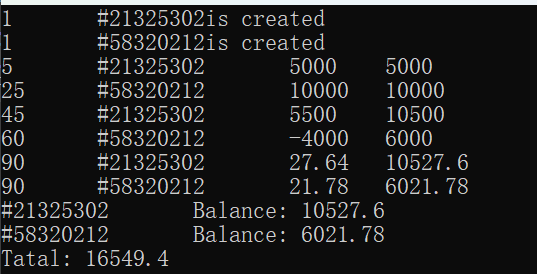
目前教材上的接口和类内部的计算模块还是比较合理的,我认为计算模块还需要改进:
- 账户余额的计算要更准确。例如,存款后余额是否增加,取款后余额是否减少,且不会出现负数余额的情况。
- 舍去不必要的复杂算法或数据结构,避免性能下降

 浙公网安备 33010602011771号