


第十话-Java类
类创建

构造器
package com.xie.oop;

public class Person {
    String name;

    //无参构造器
    //1. 使用new关键字,本质就是调用构造器
    //2. 主要用来初始化
    public Person(){
        this.name = "aa";
    }
    //有参构造器
    public Person(String name){
        this.name = name;
    }
}

package com.xie.oop;

public class Demo01 {
    public static void main(String[] args) {
        Person person = new Person("bbbb");
        System.out.println(person.name);
    }
}
快捷键Alt+Insert
Alt+Insert按键可以快速生成构造器、Getter、Setter、Override等方法。
创建对象内存分析
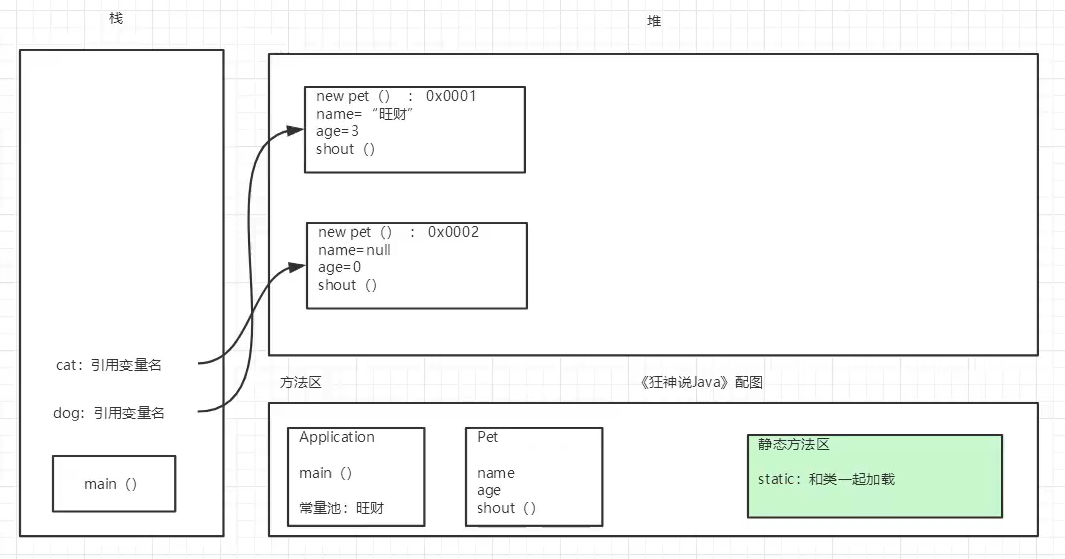
说明:
- 方法区:加载类和静态方法(类中可以直接被调用不需要实例对象调用)
- 栈:栈最里面是main方法,程序入口
- 栈:存放声明的对象名和内存地址
- 堆:对象对应的实际内存地址,存放对象的各种属性值、方法等。
封装
package com.xie.oop;

public class Student {
    //属性私有,通过get、set来设置值、取值
    private String name;
    private int id;

    public String getName() {
        return name;
    }

    public void setName(String name) {
        this.name = name;
    }

    public int getId() {
        return id;
    }

    public void setId(int id) {
        this.id = id;
    }
}
package com.xie.oop;

public class Application {
    public static void main(String[] args) {
        Student student = new Student();
        student.setName("aaa");
        System.out.println(student.getName());
    }
}
继承
package com.xie.oop.demo01;

public class Person {

    //public  //继承用public修饰
    //private //无法继承private修饰的属性和方法
    private int aa = 11000;

    public int getAa() {
        return aa;
    }

    public void setAa(int aa) {
        this.aa = aa;
    }

    public int money = 1000;

    public void say(){
        System.out.println("say some thing");
    }
}

package com.xie.oop.demo01;

public class Student extends Person{
}

package com.xie.oop.demo01;

public class Application {
    public static void main(String[] args) {
        Student student = new Student();
        student.say();
        System.out.println(student.money);
        System.out.println(student.getAa());
    }
}
快捷键Ctrl + h
Ctrl + h,显示父子类继承关系
super
- super只能在继承条件下才可以使用
- super代表父类对象的应用,super.属性名,super.方法(),可以调用父类的属性或方法,只能使用在方法中。
- super()调用父类的构造方法,只能放在构造方法的第一个。
- super()只能出现在构造方法中
- super()和this()不能放在一个构造方法中,this():调用当前类的构造方法
- this代表当前类对象的应用。
package com.xie.oop.demo02;

public class Person {
    public Person() {
        System.out.println("Person-Construtor");
    }

    protected String name = "xiexieyc";
    public void test(){
        System.out.println("Person-test");
    }
}
package com.xie.oop.demo02;

public class Student extends Person{

    public Student() {
        super();//调用父类构造方法,默认会省略。
        System.out.println("Student-Construtor");
    }

    private String name = "aaa";
    public void test(){
        String name = "bbb";
        System.out.println(name+"--"+this.name+"--"+super.name);
        super.test();
    }
}
package com.xie.oop.demo02;

public class Application {
    public static void main(String[] args) {
        Student student = new Student();
        student.test();
    }
}
方法重写
- 重写需要有继承关系,子类重写父类的非静态方法
- 方法名必须相同
- 参数列表必须相同
- 修饰符:范围可以扩大;default-->pretected-->public
- 抛出的异常:范围可以被缩小,但不能扩大;Exceptoin-->ClassNotFoundException
- 只有方法体不同
package com.xie.oop.demo03;

public class A {
    public static void stest(){
        System.out.println("a-stest");
    }
    public void test(){
        System.out.println("a-test");
    }
}
package com.xie.oop.demo03;

public class B extends A{
    public static void stest(){
        System.out.println("b-stest");
    }
    @Override
    public void test() {
        System.out.println("b-test");
    }
}
package com.xie.oop.demo03;

public class Application {
    public static void main(String[] args) {
        B b = new B();
        b.test();
        b.stest();
        //静态方法调用只和左边的定义类型有关
        //非静态方法可以重写,重写后会调用子类方法
        //父类声明后,父类的引用指向子类
        A a = new B();
        a.test();
        a.stest();
    }
}
多态
- 多态是方法的多态,属性没有多态
- 父类和子类要有联系,否则类型转换异常!ClassCastException
- 存在条件:继承关系,方法重写,父类引用指向子类对象。 Father f1 = new Son();
- 无法重写的方法:static(静态)、final(常量)、private(私有)修饰的方法
package com.xie.oop.demo04;

public class Person {
    public void run(){
        System.out.println("Person-run");
    }
    public void say(){
        System.out.println("Person-say");
    }
}
package com.xie.oop.demo04;

public class Student extends Person{
    @Override
    public void run() {
        System.out.println("Student-run");
    }
    public void eat(){
        System.out.println("Student-eat");
    }
}
package com.xie.oop.demo04;

public class Application {
    public static void main(String[] args) {
        //父类引用指向子类
        //student可以调用自己或父类继承的方法
        //person不能调用子类独有的方法,除非强制转换
        Student student = new Student();
        Person person = new Student();
        Object object = new Student();
        student.say();
        person.say();
        student.run();
        person.run();
        student.eat();
        ((Student) person).eat();
    }
}
instanceof和类型转换
package com.xie.oop.demo04;

public class Application {
    public static void main(String[] args) {
        Object object = new Student();
        System.out.println(object instanceof Student);//true
        System.out.println(object instanceof Person);//true
        System.out.println(object instanceof Object);//true
        System.out.println(object instanceof Teacher);//false
        System.out.println(object instanceof String);//false
        System.out.println("-------------");
        Person person = new Student();
        System.out.println(person instanceof Student);//true
        System.out.println(person instanceof Person);//true
        System.out.println(person instanceof Object);//true
        System.out.println(person instanceof Teacher);//false
        //System.out.println(person instanceof String);//编译报错
        System.out.println("-------------");
        Student student = new Student();
        System.out.println(student instanceof Student);//true
        System.out.println(student instanceof Person);//true
        System.out.println(student instanceof Object);//true
        //System.out.println(student instanceof Teacher);//编译报错
        System.out.println("-------------");
        Person p = new Person();
        System.out.println(p instanceof Student);//false
        System.out.println(p instanceof Person);//true
        System.out.println(p instanceof Object);//true
    }
}
- 父类引用指向子类的对象
- 把子类转换为父类,向上转型
- 把父类转换为子类,向下转型,强制转换
- 方便调用方法,较少重复代码
static关键字详解
- 静态变量和方法可以类名直接访问
package com.xie.oop.demo05;

public class Student {
    //静态变量和方法可以类名直接访问
    private static int age;
    private double score;

    public static void go(){}
    public void run(){}

    public static void main(String[] args) {
        Student s1 = new Student();
        System.out.println(s1.age);
        System.out.println(s1.score);
        System.out.println(Student.age);
        //System.out.println(Student.score);会报错
        s1.run();
        s1.go();
        Student.go();
        go();
        //run();//会报错
    }
}
- 静态代码块
package com.xie.oop.demo05;

public class Person {
    //2
    {
        System.out.println("匿名代码块");
    }
    //1 只执行一次
    static {
        System.out.println("静态代码块");
    }
    //3
    public Person(){
        System.out.println("构造方法");
    }

    public static void main(String[] args) {
        Person person1 = new Person();
        System.out.println("=============");
        Person person2 = new Person();
    }
}
- 静态导入包
package com.xie.oop.demo05;
//静态导入包
import static java.lang.Math.random;
import static java.lang.Math.PI;

public class Test {
    public static void main(String[] args) {
        System.out.println(Math.random());
        System.out.println(random());
        System.out.println(PI);
    }
}
抽象类
- 不能new这个抽象类,只能靠子类去实现,约束的作用
- 抽象类可以写普通的方法
- 抽象方法必须在抽象类中
package com.xie.oop.demo06;

public abstract class Action {
    public void doSomething(){
        System.out.println("普通方法");
    };
    //抽象方法,没有方法的实现
    public abstract void doSomething2();
}
package com.xie.oop.demo06;

//继承抽象类的子类,必须实现所有抽象类的抽象方法,除非子类也是抽象类
public class A extends Action{
    @Override
    public void doSomething2() {
        System.out.println("重写抽象方法");
    }
}
package com.xie.oop.demo06;

public class Application {
    public static void main(String[] args) {
        A a = new A();
        a.doSomething();
        a.doSomething2();
        Action b = new A();
        b.doSomething();
        b.doSomething2();
    }
}
接口
- 起到约束作用,定义一些方法,让不同人实现
- 方法默认修饰:public abstract
- 属性默认修饰:public static final
- 接口不能被实例化,没有构造方法
- implements可以实现多个接口
- 必须重写接口的方法
package com.xie.oop.demo7;

public interface UserService {

    //默认public static final修饰,很少这样用
    int AGE = 99;
    //默认public abstract修饰
    void add(String name);
    void update(String name);
    void delete(String name);
    void query(String name);
}
package com.xie.oop.demo7;

public interface TimeService {
    void time();
}
package com.xie.oop.demo7;

public class UserServiceImpl implements UserService,TimeService{
    @Override
    public void add(String name) {

    }

    @Override
    public void update(String name) {

    }

    @Override
    public void delete(String name) {

    }

    @Override
    public void query(String name) {

    }

    @Override
    public void time() {

    }
}
内部类
package com.xie.oop.demo08;

public class Outer {
    private int id =10 ;
    private void out(){
        System.out.println("外部类的方法");
    }

    class Inner{
        public void in(){
            System.out.println("内部类的方法");
        }
        public void getId(){
            System.out.println(id);
        }
        public void test(){
            out();
        }
    }
}
package com.xie.oop.demo08;

public class Application {
    public static void main(String[] args) {
        Outer outer = new Outer();
        Outer.Inner inner = outer.new Inner();
        inner.in();
        inner.getId();
        inner.test();
    }
}
- 内部类用static修饰,则不能调用外部类的非static属性和方法
- 一个java文件中可以有多个class类,但只能有一个public class
- 局部内部类
package com.xie.oop.demo08;

public class Outer2 {
    public void method(){
        //局部内部类
        class Inner{
            public void in(){

            }
        }
    }
}
- 匿名内部类
package com.xie.oop.demo08;

public class Test {
    public static void main(String[] args) {
        //匿名内部类
        new Apple().eat();

        new UserService() {
            @Override
            public void hello() {

            }
        };
    }
}

class Apple{
    public void eat(){
        System.out.println("111");
    }
}

interface UserService{
    void hello();
}
以上仅供参考,如有疑问,留言联系

 浙公网安备 33010602011771号