

Socket与系统调用深度分析
一、什么是系统调用
系统态和用户态
系统态(也称为管态或核心态),操作系统在系统态运行
在实际运行过程中,处理机会在系统态和用户态间切换。相应地,现代多数操作系统将 CPU 的指令集分为特权指令和非特权指令两类。
1) 特权指令——在系统态时运行的指令
对内存空间的访问范围基本不受限制,不仅能访问用户存储空间,也能访问系统存储空间,
一般应用程序所使用的都是非特权指令,它只能完成一般性的操作和任务,不能对系统中的硬件和软件直接进行访问,其对内存的访问范围也局限于用户空间。
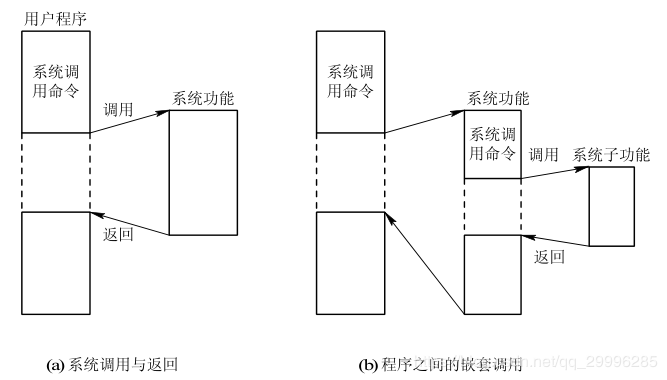
当应用程序中需要操作系统提供服务时,如请求 I/O 资源或执行 I/O 操作,应用程序必须使用系统调用命令。由操作系统捕获到该命令后,便将 CPU 的状态从用户态转换到系统态,然后执行操作系统中相应的子程序(例程),完成所需的功能。执行完成后,系统又将CPU 状态从系统态转换到用户态,再继续执行应用程序。
系统调用和一般调用的区别:
系统调用不允许由调用过程直接转向被调用过程。
通常都是通过软中断机制,先由用户态转换为系统态,经核心分析后,才能转向相应的系统调用处理子程序。
中断机制
系统调用是通过中断机制实现的,并且一个操作系统的所有系统调用都通过同一个中断入口来实现。对于拥有保护机制的操作系统来说,中断机制本身也是受保护的。
系统调用的类型
对于一般通用的 OS 而言,可将其所提供的系统调用分为:进程控制、文件操纵、通信管理和系统维护等几大类。
系统调用的实现
系统调用的实现与一般过程调用的实现相比,两者间有很大差异。对于系统调用,控制是由原来的用户态转换为系统态,这是借助于中断和陷入机制来完成的,在该机制中包括中断和陷入硬件机构及中断与陷入处理程序两部分。当应用程序使用 OS 的系统调用时,产生一条相应的指令,CPU 在执行这条指令时发生中断,并将有关信号送给中断和陷入硬件机构,该机构收到信号后,启动相关的中断与陷入处理程序进行处理,实现该系统调用所需要的功能。
二、Socket系统调用过程
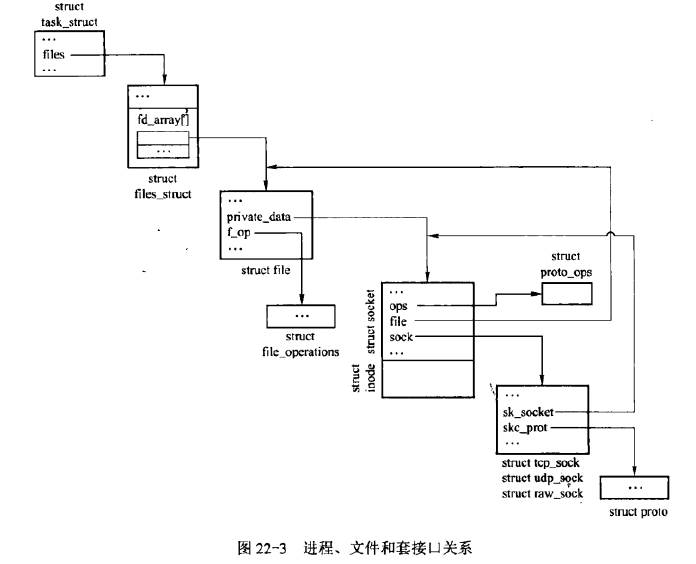
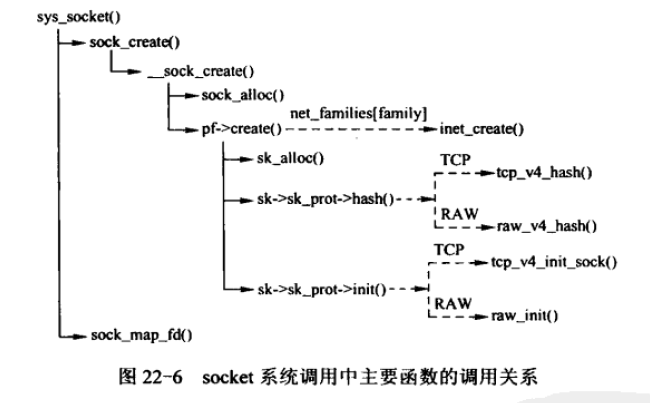

socket()函数系统调用过程
在sys_socketcall()函数中可以看到,socket系统调用最终调用的是sys_socket()函数
sys_socket()函数声明如下:
asmlinkage long sys_socket(int, int, int);
同样的,sys_socket()函数实现为:
sys_socket()
参数kern:表示由应用程序还是内核创建该套接口,一般为0(表示应用程序),或者1(表示内核)。
sock_create()函数
这个函数是对__socket_create函数的封装,直接调用__sock_create()函数。
int sock_create(int family, int type, int protocol, struct socket **res)
{
    return __sock_create(current->nsproxy->net_ns, family, type, protocol, res, 0);
}
__sock_create()函数
创建socket及inode
int __sock_create(struct net *net, int family, int type, int protocol,
             struct socket **res, int kern)
{
    int err;
    struct socket *sock;
    const struct net_proto_family *pf;
    /*
     *      Check protocol is in range
     */
    /*family和type字段范围检查*/
    if (family < 0 || family >= NPROTO)
        return -EAFNOSUPPORT;
    if (type < 0 || type >= SOCK_MAX)
        return -EINVAL;
    /*兼容性考虑,IPv4协议族的SOCK_PACKET已经废弃,当family ==F_INET && type == SOCK_PACKET时,
    强制把family改为PF_PACKET。*/
    if (family == PF_INET && type == SOCK_PACKET) {
        static int warned;
        if (!warned) {
            warned = 1;
            pr_info("%s uses obsolete (PF_INET,SOCK_PACKET)\n",
               current->comm);
        }
        family = PF_PACKET;
    }
    /*安全模块对套接口的创建做检查,安全模块不是网络中必需的组成部门,不做讨论。*/

    // 检查权限,并考虑协议集、类型、协议,以及 socket 是在内核中创建还是在用户空间中创建
    err = security_socket_create(family, type, protocol, kern);
    if (err)
        return err;
    /*
     *    Allocate the socket and allow the family to set things up. if
     *    the protocol is 0, the family is instructed to select an appropriate
     *    default.
     */
    /*调用sock_alloc()在sock_inode_cache缓存中分配与套接口关联的i结点和套接口,同时
    初始化i结点和套接口,失败则直接返回错误码。*/
    sock = sock_alloc();
    if (!sock) {
        net_warn_ratelimited("socket: no more sockets\n");
        return -ENFILE;    /* Not exactly a match, but its the
                   closest posix thing */
    }
    sock->type = type;
/*如果协议族支持内核模块动态加载,但在创建此协议族类型的套接字时,内核模块并未被加载,则调用
request_module()进行内核模块的动态加载。*/
#ifdef CONFIG_MODULES
    /* Attempt to load a protocol module if the find failed.
     * 12/09/1996 Marcin: But! this makes REALLY only sense, if the user
     * requested real, full-featured networking support upon configuration.
     * Otherwise module support will break!
     */
    if (rcu_access_pointer(net_families[family]) == NULL)
        request_module("net-pf-%d", family);
#endif
    rcu_read_lock();
    /*获取对应协议的net_proto_family指针*/
    pf = rcu_dereference(net_families[family]);
    err = -EAFNOSUPPORT;
    if (!pf)
        goto out_release;
    /*
     * We will call the ->create function, that possibly is in a loadable
     * module, so we have to bump that loadable module refcnt first.
     */
    /*如果对应协议族模块是动态加载到内核中去的,则对此内核模块的应用计数+1,以防
    在创建过程中,该模块被卸载,造成严重的后果。*/
    if (!try_module_get(pf->owner))
        goto out_release;
    /* Now protected by module ref count */
    rcu_read_unlock();
    /*在IPv4协议族中调用inet_create()对已创建的socket继续进行初始化,同时创建网络层socket。*/
    err = pf->create(net, sock, protocol, kern);
    if (err < 0)
        goto out_module_put;
    /*
     * Now to bump the refcnt of the [loadable] module that owns this
     * socket at sock_release time we decrement its refcnt.
     */
    /*如果proto_ops结构实例所在模块以内核模块方式动态加载进内核,
    则增加该模块的引用计数,在sock_release时,减小该计数。*/
    if (!try_module_get(sock->ops->owner))
        goto out_module_busy;
    /*
     * Now that we're done with the ->create function, the [loadable]
     * module can have its refcnt decremented
     */
    /*调用完inet_create函数后,对此模块的引用计数减一。*/
    module_put(pf->owner);
    /*安全模块对创建后的socket做安全检查,不做讨论。*/
    err = security_socket_post_create(sock, family, type, protocol, kern);
    if (err)
        goto out_sock_release;
    *res = sock;
    return 0;
out_module_busy:
    err = -EAFNOSUPPORT;
out_module_put:
    sock->ops = NULL;
    module_put(pf->owner);
out_sock_release:
    sock_release(sock);
    return err;
out_release:
    rcu_read_unlock();
    goto out_sock_release;
}
sock_alloc()函数
sock_alloc()函数,创建i结点和socket,i结点和socket是绑定在一起的,放在结构体socket_alloc中,并且进行相关初始化。
static struct socket *sock_alloc(void)
{
    struct inode *inode;
    struct socket *sock;
    /*创建i借点和socket*/
    inode = new_inode_pseudo(sock_mnt->mnt_sb);
    if (!inode)
        return NULL;
    /*返回创建的socket指针*/
    sock = SOCKET_I(inode);
    kmemcheck_annotate_bitfield(sock, type);
    /*inode相关初始化*/
    inode->i_ino = get_next_ino();
    inode->i_mode = S_IFSOCK | S_IRWXUGO;
    inode->i_uid = current_fsuid();//用户id
    inode->i_gid = current_fsgid();//组id
    inode->i_op = &sockfs_inode_ops;//inode的操作函数指针指向sockfs_inode_ops
    this_cpu_add(sockets_in_use, 1);
    return sock;
}
sock_alloc_inode()函数
这个函数很重要,给socket_alloc结构体分配内存,初始化socket基本参数。
static struct inode *sock_alloc_inode(struct super_block *sb)
{
    struct socket_alloc *ei;
    struct socket_wq *wq;
    /*从sock_inode_cachep缓存中分配socket_alloc类型大小的内存来存放i结点和socket。*/
    ei = kmem_cache_alloc(sock_inode_cachep, GFP_KERNEL);
    if (!ei)
        return NULL;
    /*创建等待队列*/
    wq = kmalloc(sizeof(*wq), GFP_KERNEL);
    if (!wq) {
        kmem_cache_free(sock_inode_cachep, ei);
        return NULL;
    }
    /*初始化等待队列*/
    init_waitqueue_head(&wq->wait);
    wq->fasync_list = NULL;
    // 将socket_alloc中socket的等待队列指向wq
    RCU_INIT_POINTER(ei->socket.wq, wq);
    /*套接口状态设置为SS_UNCONNECTED*/
    ei->socket.state = SS_UNCONNECTED;
    ei->socket.flags = 0;
    ei->socket.ops = NULL;
    ei->socket.sk = NULL;
    ei->socket.file = NULL;
    return &ei->vfs_inode;

}
inet_create()函数
这个函数很重要。创建网络层socket,包括具体的tcp_socket啥的,将相关结构关联起来。
/*
 *    Create an inet socket.
 */
static int inet_create(struct net *net, struct socket *sock, int protocol,int kern)
{
    struct sock *sk;
    struct inet_protosw *answer;
    struct inet_sock *inet;
    struct proto *answer_prot;
    unsigned char answer_flags;
    int try_loading_module = 0;
    int err;
    /*协议值正确性判断*/
    if (protocol < 0 || protocol >= IPPROTO_MAX)
        return -EINVAL;
    /*socket的状态初始化为SS_UNCONNECTED*/
    sock->state = SS_UNCONNECTED;
    /* Look for the requested type/protocol pair. */
lookup_protocol:
    err = -ESOCKTNOSUPPORT;
    rcu_read_lock();
    /*遍历inetsw[sock->type]链表*/
    list_for_each_entry_rcu(answer, &inetsw[sock->type], list) {
        err = 0;
        /* Check the non-wild match. */
        /*感觉这里选择protocol有点问题,还是不要设为0了,用具体的的协议。例如IPPROTO_UDP*/
        if (protocol == answer->protocol) {
            if (protocol != IPPROTO_IP)
                break;
        } else {
            /* Check for the two wild cases. */
            if (IPPROTO_IP == protocol) {
                protocol = answer->protocol;
                break;
            }
            if (IPPROTO_IP == answer->protocol)
                break;
        }
        err = -EPROTONOSUPPORT;
    }
    /*如果在inetsw中未能找到匹配的inet_protosw结构的实例,则需加载对应的模块,再返回到lookup_protocol进行处理。
    尝试加载次数不超过两次,第一次要求加载的模块和PF_INET, protocol, sock->type这三个参数完全对应,
    第二次要求加载的模块和PF_INET, protocol两个参数对应即可。*/
    if (unlikely(err)) {
        if (try_loading_module < 2) {
            rcu_read_unlock();
            /*
            * Be more specific, e.g. net-pf-2-proto-132-type-1
             * (net-pf-PF_INET-proto-IPPROTO_SCTP-type-SOCK_STREAM)
             */
            if (++try_loading_module == 1)
                request_module("net-pf-%d-proto-%d-type-%d",
                           PF_INET, protocol, sock->type);
            /*
             * Fall back to generic, e.g. net-pf-2-proto-132
             * (net-pf-PF_INET-proto-IPPROTO_SCTP)
             */
            else
                request_module("net-pf-%d-proto-%d",
                           PF_INET, protocol);
            goto lookup_protocol;
        } else
            goto out_rcu_unlock;
    }
    err = -EPERM;
    /*检测用户是否用创建原始套接字的权利,只有root用户才能创建RAW SOCKET。*/
    if (sock->type == SOCK_RAW && !kern &&
        !ns_capable(net->user_ns, CAP_NET_RAW))
        goto out_rcu_unlock;
    /*socket的ops指向对应的proto_ops结构*/
    sock->ops = answer->ops;
    answer_prot = answer->prot;
    answer_flags = answer->flags;
    rcu_read_unlock();
    WARN_ON(!answer_prot->slab);
    err = -ENOBUFS;
    /*创建网络层socket,这里其实分配的大小为tcp_sock或者udp_sock内存大小,不单单是sock大小。*/
    sk = sk_alloc(net, PF_INET, GFP_KERNEL, answer_prot);
    if (!sk)
        goto out;
    err = 0;
    /*设置是否可以重用地址和端口?*/
    if (INET_PROTOSW_REUSE & answer_flags)
        sk->sk_reuse = SK_CAN_REUSE;
    /*取inet_sock头*/
    inet = inet_sk(sk);
    /*表示是否为基于连接的传输控制块,即是否是基于inet_connection_sock结构的传输控制块,例如TCP的传输控制块*/
    inet->is_icsk = (INET_PROTOSW_ICSK & answer_flags) != 0;
    inet->nodefrag = 0;
    /*如果套接字类型为原始套接字,则设置本地端口为协议号,并且如果协议为RAW协议,
    则设置inet_sock中的hdrincl,表示需要自己构建IP首部。*/
    if (SOCK_RAW == sock->type) {
        inet->inet_num = protocol;
        if (IPPROTO_RAW == protocol)
            inet->hdrincl = 1;
    }
    /*根据系统参数sysctl_ip_no_pmtu_disc设置创建的传输控制块是否支持PMTU。*/
    if (net->ipv4.sysctl_ip_no_pmtu_disc)
        inet->pmtudisc = IP_PMTUDISC_DONT;
    else
        inet->pmtudisc = IP_PMTUDISC_WANT;
    inet->inet_id = 0;
    /*初始化sk参数。*/
    sock_init_data(sock, sk);
    /*初始化析构函数*/
    sk->sk_destruct       = inet_sock_destruct;
    /*设置协议类型*/
    sk->sk_protocol       = protocol;
    /*设置传输控制块中的sk_backlog_rcv后备队列接收函数。*/
    sk->sk_backlog_rcv = sk->sk_prot->backlog_rcv;
    inet->uc_ttl    = -1;
    inet->mc_loop    = 1;
    inet->mc_ttl    = 1;
    inet->mc_all    = 1;
    inet->mc_index    = 0;
    inet->mc_list    = NULL;
    inet->rcv_tos    = 0;
    sk_refcnt_debug_inc(sk);
    /*如果传输控制块中的num设置了本地端口号,则设置inet的inet_sport参数*/
    if (inet->inet_num) {
        inet->inet_sport = htons(inet->inet_num);
        /* Add to protocol hash chains. */
        /*调用传输层接口hash,把传输控制块加入到散列表中。*/
        sk->sk_prot->hash(sk);
    }
    /*如果init指针已被设置,则调用init函数进行具体传输控制块的初始化,TCP为tcp_v4_init_sock(),
    而UDP中则没有对应的实现。此时,套接口及传输控制块的创建过程全部结束。*/
    if (sk->sk_prot->init) {
        err = sk->sk_prot->init(sk);
        if (err)
            sk_common_release(sk);
    }
out:
    return err;
out_rcu_unlock:
    rcu_read_unlock();
    goto out;
}
三、内核跟踪
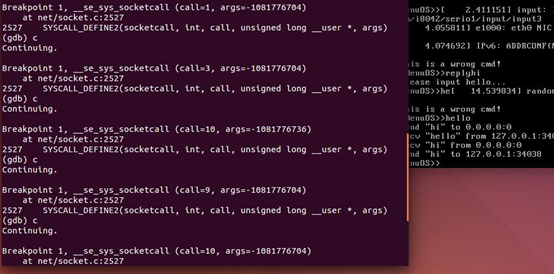
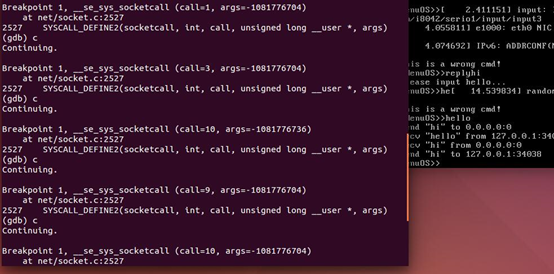
在Menuos中输入replyhi命令,观察其系统调用
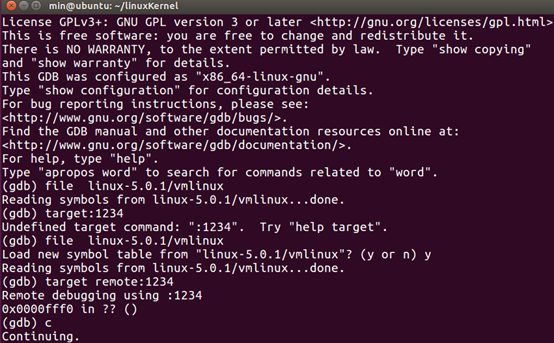
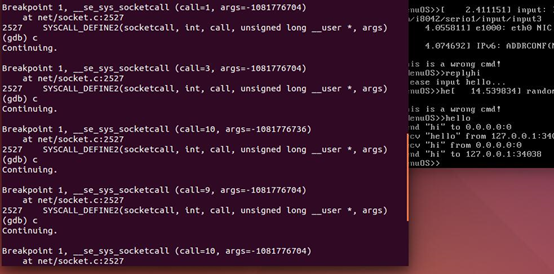
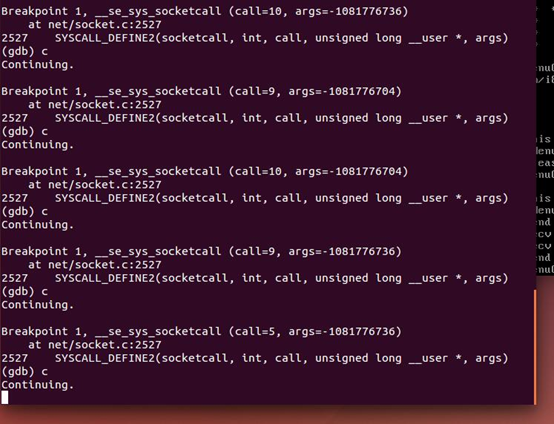
再输入hello命令,观察系统系统调用


 浙公网安备 33010602011771号